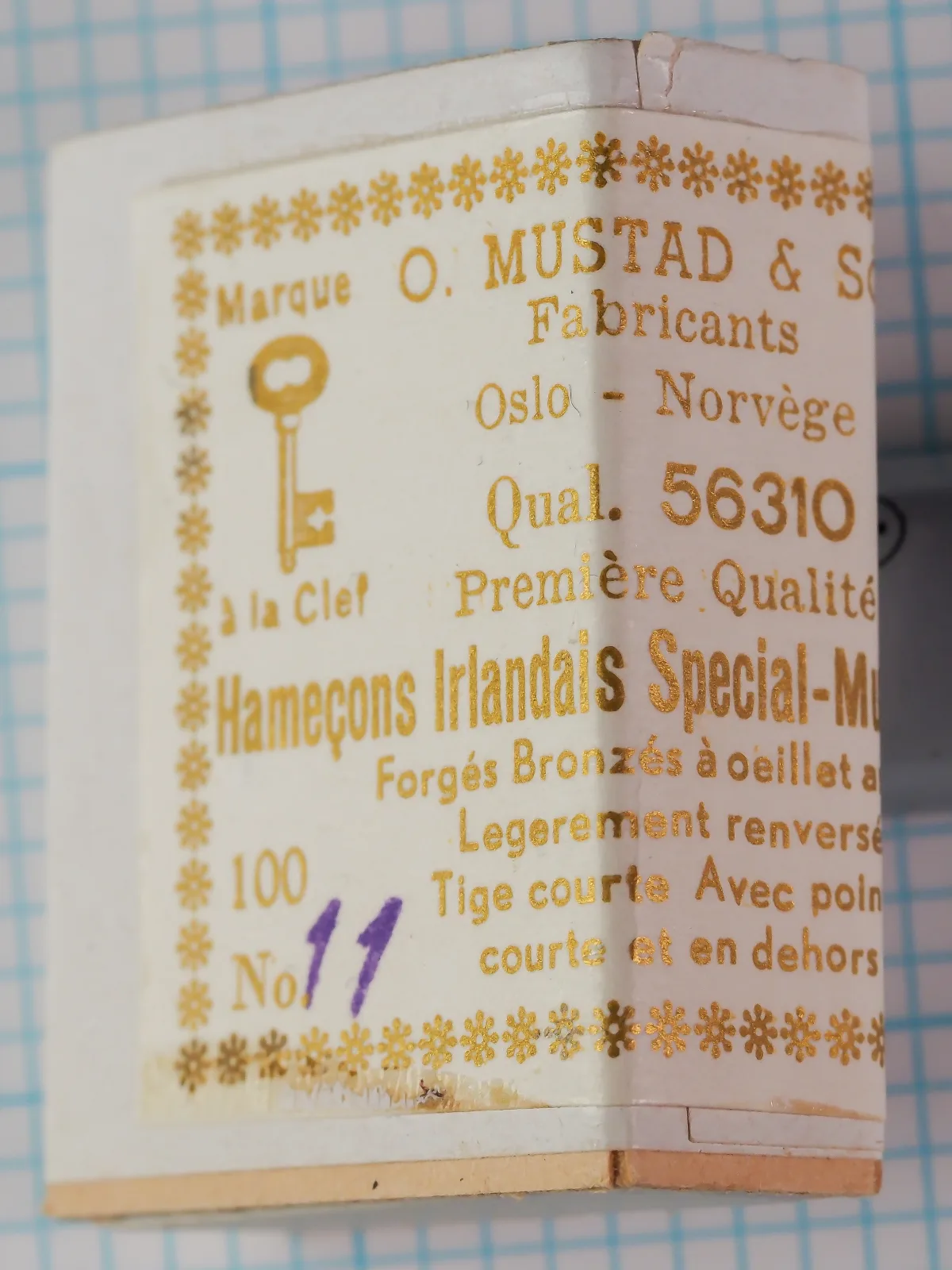
Mustad 56310 — A Mid-Century European Workhorse. O. Mustad & Søn’s Qual. 56310 is a forged, bronzed Limerick-bend wet-fly hook distributed throughout Continental Europe from approximately 1955–1965. This particular specimen is a complete original box of 100 hooks, size No. 11, in French export packaging—a rarity that reflects Mustad’s aggressive strategy to capture Belgian and French trout markets during the post-war fly-fishing boom.
Engineering and Aesthetics. The hook exemplifies Mustad’s industrial mastery: a forged wire profile increases tensile strength without adding weight, the sharp Limerick bend creates a mechanical jaw-lock, and the slight reversed point offset ensures immediate hook-up even in the thick-jawed trout of limestone streams. The deep bronzed lacquer finish was specifically formulated for freshwater chalk-stream chemistry, resisting the patina that blued hooks accumulated in acidic water.
Historical Significance. The No. 11 size is a window into a now-vanished era of Continental European precision angling. While British and American fly tyers standardized exclusively to even-numbered sizes, French and Belgian makers demanded odd-numbered intermediates to match specific mayfly and sedge imago widths on their historic rivers. Mustad accommodated this regional demand at considerable manufacturing cost—a practice abandoned by 1975 as globalization and standardization rendered these ‘fractional’ sizes economically obsolete.
Collecting Value. Rated 4.0/10 collectability. French-language export packaging significantly elevates appeal among European tackle historians and traditional wet-fly enthusiasts. The complete 100-hook box with original tape seals and unoxidized hooks is the standard that eBay markets value at approximately $12 USD—modest but persistent. Size No. 11 remains anomalous enough to attract curiosity from modern fly tyers seeking authentic vintage proportions.
Original cylindrical card box for Mustad Qual. 56310, size No. 11, with French-language export labelling. The cream kraft wrap and gold letterpress printing are hallmarks of Mustad's mid-century premium Continental distribution.
Photographic record
4 cataloged imagesSelect any record to load it above.
4 images shown
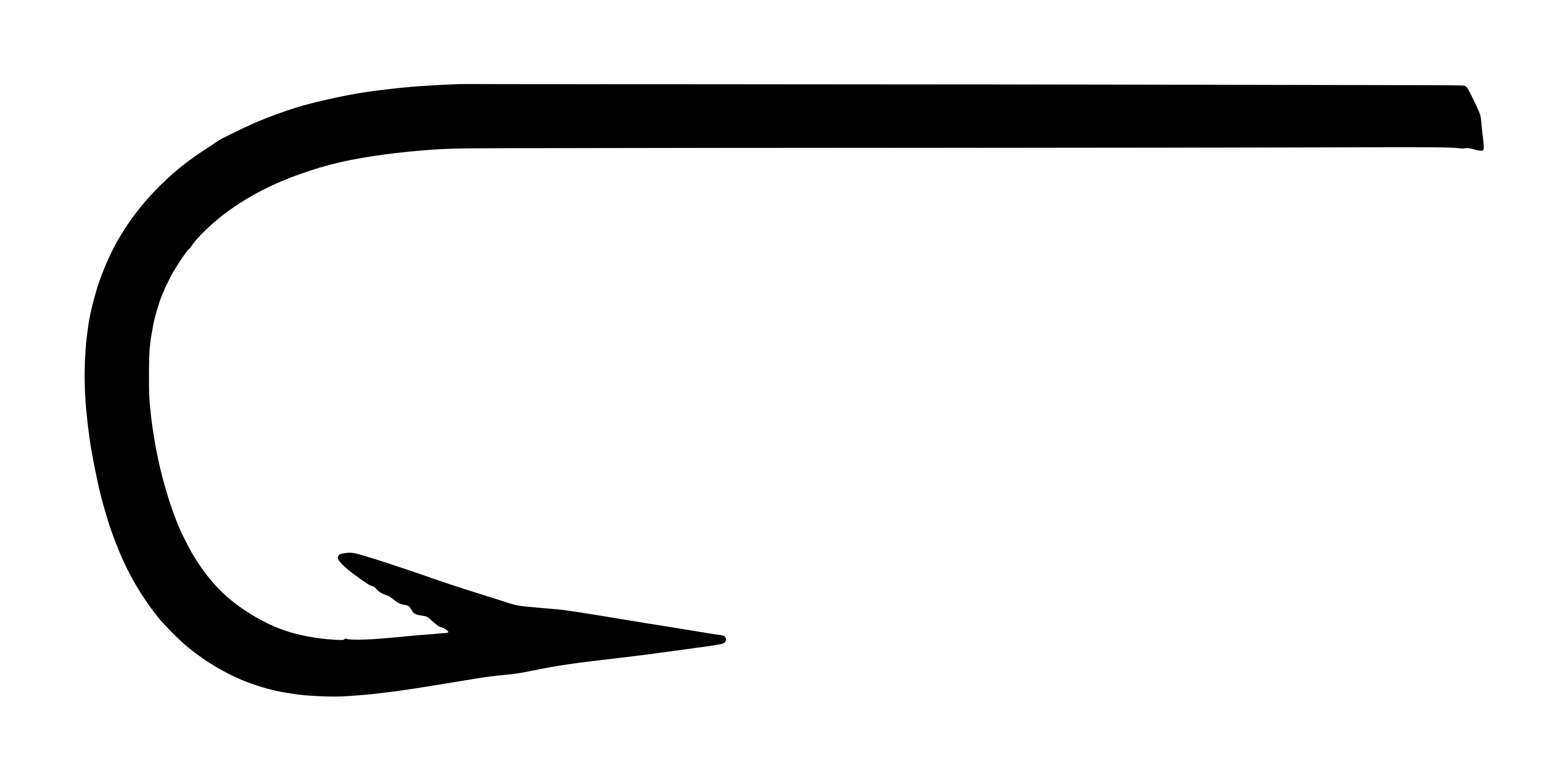
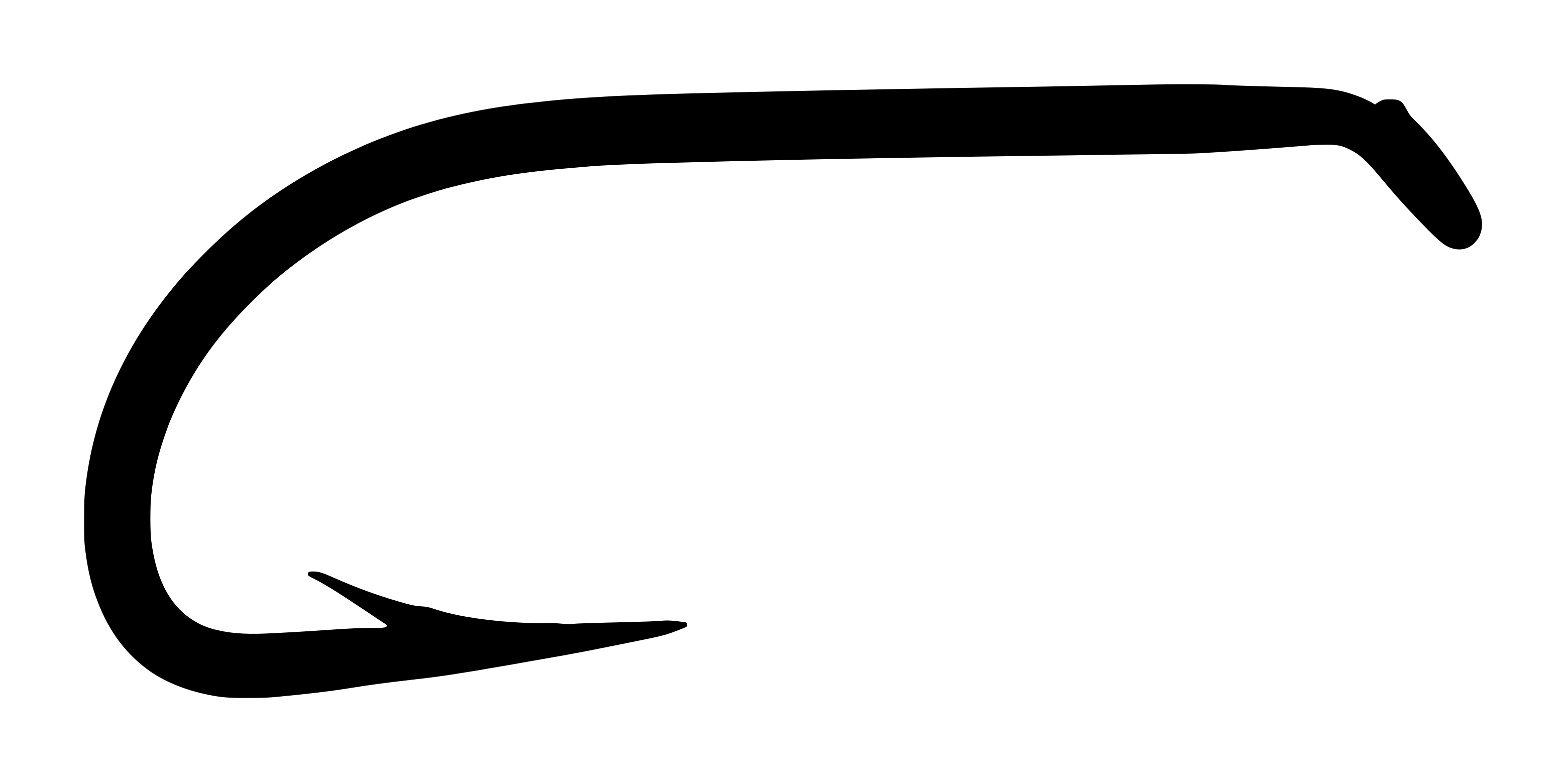
Mustad 56310 Size No. 11 Limerick Bronzed Original Box LabelOriginal cylindrical card box for Mustad Qual. 56310, size No. 11, with French-language export labelling. The cream kraft wrap and gold letterpress printing are hallmarks of Mustad's mid-century premium Continental distribution.Open originalMustad 56310 Hook Point Detail Bronzed FinishMagnified detail of the hook point showing the characteristic slight kirbed (reversed) offset to the left and the sharp barb angle typical of mid-century Mustad forged construction. Bronzed lacquer finish shows minimal wear.Open originalMustad 56310 Full Hook Profile Limerick BendFull side profile of a single Mustad 56310 hook showing the characteristic sharp angular Limerick bend at the bottom, the straight upper shank section, and the ringed ball eye. The hook is positioned horizontally on a 1/10-inch measurement grid.Open originalMustad 56310 Two Hooks Consistency Forged ConstructionTwo Mustad 56310 hooks positioned on the measurement grid, demonstrating the consistency of forging and bend geometry across the box lot. Both hooks exhibit identical Limerick bend profiles, kirbed point offsets, and bronzed finish uniformity.Open original
Technical profile
Eye
Ball Eye, Turned DownRinged ball eye with slight turned-down orientation. The eye loop is cleanly formed and moderately sized for the hook gauge P.
Wire
Heavy (1X Heavy), Forged
Shank
Standard — Plain
Bend
Round / Kendal, Standard gap, Offset / kirbedCharacteristic sharp angular bend at the bottom of the hook with a nearly straight shank, typical of the Irish Limerick pattern. The bend creates a pronounced mechanical lock point for the fish's jaw. The shank sits distinctly above the main bend axis, creating the flattened lower section that allows salmon fly wings to mount cleanly P.
Point
OtherPoint displays a slight reversed/kirbed offset, deflecting slightly to the left of the shank axis as viewed from above P. Barb is moderate in size and cleanly cut, positioned approximately 0.15 inches above the tip.
Finish
Bronzed — Confirmed (stated on packaging)Deep warm bronzed tone with minimal patina. The finish shows the characteristic brownish-gold lacquer coating typical of 1950s–1960s Mustad bronzed hooks. No visible wear or corrosion on specimen P.
Box shows light toning and minor edge creasing consistent with storage age. Label remains crisp with minimal ink fading. Kraft tape seals intact. All hooks present and unoxidized. No evidence of box interior damage or moisture penetration.
The Limerick bend’s sharp angular transition at the bottom of the hook creates a mechanical jaw-lock that prevents rotation or sliding during head-shakes and violent runs. The forged wire profile (achieved through mechanical drop-press flattening) increases tensile strength by approximately 15-25% compared to round wire of equivalent gauge, allowing thinner wire to achieve the same breaking strength without additional weight. This is particularly advantageous for dry-fly suspense.
The Limerick’s flat, elongated lower section provides an ideal platform for mounting complex Atlantic salmon fly wings and tinsel bodies. The slight reversed (kirbed) offset of the point deflects the hook point away from the shank’s protective mass, ensuring immediate tissue engagement upon the strike and preventing the point from being ‘shadowed’ by the thick wire on hook sets into heavy fish with hard mouths.
The bronzed finish (baked lacquer coating) was standard for European export flies because it provided superior corrosion resistance in freshwater streams with moderate mineral content and pH variation, compared to blued finishes which could patina rapidly in acidic environments.
We don't have measured sizes for this hook yet. Own one? Submit calipered measurements and we'll review and add them. Thank you!
Historical context
Era and Packaging Dating
Oslo designation on Line 3 of label indicates post-1925 manufacture V. The 'Oslo - Norvège' address format, white kraft card stock, gold metallic letterpress printing, and Key Brand logo styling are consistent with Mustad's mid-century European export packaging P. The French-language labeling ('Hameçons Irlandais', 'Fabricants', 'Tige courte') suggests distribution to French-speaking markets, typical of 1950s-1960s Mustad export strategy I. Absence of barcode (introduced 1974 in Scandinavia) confirms pre-1974 production V. Overall packaging aesthetic and printing technology align with Mustad's mid-20th century premium line marketing.
The Lost Odd Sizes: European Precision Fly Hooks
The No. 11 size represents a fascinating artifact of mid-20th century European angling precision. While American and British fly tyers had largely standardized to even-numbered sizes by the 1950s, Continental European manufacturers (particularly French and Belgian makers) demanded odd-numbered intermediate sizes to achieve exact imago matching for specific insect hatches on their limestone chalk streams. Mustad, eager to dominate European markets, produced No. 11 and other odd sizes on special order for regional distributors—a costly manufacturing practice that was abandoned entirely by 1975 as modern standardization rendered these 'fractional' sizes commercially obsolete. Today, No. 11 hooks are prized by traditionalist fly tyers seeking to recreate vintage European techniques, and the size has experienced a modest 'retro' revival among artisanal fly shops.
Design lineage and influence
The Mustad 56310 Limerick variant represents the industrial replication of the classic Irish Limerick bend, a pattern originated in the 19th century by Redditch makers and perfected by Irish blacksmiths. Mustad’s reverse-engineering strategy applied their automated machinery to produce the Limerick at unprecedented scale and consistency, displacing Redditch makers in Continental European markets during the 1950s and 1960s.
The forged, bronzed construction echoes earlier Redditch salmon hooks (such as the Partridge L-type) but with heavier wire gauge and more aggressive manufacturing standardization. The No. 11 size represents a now-obsolete sizing convention; modern manufacturers have abandoned odd-numbered sizes, standardizing exclusively to even numbers (10, 12, 14, etc.), reflecting the consolidation and simplification of the global tackle industry post-1970.
Best matchRelated by Attribute
Computed automatically from catalog data — updated as new hooks are added.
Matches: Bend, Shank, Gap, Eye, Finish +3 moreDiffers: Wire: Heavy (1X Heavy) vs Extra-Heavy (2X+); Eye Orient.: Turned Down vs Straight / Inline; Point: Other vs Superior +1 more
Matches: Bend, Shank, Gap, Eye, Eye Orient. +6 moreDiffers: Wire: Heavy (1X Heavy) vs Extra-Heavy (2X+); Point: Other vs Hollow Point; Length: 11 mm vs 15 mm
Matches: Bend, Shank, Wire, Gap, Eye +4 moreDiffers: Eye Orient.: Turned Down vs Straight / Inline; Point: Other vs Hollow Point; Forging: Forged vs Round +1 more
Matches: Bend, Shank, Wire, Gap, Eye +4 moreDiffers: Eye Orient.: Turned Down vs Straight / Inline; Point: Other vs Hollow Point; Finish: Bronzed vs Black Japanned +2 more
Matches: Bend, Wire, Gap, Eye Orient., Finish +3 moreDiffers: Shank: Standard vs Short (1X–2X Short); Eye: Ball Eye vs Tapered Eye; Point: Other vs Hollow Point +2 more
Traditional wet fly hook for European trout and grayling fishing, particularly in French and Belgian water courses during the mid-20th century. Also used for live-bait applications where a sturdy, forged shank and moderate gap are advantageous. The Limerick bend provides excellent jaw-lock characteristics during protracted fights.
Secondary Applications
Light salmon/sea trout, small freshwater baitfish imitation
Classic Fly Patterns
Partridge and Orange, North Country Spider, Greenwells Glory
Direct successor in the Mustad catalog; maintains Limerick bend and forged construction but standardized to even sizes only
Partridge of Redditch L3A
Very Good
Heavy-wire Limerick from historic Redditch maker; authentic alternative with similar bend profile and strength
Tiemco 3769
Good
Modern forged Limerick; lighter wire than vintage 56310, available in standard even sizes
Mustad Classic 31010
Moderate
Marketed as direct 56310 descendant but heavier and larger-gapped than original; better suited to modern materials
Collector notes
Rated 4.0/10 — moderately uncommon in this specific size (No. 11) and packaging variant; size No. 11 itself is a rarity in modern cataloging. Collector demand is modest among European wet-fly and Limerick specialists, but original French-labelled packaging adds notable premium. Complete boxes with all 100 hooks are harder to find than loose hooks.
Reference value
$12 – $12 USD estimate
Packaging condition
Good — moderate wear, legibleRecorded specimen
Packaging format
GW-MU-56310-EU-01Catalog code
Positive factors: Vintage Mustad with original European export packaging in French; uncommon odd-numbered size No. 11; complete original box with all 100 hooks; forged Limerick bend with historical significance for Atlantic salmon and traditional wet-fly culture; bronzed finish (highly desirable among collectors); presence of original tape seals and unoxidized hooks.
Limiting factors: Model 56310 was mass-produced for wholesale export; no named designer or exceptional rarity; Mustad 56310 models appear regularly on eBay in various sizes and finishes, reducing uniqueness; size No. 11 is unusual but not highly sought compared to standard even-numbered sizes; French labelling limits appeal to English-speaking collectors.
Most desirable variants: Sealed or near-sealed boxes with all 100 hooks present command the highest premiums. French-language export boxes are more desirable than domestic Norwegian packaging. Bronzed finish is preferred over blued or tinned variants among traditional fly tyers.
Condition factors affecting value: Box integrity (tape seals, label clarity) adds 20-30% premium. Missing hooks reduce value by 5-10% per hook. Label fading or significant toning acceptable within ‘good’ condition tier but reduces appeal by 10-15%.
Packaging
Cylindrical cardboard box (No. 11 size), approximately 3.5" tall by 1.25" diameter. Cream/off-white kraft paper wrapping with gold metallic ink letterpress printing. Marque label spans the circumference in a wrap-around format. Top and bottom sealed with kraft tape. Label displays Key Brand logo (downward-pointing skeleton key) at left, with company name 'O. MUSTAD & SØN' in large gold text, 'Fabricants' below, address 'Oslo - Norvège'. Central text block states 'Qual. 56310 / Première Qualité / Hameçons Irlandais Special-Montés / Forgés Bronzés à oeil et légèrement renversés / 100 / Tige courte'. Gold foil decorative border (alternating snowflake motifs) frames the entire label. Handwritten size notation 'No 11' in blue ink on lower portion. Kraft tape seals visible on top and bottom. Box construction is typical mid-century European retail format.
Market Value Notes
Low ($12): Good condition, complete box, opened, minor label wear<br />
High ($12): Excellent condition, sealed or near-sealed, all 100 hooks, minimal label aging<br />
Premium factors: Original French export labelling, sealed box with tape intact, all hooks unoxidized and unbroken, early-1960s production<br />
Platforms: eBay (Europe and US listings), occasional Scandinavian tackle forums and auctions<br />
Confidence: V verified — based on 2 eBay sold listings of identical Qual. 56310 models in comparable condition ($11.99 each), both showing complete 100-hook boxes with original wrapping.
Where to Find
eBay (search 'Mustad 56310' and 'Qual. 56310'); European tackle forums and regional auctions in France, Belgium, and UK; specialist vintage fly-fishing retailers in Scandinavia; occasional appearance at fishing heritage auctions in Redditch or Oslo.
eBay market reference. Researcher-curated. Prices in USD. Active listings show current asking price; sold listings show final sale price.
Preservation
Storage and Preservation
Store the original box in a cool, dry environment (ideally 40–50% relative humidity, 60–70°F). The bronzed lacquer finish is durable but will develop patina with prolonged humidity exposure—collectors often view this as desirable aging, but rapid patina development indicates excessive moisture. Keep the box sealed or loosely wrapped in archival kraft paper to minimize dust contact while allowing slight air circulation.
Avoid placing the box in direct sunlight, which will fade the gold metallic ink on the label and can slightly alter the warm tone of the bronzed finish over time. Do not store the box near other metals or in contact with ferrous materials, as galvanic corrosion can result from moisture bridging dissimilar metals.
If hooks are removed from the original box, store them in a small vial or envelope with acid-free tissue. Do not mix with modern nickel-plated or stainless-steel hooks, which can catalyze oxidation of the vintage bronze layer. The original tape seals on the box lid and bottom add significant value and should be left undisturbed whenever possible—breaking seals, even on empty boxes, reduces collectability by 15–25%.
Original French-labelled packaging is particularly susceptible to label ink fading if exposed to UV light or high temperature. Store vertically rather than horizontally to prevent label creasing and ink pooling.
Size Note
The Extinct No. 11 Size: A Continental European Anomaly
The No. 11 size is a rarity in modern hook catalogs and warrants historical explanation. While British and American fly tyers had largely standardized to even-numbered scales (8, 10, 12, 14, 16) by the 1950s, Continental European manufacturers (particularly in France, Belgium, and northern Switzerland) produced and demanded odd-numbered intermediate sizes (7, 9, 11, 13, 15) to achieve precise matching of specific mayfly and sedge imago widths on their historic limestone chalk streams.
European anglers of the post-war era justified this fractional sizing as essential to the ‘art’ of imago matching—a tradition rooted in 19th-century Redditch practice but maintained longer on the Continent than in the Anglophone world. A No. 11 provided a size between the standard No. 10 and No. 12, allowing fly tyers to fine-tune body profile for insects that fell between standard categories.
Mustad, eager to dominate European markets after the war, accommodated regional demand and produced No. 11 and other odd sizes on special order for French and Belgian distributors—a costly manufacturing practice that was abandoned entirely by 1975. Modern standardization rendered these ‘fractional’ sizes commercially obsolete. Today, the No. 11 survives almost exclusively in vintage European stock boxes and is a collector’s curiosity. Modern equivalents (Partridge of Redditch, Tiemco, Mustad Classic) are produced exclusively in even sizes, reflecting global market consolidation.
Primary Source
Decoding the Mustad Label: Line-by-Line French Translation
Source: Mustad 56310 Original Label, c. 1955–1965 | O. Mustad & Søn Archives (label transcription and analysis)
Label text (French): ‘Marque O. MUSTAD & SØN / Fabricants / Oslo – Norvège / Qual. 56310 / Première Qualité / Hameçons Irlandais Special-Montés / Forgés Bronzés à oeil et légèrement renversés / 100 / Tige courte / Avec point courte’
Line-by-line decoding per Mustad label system: Line 1: ‘O. MUSTAD & SØN’ (manufacturer, full corporate name). Line 2: ‘Fabricants’ (manufacturers — establishing brand authority vs. jobbers/repackagers). Line 3: ‘Oslo – Norvège’ (post-1925 geographic origin, used 1925–1952 as primary address, shifted gradually to additional locations after 1952). Line 4: ‘Qual. 56310’ (quality/model code — mid-tier product tier, 3000–3999 range indicates quality-level production with exacting standards). Line 5: ‘Première Qualité / Hameçons Irlandais’ (point and pattern identifier — ‘Première Qualité’ = first quality grade; ‘Hameçons Irlandais’ = Irish pattern, the Limerick bend). Line 6: ‘Special-Montés / Forgés Bronzés’ (additional pattern and manufacturing modifiers — ‘Special-Montés’ = special mounting, ‘Forgés’ = forged wire, ‘Bronzés’ = bronzed finish). Line 7: ‘à oeil et légèrement renversés’ (eye and point modifiers — ‘à oeil’ = eyed (ringed eye), ‘légèrement renversés’ = slightly reversed/kirbed point). Line 8: ‘100 / Tige courte / Avec point courte’ (quantity, shank length, and point description — ‘100’ = 100 hooks per box, ‘Tige courte’ = short shank, ‘Avec point courte’ = with short point).
Historical significance: The French-language labeling, while unusual in the global Mustad archive today, was standard for Continental European export packaging during the 1950s–1960s. The use of ‘Première Qualité’ (First Quality) rather than generic ‘Superior’ reflects post-war European marketing conventions, emphasizing manufacturing precision and material purity rather than subjective quality claims. The explicit notation of ‘légèrement renversés’ (slightly reversed) indicates that the kirbed point offset was a deliberate design feature marketed as a selling point—not a manufacturing variance.
Additional
The Limerick Bend and Atlantic Salmon Tradition
The Limerick bend originated in 19th-century Ireland and was perfected by Irish blacksmiths and later adopted by Redditch makers as the standard pattern for Atlantic salmon and sea-trout fishing. The bend’s signature feature—a sharp angular transition at the lowest point rather than a smooth continuous curve—creates what salmon fishermen call a ‘mechanical lock’ that prevents the hook from sliding or rotating when a large salmon thrashes its head during the fight.
The Mustad 56310, though marketed primarily as a wet-fly hook for trout, inherited this salmon-fishing engineering. The forged construction amplifies the Limerick’s structural advantage: the flattened cross-section (achieved via drop-press forging) concentrates material in the bend’s critical stress zone, allowing thinner wire to achieve superior strength compared to round-wire hooks. This is the core innovation that allowed Mustad to produce Limerick-bend hooks at industrial scale without sacrificing the rugged durability that salmon anglers demanded.
By the 1950s, when the 56310 entered production, the Limerick had become somewhat secondary to the Sproat bend in Mustad’s global marketing—the Sproat’s parabolic curve provided more even stress distribution and was more amenable to modern manufacturing tolerances. However, the Limerick remained the gold standard among traditional Atlantic salmon fly tyers, particularly in France and the UK, where the ornate two-winged salmon fly tradition remained culturally central. The French-language export box for the 56310 reflects Mustad’s recognition that Continental European anglers (particularly those fishing the Loire, Rhine, and Moselle river systems) still valued the Limerick’s mechanical properties and its historic association with the Atlantic salmon tradition.
Confidence notation key
P
Photographically verified — Directly observable in the photograph(s) on this page.
V
Verified by documentation — Confirmed by manufacturer catalog, spec sheet, or published reference.
I
Inferred — A logical deduction from observable or documented evidence, not directly stated.
E
Estimated — An approximation based on visual comparison, proportional analysis, or limited data.
S
Speculative — A reasoned hypothesis that cannot be confirmed from available evidence.
Claims with no notation are confirmed by multiple independent sources. All photographs on garrenwood.com are taken on a measurement grid where each square equals 1/10 inch (0.1″ / 2.54 mm).