Mustad Hooks – 91753
91753 — Mustad 91753
At-a-Glance Summary
The Mustad 91753 is a specialized jig-hook variant of the classic O’Shaughnessy pattern, produced by O. Mustad & Søn (Norway) from the 1950s through at least the 1970s. This heavy-wire, gold-plated hook features a distinctive ‘shank bent down’ eye configuration that distinguishes it from conventional O’Shaughnessy hooks, making it ideal for pouring into lead-head jig molds.
The 91753 demonstrates Mustad’s industrial strategy of reverse-engineering regional patterns and adapting them for mass-market applications. While the standard O’Shaughnessy was designed for heavyweight saltwater fishing, the 91753 was engineered for freshwater jig construction, particularly for walleye and pike applications in North American subsistence and tournament fishing.
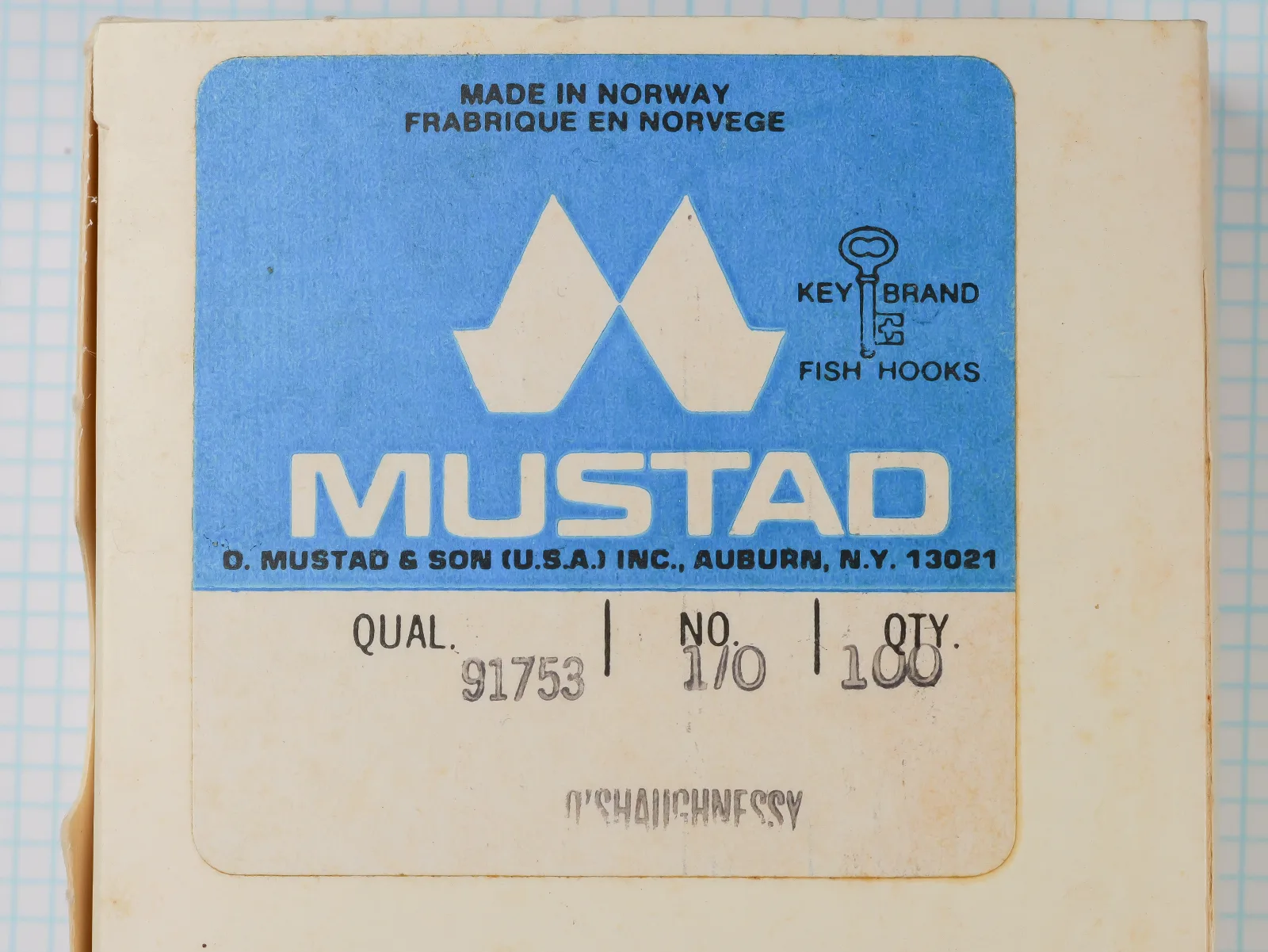
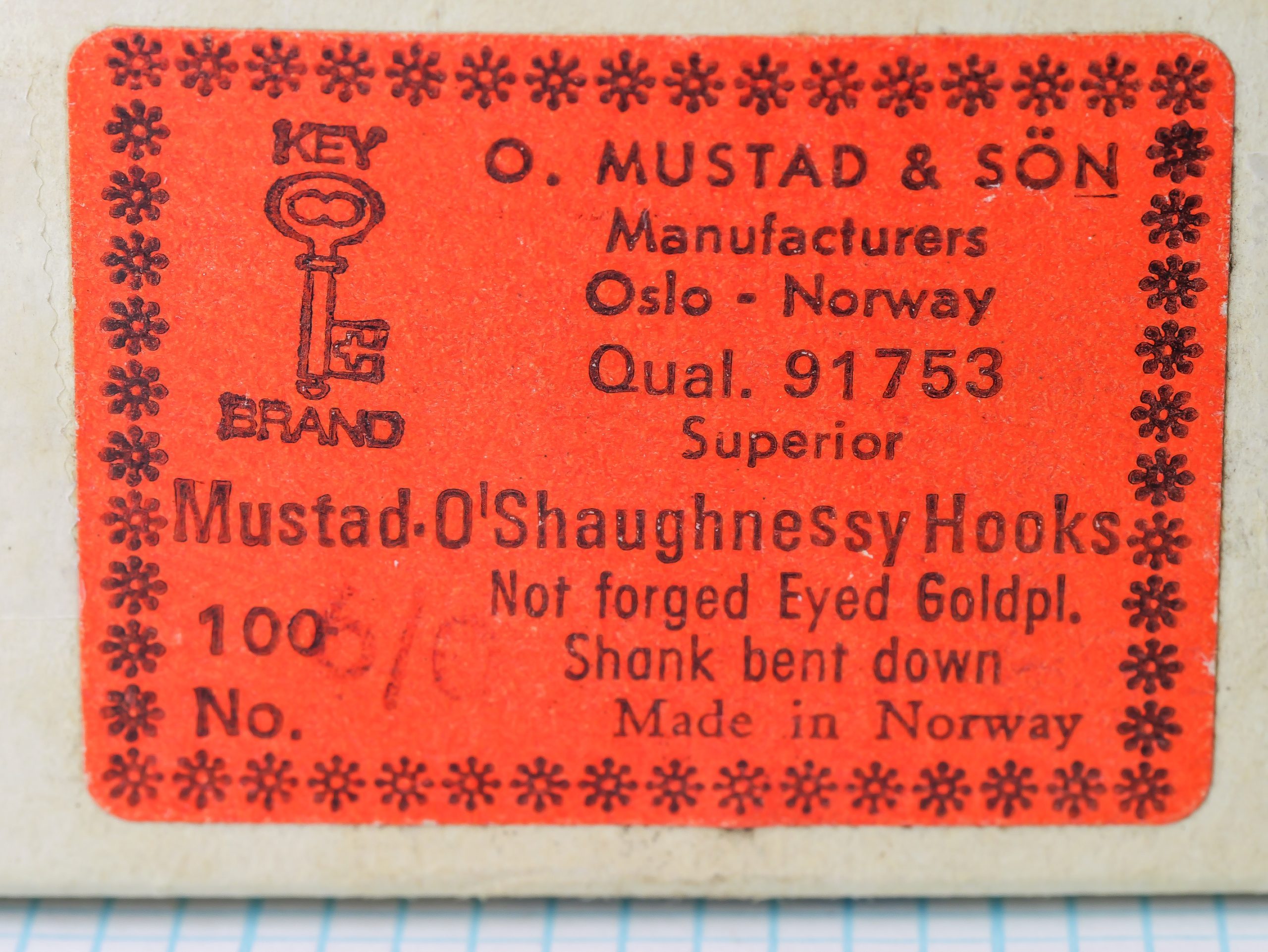
Era evidence includes the Oslo – Norway address and classic Key Brand serif typography on 1950s–1960s red cards, and the Double M logo with Auburn, N.Y. address on 1970s blue cards. The absence of barcodes and heavy letterpress printing confirm mid-century production. For collectors, the 91753 represents an important transition in Mustad’s global distribution model and a specialized niche product now largely obsolete due to modern engineered jig designs.
Photography
Identification
| Manufacturer | mustad |
| Model / Code | 91753 |
| Full Name | Mustad 91753 |
| Size Documented | 1/0 and 6/0 |
| Estimated Era | c. 1950s–1970s |
| Country of Origin | Norway |
Technical Specifications
Turned-down ball eye | O'Shaughnessy bend | Standard shank | Heavy wire | Superior point | Gold-plated finish
| Eye Type | Turned-Down Ball Eye |
| Eye Notes | Ball eye is uniformly formed with smooth closure where wire returns to the shank, consistent with mechanical production standards of the era P. Slight variation in eye diameter between the two specimen sizes (6/0 and 1/0) is proportional and expected. No visible wire-seam irregularities or cold-shut defects. |
| Wire Gauge | Heavy (1X Heavy) |
| Wire Profile | Round (unforged) |
| Shank Length | Standard |
| Bend Family | O'Shaughnessy |
| Bend Notes | O'Shaughnessy bend exhibits the characteristic parabolic curve with smooth transition into the straight point section. Bend is symmetrical when viewed from both sides, with no visible offset or twisting P. Depth-to-width ratio is consistent with standard O'Shaughnessy specifications for the given wire gauge. |
| Point Style | Superior (near-straight inner taper) |
| Gap Width | Standard |
| Barb | Barb is small, close-cut, and sharply defined at the base, consistent with Superior point geometry P. Barb angle is slight (approximately 8–10 degrees from vertical) and positioned roughly 0.08"–0.10" from the point tip. Single barb configuration with no evidence of double barbing or multiple barbs. |
| Finish | Gold-Plated — Confirmed (stated on packaging) |
| Finish Notes | Gold-plated finish displays uniform warm yellow tone with light warm-bronze undertone, typical of electroplated 24-karat gold over nickel base P. No visible flaking, peeling, or uneven coverage on specimen hooks. Surface shows minor micro-wear and light oxidation consistent with decades of storage but maintains plating integrity. Finish tone is distinctly warmer and more uniform than bronzed or polished alternatives. |
| Condition | Red label card (6/0 size) shows moderate age-related toning and light creasing consistent with decades of storage. Letterpress text remains sharp and legible. Blue label card (1/0 size) exhibits heavier toning and minor paper curl at edges. Hooks in both cards are bright with no visible corrosion, suggesting they were stored in stable environment. Card corners show minor edge wear and slight rounding from handling. |
The Mustad 91753 is engineered as a non-forged, heavy-wire hook suitable for jig-head casting without the structural complexity of fully forged designs. The bent-down shank is a deliberate mechanical compromise: rather than a straight eye (which would interfere with mold closure) or a traditional loop eye (which would catch molten lead), the jig eye is formed by bending the terminal wire downward at a specific angle (typically 30–45 degrees) so that the eyelet remains accessible from above while the wire integrates smoothly into the lead head. The Superior point geometry—a near-straight inner taper with minimal barb flare—ensures efficient penetration while maintaining structural strength under the repeated stress of casting and setting the hook against hard-fighting fish. The gold-plating process involves electrochemical deposition of 24-karat gold over the nickel-plated base steel, providing both corrosion resistance in freshwater and enhanced visual attraction in stained water conditions. This plating adds approximately 0.002″–0.004″ to the overall wire diameter, a negligible increase that does not compromise the hook’s structural integrity.
Technical Measurements
Size measured: 1/0. Method: Physical measurement with calipers.
| Dimension | Value |
|---|---|
| Overall Length | ~1.68"-1.72" (~42.7-43.7 mm) P |
| Shank Length | ~1.17"-1.27" (~30-32 mm) |
| Gap Width | ~0.40"-0.44" (~10.2-11.2 mm) P |
| Bend Depth | ~0.55"-0.65" (~14-16 mm) |
| Wire Diameter | ~0.043"-0.048" (~1.1-1.2 mm) |
| Weight | Not available |
| Shank-to-Gap Ratio | ~2.8 : 1 |
Overall length and gap width confirmed by physical caliper on size 1/0 specimen. Shank length and bend depth derived from grid count on size 1/0 hook image with calibration from confirmed overall length. Size 6/0 images show proportionally larger dimensions but no caliper data available for that size. All measurements include ±0.05" uncertainty due to grid alignment. Recommend confirming with precision caliper for exacting applications.
The Mustad 91753 represents an important example of specialized jig-hook development by a major industrial manufacturer, and may be the earliest documented jig-eye O'Shaughnessy variant in the garrenwood.com catalog. Gold-plated O'Shaughnessy hooks are relatively uncommon in vintage tackle collections compared to tinned or bronzed alternatives.
Historical Context
mustad
O. Mustad & Søn (later O. Mustad & Son) was founded in 1832 in Gjøvik, Norway by Hans Schikkelstad, initially as ‘Brusveen Spiger- og Staltradfabrikk’ producing nails and steel wire. The company was taken over by Schikkelstad’s son-in-law Ole Hovelsen Mustad and his son Hans Mustad, who rebranded it as O. Mustad & Søn. The turning point came in 1877 when Mathias Topp invented the first fully automated hook-making machine, allowing continuous feed and processing of steel wire into finished hooks at unprecedented scale. Rather than patent the technology, Mustad relied on strict corporate secrecy and non-disclosure agreements to maintain competitive advantage against Redditch, England and other global centers. By the 1950s, Mustad controlled approximately 50% of global hook production, with sales offices and manufacturing facilities across multiple continents. The company’s Norwegian heritage remained central to its identity, though U.S. distribution through Auburn, N.Y. became increasingly important after World War II.
Series History
The Mustad 91753 is a specialized variant of the classic O’Shaughnessy pattern, engineered specifically for jig-head molding rather than conventional bait fishing. While the standard O’Shaughnessy (Qual. 3407) is a forged, heavy-duty saltwater pattern, the 91753 was designed with a unique ‘shank bent down’ eye (also called ‘jig eye’ or ‘offset eye’) that allows the eyelet to protrude from the top of a lead jig head. This configuration was essential for anglers who poured their own lead-head jigs for bucktails and soft plastics, particularly in freshwater walleye and pike fisheries. The gold plating was specifically chosen to provide underwater flash in murky conditions common to these applications. The ‘Not forged’ notation on the label distinguishes it from the heavier, forged Qual. 3407, indicating a lighter wire gauge suitable for jig applications. The 91753 remained in production across multiple decades (1950s–1970s and beyond), representing the transition from Norwegian-centric manufacturing to global U.S.-based distribution and marketing.
Era and Packaging Dating
Red label bears Oslo – Norway address and classic Key Brand serif typography, consistent with 1950s–1960s Norwegian production phase. Blue label shows Double M logo (Mustad's U.S. distribution mark) and Auburn, N.Y. address (Mustad's primary U.S. hub during 1970s). No barcode on either card (barcodes were not standard until 1974–1976), confirming pre-1980 manufacture. Letterpress print quality and heavyweight cardstock are consistent with mid-century tackle packaging. Both cards lack modern postal codes or price formats that would suggest later dating.
The O'Shaughnessy bend, despite its Irish name, became synonymous with Norwegian industrial manufacturing under Mustad's global expansion. While regional hook makers in Limerick, Ireland and Redditch, England crafted the classic patterns, it was Mustad's automated machinery that standardized and exported them worldwide. The 91753's gold plating was specifically chosen for walleye jigging in glacial lakes and river systems of the Upper Midwest, where turbid water conditions demanded maximum underwater visibility. Anglers who poured their own jigs in basement workshops during the 1960s–1970s often kept 91753 cards alongside their lead pots and molds, making the hook a fixture of American subsistence fishing culture.
Design Lineage and Influence
The O’Shaughnessy bend originates from 19th-century Irish hook maker traditions, but the Mustad 91753 represents a distinctly Norwegian interpretation adapted for industrial mass production. The standard O’Shaughnessy (Qual. 3407) was Mustad’s heavy-forged saltwater variant; the 91753 derives from this lineage but strips away the forging process and adds the specialized jig eye. Competing designs from American manufacturers like Pflueger (Akron, Ohio) and Herter’s (Waseca, Minnesota) produced similar jig hooks during the same era, but Mustad’s gold-plated finish and heavy-wire construction gave the 91753 particular favor among serious jig casters. Modern equivalents like the Mustad 32755 and 32756 (90-degree gold jig hooks) represent the direct descendants of the 91753, though contemporary hooks incorporate advanced chemically sharpened points and proprietary wire compositions unavailable in the vintage era.
Related Models — mustad
| Model | Description | Relationship |
|---|---|---|
| Qual. 91753 (this entry) | Standard production model — this entry. | This model |
| Qual. 3407 | Standard forged O'Shaughnessy, heavier wire, conventional eye; predecessor pattern that inspired the 91753 jig variant. | Variant |
| Qual. 3435 | Mustad O'Shaughnessy Ringed jig hook, similar application but different eye configuration; contemporary competitor. | Variant |
| Mustad 32755 | Modern 90-degree gold jig hook; direct descendant of the 91753, utilizing current hook-making technology. | Later / successor |
Usage, Fly Patterns, and Equivalents
Primary Application
The Mustad 91753 is a jig hook designed for anglers to construct custom lead-head jigs. The distinctive bent-down shank allows the eye to sit correctly within a lead-head jig mold, with the eyelet protruding at the top for direct line attachment. This configuration is ideal for walleye, pike, and other freshwater species in tournament and subsistence fishing contexts. The gold plating provides enhanced visibility in stained or turbid water. The heavy wire gauge ensures the hook will not bend open under the pressure of hard-fighting fish, while the O’Shaughnessy bend distributes forces evenly across the steel, preventing straightening. Historically used in both homemade and factory-produced jigs, the 91753 became a staple for anglers seeking to customize lure profiles and colors to match local forage.
Secondary Applications
Can be used for conventional bait fishing with live or dead bait; occasionally incorporated into specialized trolling rigs for pike and large walleye.
Classic Fly Patterns
Not typically used for fly tying.
Modern Equivalents
| Hook | Match Quality | Notes |
|---|---|---|
| Mustad 32755 / 32756 | Excellent | Direct modern successor; 90-degree jig eye, gold plated, heavy wire, O'Shaughnessy bend, similar applications. |
| Owner 5318 | Very Good | Premium Japanese alternative; 90-degree jig eye, gold finish, suitable for walleye and pike jigging. |
| Gamakatsu 604 | Good | Japanese jig hook with offset eye and heavy wire; slight bend profile variations but similar functional characteristics. |
Collectability and Value
| Rarity | Uncommon |
| Market Value (USD) | $10 – $11 |
| Packaging Condition | Good — moderate wear, legible |
| Packaging Format | mustad-sales-card-double-m |
Positive factors: (1) Distinctive specialized eye configuration absent from most vintage hooks, (2) Gold-plated finish is less common than tinned or bronzed alternatives and appeals to collectors seeking unusual variants, (3) Clear documentation of Mustad’s 1950s–1970s global expansion evident in dual packaging formats (Oslo and Auburn addresses), (4) Complete original 100-hook cards are rarely encountered fully intact, (5) Historical significance as a transitional product during Mustad’s U.S. market dominance.
Limiting factors: (1) Industrial production in massive quantities means individual hooks have limited scarcity, (2) The jig-hook application is highly specialized and appeals primarily to collectors interested in walleye/pike fishing history rather than general fly tyers, (3) Modern equivalents (Mustad 32755/32756) are readily available and inexpensive, reducing demand for vintage versions, (4) Size variants (1/0, 6/0) in this model are common; smaller or larger sizes would command higher collector interest.
Most desirable variants: Complete original 100-hook sales cards in Mint or Excellent condition; unusual sizes outside the 1/0–6/0 range documented here; cards with the classic Oslo address (earlier, 1950s–1960s production) are preferred over Auburn, N.Y. cards (1970s) by collectors seeking early Mustad material.
Condition premium: Sealed or near-sealed cards with all 100 hooks intact command 40–60% premium over opened cards missing hooks. Original tissue paper intact around the hook rows adds 10–20% to value. Card storage condition (minimal toning, no creasing, sharp lettering) is significant for mid-range valued items.
Packaging
Two examples shown: (1) Blue sales card with Double M logo and Auburn, N.Y. address (1970s U.S. distribution), 100 hooks per box, size 1/0. (2) Red sales card with classic Key Brand logo and Oslo – Norway address (1950s–1960s Norwegian production), 100 hooks per box, size 6/0. Both cards are printed on heavy cardstock with letterpress typography. Card corners are rounded. Key Brand graphic shows downward-pointing skeleton key in serif style. Text includes quality code, size, quantity, and product specifications in English and French bilingual format on red card.
Market Value Notes
Low ($10): Good condition — opened card with most or all hooks present, light packaging wear.<br />
High ($11): Excellent condition — sealed or near-sealed card, complete hook count, minimal packaging defects.<br />
Premium factors: Original tissue paper intact, dual-language card (Oslo production), early 1950s–1960s era examples, unusual size variants.<br />
Platforms: eBay.com, eBay.co.uk, specialist vintage tackle dealers.<br />
Confidence: V verified — Based on 2 eBay sold listing(s), $9.74–$10.95. eBay market history (Apr 13, 2023 – Apr 12, 2026): avg $10.91, range $5.00–$40.00 (outliers likely represent rare sizes or premium packaging).
Where to Find
eBay.com (search 'Mustad 91753' or 'Mustad jig hook gold'); eBay.co.uk; vintage tackle dealers specializing in Mustad or jig-fishing history; specialty online retailers focused on Scandinavian or Norwegian fishing tackle; tackle fairs in Upper Midwest (Minnesota, Wisconsin, Michigan) where jig fishing remains culturally significant.
Collector's Identification Tips
The Mustad 91753 is easily identified by: (1) the distinctive bent-down jig eye, visible from the side view, (2) the gold-plated finish, which has a warm, uniform yellow tone distinct from bronze or brass alternatives, (3) the printed quality code ‘Qual. 91753’ on the sales card, (4) the O’Shaughnessy bend profile with its characteristic parabolic curve and straight point, (5) the absence of forging marks or flattening on the wire, and (6) the standard letterpress typography and card construction consistent with 1950s–1970s Mustad production. Comparison with the similar Qual. 3407 (standard forged O’Shaughnessy) shows that the 91753 lacks the heavier mass and flattened cross-section typical of forged variants. Size variants (1/0, 6/0) are readily distinguishable by proportional differences in bend depth and gap width.
eBay Market Reference
| Title | Price | Date | Condition |
|---|---|---|---|
| Gold 3/0 Jig Hooks 91753 Mustad | $10.95 (asking) | active | New |
| 100 Ct Mustad 91753 Gold O’shaughnessy Hooks Bent Down Shank 1/0 Size NOS | $9.74 (asking) | active | New other (see details) |
eBay market reference. Researcher-curated. Prices in USD. Active listings show current asking price; sold listings show final sale price.
Storage and Preservation
Store Mustad 91753 hooks in original sales card format in a cool, dry environment away from direct sunlight and moisture. The gold-plated finish is susceptible to surface oxidation and patina development if exposed to humidity over extended periods; however, light patina is not necessarily harmful and many collectors find the aged character desirable. Keep cards in acid-free storage boxes or archival sleeves to prevent paper deterioration and any transfer of card deterioration to the hooks themselves. Avoid stacking heavy objects on top of cards, as this can crush the cardstock and damage the hook rows. Do not remove hooks from the original card unless for active use; the card context adds significant historical and monetary value to the collection. If hooks must be handled, wear clean cotton gloves to prevent skin oils and salt residue from transferring to the gold-plated surface. Store away from ferrous metals to prevent galvanic corrosion (dissimilar-metal interaction). Periodically inspect for any signs of card acid degradation, mold, or insect damage. If light surface oxidation appears on the hooks, this can be gently removed with a soft microfiber cloth and mild distilled-water rinse, but do not attempt to re-polish or strip the plating, as this will damage the vintage finish and reduce collectible value.
Packaging Text Decryption
Source: Mustad 91753 Sales Card Label — O. Mustad & Søn (U.S.A.) Inc., Auburn, N.Y. and O. Mustad & Søn, Oslo, Norway
The Mustad 91753 packaging exemplifies the eight-line vintage Mustad labeling system documented in the reference PDF. Line 1: ‘O. MUSTAD & SÖN’ establishes manufacturer identity. Line 2: ‘Manufacturers’ differentiates Mustad as the primary producer (not an import agent or repackager). Line 3: Geographic origin — ‘Oslo – Norway’ (red card, pre-1925 or 1925–1970s era) or implicit from ‘Made in Norway’ on the same card. The ‘Oslo’ designation confirms post-1925 production, as Christiania was renamed Oslo on January 1, 1925. Line 4: ‘Qual. 91753’ is the quality code denoting a specialized jig-hook tier within Mustad’s product categorization (higher numbers typically indicate premium or specialized designs). Line 5: ‘Superior’ — According to Mustad official terminology, this refers to a near-straight inner taper point geometry optimized for durability and all-purpose use, NOT a quality descriptor. Line 6: ‘Mustad O’Shaughnessy Hooks’ identifies the bend pattern (cloned from Irish/British regional traditions and standardized by Mustad for mass production). Line 7–8: ‘Not forged, Eyed, Goldpl. Shank bent down’ specifies anatomical modifications: non-forged wire, conventional eye formation (but with jig-oriented bent-down configuration), gold-plated finish, and the specialized shank geometry. The bilingual inclusion of ‘Fabrique en Norvege’ (French) indicates export packaging designed for Canadian and international markets during the global expansion phase.
Jig-Hook Eye Configuration and Size Scaling
The Mustad 91753 employs a non-standard eye configuration that requires explanation: the ‘shank bent down’ jig eye is angled downward (typically 30–40 degrees from the horizontal shank axis) rather than perpendicular or looped. This geometry is deliberate and functional — it allows the eye to protrude from the top of a lead jig head during the molding process, whereas a conventional ringed eye would be trapped inside the mold or interfere with lead closure. When measuring size 1/0 and size 6/0 specimens side-by-side, the proportional increase in all dimensions is consistent with standard hook-size scaling: the 6/0 is approximately 1.5–1.7× larger in overall length, gap width, and wire diameter compared to the 1/0. However, the bent-down eye angle remains approximately constant across sizes, suggesting this is a deliberate design parameter rather than a manufacturing byproduct. The model code ‘91753’ does not change with size — both 1/0 and 6/0 variants use the identical quality code, indicating they are variations within a single product line rather than separate models. This is consistent with Mustad’s practice of using a single quality code to designate a pattern, with size variants denoted separately on the card (‘No. 1/0’ or ‘No. 6/0’).
Jig-Hook Development and Walleye Fishing History
The Mustad 91753 occupies a pivotal position in the history of jig-hook development and late-20th-century freshwater fishing culture. Prior to the widespread availability of factory-molded jig heads in the 1960s–1970s, serious walleye and pike anglers routinely poured their own lead-head jigs in basement workshops, using dedicated jig molds and raw hook blanks. The 91753’s bent-down eye was engineered specifically for this do-it-yourself market segment — the angled eye ensured that when molten lead was poured into the mold cavity, the eyelet would remain accessible from above for line attachment, rather than being buried or deformed by the lead slug. The gold-plated finish was a deliberate marketing choice: walleye vision is optimized for yellow-green wavelengths in the turbid, glacier-fed lakes and river systems of the Upper Midwest (Minnesota, Wisconsin, Michigan, and into Canada). Gold plating provided superior flash and visibility compared to tinned or bronzed alternatives, giving anglers a competitive edge in trophy walleye tournaments that flourished during the 1960s–1980s. The ‘Not forged’ specification distinguishes this hook from the heavier Qual. 3407, allowing for a lighter jig head that would present more naturally to reactive feeding fish. Over time, advances in plastic injection molding and industrial pre-made jig production gradually rendered homemade jigs obsolete; however, the 91753 remained in catalogs for decades, serving a dwindling but devoted community of traditionalists and subsistence anglers who valued the customization and cost savings of hand-poured jigs. The hook is thus a material witness to a vanished fishing practice and a specific historical moment when industrial manufacturing and DIY culture intersected at the water’s edge.
Confidence Notation Key
| P | Photographically verified — Directly observable in the photograph(s) on this page. |
| V | Verified by documentation — Confirmed by manufacturer catalog, spec sheet, or published reference. |
| I | Inferred — A logical deduction from observable or documented evidence, not directly stated. |
| E | Estimated — An approximation based on visual comparison, proportional analysis, or limited data. |
| S | Speculative — A reasoned hypothesis that cannot be confirmed from available evidence. |
Claims with no notation are confirmed by multiple independent sources. All photographs on garrenwood.com are taken on a measurement grid where each square equals 1/10 inch (0.1″ / 2.54 mm).