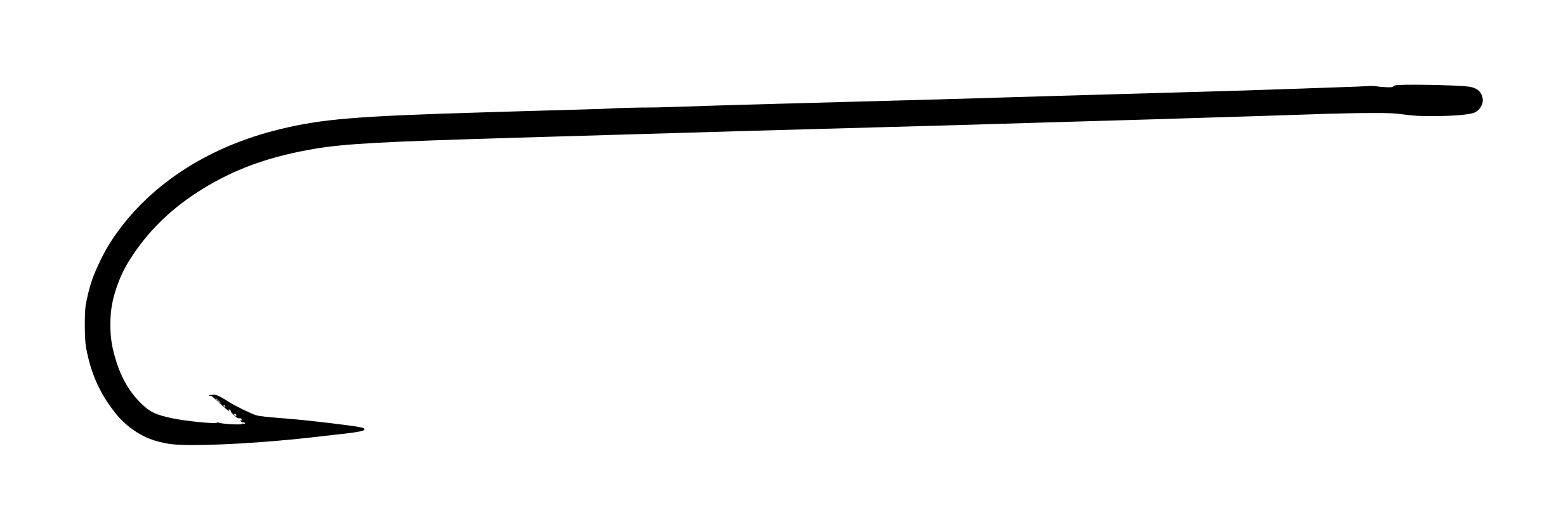
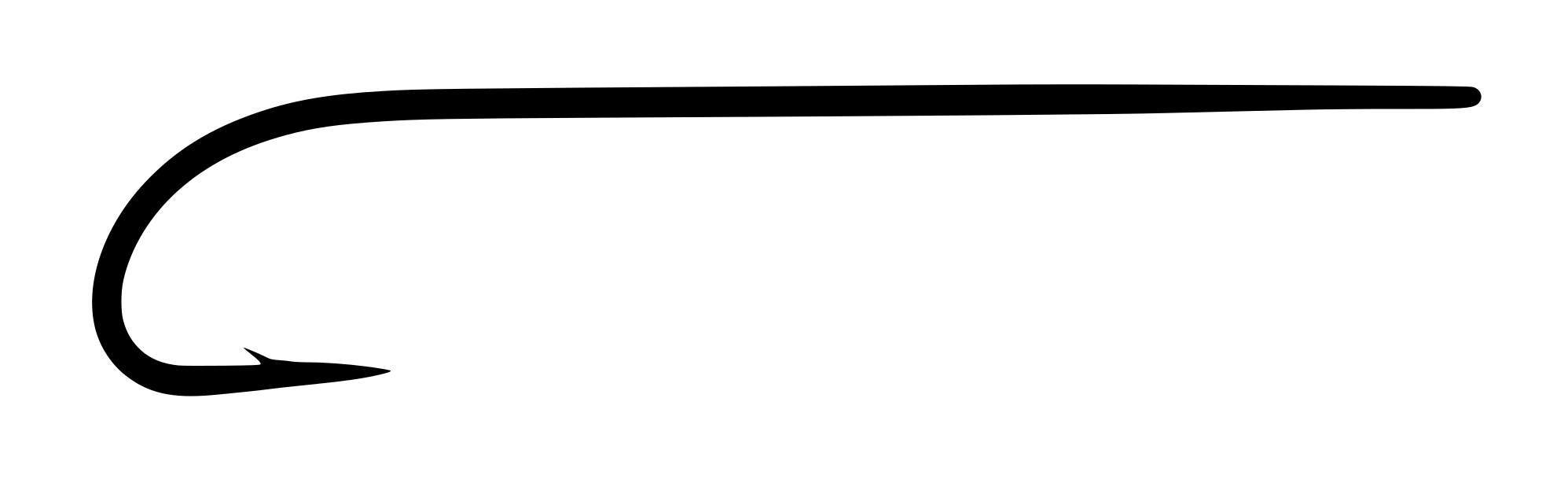
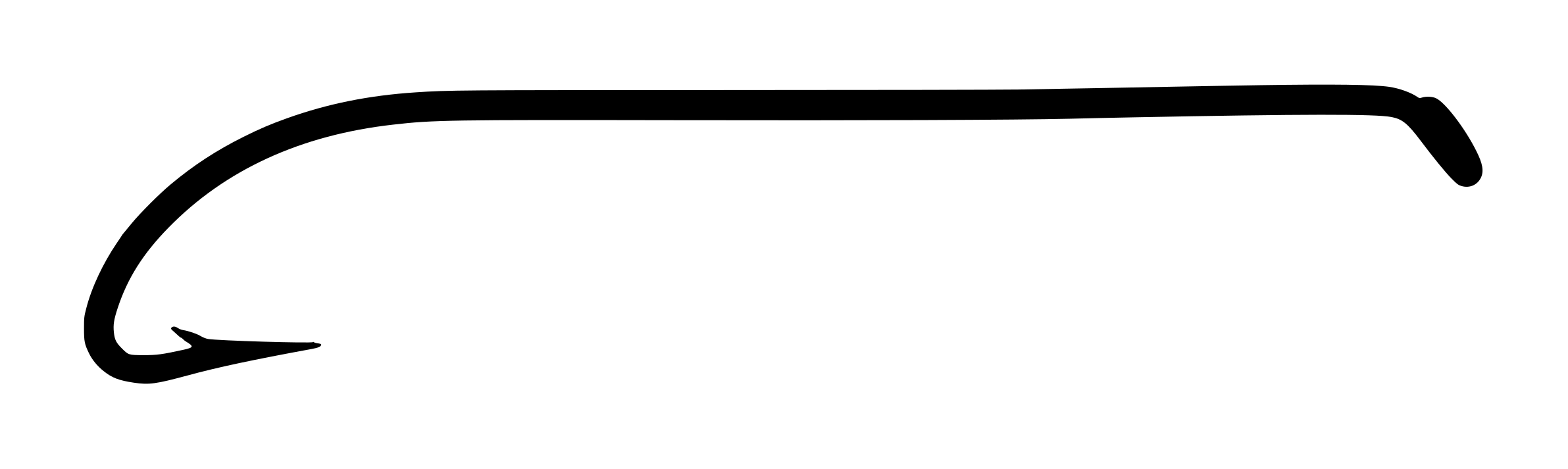
The Pflueger Carlisle Pelican 3320-G is a classic American light-wire bait hook manufactured by Pflueger Manufacturing Company (Akron, Ohio) during the early-to-mid 20th century. This particular specimen is a size 2 in the premium gold-plated finish, originally sold in 100-count boxes for freshwater panfish and small gamefish applications.
The defining features are the fine-gauge round wire, the sproat-style rounded bend with a curved spear point, and the traditional straight-ring eye that allows the eye ring to pivot freely on the shank. The gold plating — a brass-based electrodeposited finish — provides superior corrosion resistance compared to simple tinning or bronzing, reflecting this variant’s position as a premium offering within the Carlisle Pelican line.
Era evidence includes the distinctive letterpress-printed kraft box with green wrap and gold decorative border, the bulldog Pflueger logo, patriotic ‘Made in U.S.A.’ declaration, and ‘Since 1864’ heritage claim — all hallmarks of 1920s–1940s American tackle packaging. The absence of any barcode, modern SKU format, or photographic box artwork places this example firmly in the pre-1950s era, likely c. 1930s based on typography and box construction methods.
For collectors, the Carlisle Pelican represents an important chapter in American tackle manufacturing: Pflueger’s successful positioning of domestic-made hooks as credible alternatives to expensive English Redditch imports. Original boxes with complete hook counts are genuinely scarce, making this a desirable reference specimen for both American tackle historians and general vintage hook collectors.
Front label of the Pflueger Carlisle Pelican 3320-G original manufacturer box, size 2, showing letterpress printing in red and green on cream kraft paper with gold decorative border. The label identifies the model number (No. 3320-G) and finish (GOLD).
Photographic record
5 cataloged imagesSelect any record to load it above.
5 images shown
Pflueger Carlisle Pelican 3320-G Size 2 Gold Box FrontFront label of the Pflueger Carlisle Pelican 3320-G original manufacturer box, size 2, showing letterpress printing in red and green on cream kraft paper with gold decorative border. The label identifies the model number (No. 3320-G) and finish (GOLD).Open originalPflueger Carlisle Pelican 3320-G Box BackReverse side of the Pflueger Carlisle Pelican box showing the company's trademark bulldog logo, 'Best by Test' slogan, 'Since 1864' heritage claim, and quality assurance text about accuracy of pattern, size uniformity, and finish excellence.Open originalPflueger Carlisle Pelican 3320-G Size 2 Hook Point ProfileSide-view close-up of the hook point showing the characteristic curved spear-point geometry and short swept barb typical of the Carlisle Pelican sproat design. Gold plating finish is clearly visible on the measurement grid.Open originalPflueger Carlisle Pelican 3320-G Size 2 Full Hook ProfileFull profile view of the Pflueger Carlisle Pelican hook showing the complete shank, rounded sproat bend, and straight-ring eye. The lightweight construction and fine-wire gauge are evident from the proportions relative to the measurement grid.Open originalPflueger Carlisle Pelican 3320-G Size 2 Multiple HooksPair of Pflueger Carlisle Pelican hooks (size 2, model 3320-G) displayed side by side on the measurement grid, showing the consistency of the sproat bend profile and the straight-ring eye construction typical of this bait hook design.Open original
Ball Eye, Straight / InlineLoose ring eye construction typical of ringed bait hooks P. Ring appears properly centered and moves freely on the shank.
Wire
Heavy (1X Heavy), Round
Shank
Extra-Extra Long (XXL) — Plain
Bend
Sproat, Standard gapRounded sproat-style bend with smooth, symmetrical profile P. Shallow to moderate depth relative to gap width. No visible offset or reversal.
Point
Standard / SpearShort, cleanly cut barb set approximately 2-3 wire diameters above the point P. Barb angle is slightly swept rearward. Single barb without microbarbs.
Finish
Gold-Plated — Confirmed (stated on packaging)Bright gold plating with uniform color throughout the specimen P. No visible wear or bare spots on the measured hook. Warm tone characteristic of brass-based gold plate finish.
Hooks in specimen are bright gold with no corrosion or discoloration. All hooks appear to be original factory stock. Card backing is intact and secure. Packaging shows light toning, minor edge creasing, and age patina consistent with c. 1930s origin.
The sproat bend with curved point is optimized for bait fishing where hook-setting force and penetration are less critical than with fly tying. The rounded bottom provides a stable platform for live-bait presentation and allows the hook to hang naturally under its own weight. Fine wire gauges (like this specimen) minimize disturbance to live bait and reduce visibility in clear water, a design choice reflecting late 19th and early 20th century understanding of fish behavior.
The straight-ring eye was the standard for bait hooks of this era — it permits easier knot-tying and allows the eye ring to rotate slightly, reducing stress on the knot during the fight. The gold-plated finish is not merely decorative: brass-based gold plating provides corrosion resistance superior to simple tinning, extending the hook’s lifespan in freshwater use. This finish was a premium offering, typically commanding a higher retail price than bronzed equivalents.
We don't have measured sizes for this hook yet. Own one? Submit calipered measurements and we'll review and add them. Thank you!
Historical context
pflueger
Pflueger Manufacturing Company was founded in Akron, Ohio, in the 1860s (the box claims ‘Since 1864’), becoming one of America’s earliest and most prolific fishing tackle manufacturers. The company’s founding era coincided with the rapid industrialization of American fishing tackle, a period when American makers began to challenge the dominance of English Redditch hook manufacturers.
Pflueger distinguished itself through aggressive product diversification and brand marketing. By the early 20th century, the company produced not only fish hooks but also reels, lures, lines, and complete rod-and-reel outfits. The bulldog logo — registered as a trademark — became synonymous with American-made quality in tackle shops and sporting goods stores across the United States.
During the 1920s and 1930s, Pflueger capitalized on nationalist sentiment and labor pride by emphasizing ‘Made in U.S.A. by American Workers.’ This messaging directly countered the prestige associated with imported English hooks, which commanded premium prices among wealthy anglers. The strategy was commercially successful: Pflueger’s hook line proliferated in dozens of sizes and finishes, and the company established itself as a household name in American sport fishing.
Pflueger eventually acquired or partnered with other American tackle makers, including the Sealey hook line (Edgar Sealey & Sons of Redditch had partnered with American distributors). In the mid-20th century, the company was acquired by Shakespeare Manufacturing (also American-based), and hook production was later consolidated or discontinued as modern fishing tackle evolved. However, Pflueger hooks remain widely recognized by collectors and are iconic representations of American tackle manufacturing heritage.
Series History
The Carlisle Pelican line was Pflueger’s signature sproat-pattern bait hook series, positioned in the mass-market segment for anglers seeking reliable, economical bait hooks suitable for panfish and small gamefish. The ‘Carlisle’ name references an English hook-making center (Carlisle, Cumberland), signaling to consumers that this American hook was comparable in design to respected English patterns.
The series was produced in multiple variants distinguished by finish (bronzed, tinned, gold-plated, nickelled) and size range (from size 10 or 12 down to larger bait-fishing sizes). The gold-plated variant (3320-G) represented a premium offering within the line, commanding higher retail prices and appealing to anglers who valued the appearance and superior corrosion resistance of gold plating.
The ringed (straight-ring) eye was the standard for the entire Carlisle Pelican line, a feature that distinguished it from other Pflueger bait hooks and made it particularly suitable for the knot-tying preferences of the era. The ‘curved point’ designation on the packaging — emphasizing the gently curved spear point — was Pflueger’s way of signaling that this was not a hollow-point or deeply forged design, but rather a refined, standard-geometry sproat pattern.
The Carlisle Pelican line remained in production through the mid-20th century, though production volumes likely declined sharply after World War II as sport fishing tackle evolved and modern hook designs emerged. Original boxes from the 1920s–1940s era are far scarcer than later production, making early examples valuable reference specimens for collectors and historians.
Era and Packaging Dating
Box construction and letterpress printing with hand-stamped price indicate early-to-mid 20th century production. No barcode present (pre-1974 strong indicator). Kraft box with green wrap and decorative gold border typical of 1920s-1940s American tackle packaging. Typography style (chunky serif display fonts for Pflueger and product name) consistent with 1920s-1930s commercial printing. Bulldog logo and 'Since 1864' claim suggest box produced well after company founding. Patent office credit (Reg. U.S. Pat. Office) and nationalist slogan ('Made in U.S.A. by American Workers of American Material') indicate post-WWI production, likely 1920s-1930s. Card backing text and layout style support 1920s-1940s dating. No visible modern UPC or SKU format.
Pflueger's Patriotic Pride
The Carlisle Pelican box proudly declares 'Made in U.S.A. by American Workers of American Material' — a nationalist slogan that gained prominence after World War I. Pflueger, based in Akron, Ohio, and later acquired by Shakespeare Manufacturing, leveraged domestic manufacturing as a marketing advantage throughout the 1920s and 1930s. At a time when English Redditch hooks commanded premium prices among American sport fishermen, Pflueger's patriotic messaging and consistent quality helped establish American-made hooks as a credible alternative. The company's motto 'Best by Test' and the enduring bulldog logo reflected Pflueger's position as one of America's oldest tackle manufacturers, having roots back to 1864.
Design lineage and influence
The sproat bend originated in England in the early 1800s and became one of the most widely manufactured hook patterns across all manufacturers. Pflueger’s Carlisle Pelican represents the American adaptation of this design for a mass market. By the 1920s, sproat-pattern bait hooks were ubiquitous in American tackle boxes, competing directly with English imports and with other American designs like the Aberdeen and Limerick bends. The Carlisle Pelican’s positioning as a light-wire, fine-point option placed it in the middle market — more refined than heavy utility hooks but less specialized than fly-tier patterns.
The gold-plated variant suggests Pflueger’s attempt to capture demand from anglers willing to pay a modest premium for a more refined appearance and superior corrosion resistance. This variant likely saw production during the economically robust 1920s, with the market shifting toward more economical bronzed versions during the Depression era of the 1930s.
Best matchRelated by Attribute
Computed automatically from catalog data — updated as new hooks are added.
Matches: Bend, Shank, Gap, Eye, Eye Orient. +3 moreDiffers: Wire: Heavy (1X Heavy) vs Standard; Point: Standard / Spear vs Superior; Finish: Gold-Plated vs Bronzed +1 more
Matches: Bend, Shank, Gap, Eye, Eye Orient. +3 moreDiffers: Wire: Heavy (1X Heavy) vs Standard; Point: Standard / Spear vs Superior; Finish: Gold-Plated vs Nickelled +2 more
Matches: Bend, Wire, Eye, Eye Orient., Point +3 moreDiffers: Shank: Extra-Extra Long vs Short (1X–2X Short); Gap: Standard vs Wide; Finish: Gold-Plated vs Black Japanned +1 more
Matches: Wire, Gap, Eye, Eye Orient., Point +4 moreDiffers: Bend: Sproat vs Round / Kendal; Shank: Extra-Extra Long vs 2X Long; Finish: Gold-Plated vs Nickelled
The Carlisle Pelican 3320-G is a classic light-wire bait hook designed for freshwater panfish and small gamefish. The curved point and ringed eye facilitate secure attachment of small live baits, worms, and insects. The lightweight construction and fine wire gauge make it suitable for delicate presentations with minimal impact on bait liveliness. Historically positioned as a versatile general-purpose bait hook for common North American freshwater species including bluegill, crappie, and small bass.
Secondary Applications
May be used for small crustaceans, insects, or delicate live-bait presentations where wire weight is a consideration.
Classic Fly Patterns
Not typically used for fly tying.
Modern Equivalents
Hook
Match Quality
Notes
Mustad 92620
Very Good
Modern sproat bait hook with similar proportions and fine wire; Mustad's continuation of the sproat style
Owner 5308
Good
Japanese sproat-bend bait hook; similar size and wire gauge, though modern temper and plating
Eagle Claw 139
Good
American-made sproat variant; comparable light-wire construction for panfish
Collector notes
Rated 3.5/10 — common model in most sizes but original gold-plated boxes with complete hook count are moderately scarce. Collector demand is modest but steady among vintage American tackle specialists and general hook collectors. Original box condition and complete count are the primary value drivers.
Reference value
$6 – $12 USD estimate
Packaging condition
Good — moderate wear, legibleRecorded specimen
Packaging format
GW-PFL-BX-01Catalog code
The Carlisle Pelican line was Pflueger’s mass-produced bait hook series, ensuring wide surviving stock. However, the gold-plated variant (3320-G) is less common than the standard bronzed versions, and original boxes in good condition with complete hook counts (100 hooks) are genuinely scarce — most survivors are loose hooks or damaged cards. The early letterpress-printed box and patriotic manufacturing claim add nostalgic appeal to American tackle collectors and Pflueger specialists.
Positive factors: Early American manufacturer; distinctive gold finish; original box with period graphics; complete count on specimen. Limiting factors: Not a rare or exotic design; bait hooks have less collector demand than specialty dry-fly patterns; condition of the kraft box is critical — foxing, edge loss, or loose labels dramatically reduce value. Size 2 is standard and readily available; smaller sizes (8-16) would be more collectible. Missing hooks or damaged box can reduce value by 50% or more.
Most desirable: Original sealed boxes, smaller sizes (8-14), boxes with intact price labels or handwritten notations, bronzed variants for comparison collecting, complete 100-hook count. Least desirable: Loose hooks, boxes with heavy foxing or label loss, incomplete counts, boxes that have been opened and repacked.
Packaging
Original manufacturer kraft box with green cloth-backed wrap and gold decorative border stripe. Front label is cream-colored with red and green letterpress printing. Product identification: 'PFLUEGER / CARLISLE PELICAN / FISH HOOKS' (red letterpress). Model code and size printed in green: 'No. 3320-G / GOLD' and size '2'. Box back side bears Pflueger brand identity with bulldog logo, 'Best by Test' slogan, and 'Since 1864' patent claim. Text reads: 'PFLUEGER FISH HOOKS / BEST BY TEST [bulldog logo] SINCE 1864 / THE STANDARD OF THE WORLD / FOR ACCURACY OF PATTERN / and SIZES, UNIFORMITY OF TEMPER / and EXCELLENCE OF FINISH / TRADE MARKED REG. U.S. PAT. OFFICE'. Price appears hand-stamped in period pencil. Box shows light toning and minor edge wear consistent with age; label remains legible. Kraft material shows expected light patina.
Market Value Notes
Low ($6): Good condition — opened box with nearly complete hook count (90-100 hooks), light packaging wear, all hooks bright and unbent.<br />
High ($12): Excellent condition — sealed or near-sealed box, full 100-hook count verified, minimal label wear, packaging sharp.<br />
Premium factors: Original box (not loose hooks) adds substantial value; complete 100-hook count; gold finish rarity; early letterpress box graphics; sealed/near-sealed condition.<br />
Platforms: Based on 1 eBay sold listing ($12.00) and eBay market history (Apr 2023–Apr 2026: avg $7.99, range $7.99–$7.99).<br />
Confidence: V verified — anchored by direct eBay sold data. Limited dataset (n=1 listing, 1 aggregate history entry) suggests range conservatively. Sealed box or exceptional condition unlikely to exceed $15 in current market. Loose hooks from same lot typically $2–4.
Where to Find
eBay (US listings with 'Pflueger 3320' or 'Carlisle Pelican'); tackle antique dealers in the Northeast (especially New York, Pennsylvania); regional tackle fairs and fishing memorabilia shows; general vintage fishing hook lots on eBay; occasional appearance in large tackle collections offered at estate sales.
eBay market reference. Researcher-curated. Prices in USD. Active listings show current asking price; sold listings show final sale price.
Preservation
Storage and Preservation
Store the original box in a cool, dry environment away from direct sunlight and humidity. The kraft box is susceptible to moisture damage, foxing (brown spotting from acid content), and edge delamination if exposed to damp conditions. Keep the box away from basements, attics prone to temperature fluctuation, and any source of water intrusion.
The gold-plated finish is extremely durable and resistant to corrosion in normal conditions. However, handle the hooks minimally to avoid transferring skin oils and salts to the finish. If the box has been opened, store the hooks on the original card or backing rather than loose to prevent puncture damage to the box interior and to preserve the presentation.
If you possess a sealed box, resist the temptation to open it — sealed original packaging is significantly more valuable to collectors. If the box is already open, consider placing it in a protective archival sleeve or acid-free kraft folder to slow environmental degradation. Never store with other metals that could cause galvanic corrosion through direct contact.
Check periodically for pest damage (especially insects that feed on kraft glue and paper). A thin layer of cedar block or lavender sachet placed nearby (not touching the box) can help deter pests without chemical fumigation.
Primary Source
Box Packaging Analysis
Source: Pflueger Carlisle Pelican 3320-G front and back label text, c. 1920–1945
The Carlisle Pelican box displays three distinct text zones that reveal Pflueger’s marketing strategy and company positioning in the American tackle market of the early-to-mid 20th century:
Front Label (Product Identity): ‘PFLUEGER CARLISLE PELICAN FISH HOOKS / Curved Point / Ringed / MADE IN U.S.A.–BY AMERICAN WORKERS– / OF AMERICAN MATERIAL / [model code] No. 3320-G GOLD / [size] 2’. This front-and-center identification emphasizes three selling points: the Carlisle brand (an American hook design), the specific features (curved point, ringed eye), and aggressive nationalist manufacturing claims. The phrase ‘Made in U.S.A. by American Workers of American Material’ is not coincidental — it reflects Pflueger’s post-WWI strategy to compete against British Redditch imports by appealing to American patriotism and labor consciousness.
Back Label (Brand Heritage & Quality Claims): ‘PFLUEGER FISH HOOKS / BEST BY TEST [bulldog logo] SINCE 1864 / THE STANDARD OF THE WORLD / FOR ACCURACY OF PATTERN / and SIZES, UNIFORMITY OF TEMPER / and EXCELLENCE OF FINISH’. This messaging builds credibility through age (company founding date), empirical testing (‘best by test’), and technical specifications (pattern accuracy, temper uniformity, finish excellence). The bulldog logo reinforces a sense of strength, loyalty, and American identity — a consistent Pflueger trademark from the 1880s onward.
The repetition of nationalist language and quality assurance across both sides suggests that Pflueger faced serious competition from English makers during the 1920s–1930s and sought to position American-made hooks as cost-competitive and quality-equivalent. The success of this marketing is evidenced by Pflueger’s survival and profitability through the Depression era — a period when many smaller American tackle makers failed.
Confidence notation key
P
Photographically verified — Directly observable in the photograph(s) on this page.
V
Verified by documentation — Confirmed by manufacturer catalog, spec sheet, or published reference.
I
Inferred — A logical deduction from observable or documented evidence, not directly stated.
E
Estimated — An approximation based on visual comparison, proportional analysis, or limited data.
S
Speculative — A reasoned hypothesis that cannot be confirmed from available evidence.
Claims with no notation are confirmed by multiple independent sources. All photographs on garrenwood.com are taken on a measurement grid where each square equals 1/10 inch (0.1″ / 2.54 mm).