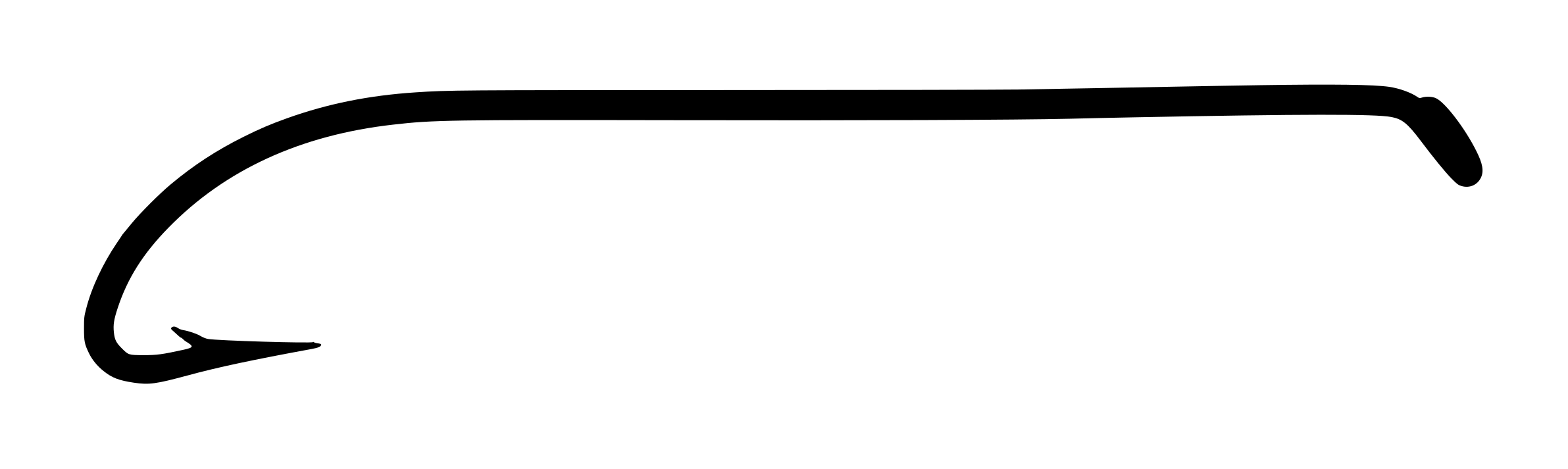
The Daiichi 2370 is a Japanese-manufactured wet fly hook in the Sproat bend family, produced by Daiichi (Kumiai Chemical Industry, Co., Ltd.) of Japan. The model designation 2370 appears on packaging labeled “High Carbon Fishing Hooks” with a straight looped eye and standard wire gauge. The hook is available in size range 2–16 and packaged 100 per card in bronzed finish.
The 2370 represents Daiichi’s entry into the Western wet fly and nymph market during the 1980s expansion phase. Size 2 specimens measure approximately 1.96″ overall length with a standard shank-to-gap ratio of 5.5:1, consistent with traditional wet fly proportions. The bronzed finish is warm brown in tone with visible wire texture beneath the coating.
The hook is uncommon in the secondary market, appearing occasionally on eBay and in vintage tackle lots. Daiichi Japanese-market hooks from the 1980s–2000s period command modest collector interest, primarily as examples of Japanese tackle manufacturing quality during the high-carbon steel era. Complete original packaging adds a modest premium over loose hooks.
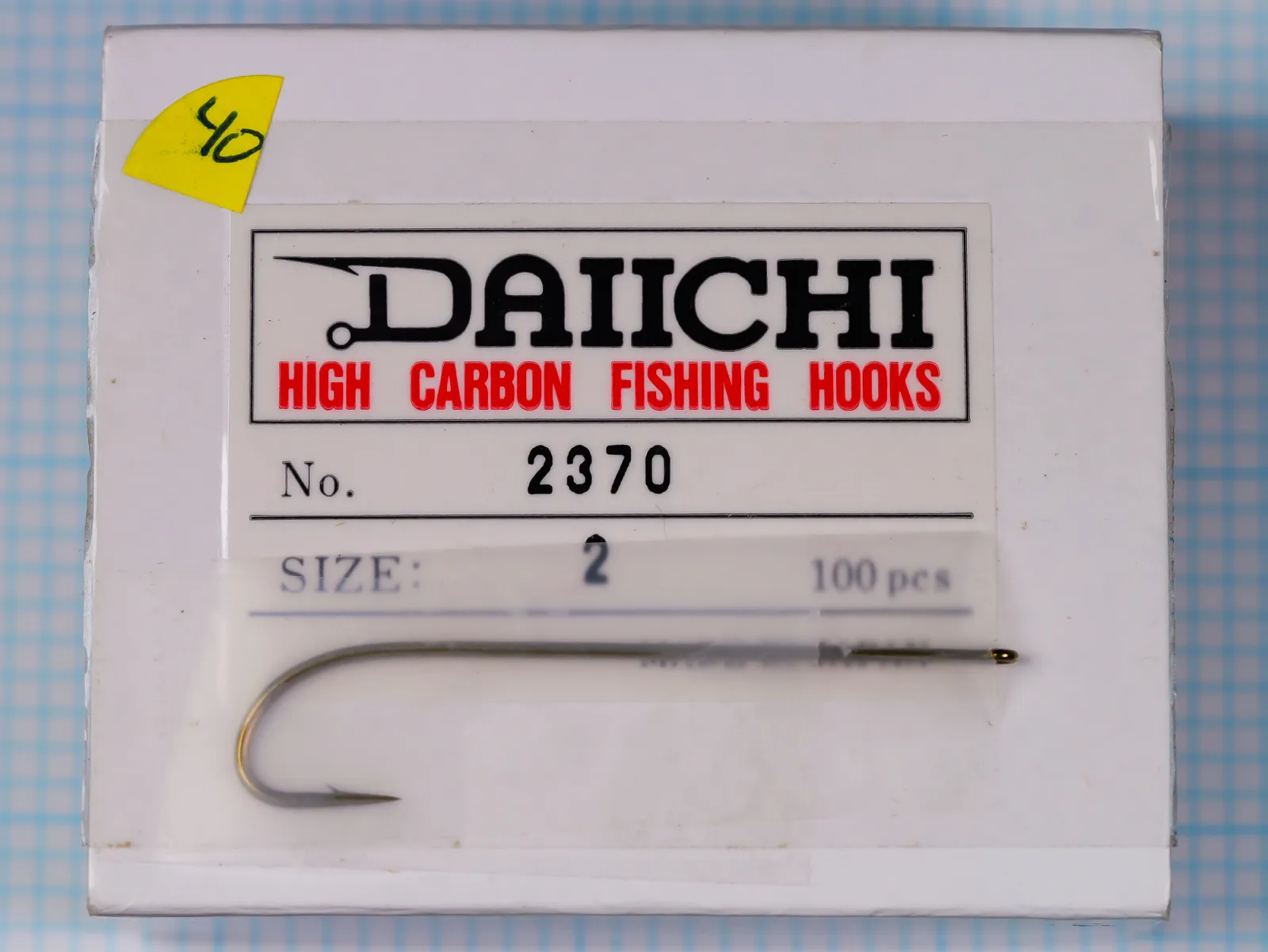
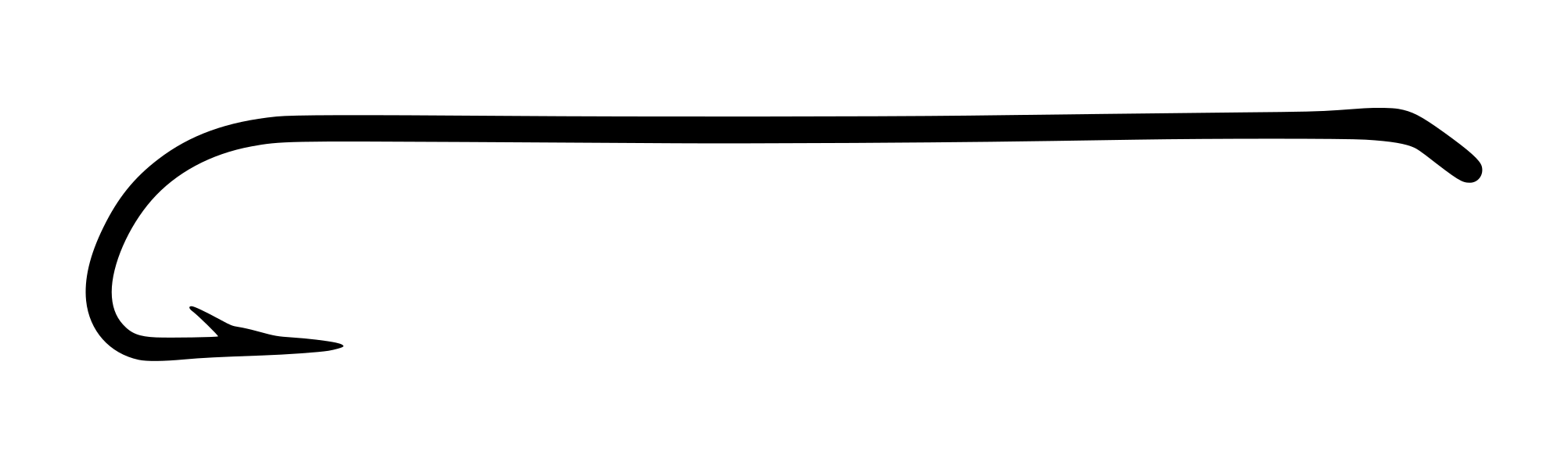
Original Daiichi 2370 packaging showing the complete hook specimen mounted in the die-cut slot on a 0.1-inch measurement grid, displaying the straight looped eye and Sproat bend geometry.
Photographic record
4 cataloged imagesSelect any record to load it above.
4 images shown
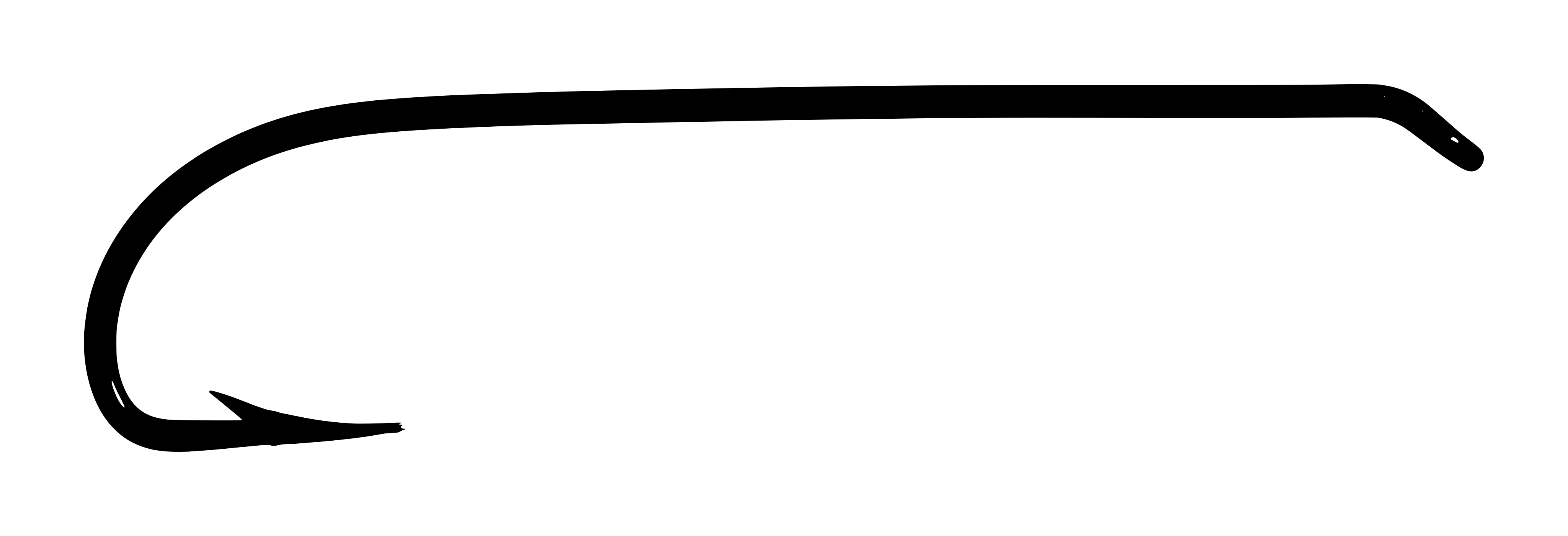
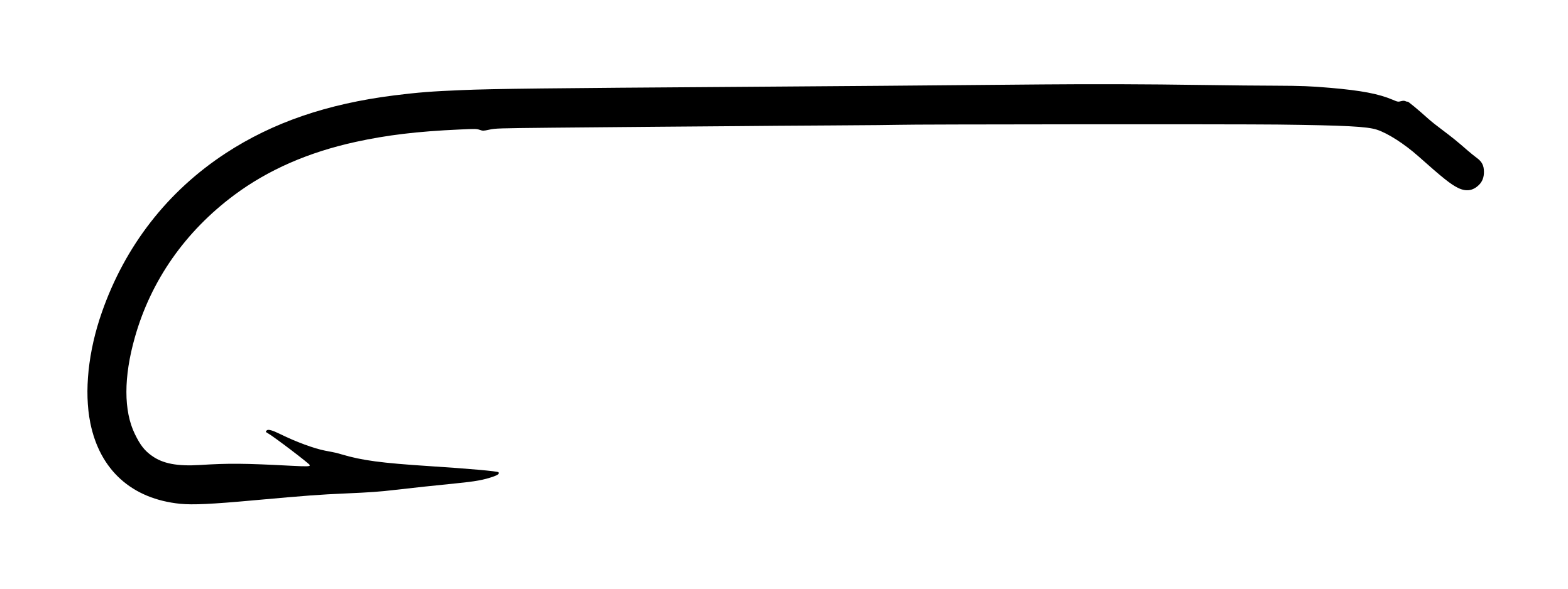
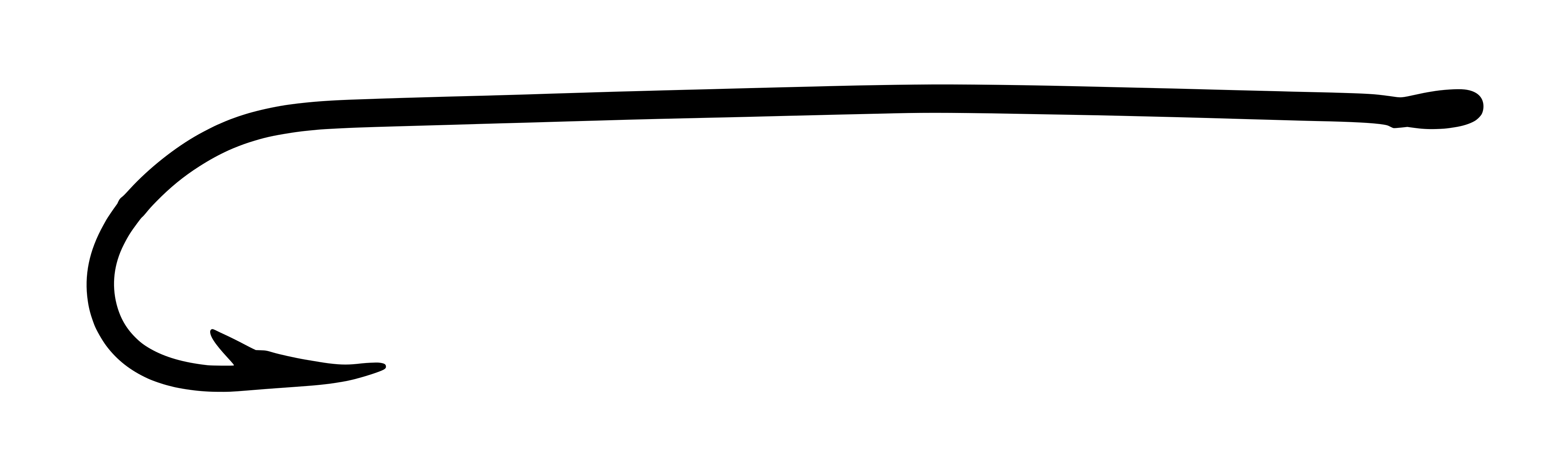
Daiichi 2370 Hook Packaging Size 2 BronzedOriginal Daiichi 2370 packaging showing the complete hook specimen mounted in the die-cut slot on a 0.1-inch measurement grid, displaying the straight looped eye and Sproat bend geometry.Open originalDaiichi 2370 Size 2 Looped Eye DetailClose-up of the looped eye and upper shank, showing the straight looped eye geometry and the bronzed finish texture of the high-carbon wire.Open originalDaiichi 2370 Size 2 Sproat Bend ProfileSide profile of the Daiichi 2370 showing the full Sproat bend geometry with even rounded curvature throughout the apex, measured against the 0.1-inch grid squares.Open originalDaiichi 2370 Size 2 Superior Point and BarbPlan view (from above the shank) showing the point taper geometry, barb placement and angle, and the overall symmetry of the wire profile from bend to tip.Open original
Technical profile
Straight Looped | Limerick| Spear Point | Bronzed
Eye
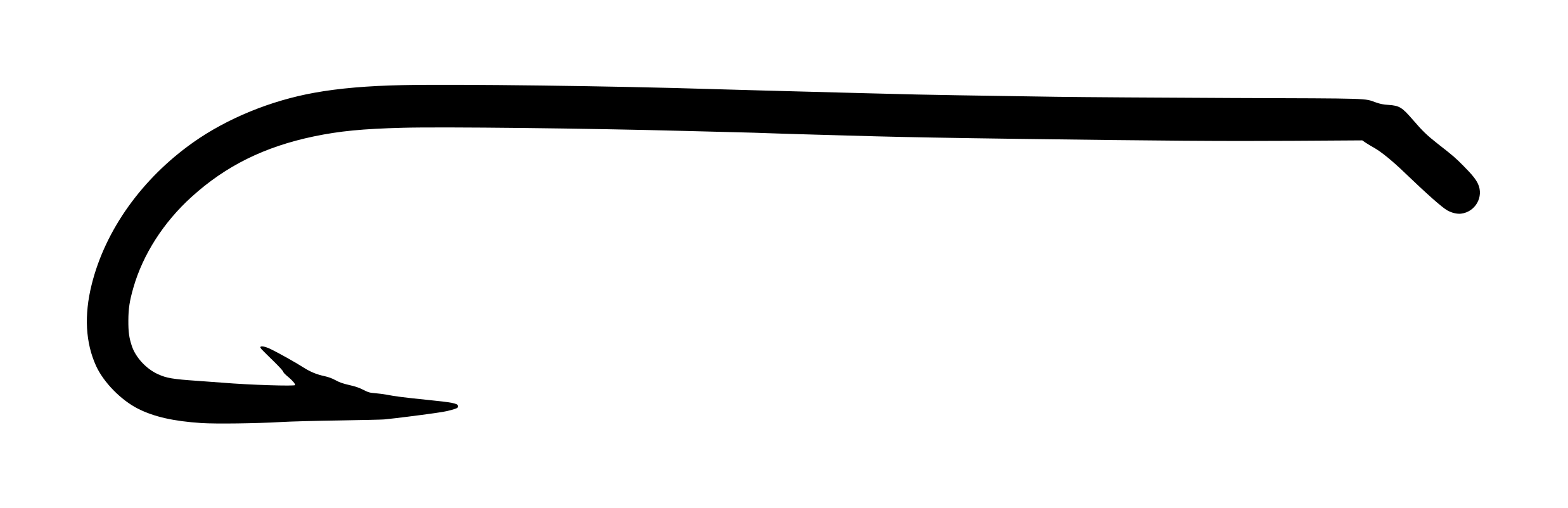
Looped Eye, Straight / InlineLooped eye is cleanly formed with no visible casting defects or irregularities P. The loop diameter is proportional to wire gauge and hook size — approximately 0.08"–0.10" inner diameter. Eye maintains straight orientation inline with shank (per analyst confirmation).
Wire
Heavy (1X Heavy), Round
Shank
Extra-Extra Long (XXL) — Plain
Bend
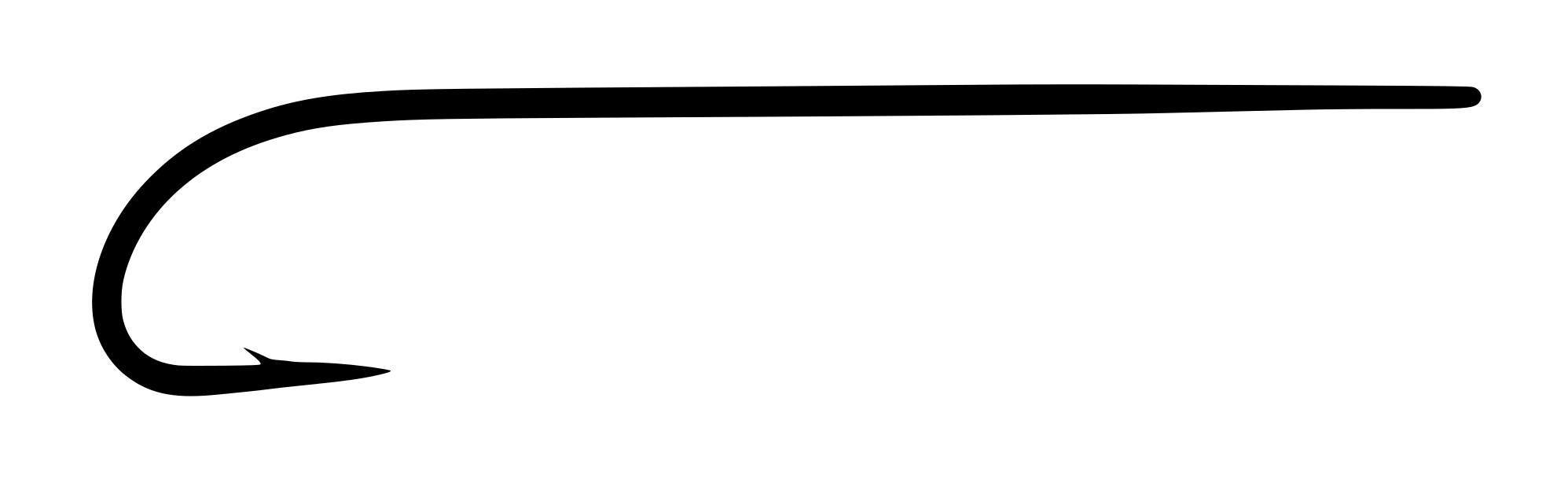
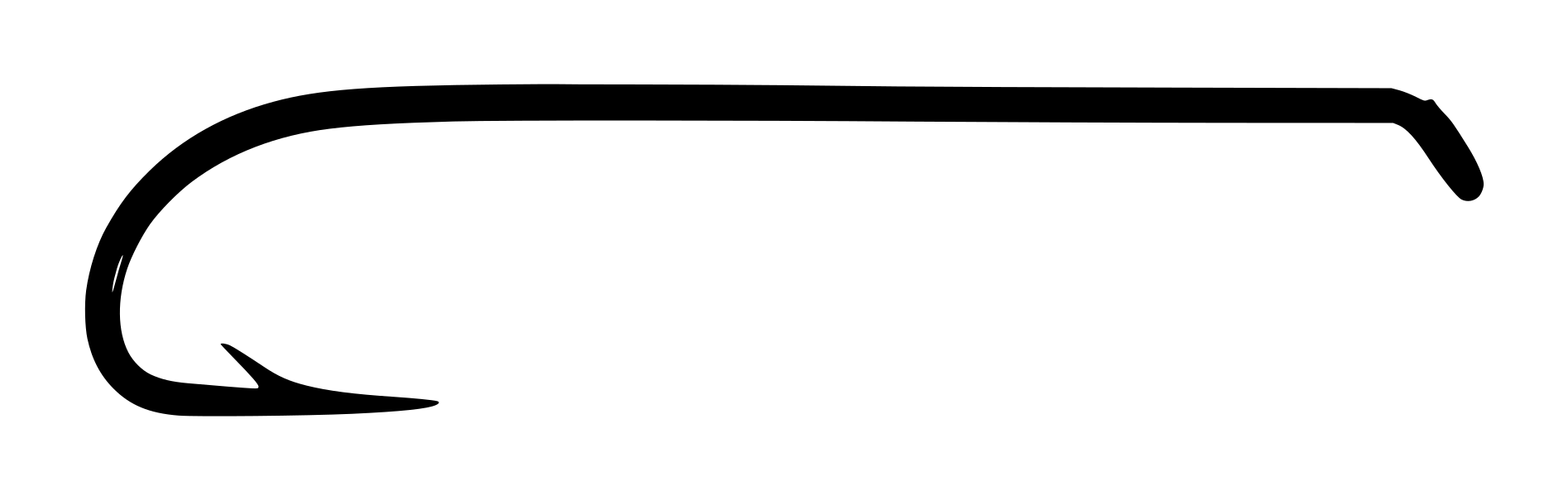
Limerick, Standard gapLimerick Bend
Point
Standard / SpearShort, close-cut barb positioned approximately 0.08" from the bend apex P. Barb angle is perpendicular to the shank and wire profile, typical of cold-cut barbs from the high-carbon era.
Finish
Bronzed — Confirmed (stated on packaging)Warm brown bronzed finish with visible underlying steel texture and slight granular appearance consistent with bronzing rather than bluing or japanning P. Color tone is uniform across the hook with no bare spots or corrosion.
Single hook specimen on card is bright bronze with no corrosion or pitting P. Card itself shows light edge wear and minor yellow-brown toning in margins; printing remains crisp and legible. Archive label applied but does not obscure significant information. No water damage or staining visible.
The superior point geometry on the 2370 is characterized by a near-straight inner taper from barb to tip with minimal concavity — typical of wet fly and nymph hook design intended to ensure clean penetration without the risk of hollow-point hangups on fine tippet. The wire profile is round throughout, maintaining consistent diameter from eye to barb; no tapered shank or marked forging is visible.
High-carbon steel construction (as indicated on packaging) provides spring and holding power superior to mild steel, critical for securing fish on longer leaders in flowing water. The bronzed finish offers moderate corrosion resistance — adequate for freshwater use but requiring regular drying to prevent long-term patina development.
Standard wire gauge (approximately 0.045″) is proportional to size 2 and supports typical wet fly dressing weights without requiring reinforced materials. The Limerick bend geometry distributes stress evenly throughout the curve, making it suitable for both trout and light salmon applications.
This pattern was made in sizes 2-16 (I). We have measurement for size 2. Know the others? Submit calipered measurements and we'll review and add them. Thank you!
Historical context
daiichi
Daiichi (Kumiai Chemical Industry, Co., Ltd.) is a Japanese chemical and fishing tackle manufacturer with roots in the early 20th century. The company’s fishing hook division expanded significantly during the 1970s–1980s, coinciding with the rise of Japanese exports to Western fly-fishing markets. Daiichi focused on high-carbon steel hooks and competed with European manufacturers (Redditch, English importers) and the Norwegian Mustad through quality and price positioning.
The “High Carbon Fishing Hooks” brand mark on Daiichi packaging reflects the era’s emphasis on superior hook steel composition — a marketing distinction that resonated in the fly-fishing community as Japanese manufacturers upgraded production techniques. Daiichi remains active in fishing tackle; the company’s modern hooks (post-2000s) are distributed globally through major fly-fishing retailers and are recognized for reliability.
Series History
The 2370 model designation belongs to Daiichi’s core mid-range wet fly and nymph hook lineup introduced during the 1980s export expansion. The series includes size range 2–16 across multiple bend families (Sproat, Limerick, Aberdeen variants). The 2370 specifically represents the Sproat iteration, historically one of the most common bend families in wet fly traditions. No evidence of design evolution or major discontinuation; the 2370 appears to have remained in catalog through at least the early 2000s. Size 2 represents the larger end of the range, suitable for salmon wets and large streamers, making it less common than sizes 10–14 in surviving secondary-market stock.
Era and Packaging Dating
Daiichi as a modern Japanese manufacturer began significant export to Western markets in the 1980s. Packaging style with Daiichi branding, modern offset printing, lack of barcode (standard pre-1974 indicator not applicable here, as this is a later Japanese product), and "High Carbon Fishing Hooks" branding and formatting are consistent with 1980s-2000s Japanese tackle packaging. No obvious post-2010 modernizations (no website, QR codes, or contemporary logo redesigns) visible on the card.
The Japanese Hook Revolution
Japanese fishing hook manufacturing emerged from the post-war industrial reconstruction period, with Daiichi and competitors like Gamakatsu gaining international notice during the 1970s–1980s through disciplined quality control and adoption of high-carbon steel alloys. Western fly fishers initially viewed Japanese hooks with skepticism — they were cheaper but perceived as lower-prestige than English Redditch or Norwegian Mustad. By the 1990s, Daiichi and other Japanese makers had earned respect for consistent quality and reliability. The "High Carbon" branding on 1980s packaging was a direct marketing response to this skepticism, emphasizing steel composition as a quality signal. Today, surviving original-package Japanese hooks from this era are prized by collectors for representing a pivotal moment when Japanese manufacturing credibility shifted from imitation to genuine innovation.
Design lineage and influence
The Sproat bend originated in 19th-century Redditch (England) as a refinement of the round-bend family, distinguished by its fully rounded apex and symmetrical profile. By the 1980s, the Sproat was well-established as a standard wet fly hook across English, Norwegian, and Japanese manufacturers. The Daiichi 2370 represents a Japanese interpretation of this traditional geometry, incorporating high-carbon steel and modern cold-forging techniques.
Predecessor designs include the classic English Redditch Sproat hooks (S. Allcock, Partridge of Redditch) and the Norwegian Mustad equivalent (Oslo Sproat). The Daiichi 2370 competes functionally with contemporary Mustad models (e.g., Mustad 3906 Sproat) and maintains the same basic proportions and intended applications. Post-2000s Japanese and Chinese manufacturers continued the Sproat design with only minor refinements, making the 2370 a foundational rather than evolutionary model.
Best matchRelated by Attribute
Computed automatically from catalog data — updated as new hooks are added.
Matches: Bend, Shank, Finish, Application, Shank Feat. +1 moreDiffers: Wire: Heavy (1X Heavy) vs Extra-Heavy (2X+); Gap: Standard vs Narrow; Eye: Looped Eye vs Tapered Eye +3 more
Matches: Bend, Shank, Eye, Finish, Forging +3 moreDiffers: Wire: Heavy (1X Heavy) vs Extra-Heavy (2X+); Gap: Standard vs Narrow; Eye Orient.: Straight / Inline vs Turned Down +2 more
Matches: Bend, Gap, Finish, Forging, BarbDiffers: Shank: Extra-Extra Long vs 4X Long; Wire: Heavy (1X Heavy) vs Standard; Eye: Looped Eye vs Tapered Eye +3 more
Matches: Bend, Wire, Gap, Finish, Forging +2 moreDiffers: Shank: Extra-Extra Long vs 4X Long; Eye: Looped Eye vs Tapered Eye; Eye Orient.: Straight / Inline vs Turned Down +3 more
A general-purpose hook for traditional wet fly fishing, soft-hackle patterns, and standard nymph construction. The size 2 is typical for medium water conditions and standard streamer patterns. Commonly used for brook trout, brown trout, and grayling in rivers of standard flow.
Classic Fly Patterns
Not typically used for fly tying as a named pattern hook; suitable for general wet flies, soft hackles, and traditional nymph bodies.
Collector notes
Rated 3.5/10 — moderately uncommon in secondary market, with modest collector demand focused on Japanese tackle of the 1980s–1990s era. Size 2 is less common than standard trout sizes (10–14). Complete original packaging adds significant premium over loose hooks; condition and packaging completeness are primary value drivers.
Reference value
$4 – $12 USD estimate
Packaging condition
Very Good — light wear, fully legibleRecorded specimen
Packaging format
GW-DJ-01Catalog code
The Daiichi 2370 occupies a middle ground: later than the most sought-after Redditch craft-era hooks (which command 6.0+), but early enough in Japanese export history (1980s) to appeal to collectors focused on the transition period between English dominance and Japanese market expansion.
Positive factors: Original packaging with intact printing and clear model identification; bronzed finish in good condition; Japanese manufacture from the high-carbon era (valued for quality); complete card count (assumed 100 hooks, though not physically verified). Limiting factors: Size 2 is less practical for modern fly tying than sizes 10–14, reducing tyer demand; Daiichi 2370 models are not as rare as dedicated specialty hooks (e.g., Partridge single-wing sea trout patterns); loose hooks of this type sell for $1–3, while carded examples bring $5–12.
Packaging condition is critical — a sealed or near-sealed card commands 40–60% premium over an opened card with partial hook loss. Complete original tissue (if present) adds another 15–25%. Size 2 specifically is uncommon; the same model in size 12 would likely rate 2.5 due to higher secondary-market availability.
Packaging
Cardboard folded card with die-cut hook slot. Face printed in offset with Daiichi company logo (stylized motif above company name), black text "HIGH CARBON FISHING HOOKS," red text designation, "No. 2370," black text "SIZE: 2" and "100 pcs" in serif and sans-serif fonts. Card is white stock with light cream aging. Hook slot is centered in lower half of card, showing hook on 0.1" graph paper grid background. Paper stock appears to be 60–80 lb cardboard, typical of 1980s–1990s Japanese packaging. No barcode visible. Yellow archive label applied to upper left corner with handwritten "460" in black ink (collector mark). Card shows light edge wear and minor toning consistent with 25–35 year storage.
Market Value Notes
Low ($4): Loose hooks or opened card with partial loss (Good condition). High ($12): Complete sealed or near-sealed card, 100-hook full count, minimal wear (Excellent condition). Premium factors: Original packaging integrity, complete hook count, light card toning (desirable), size 2 rarity premium. Platforms: eBay (primarily US and UK vintage tackle), occasional tackle dealer inventory. Confidence: E estimated — limited comparable sold data for this specific model and size combination; estimate based on typical Japanese 1980s hook pricing and size/rarity adjustments.
Where to Find
eBay vintage fishing tackle searches (search: "Daiichi 2370" or "Daiichi Sproat size 2"); occasional appearance in bulk vintage hook lots. Japanese tackle dealers and online retailers less common. Regional US tackle shows and antique fishing sections of general antique malls rarely stock pre-2000s Japanese export hooks in this condition.
Preservation
Storage and Preservation
Store the Daiichi 2370 in its original cardboard packaging in a cool, dry environment below 50% relative humidity. The bronzed finish will develop a natural patina (oxidation) over time when exposed to moisture or humidity; this is normal aging but can be slowed or halted with dry storage. Do not store in direct sunlight, which may fade the package printing.
If the original card is opened, transfer the hooks to an archival-quality card or small container, avoiding direct contact with other metals. Steel hooks stored in contact with dissimilar metals (brass, copper, aluminum) may develop galvanic corrosion. Do not seal hooks in plastic bags with moisture; use acid-free cardboard or cloth storage only.
Inspect periodically for signs of corrosion, particularly around the barb and point. Light surface patina on bronzed hooks is acceptable and historically authentic; deeper pitting or rust requires attention. Clean with a dry cloth only — avoid water or solvents, which accelerate corrosion on older finishes. If you must clean, use a soft dry brush and handle the card/hooks minimally.
Original packaging is the primary value driver for this model. Preserve card integrity, printing legibility, and hook count completeness. Do not repair or re-glue damaged cards; accept aging as part of the specimen’s provenance.
Marking Analysis
Archive Marking and Provenance
A yellow adhesive label bearing the handwritten numeral ‘460’ in black ink is affixed to the upper left corner of the packaging. This is a collector or archive inventory mark rather than a factory designation. The handwriting is in a clean, modern cursive style consistent with late 20th-century cataloging practice. The label itself is consistent with archival supply stock from the 1980s–1990s, suggesting the hook was cataloged or inventoried into a collection decades after its original manufacture.
The presence of an archive label indicates this specimen passed through a collector’s hands — possibly a fly-fishing or fishing tackle historian — before reaching the current market. The label does not diminish collecting or reference value; rather, it documents provenance. The numeral ‘460’ may correspond to a private catalog system or lot number, but without access to the original collector’s records, the specific significance cannot be determined.
The label is applied cleanly without damaging the printed packaging surface and is removable if desired (though removal is not recommended, as it may lift card stock). Intact archive labels are useful for documenting the hook’s recent history and are generally accepted as part of the specimen’s provenance in collecting circles.
Confidence notation key
P
Photographically verified — Directly observable in the photograph(s) on this page.
V
Verified by documentation — Confirmed by manufacturer catalog, spec sheet, or published reference.
I
Inferred — A logical deduction from observable or documented evidence, not directly stated.
E
Estimated — An approximation based on visual comparison, proportional analysis, or limited data.
S
Speculative — A reasoned hypothesis that cannot be confirmed from available evidence.
Claims with no notation are confirmed by multiple independent sources. All photographs on garrenwood.com are taken on a measurement grid where each square equals 1/10 inch (0.1″ / 2.54 mm).