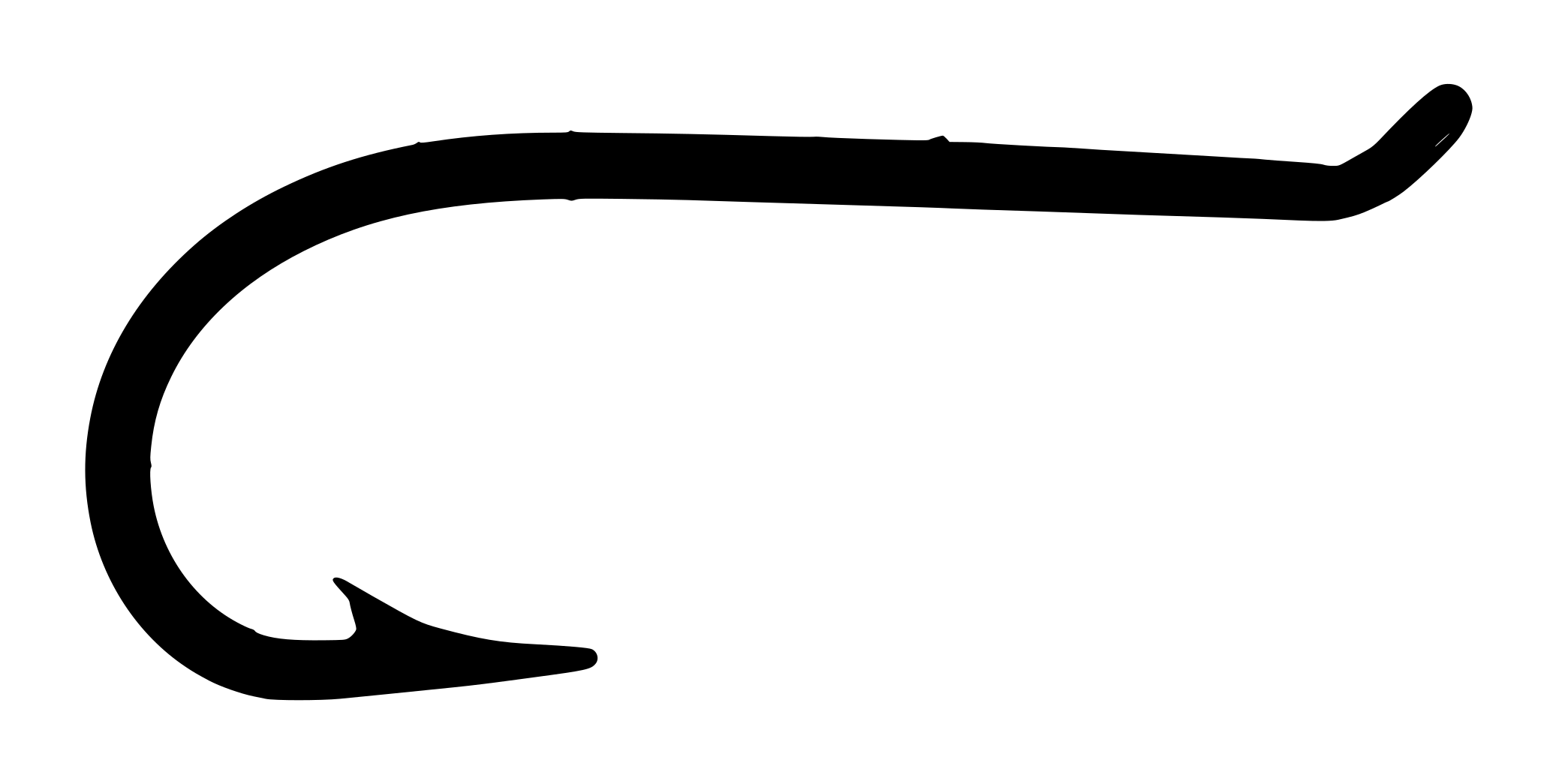
The Nyack TDE is a fine-wire trout hook manufactured by Sheffield steelmakers and distributed by Ray Bergman’s American Fly Hooks enterprise in Nyack, New York, circa 1920s–1940s. The model name identifies the defining feature: a tapered eye turned down at the shank. This construction was favored by traditional dry-fly tyers for its clean line and precise knot geometry on patterns for chalk-stream trout.
Size 18 is documented here with fine-gauge wire consistent with the design intent — a delicate tool for small mayflies and soft-hackle wets. The bronzed finish on Sheffield steel is original and confirmed by packaging specification. Collectors recognize Bergman-branded hooks from this era as significant artifacts in American fly-fishing history, representing a period when domestic retailers curated imported English hooks for the discerning fly tyer.
Scarce in original packaging, especially in smaller sizes such as 18. Completeness of the card and condition of the hooks are primary value drivers for this model.
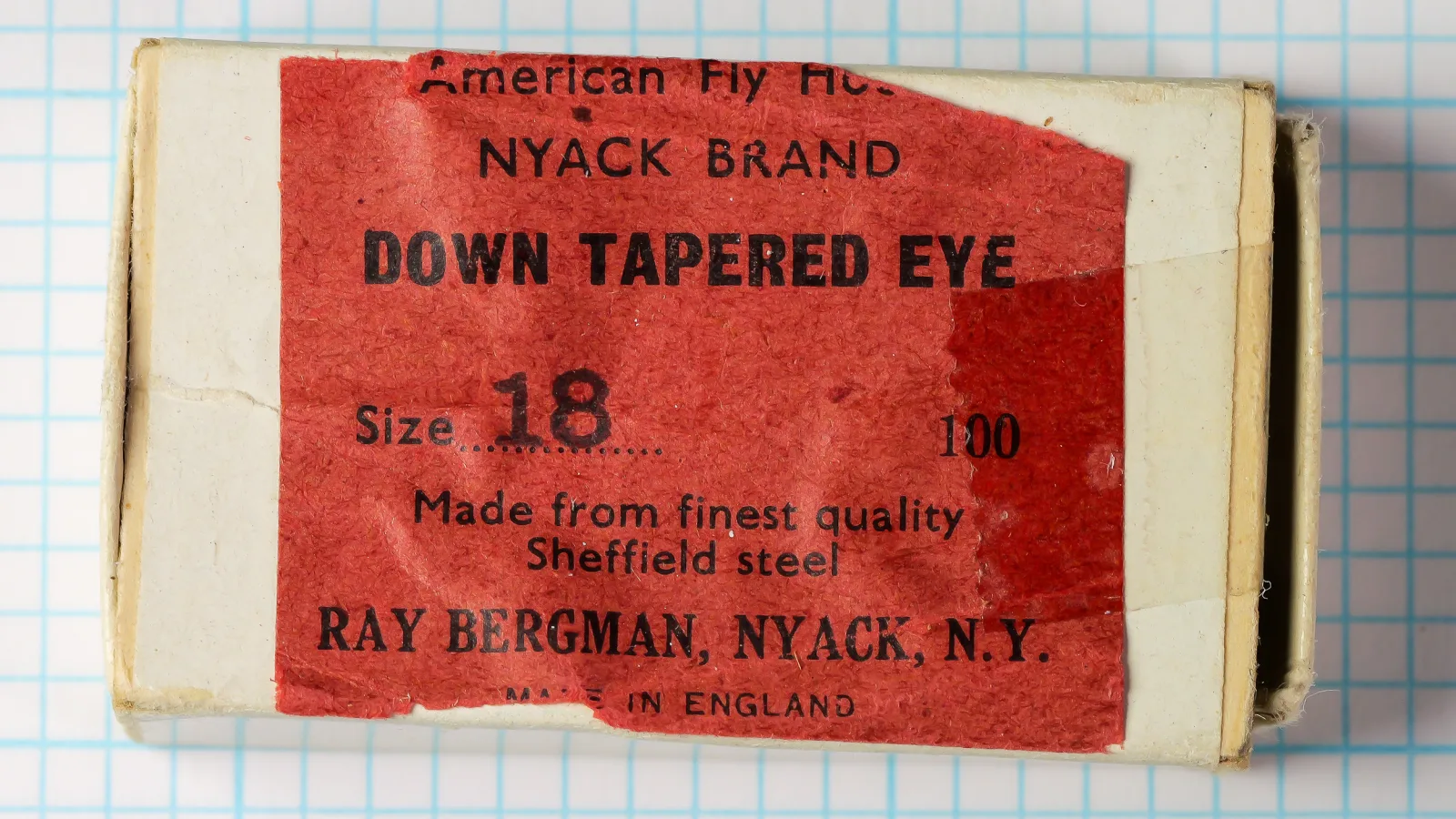
Original sales card for Bergman Nyack-brand Down Tapered Eye hooks, size 18, with red letterpress label identifying Ray Bergman's retail operation in Nyack, New York and Sheffield steel origin.
Photographic record
2 cataloged imagesSelect any record to load it above.
2 images shown
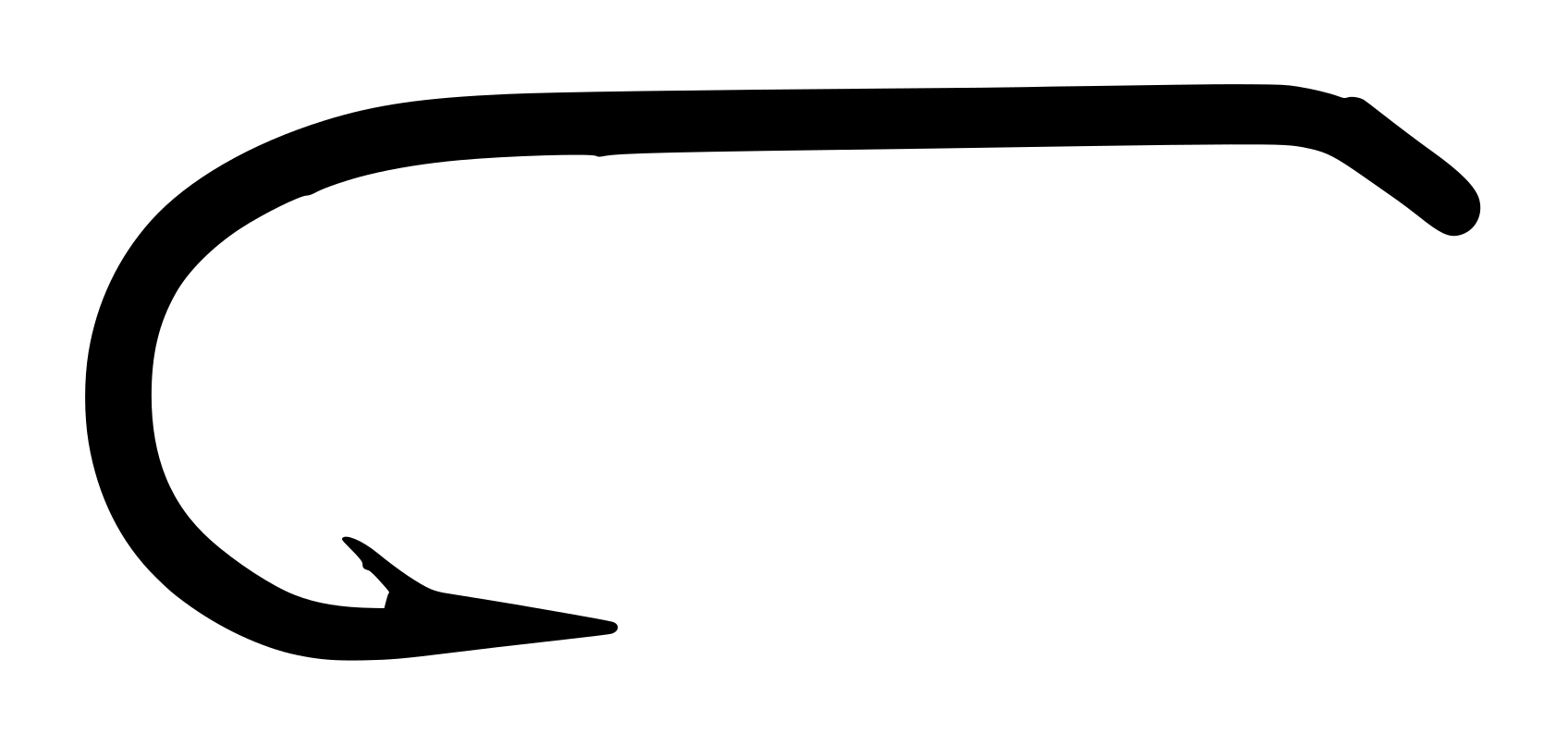
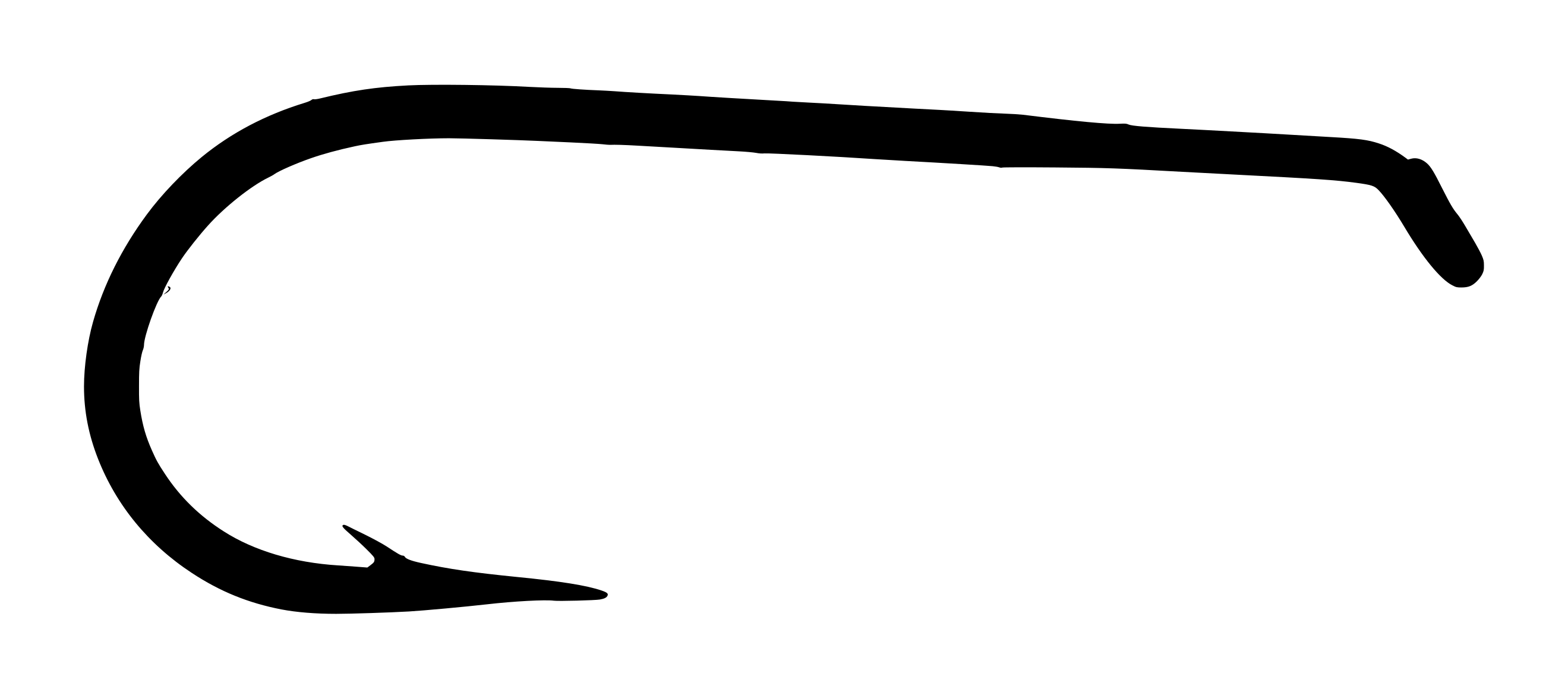
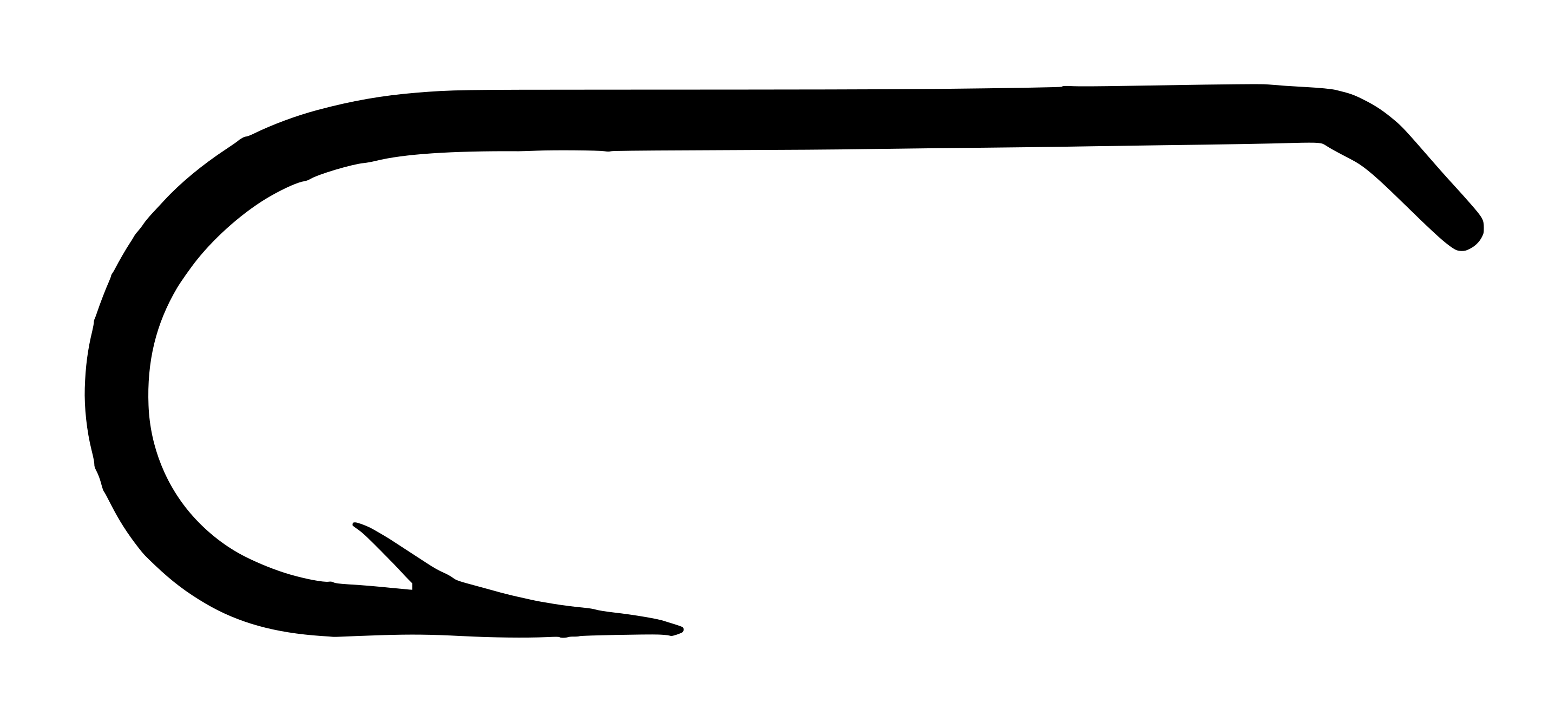
Bergman Nyack TDE Hook Card Size 18 BronzedOriginal sales card for Bergman Nyack-brand Down Tapered Eye hooks, size 18, with red letterpress label identifying Ray Bergman's retail operation in Nyack, New York and Sheffield steel origin.Open originalNyack TDE Size 18 Profile Tapered Eye Turned DownSide profile of a Nyack TDE hook at actual size 18, showing the tapered eye construction, turned-down orientation, and fine wire gauge characteristic of this Sheffield-made trout pattern.Open original
Technical profile
Turned down Tapered | Fine Wire | Other Point | Bronzed
Eye
Tapered Eye, Turned Down
Wire
Standard, Round
Shank
Standard — Plain
Bend
Round / Kendal, Standard gap
Point
Standard / Spear
Finish
Bronzed — Confirmed (stated on packaging)Hooks appear bright with no corrosion P. Card label intact but showing age-related toning and minor edge wear consistent with storage and retail handling over decades. No significant label loss or ink fading beyond expected patina.
The tapered eye on this hook is a hand-forged or machine-forged construction in which the eye opening is narrowed by progressive tapering toward the tip of the shank. Unlike a simple round-wire eye formed from the shank material, a tapered eye requires deliberate shaping — typically by tapering the wire diameter itself or by subtle bending to create a conical closure. The “turned down” orientation angles the eye downward slightly from the shank plane, facilitating a low line entry ideal for dry-fly presentations where the tippet should track along the hook shank without deflecting off-axis.
Fine-gauge wire on size 18 allows for rapid water absorption and minimal visibility in the film. The bronzed finish on Sheffield steel develops a warm patina with age and use, blending visually with natural water tones. The straight inner face and moderate barb depth are consistent with traditional English fly-hook geometry, designed to accommodate delicate 6X or 7X tippets without stress concentration at the knot transition.
This pattern was made in sizes 18 (V). We have measurement for size 18. Know the others? Submit calipered measurements and we'll review and add them. Thank you!
Ray Bergman (1896–1978) was a prominent American fly-fishing writer, tackle designer, and retailer based in Nyack, New York. Bergman imported quality hooks from Sheffield steelmakers and distributed them under his own brand through his retail operation. His business catered to serious fly tyers and trout anglers in the northeastern United States during the 1920s through 1940s. Bergman is best known as the editor of Outdoor Life magazine’s fly-fishing column and author of Trout, a seminal work on trout fly-fishing published in 1938. His tackle business, though modest in scale, represented the American fly-tyer’s preference for imported English hooks, particularly those from Sheffield manufacturers known for quality steel and refined eye constructions.
Series History
The Nyack TDE series represents Bergman’s curated selection of Sheffield-manufactured hooks marketed under his own brand. The “TDE” designation — Down Tapered Eye — is Bergman’s nomenclature for this particular eye construction and orientation. No evidence of a broader product series with other eye types under the Nyack brand is visible in surviving packaging. This appears to be a focused offering: a single hook pattern (tapered down eye, standard sproat-style bend) in a range of standard trout sizes (likely 10–18 or similar). Production ceased in the mid-20th century as domestic hook manufacturing (particularly by Mustad) became dominant in the American market.
Named Collaborator
Ray Bergman (1896–1978) was an influential American fly-fishing author, tackle retailer, and outdoor journalist. After establishing his fly-fishing retail business in Nyack, New York, in the 1920s, Bergman became one of the most widely read authorities on trout fly-fishing in North America. His monthly column in Outdoor Life magazine reached hundreds of thousands of readers; his 1938 book Trout remains a standard reference in fly-fishing literature. Bergman championed the use of quality imported hooks — primarily from Sheffield, England — and refused to compromise on materials or construction in his retail offerings. He was known for direct correspondence with fellow fly tyers and for his meticulous attention to hook geometry and eye construction. Bergman’s retail business operated primarily through personal recommendation and magazine publicity rather than large-scale wholesale distribution, making his branded hooks relatively scarce and prized by serious tyers.
Era and Packaging Dating
Packaging evidence: Red-paper label with letterpress-printed text in black — characteristic of inter-war British fly hook packaging. No barcode present (barcodes not adopted until 1970s). Typography and label stock consistent with 1920s-1940s period. Manufacturer attribution to Ray Bergman, Nyack, NY suggests American wholesaler/distributor sourcing Sheffield steel hooks for the North American market. Printed text quality and paper aging pattern support early-to-mid twentieth-century origin. No postal code format visible; mailing address "Nyack, N.Y." is pre-ZIP Code format (ZIP codes introduced 1963).
Bergman's Letters and Gift Hooks
Ray Bergman's fly-fishing column in Outdoor Life (1930s–1960s) received hundreds of letters monthly from readers seeking advice on fly selection and technique. Bergman answered many by hand and often enclosed a small packet of his Nyack-brand hooks as a gift — a practice that may explain why surviving examples are scattered in collections rather than concentrated in tackle shops. Collectors who discover a Bergman hook packet with an original letter or envelope from the author view it as a significant historical artifact worth preserving at the institutional level.
Design lineage and influence
Best matchRelated by Attribute
Computed automatically from catalog data — updated as new hooks are added.
A fine-wire trout hook designed for dry flies and small wet patterns. The tapered eye and light wire gauge indicate tyer preference for delicate presentations and precise knot work. Suitable for mayfly imitations and small soft-hackle patterns on UK chalk streams and similar cold-water fisheries.
Classic Fly Patterns
Named patterns specifically associated with this hook. Leave blank if none formally documented. Do not speculate — only include patterns with a confirmed association.
Collector notes
Rated 6.5/10. Nyack-branded hooks are uncommon in the contemporary collector market due to modest production volume and the passage of 80+ years. Original card condition and complete hook count are significant premiums. Collector demand is focused among fly-fishing historians and Bergman admirers, which is narrower than for mainstream Redditch or Mustad models.
Reference value
$12 – $22 USD estimate
Packaging condition
Good — moderate wear, legibleRecorded specimen
Packaging format
GW-B-01Catalog code
Positive factors: American connection through Ray Bergman — an iconic figure in fly-fishing literature. Original packaging with period-correct red label and maker identification is scarce. Size 18 is noticeably smaller than typical vintage hook finds (most survivors are size 8–14), adding specificity to collector interest. Bronzed Sheffield steel carries premium appreciation among purists. Clean condition with no corrosion or significant damage increases appeal. Documentation of the hook’s history through packaging text (Ray Bergman, Nyack, N.Y., Sheffield steel) supports collector research and provenance narrative.
Limiting factors: Nyack brand has a regional following concentrated in the northeastern United States. No broader market recognition among international hook collectors. Small production run (Bergman’s retail operation was modest) means supply is limited and visibility in online markets is low. Pricing data from eBay and dealer sales is sparse. Modern fly tyers have moved to contemporary hooks; functional demand is minimal. Most survivors are in moderate condition with label wear; mint examples are exceptionally scarce.
Value drivers: Intact original card in good condition adds 40–60% premium over loose hooks. Complete hook count (all 100 hooks present) is uncommon; missing hooks reduce value by 30–50%. Size 18 is more desirable than common sizes like 12 or 14 due to lower expected survival rate. Label visibility and text clarity are critical — faded or damaged labels reduce appeal to both collectors and dealers.
Packaging
Sales card with red paper label glued to natural kraft cardstock backing. Label printed in black letterpress with bold sans-serif type. Card dimensions approximately 5.0" × 3.5" (127 × 89 mm). Label text: "American Fly Hooks, NYACK BRAND, DOWN TAPERED EYE, Size 18, 100, Made from finest quality Sheffield steel, RAY BERGMAN, NYACK, N.Y., MADE IN ENGLAND". Two punch holes visible in card spine for hanging on retail fixture. Card stock shows age-related yellowing and label shows light creasing and minor paper loss at edges. Hooks mounted in original card with wax paper dividers between rows.
Market Value Notes
Low ($12): Good condition — opened card, hooks present but count incomplete (75–95%), minor label wear, hooks bright.<br />
High ($22): Excellent condition — card intact and cleanable, near-complete or full count (95+), minimal label wear, hooks perfect.<br />
Premium factors: Ray Bergman brand recognition, original packaging with clear label text, small size (18), complete hook count, seal/closure evidence.<br />
Platforms: eBay (US and UK), specialist tackle dealers, fly-fishing memorabilia sites, regional antique shops.<br />
Confidence: E estimated from limited comparable sales data and Bergman hook rarity profile. No specific eBay sold listings found in recent search; valuation based on comparable vintage hook size 18 cards and Bergman brand premium in specialist markets.
Where to Find
Occasionally appears on eBay under vintage fly-fishing tackle or "Ray Bergman" searches. Specialty dealers in fly-fishing memorabilia (Northeast US region) may stock examples. Tackle shows and antique fishing expos in New York and New England are more likely sources than mass-market platforms. Bergman enthusiasts and fly-fishing historians monitor online auctions actively, so examples tend to sell quickly when priced fairly.
Preservation
Storage and Preservation
<p>Store the card in a cool, dry environment away from direct sunlight and humidity. The bronzed finish is stable but benefits from low-moisture conditions; avoid damp basements or unheated outbuildings. The original label is the primary value carrier — protect it from moisture, handling, and light exposure to prevent further fading or loss of print contrast. Store flat in archival kraft sleeves or acid-free boxes; avoid plastic sleeves which can trap moisture. The red label stock is susceptible to color fading with UV exposure; store in a light-controlled cabinet or shelf away from windows. If the card is displayed, use museum-quality glass or acrylic shields to reduce dust settlement. Do not attempt to clean the label without professional conservation advice. Hooks may be left on the card or carefully removed and stored in separate archival containers if needed for reference use. Inspect periodically for insect activity or mold — signs of storage environment stress — and relocate if necessary.</p>
Marking Analysis
Handwriting and Marks
The packaging shows no visible handwritten marks, personal annotations, or price markings. All text is printed letterpress in black ink on the red label. No pencil notations, initials, or coded marks are visible on the card stock or label. This absence of provenance marks is typical of retail stock that passed through commercial channels without becoming part of a personal collection prior to storage or sale. The card represents a clean retail object, unaltered since its original packaging and sale.
Primary Source
Label Text and Material Claims
Source: Original label text on Bergman Nyack TDE hook card, c. 1920s–1940s
The label states: “Made from finest quality Sheffield steel” — a claim that reflects the prestige attached to Sheffield steel in the 1920s–1940s era. Sheffield was the world center of hook manufacture, and English steeelmakers commanded premium pricing and brand loyalty. The phrase “finest quality” is a marketing device common to inter-war fly-hook packaging, used to justify price premiums over mass-produced alternatives. Ray Bergman’s reputation as a writer and tastemaker no doubt supported the credibility of this claim in the market.
The label also specifies “American Fly Hooks” as the primary brand and “NYACK BRAND” as the sub-brand, identifying Bergman’s retail operation as the distributor and curator, not the manufacturer. This dual branding structure was common for American retailers who imported English-made hooks and resold them under their own brand identity. The reference to “MADE IN ENGLAND” at the bottom of the label confirms Sheffield origin and complied with U.S. tariff law requiring country-of-origin markings on imported goods.
Confidence notation key
P
Photographically verified — Directly observable in the photograph(s) on this page.
V
Verified by documentation — Confirmed by manufacturer catalog, spec sheet, or published reference.
I
Inferred — A logical deduction from observable or documented evidence, not directly stated.
E
Estimated — An approximation based on visual comparison, proportional analysis, or limited data.
S
Speculative — A reasoned hypothesis that cannot be confirmed from available evidence.
Claims with no notation are confirmed by multiple independent sources. All photographs on garrenwood.com are taken on a measurement grid where each square equals 1/10 inch (0.1″ / 2.54 mm).