Selected size
1/0
Catalog record
- Overall Length
- 36.7 mm V
- Shank Length
- 27 mm V
- Bend Depth
- 11.4 mm V
- Wire Diameter
- 0.9 mm V
- Confidence
- V Catalog record only
 Garren WoodFishing Hook Reference

Save this hook to your account to build a list you can come back to.
The Horrocks-Ibbotson Co. Grade 552 is a German-manufactured general-purpose bait hook distributed through the Utica, New York sporting goods importer during the inter-war period. The No. 1 size features a classic sproat bend, hollow point, and straight-ring eye design optimized for larger baits in both freshwater and saltwater applications.
The hook displays the hollow point geometry characteristic of German industrial hook production of this era — a concave inner face forming a cutting knife-edge that contrasts sharply with British superior-point aesthetics. The straight-ring eye allows rapid leader attachments and accommodates heavier tackle, reflecting practical American fishing preferences of the 1920s-1940s.
The specimen’s weathered cardstock label with bold burgundy letterpress printing, die-cut fish illustration, and ‘Made in Germany’ attribution provides strong era evidence. The absence of a barcode, letterpress method, and paper stock all confirm pre-WWII production. The UTICAN trademark indicates Horrocks-Ibbotson Co., a major East Coast distributor whose brand appears on German and other foreign manufactures.
This hook represents a transitional moment in American tackle supply — a period when German industrial hook production dominated the budget market, before tariffs and WWII disrupted those supply chains. The Grade 552 survives in modest collector interest, primarily valued for its label design and German-American trade history rather than rarity.
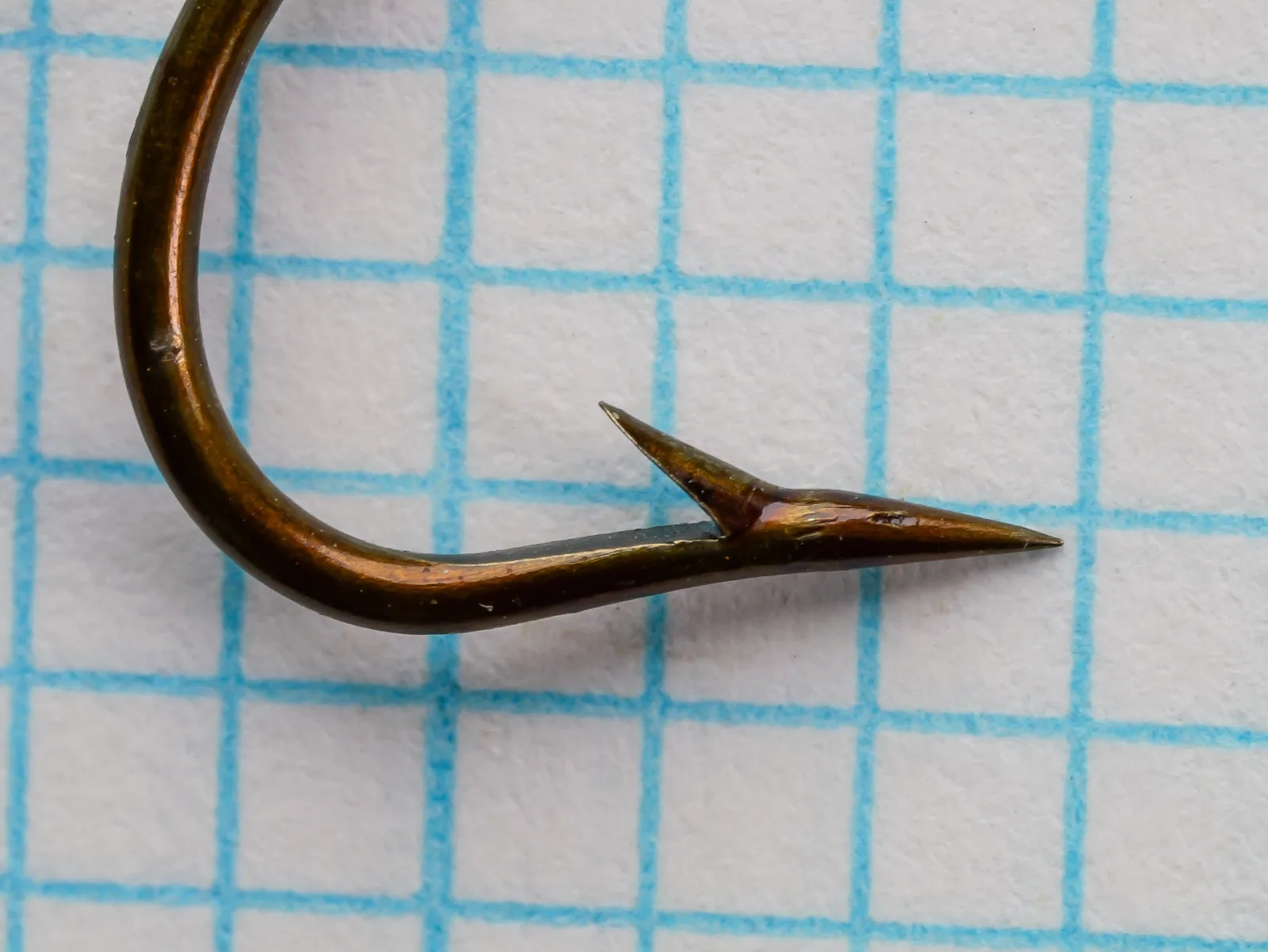
3 cataloged imagesSelect any record to load it above.
3 images shown
The hollow point geometry represents a deliberate manufacturing choice reflecting German hook-making traditions that prioritized cutting efficiency and penetration. The concave inner face creates a two-sided cutting edge — the inner taper and the barb — that initiates penetration aggressively in fish mouths. This contrasts with the superior-point geometry favored by British manufacturers, which prioritizes holding power and strength over cutting action.
The sproat bend’s wide gap (0.4 inch / 10 mm) and generous depth accommodate large baitfish and provide positive barb clearance even when baits are tightly wrapped around the hook body. The straight-ring eye allows direct leader attachment without bending or weakening the wire, a practical advantage for saltwater use where corrosion and abrasion demand rapid gear changes.
German precision forging produced consistently uniform wire gauges and bend profiles, accounting for the model’s reputation for reliability. The standard wire gauge (approximately 0.05 inch / 1.27 mm diameter) balances penetration with sufficient strength for struggle with larger fish and saltwater species.
Physical measurement with calipers
We have measurement for size 1/0. Know any others? Submit calipered measurements and we'll review and add them. Thank you!
The Horrocks-Ibbotson Co. was a major American sporting goods importer and distributor headquartered in Utica, New York. While primarily a distributor and marketer of firearms, reels, and tackle rather than a hook manufacturer, Horrocks-Ibbotson maintained relationships with European hook makers — particularly German manufacturers — during the inter-war period. The company sourced hooks under private-label agreements and resold them under house brands like UTICAN, leveraging their established retail network and reputation to move volume.
The UTICAN trademark (appearing as a diamond-shaped registered mark on the Grade 552 label) was Horrocks-Ibbotson’s house brand for fishing tackle. The company’s strategy of sourcing German-made hooks at competitive prices and distributing them through sporting goods retailers reflected broader American manufacturing trends of the 1920s-1940s, when German metalworking and precision manufacturing dominated the budget hook market.
After WWII, Horrocks-Ibbotson continued operations but gradually shifted to Mustad and domestic sources as German imports became unavailable. The company’s role as a distributor of German tackle makes it historically significant in documenting pre-war supply chains and the American tackle market’s dependence on European imports.
The Grade 552 represents a single model in Horrocks-Ibbotson’s UTICAN-branded hook line, part of their budget-oriented bait hook offerings. ‘Grade 552’ appears to be an internal classification or model designation rather than a broader product family. The ‘Carlisle’ nomenclature on the label suggests a sproat-bend form — Carlisle being a generic term used by multiple manufacturers for the sproat bend profile, particularly in the saltwater and larger-bait market.
No evidence of variant finishes or widespread size distribution has been documented, though the label’s prominent ‘100 RINGED’ designation suggests this came in standard 100-hook packages. The model likely occupied a middle tier in Horrocks-Ibbotson’s range — above basic economy hooks but below premium imports or domestic Mustad equivalents.
Production likely ceased in the early-to-mid 1940s as German imports became restricted and then unavailable due to WWII. Post-war, Horrocks-Ibbotson appears to have repositioned its tackle line toward domestic sources.
No barcode present (strong pre-1974 indicator). Letterpress printing method and paper stock consistent with 1920s-1940s manufacturing. 'Made in Germany' attribution typical of pre-WWII American tackle imports. UTICAN trademark and Utica, NY address confirm Horrocks-Ibbotson Co. distribution. Box construction and label design (die-cut fish, color palette, typography) align with 1920s-1940s American tackle packaging. Burgundy ink and cream stock typical of this era. No postal ZIP code visible — address uses city and state only, typical of pre-1963 packaging.
During the 1920s and 1930s, German hook manufacturers exported more hooks to the United States than any other country, despite intense marketing by American and Norwegian competitors. The quality-to-price ratio was unbeatable, allowing American distributors like Horrocks-Ibbotson to market budget brands that outsold premium domestic alternatives on retail shelves. When WWII erupted and German exports ceased, American distributors scrambled to source hooks from remaining suppliers — primarily Mustad (Norway) and a handful of domestic makers. The Grade 552, frozen in its original packaging, documents the moment before that market shift permanently altered the landscape.
The sproat bend has roots in 19th-century British freshwater fishing tradition, but was adopted and industrialized by German manufacturers for saltwater and large-bait applications. German precision forging techniques applied to the sproat profile created a consistency and uniformity that British hand-forgers initially could not match at scale.
The hollow-point geometry reflects distinctly German aesthetic and functional priorities — the concave inner face prioritizes cutting action over holding power, appealing to Continental fishing traditions that favored penetration over strength. This contrasts sharply with the superior-point geometry favored by British Redditch makers, which emphasizes a nearly flat inner face and greater holding reliability.
The straight-ring eye is a practical American and saltwater innovation, allowing rapid leader attachment without requiring the angler to form and thread a loop. While less elegant than a tapered or ball eye, the straight-ring’s functional advantage made it popular in working tackle and bait-fishing applications.
Post-war successors include the Mustad 3366 (sproat, similar gap and profile) and modern circle-hook designs that borrowed the sproat’s wide gap while introducing a completely different point geometry. The Grade 552’s specific combination — sproat bend, hollow point, straight ring, standard wire — largely disappeared after 1950 as bait-fishing tackle evolved toward circle hooks and specialized saltwater profiles.
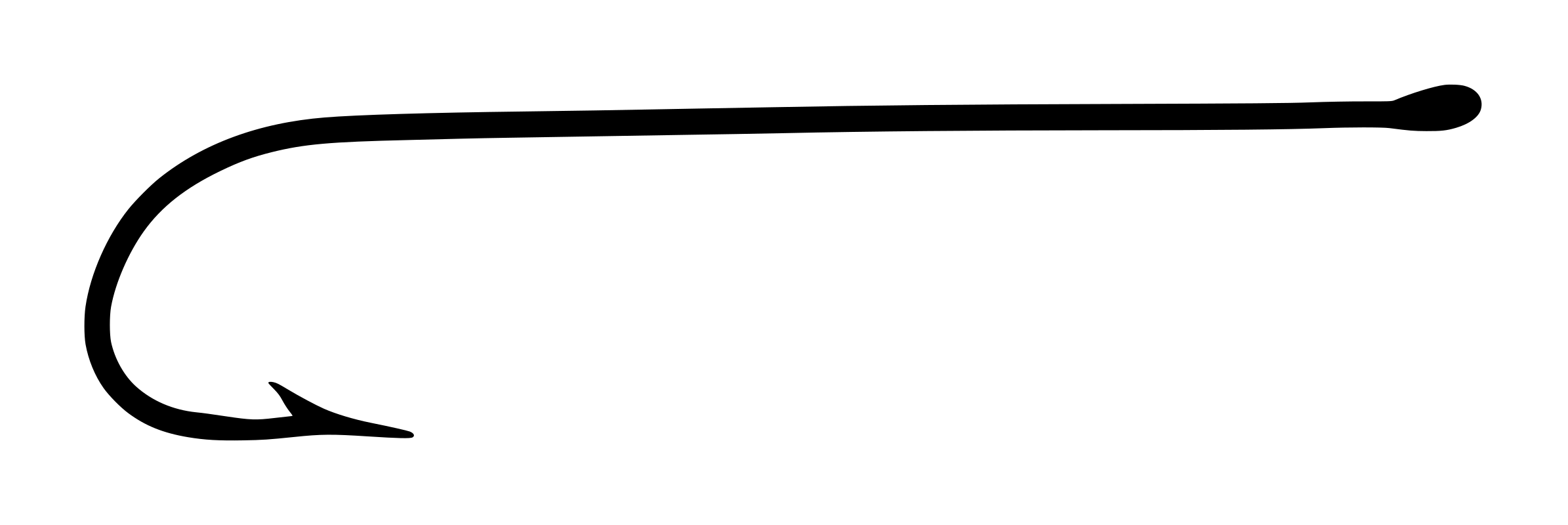
| Silhouette | Hook Model | Match | Analysis | Compare |
|---|---|---|---|---|
|
3321-Br No. 1/0 — Carlisle | 86% | Compare | |

|
3191 No. 5/0, 6/0 — Mustad-Carlisle Hooks | 84% | Compare | |

|
8921 No. 4/0 (V) — Bulldog Carlisle | 79% | Compare | |
|
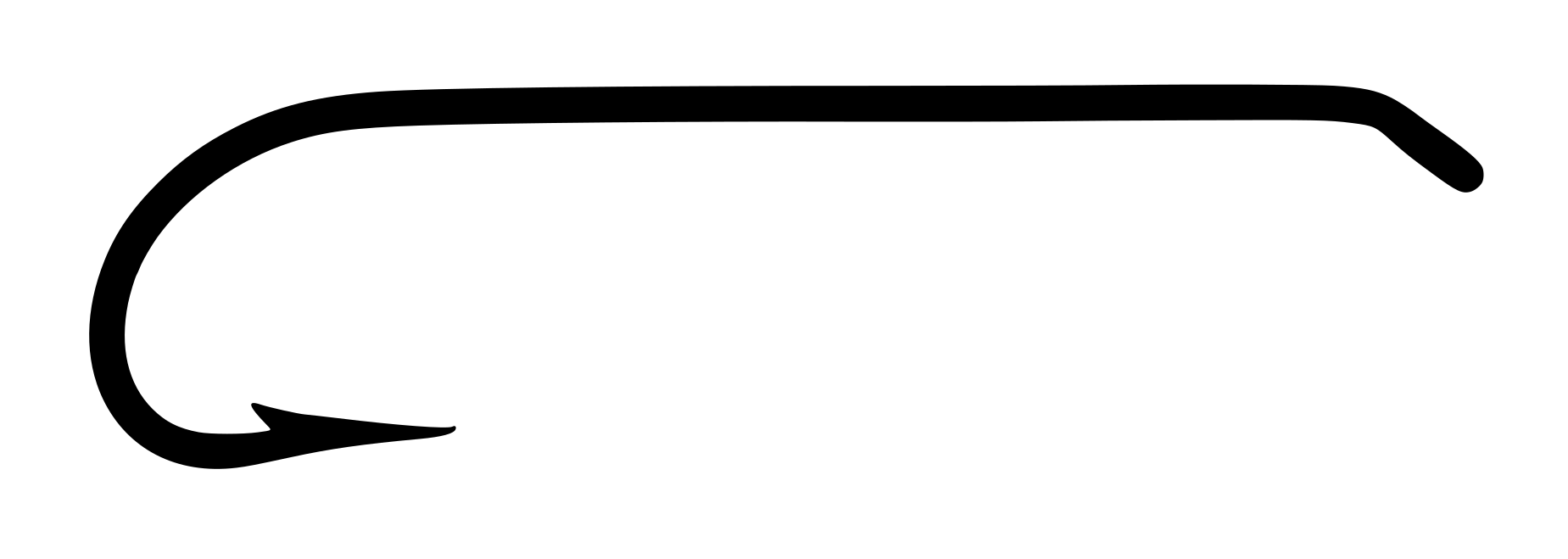
3498 No. true — Pacific Bass Hooks | 78% | Compare | |
|
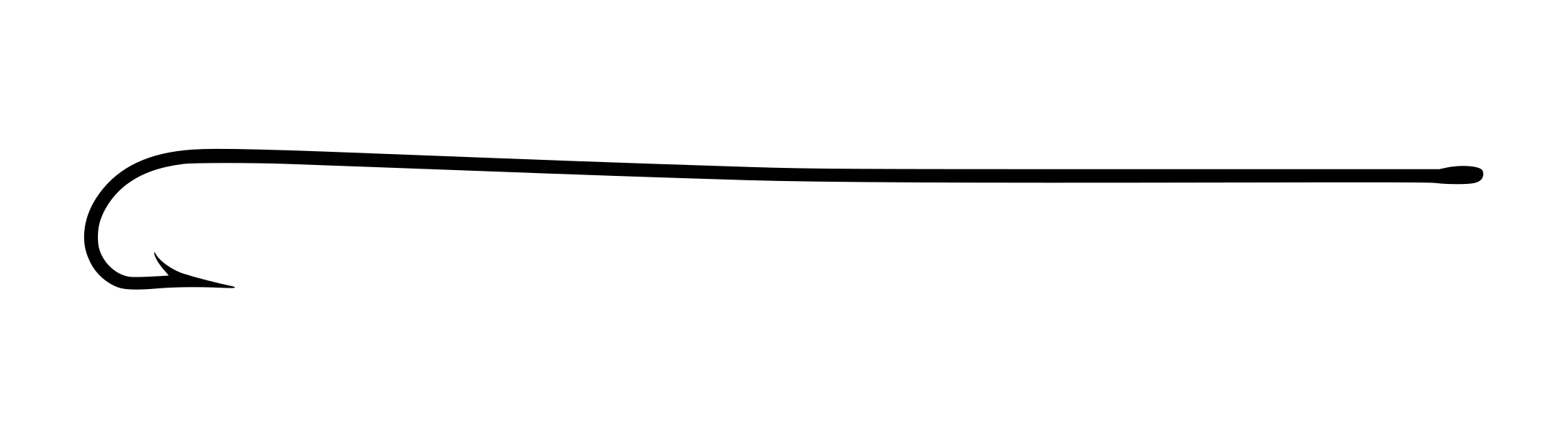
3576E No. 4 — Mustad 3576E | 78% | Compare |
| Silhouette | Hook Model | Match | Compare |
|---|---|---|---|

|
3300 No. 7 — Chestertown Hook | 100% | Compare |

|
3301 R No. 5 — Mustad-Chestertown Hooks 3301 R | 100% | Compare |
|
993 R 6X Long No. 4 — Celebrated No. 993 | 99% | Compare |
|
37120 No. 6 — Carlisle Hooks | 99% | Compare |

|
31867 No. 6/0 — Carlisle Hook | 99% | Compare |
The Grade 552 Carlisle is a general-purpose bait hook, optimized for both freshwater and saltwater fishing. The hollow point geometry provides reliable penetration into fish mouths, while the sproat bend’s deep curve and wide gap accommodate larger baits and target fish with strong jaw structure. The straight-ring eye accommodates larger leader materials and allows for rapid hook changes — a significant practical advantage in saltwater and boat fishing contexts where speed matters.
Suitable for larger saltwater baits, eels, small mullet, and other baitfish; regional use in Great Lakes and Atlantic coast commercial and recreational fisheries.
| Hook | Match Quality | Notes |
|---|---|---|
| Mustad 3366 Sproat | Good | Modern sproat-bend bait hook with similar gap and depth; slightly heavier wire gauge; available in identical sizes; nikel or bronzed finishes. |
| Owner Mutu Circle Hook | Moderate | Modern circle-hook alternative for large baits; different point geometry (circle vs hollow) but similar functional target (saltwater bait fishing). |
Rated 4.0/10 — uncommon but not scarce; moderate collector interest driven by label design and German-American trade history. The Grade 552 survives in modest quantities, primarily as complete original packages with intact labels. Scarcity is driven by packaging fragility and age toning rather than production rarity. Collector demand is primarily from label and trade-history specialists rather than functional hook tyers.
What makes this hook collectible: The Grade 552 appeals to several collector constituencies: (1) Horrocks-Ibbotson company historians and trade-mark collectors seeking UTICAN-branded examples; (2) label-design enthusiasts attracted to the die-cut fish illustration and burgundy letterpress printing; (3) German-American trade-history researchers documenting inter-war hook imports; (4) general vintage tackle collectors seeking unusual house-brand offerings from regional distributors.
Limiting factors: The Grade 552 was a budget product in its era, manufactured in volume as part of a commodity supply chain rather than as a specialty or prestige item. German industrial production was consistent and reliable, meaning surviving examples are not exceptionally rare. The model lacks attribution to a famous designer or exclusive origin story. No direct connection to a named fly pattern or legendary angler enhances its appeal. Post-WWII, the model was discontinued and superseded by Mustad and American domestic alternatives, so no nostalgic user base maintains demand.
Most desirable variants: Complete original packages with intact labels command the highest premium. Sealed or near-sealed boxes are exceptionally scarce. The No. 1 size is the most commonly encountered, making other sizes (if they exist) potentially more collectible. Packages with pristine label printing and minimal age toning are strongly preferred; heavily aged or faded labels reduce value substantially.
Condition factors affecting value: Label integrity is paramount — a clean, bright label with sharp printing and minimal toning can double the value of an opened package. Missing hooks reduce value by 5-10% per missing hook. Water staining, foxing, or mold spots on the label significantly diminish appeal. Loose or detached rings on the eyes are acceptable but slightly reduce value. Original tissue wrapping, if present and intact, adds 15-20% premium. A sealed package commands a 40-50% premium over an opened equivalent.
Cardstock box with blue wraparound label. Label features die-cut fish illustration (perch or sunfish in green and yellow), burgundy and black letterpress printing on cream background. Text: 'BEST RAZOR STEEL / CARLISLE FISH HOOKS / 100 RINGED / EACH HOOK WARRANTED / RUSTPROOF NO 1 / GRADE 552 / HORROCKS-IBBOTSON CO UTICA,N.Y. / MADE IN GERMANY.' Diamond-shaped 'UTICAN' trademark with 'REGS U.S. PAT OFF.' Horizontal line pattern behind fish. Substantial edge wear and age toning to label; corners creased and worn. No visible barcode (pre-1974 indicator). Original tissue wrapping may be present but not fully visible in images.
Low ($8): Good condition — opened package, all or most hooks present, label shows moderate to heavy age toning, edges creased, but fundamentally intact and readable.<br />
High ($22): Excellent condition — package sealed or near-sealed, complete hook count (100), label bright with minimal toning, original tissue present and intact, no creases or tears.<br />
Premium factors: Label brightness and legibility; intact original tissue or sealed packaging; complete hook count; sharp UTICAN trademark definition; die-cut fish illustration clarity; absence of mold or foxing.<br />
Platforms: eBay (US and international), vintage tackle dealers, eBay UK specialists in Horrocks-Ibbotson items, regional tackle auctions.<br />
Confidence: E estimated — limited comparable sales data; range based on similar inter-war German-import bait hook packages with house brands and strong label designs.
eBay (search 'Horrocks-Ibbotson Grade 552' or 'UTICAN hooks'); tackle dealers specializing in vintage American imports and German hooks; regional vintage fishing tackle auctions in the Northeast; British and European eBay (where German-made vintage tackle has strong appeal). Regional tackle fairs in New York and the Great Lakes are occasional sources.
Store the original package in a cool, dry environment away from direct light and humidity. The bronzed finish is stable and protective, but sustained high humidity can accelerate patina development. The cardstock label is the primary conservation concern — avoid flexing or bending the package, which can cause creasing and accelerate paper degradation.
If the package is opened, keep hooks on the original card rather than loose. The card provides mechanical support and documents the original quantity and packaging design. Store the card flat in a protective sleeve or acid-free storage box. Avoid contact with PVC-based plastics, which can cause chemical damage to the bronze finish and label printing over time.
Monitor annually for signs of mold, foxing (brown spots), or water damage to the label. If mold appears, gently wipe the exterior with a dry, soft cloth — do NOT use liquids or harsh cleaning agents. If the package becomes damp, air-dry it slowly at room temperature; avoid direct heat sources that can warp the cardstock.
Original tissue wrapping, if present, should remain undisturbed. Its preservation adds historical and monetary value. The UTICAN trademark and die-cut fish illustration are the visual focal points — minimize handling to preserve label ink definition and color saturation.
Source: Label text from Grade 552 Carlisle Fish Hooks package, Horrocks-Ibbotson Co., Utica, NY, c. 1920-1945.
‘Best Razor Steel’: A marketing claim emphasizing the sharpness of the hollow-point geometry. ‘Razor steel’ was common advertising language in 1920s-1940s hook packaging, denoting steel quality suitable for sharpening to a fine edge. The term does not indicate a specific steel alloy or proprietary process, but rather reflects German manufacturing reputation for precision metalwork.
‘Carlisle Fish Hooks’: ‘Carlisle’ was a generic term for the sproat-bend profile, used by multiple manufacturers (not a proprietary design). The name likely derives from historical Carlisle tackle makers or the English fishing tradition, but was adopted broadly in American and European hook nomenclature to describe the bend form.
‘100 RINGED’: Indicates the package contained 100 hooks in the size specified. ‘Ringed’ refers to the straight-ring eye, distinguishing this product from other eye styles (ball, tapered, looped). The prominently displayed quantity (‘100 RINGED / EACH HOOK WARRANTED’) emphasizes value for money — 100 functional hooks at a budget price.
‘RUSTPROOF’: A claim that the bronzed finish resists corrosion. In the 1920s-1940s, ‘rustproof’ was a significant marketing advantage, as corrosion-resistant finishes were less common than they are today. The bronzed finish was indeed more resistant to freshwater corrosion than bare steel, though not impervious to saltwater environments.
‘Made in Germany’: A legal requirement under US tariff law for all imported goods. This attribution confirms German manufacture and provides strong era evidence — pre-WWII German hooks were heavily imported into the US market; post-WWII, German imports became restricted.
UTICAN Trademark: The diamond-shaped ‘UTICAN’ mark with ‘REGS U.S. PAT OFF’ (Registered U.S. Patent Office) was Horrocks-Ibbotson’s house brand. The formal trademark registration indicates substantial investment in brand identity and distribution network, placing Horrocks-Ibbotson among major tackle distributors of the era.
The Grade 552 exemplifies a critical but under-documented chapter in American fishing tackle history: the dependence of the American budget tackle market on German precision manufacturing during the inter-war period. From roughly 1900 to 1940, German hook makers — particularly in Solingen and other industrial centers — supplied enormous volumes of hooks to American distributors like Horrocks-Ibbotson, undercut domestic producers through superior manufacturing efficiency and lower labor costs.
This trade relationship had profound competitive implications. American manufacturers like Mustad, while heavily advertising their quality, initially struggled to compete on price. German hooks were reliable, consistent, and cheap — perfect for budget brands distributed through regional sporting goods networks. House brands like UTICAN allowed American distributors to claim market presence without manufacturing expertise, positioning themselves as curators and selectors of quality rather than producers.
The onset of WWII catastrophically disrupted these supply chains. German exports ceased, tariffs rose, and American domestic manufacturers suddenly faced much reduced competition. Post-war, the German hook industry slowly recovered, but American suppliers — particularly Mustad’s expanding Norwegian operations and domestic producers — had entrenched themselves in the market. Surviving German-branded packages like the Grade 552 document a supply era that lasted barely four decades but shaped the American tackle market for generations to come.
| P | Photographically verified — Directly observable in the photograph(s) on this page. |
| V | Verified by documentation — Confirmed by manufacturer catalog, spec sheet, or published reference. |
| I | Inferred — A logical deduction from observable or documented evidence, not directly stated. |
| E | Estimated — An approximation based on visual comparison, proportional analysis, or limited data. |
| S | Speculative — A reasoned hypothesis that cannot be confirmed from available evidence. |
Claims with no notation are confirmed by multiple independent sources. All photographs on garrenwood.com are taken on a measurement grid where each square equals 1/10 inch (0.1″ / 2.54 mm).
Your cart is empty.