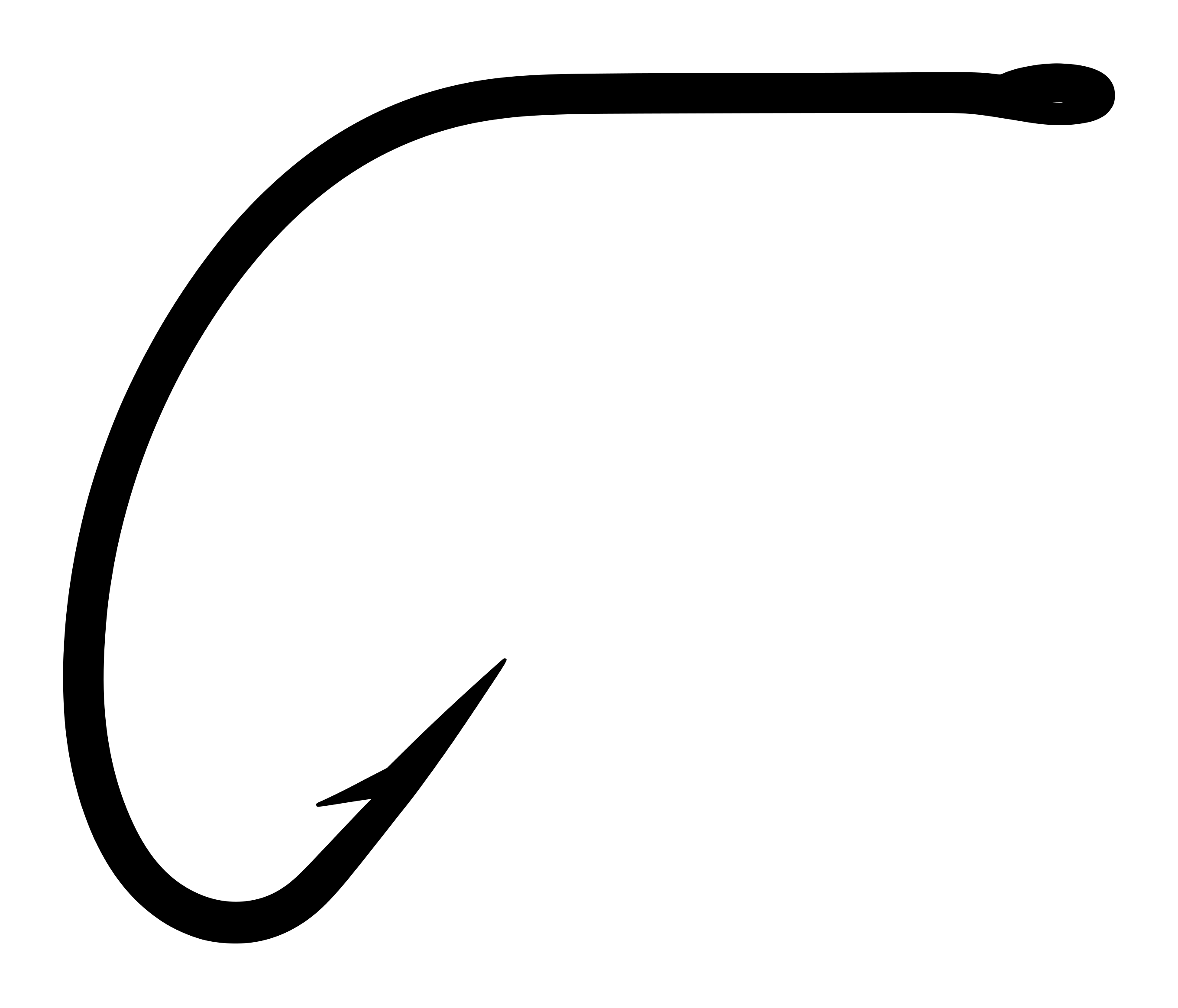
The Mustad Quality 3450 represents one of the classic Norwegian manufacturer’s traditional bait hook patterns from the early 20th century V. This Kinsey-pattern hook features the characteristic blind eye construction with marked shank, requiring traditional snelling techniques that were standard practice before wire-eyed hooks became predominant P.
The ‘CHRISTIANIA – NORWAY’ marking definitively dates this specimen to 1924 or earlier, placing it in the era when Mustad was aggressively expanding into international markets using their revolutionary automated manufacturing processes V. The japanned finish and superior point geometry reflect the quality engineering that made Mustad the dominant global hook producer by the 1950s I.
For collectors, these Christiania-era boxes represent significant historical artifacts documenting the transition period when traditional European craftsmanship was being mechanized for mass production S. The eight-line labeling format and Key Brand logo are hallmarks of this pivotal era in angling history V.
Original Mustad box with yellow label showing 'CHRISTIANIA - NORWAY' marking, dating to 1924 or earlier, on measurement grid.
Photographic record
3 cataloged imagesSelect any record to load it above.
3 images shown
Mustad 3450 Kinsey Hook Size 12 Box LabelOriginal Mustad box with yellow label showing 'CHRISTIANIA - NORWAY' marking, dating to 1924 or earlier, on measurement grid.Open originalMustad 3450 Hook Point Detail Size 12Close-up of the Superior point geometry showing the near-straight inner taper characteristic of this point style, with japanned black finish.Open originalMustad 3450 Kinsey Hooks Size 12 Complete ViewTwo complete Mustad 3450 hooks displaying the Kinsey bend geometry and marked shank construction for snelling, on measurement grid.Open original
Technical profile
Eye
Blind — Marked ShankMarked shank with serrated ridges for secure snelling P. No formed wire eye - the shank end is flattened and marked with ridges to prevent the snelled line from slipping V.
Wire
Extra-Fine, Round
Shank
Short (1X–2X Short) — Marked / Ridged
Bend
Wide gapClassic Kinsey bend with characteristic side offset (kirbed left) and angular throat section P. The bend shows the traditional sharp transition typical of early 20th century bait hooks I.
Point
Superior (near-straight inner taper)Standard barb cut with moderate length and angle, positioned close to the point P
Finish
Black Japanned — Confirmed (stated on packaging)Traditional black japanned finish typical of early 1900s hooks P. The coating appears uniform and well-preserved on the specimens shown P.
Label shows minor toning and edge wear consistent with age. Yellow color remains vibrant. Box shows handling wear but structural integrity good P.
The Superior point designation indicates a near-straight inner taper geometry that concentrates penetration force at the tip while maintaining structural strength V. This design provided optimal balance between the delicate penetration of hollow points and the durability of spear points, making it suitable for varied bait fishing conditions I.
The marked shank features precision-cut ridges that prevent snelled lines from slipping under tension, a critical engineering detail for an era when gut and silk were the primary line materials V. The japanned finish provided superior corrosion resistance compared to untreated steel, essential for the international export market Mustad was aggressively pursuing I.
Represents one of the earlier documented examples of Mustad's Christiania-era packaging in the garrenwood.com catalog, providing important reference for dating similar specimens.
Own this hook? Help us measure it.
We don't have measured sizes for this hook yet. Own one? Submit calipered measurements and we'll review and add them. Thank you!
Historical context
mustad
O. Mustad & Son was founded in 1832 in Gjøvik, Norway, initially as ‘Brusveen Spiger- og Staltradfabrikk’ specializing in nails and steel wire production V. The company was transformed under Ole Hovelsen Mustad and his son Hans, who rebranded it as O. Mustad & Son V.
The defining moment came in 1877 when Mathias Topp invented the first fully automated hook-making machine, allowing continuous production from raw steel wire V. Rather than patent this revolutionary technology, the Mustad family maintained strict corporate secrecy, giving them a devastating competitive advantage over traditional hook-making centers in Redditch, England, and other global manufacturers V. By the 1950s, this strategy had secured Mustad fifty percent of the global hook production market V.
Series History
The Quality 3450 Kinsey Hook was part of Mustad’s mid-tier product line, indicated by the 3000-series numbering system used for quality-grade hooks manufactured to exacting dimensional and tempering standards V. The Kinsey pattern itself represents one of the traditional English bait hook geometries that Mustad reverse-engineered for mass production, competing directly with Redditch manufacturers on their home turf I.
This model featured Mustad’s proprietary ‘Superior’ point geometry combined with traditional marked-shank construction, bridging old-world craftsmanship with modern manufacturing efficiency V. The pattern was likely produced continuously from the early 1900s through the mid-20th century, with packaging and finishing variations marking different production eras S.
Era and Packaging Dating
Label shows 'CHRISTIANIA - NORWAY' which was the city name before it was officially changed to Oslo in January 1925. The yellow label with decorative border, Key Brand logo, and 'Superior' designation are characteristic of early 20th century Mustad packaging. Eight-line format consistent with pre-WWI era.
The Superior Confusion
The word 'Superior' on this label caused decades of confusion among collectors and anglers who interpreted it as a quality designation. In reality, 'Superior' was simply Mustad's brand name for this product line, not a description of the hook's superiority. The actual point style - what we now call a superior point - refers to the specific geometric profile of the point's inner face, which Mustad engineers designed for optimal penetration characteristics.
Design lineage and influence
The Kinsey bend traces its origins to traditional English bait hooks developed in the Redditch workshops of the 19th century I. Mustad’s version represents industrial standardization of these regional patterns, using Norwegian precision manufacturing to compete with English craftsmen V.
The blind-eye construction reflects pre-1920s angling practice when wire loops were considered points of weakness. Mustad’s marked shank represented a refinement of this traditional approach, with machine-cut ridges replacing hand-filed serrations I. This model influenced later Mustad bait hook designs and contributed to the eventual global standardization of hook geometry S.
Best matchRelated by Attribute
Computed automatically from catalog data — updated as new hooks are added.
The Mustad 3450 Kinsey Hook was designed for traditional bait fishing, particularly with live or natural baits P. The blind eye construction required snelling with silk gut or fine wire, making it ideal for presentations where a wire loop might spook fish V. Size 12 was commonly used for trout, perch, and small panfish with worms, grasshoppers, or small minnows I.
Secondary Applications
Classic fly tying by enthusiasts seeking authentic blind-eye construction for traditional patterns
Classic Fly Patterns
Not typically used for fly tying
Modern Equivalents
Hook
Match Quality
Notes
Eagle Claw 080 Kirby
Good
Similar Kirby bend geometry but with wire eye instead of blind construction
Mustad 3191 Carlisle
Moderate
Modern Mustad bait hook with wire eye - different bend but similar application
Collector notes
Strong historical significance as Christiania-era Mustad with excellent documentation drives collector interest, though common bait hook application limits premium appeal.
Reference value
$15 – $35 USD estimate
Packaging condition
Very Good — light wear, fully legibleRecorded specimen
Packaging format
MUS-Y-02Catalog code
Positive factors include the definitive Christiania dating to pre-1925, making this a genuine antique with clear provenance V. The complete original packaging with vibrant label graphics and readable text adds significant value for Mustad collectors P. The eight-line label format and Key Brand logo represent the classic era of Mustad packaging design V.
Limiting factors include the common bait hook application – collectors typically prefer fly hooks or specialized saltwater patterns I. Size 12 is a standard size without the rarity premium of tiny or large hooks I. The japanned finish, while historically correct, lacks the visual appeal of bronzed or bright finishes preferred by display collectors S.
Packaging
Yellow paper label with decorative asterisk border pattern. Eight-line format shows: Trade mark with key logo, Qual. 3450, O. MUSTAD & SON, MANUFACTURERS, CHRISTIANIA - NORWAY, Superior, KINSEY HOOKS, Marked Japanned, Made in Norway. Side markings show 100 and No. indicating quantity and size.
Market Value Notes
Christiania-era boxes typically command $15-35 depending on condition and completeness. Label condition critical - damaged or missing labels reduce value significantly. Complete boxes of 100 hooks bring premium over partial quantities.
Where to Find
Vintage tackle shows, eBay auctions, estate sales, and specialist angling auction houses. Norwegian antique dealers occasionally have old Mustad stock.
Collector's Identification Tips
Look for the Christiania marking to confirm pre-1925 dating. Check label condition and completeness – missing or damaged labels significantly reduce value. Verify the Key Brand logo and eight-line label format. Count hooks if possible – complete boxes of 100 bring premium pricing.
Preservation
Storage and Preservation
Store in a cool, dry environment away from humidity to prevent rust on the japanned hooks. The finish is more durable than bright steel but can still corrode if exposed to moisture. Keep hooks in original box rather than loose storage – the packaging represents significant historical value and should be preserved.
Handle the yellow label carefully as the paper stock from this era is prone to brittleness and tearing. Avoid exposure to direct sunlight which can fade the vibrant yellow color. Consider archival storage methods for long-term preservation, including acid-free boxes and controlled temperature storage for serious collectors.
Size Note
Vintage Hook Sizing
The No. 12 designation on this hook follows early 20th century sizing standards that differed from modern measurements. Vintage bait hooks like the Kinsey pattern often ran larger than equivalent modern fly hooks of the same number, reflecting their intended use with bulkier natural baits rather than delicate artificial flies.
Collectors should be aware that direct size comparisons between vintage Mustad bait hooks and modern fly hooks can be misleading. The robust construction and wider gaps were purposeful design choices for the bait fishing applications these hooks were intended to serve.
Primary Source
Label Text Analysis
Source: Original Mustad packaging label, c. 1900-1924
The eight-line label format represents Mustad’s standardized international packaging system designed to communicate technical specifications across language barriers. Each line served a specific purpose: corporate identity (Lines 1-2), geographic origin for dating (Line 3), quality tier (Line 4), point designation (Line 5), pattern name (Line 6), and finishing specifications (Lines 7-8).
The ‘Superior’ designation on Line 5 has been frequently misunderstood by collectors as a quality descriptor, when it actually refers to the specific point geometry. The ‘Made in Norway’ text reinforces the international export focus, while the Key Brand logo served as a universal visual identifier for global markets where text might not be legible.
Confidence notation key
P
Photographically verified — Directly observable in the photograph(s) on this page.
V
Verified by documentation — Confirmed by manufacturer catalog, spec sheet, or published reference.
I
Inferred — A logical deduction from observable or documented evidence, not directly stated.
E
Estimated — An approximation based on visual comparison, proportional analysis, or limited data.
S
Speculative — A reasoned hypothesis that cannot be confirmed from available evidence.
Claims with no notation are confirmed by multiple independent sources. All photographs on garrenwood.com are taken on a measurement grid where each square equals 1/10 inch (0.1″ / 2.54 mm).