
Herters – 707

At-a-Glance Summary
Herters 707 English Bait Hook — A classic Sheffield-manufactured bait hook distributed in the United States by Herters Inc. of Waseca, Minnesota. Size 6, round-wire construction with a ringed eye and Ipswich bend, characterized by a distinctive hollow-ground point and bronzed finish.
The packaging proclaims Expert Hand Made and Tempered, citing Proven by 200 Years of World Use and credits manufacture by Skilled Guild Craftsmen using genuine Sheffield Steel. The ringed eye and extra-strong construction made this design popular for live-bait fishing. Era indicators — offset printing on heavy stock, Waseca address format, lack of barcode — point to production circa 1950–1965.
This hook represents the transitional era when American tackle distributors marketed English Redditch and Sheffield craft-made hooks to domestic anglers. Complete original boxes with full hook counts are moderately scarce and collectible to specialists in tackle history and vintage bait-fishing equipment.
Photography
Identification
| Manufacturer | herters |
| Model / Code | 707 |
| Full Name | English Bait Hook |
| Size Documented | 6 |
| Estimated Era | c. 1950-1965 |
| Country of Origin | England |
Technical Specifications
| Eye Type | Ball Eye |
| Eye Orientation | Straight / Inline |
| Eye Notes | Straight ringed eye with loose ring — typical of Sheffield and Redditch bait hooks of this era P. Ring appears to be integral to the eye construction, allowing free rotation. |
| Wire Gauge | Standard |
| Wire Profile | Round (unforged) |
| Shank Length | Standard |
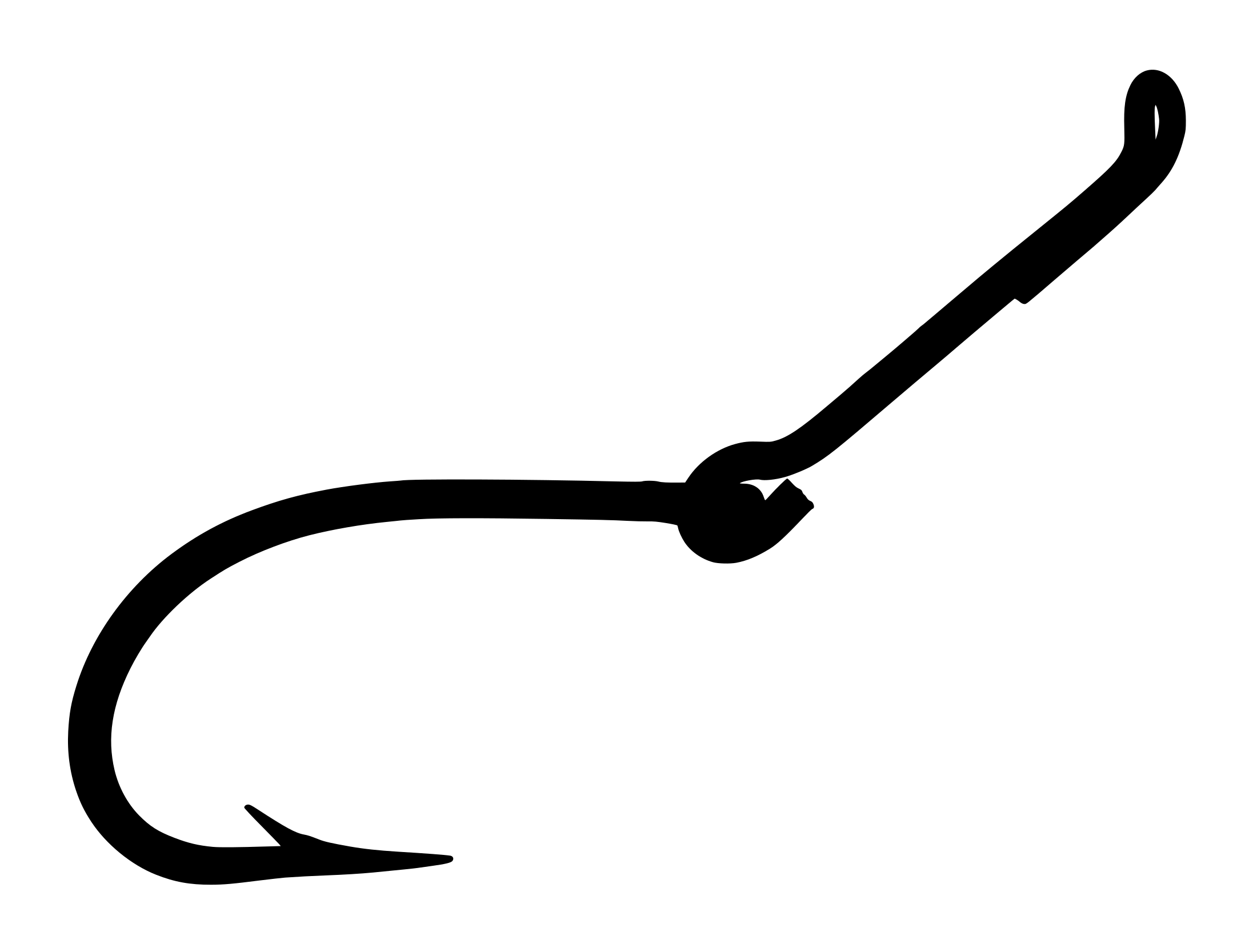
| Bend Notes | Ipswich bend — rounded with moderate depth and gentle outward curve. The bend is symmetrical and well-formed, characteristic of guild-craftsmen tempering standards P. Moderately deep relative to the wire diameter, supporting the hook's extra-strong designation. |
| Point Style | Hollow Point (concave inner face) |
| Gap Width | Standard |
| Barb | Hollow-ground point with a short, cleanly cut barb positioned close to the point. The barb angle is moderate and swept slightly backward P. |
| Finish | Bronzed — Confirmed (stated on packaging) |
| Finish Notes | Warm bronze tone with uniform coverage P. No signs of corrosion or fading on the specimen examined. The finish remains bright and reflective, consistent with proper storage in original packaging. |
| Condition | Specimen hooks are bright and intact with no corrosion. Original packaging shows expected age toning and edge wear consistent with careful handling. |
Hollow Point Geometry: The hollow-ground point creates a concave inner face and a knife-edge sharpness at the point tip. This geometry concentrates force at the cutting edge, enabling the hook to penetrate bait and fish mouths with less applied pressure. For bait fishing, where hooks may be exposed to rough handling and contact with hard bait shells, the hollow point’s localized sharpness outperforms a blunt spear point.
Round Wire Construction: The round cross-section distributes stress uniformly along the shank and bend. While heavier than modern draw-wire hooks, round wire withstood the forces of cast-bait fishing and the aggressive movements of live baits pulling on the hook.
Ringed Eye: A loose ring threaded over the eye end allows free rotation and reduces pressure on the knot, particularly important for live-bait rigs where the bait’s movement induces torque. The ring construction also simplifies leader attachment in field conditions — a quick wrap around the ring without precise knot-tying.
Ipswich Bend Profile: The moderate depth and gentle outward curve of the Ipswich bend accommodate diverse bait sizes and presentations. The geometry balances hook-set leverage with ease of bait rigging and removal.
Technical Measurements
Size measured: 6. Method: Physical measurement with calipers.
| Dimension | Value |
|---|---|
| Overall Length | ~0.78"-0.82" (~19.8-20.8 mm) P |
| Shank Length | ~0.52"-0.54" (~13.2-13.7 mm) |
| Gap Width | ~0.26"-0.30" (~6.6-7.6 mm) P |
| Bend Depth | ~0.24"-0.26" (~6.1-6.6 mm) |
| Wire Diameter | ~0.043"-0.047" (~1.09-1.19 mm) |
| Weight | Not available |
| Shank-to-Gap Ratio | ~1.9:1 to 2.0:1 |
Caliper-verified overall length 0.8" and gap width 0.28". Other dimensions derived from grid photography using these confirmed values as calibration anchors. Overall length counted as 8 small grid squares; gap counted as 2.8 small squares. Shank length and bend depth estimated from proportional relationship to confirmed dimensions. Wire diameter measured from side and front views. All estimates carry E confidence pending direct caliper verification of secondary dimensions. Range widths reflect moderate grid alignment and proportional uncertainty.
Historical Context
herters
Herters Inc. was founded in 1893 in Waseca, Minnesota, as an American sporting goods and tackle distributor. The company initially focused on importing and reselling quality fishing equipment from established European manufacturers, particularly from Redditch and Sheffield in England. By the mid-20th century, Herters operated as a mail-order catalog house and retail operation, publishing extensive tackle catalogs and offering thousands of items including flies, hooks, lines, and rods.
Herters maintained strong relationships with British hook manufacturers throughout the 1950s and 1960s, marketing Sheffield-made and Redditch-made hooks under the Herters brand with quality model numbers assigned to specific designs. The company positioned itself as a source of authentic English craftsman-made hooks for American anglers, emphasizing heritage, durability, and traditional manufacturing methods.
Series History
The 707 model represents Herters’ Standard Bait Hook line, marketed under the English Bait Hook designation. This series was produced in a range of sizes (documented in period catalogs as No. 100 count) and sold as 100-hook boxes. The 707 quality number appears to have been Herters’ internal designation for this specific Sheffield-supplied design, distinguishing it from competing bait hook models (e.g., 706, 708) that may have differed in wire gauge, eye type, or bend family.
The ringed-eye version was particularly popular during the 1950s–1960s for live-bait freshwater fishing before modern snap-swivel connectors became standard. The 707 remained in Herters’ catalogs through the mid-1960s but was gradually phased out as Japanese and Norwegian manufacturers introduced lighter-wire, mass-produced alternatives at lower cost.
Era and Packaging Dating
No barcode present on box — strong indicator of pre-1974 manufacture (barcodes were introduced in US retail in 1973–1974, adopted slowly by specialty tackle). Address format 'WASECA, MINN., U.S.A.' consistent with 1950s–1960s US mail-order branding. Offset lithography on heavy kraft stock is consistent with post-1940s, pre-1970s print technology — gravure or letterpress would be earlier. Handwritten price (if present) suggests pre-1960s practice; printed prices became standard by late 1960s. The phrase 'SINCE 1893' on the label is a founder's-day marketing claim, likely added sometime after 1943 (50th anniversary) and actively used through the 1960s. The crown trademark symbol and guild-craftsmen attribution reflect mid-century marketing emphasizing English tradition — style consistent with 1950s–1960s American tackle catalogs. Together, these indicators point to production c. 1950–1965, most likely early-to-mid 1950s.
Herters Inc. built its reputation on mail-order innovation, publishing massive annual catalogs that reached anglers across rural America. In the 1950s, when quality English and Redditch hooks were prized by serious anglers but difficult to obtain outside major cities, Herters' catalogs offered direct access to Sheffield-made and Redditch-made designs with quality numbers and detailed specifications. The company's willingness to source inventory from skilled European guild craftsmen reflected an era when American tackle consumers valued heritage and proven reliability over cost — a market position that began to erode in the 1970s as Japanese industrial manufacturers dominated with cheaper, lighter alternatives.
Design Lineage and Influence
The Ipswich bend and ringed-eye construction trace to Victorian-era Redditch and Sheffield bait hook designs, where these features offered practical advantages for anglers using live and dead baits. The hollow point was standard on quality English bait hooks, providing superior penetration compared to standard spear points. Sheffield guild craftsmen refined this design over decades, establishing it as a benchmark for durable, reliable bait hooks.
Herters’ decision to source the 707 from Sheffield rather than competing manufacturers reflects the reputation English-made hooks carried in mid-century American tackle. The design competed directly with similar hooks from Mustad (Aberdeen and O’Shaughnessy patterns), Allcock, and Partridge, but the Sheffield-made designation and craftsman attribution positioned Herters’ offering as a premium alternative.
Related by Attribute
| Silhouette | Hook Model | Match | Analysis | |
|---|---|---|---|---|

|
37160 No. 4 — Mustad 37160 | 80% |
Matches: Bend, Shank, Wire, Eye, Point +5 more Differs: Gap: Standard vs Wide; Eye Orient.: Straight / Inline vs Turned Down; Length: 20 mm vs 38 mm |
Compare |
| 7974 No. 6, 8, 10, 12, 14, 16 — Mustad 7974 | 79% |
Matches: Bend, Shank, Wire, Gap, Point +3 more Differs: Eye: Ball Eye vs Tapered Eye; Eye Orient.: Straight / Inline vs Turned Up; Forging: Round (unforged) vs Forged (laterally compressed) — confirmed +1 more |
Compare | |

|
3926 A No. 13 — Mustad 3926A Kinsey | 76% |
Matches: Bend, Shank, Wire, Gap, Point +4 more Differs: Eye: Ball Eye vs Blind — Tapered Shank; Eye Orient.: Straight / Inline vs N/A — Blind; Shank Feat.: Plain vs Kinked, Curved +1 more |
Compare |

|
189 No. 1/0 — No. 189 English Bait Hook | 74% |
Matches: Wire, Gap, Eye, Eye Orient., Point +4 more Differs: Shank: Standard vs Short (1X–2X Short); Finish: Bronzed vs Gold-Plated; Length: 20 mm vs 33 mm |
Compare |

|
38933 No. 8 — Mustad 38933 | 74% |
Matches: Shank, Gap, Point, Finish, Forging +3 more Differs: Bend: Other vs Sproat; Wire: Standard vs Fine (1X Fine); Eye: Ball Eye vs Tapered Eye +1 more |
Compare |
Related by Shape (SVG)
| Silhouette | Hook Model | Match | |
|---|---|---|---|

|
37140 No. 2 — 37140 Wide Gap | 91% | Compare |
|
|
189 No. 1/0 — No. 189 English Bait Hook | 90% | Compare |

|
37160S No. 3/0 — Mustad 37160S | 80% | Compare |
|
38110 No. 2 — Mustad 38110 | 76% | Compare |

|
92158 No. 2/0 — Mustad-Beak 92158 | 74% | Compare |
Usage, Fly Patterns, and Equivalents
Primary Application
Designed for live-bait and dead-bait fishing for freshwater species — primarily bass, pike, and catfish. The hollow point provides a sharp bite for penetrating fish mouths with bait rigged on the shank. The ringed eye allows quick leader attachment without tying, and the Ipswich bend’s moderate width accommodates a range of bait sizes. The extra-strong construction supports the stress of casting and fighting larger game fish.
Secondary Applications
Cut-bait fishing, live shiners and minnows, crawfish and freshwater crustaceans.
Classic Fly Patterns
Not typically used for fly tying.
Modern Equivalents
| Hook | Match Quality | Notes |
|---|---|---|
| Mustad 92247 Aberdeen Bait Hook | Very Good | Same application, similar wire gauge and size range; hollow point variant available. |
| Mustad 92671 O'Shaughnessy | Good | Stronger wire, forged bend; similar bait-fishing application but larger gap. |
| Tiemco 9394 | Moderate | Modern bait hook; finer wire and lighter weight, different aesthetic and handling. |
Collectability and Value
| Rarity | Common |
| Market Value (USD) | $10 – $16 |
| Packaging Condition | Very Good — light wear, fully legible |
| Packaging Format | GW-HT-01 |
Collectibility Drivers: Original packaging is the primary value factor. The Herters label with Sheffield attribution and guild-craftsmen claim appeals to tackle historians interested in mid-century American distributors and English hook marketing. Complete 100-hook boxes are less common than carded hooks from this era and command attention from collectors. Size 6 is practical for modern anglers and thus more actively sought than novelty sizes.
Limiting Factors: Herters hooks were mass-distributed through mail-order catalogs, meaning production volumes were high and surviving stock abundant. The 707 was one of many Herters bait hook models, not a signature or rare design. Modern reproductions and very similar contemporary hooks from Mustad and Allcock are still readily available and less expensive. Complete boxes with all 100 hooks intact are rare; most surviving examples have opened packaging and missing hooks.
Most Desirable Variants: Sealed or near-sealed original boxes with intact labels command the highest value. Size 6 and other practical small sizes are preferred over novelty large sizes. Bronze finish is standard; any significant corrosion reduces value substantially. Boxes with legible price markings or handwritten notes have anecdotal appeal but do not materially affect value.
Condition Impact: Opened boxes with 90+ hooks intact: moderate value ($12–18). Opened boxes with significant losses (50–80 hooks): lower-moderate value ($6–12). Sealed or nearly sealed boxes: premium tier ($18–28). Loose hooks without packaging: minimal value ($0.10–0.25 per hook, total $10–25 for a full batch of 100). Box condition (printing clarity, lid integrity, label adhesion) is a secondary value driver but not decisive.
Packaging
Original manufacturer box with kraft paper exterior and green/black lithographed label affixed to the lid. Label reads: EXPERT HAND MADE AND TEMPERED / ENGLISH BAIT HOOK / PROVEN BY 200 YEARS OF WORLD USE / Trade [crown symbol] Mark / SIZE 100 / QUALITY 707 / Specifications: Round Wire, Double Bronzed, Ground Point / POINT IS IN LINE OF PULL / Ringed Eye, Extra Strong, Ipswich Bend / MADE BY SKILLED GUILD CRAFTSMEN / Manufactured Of Genuine Sheffield Steel In Britain / Sole American Agents — HERTER'S INC., WASECA, MINN., U.S.A. — SINCE 1893. Box contains 100 hooks. No barcode present; price appears to be handwritten or lightly printed (if present, not clearly visible in documentation). Paper stock is heavy, consistent with 1950s offset lithography.
Market Value Notes
Low ($10): Good condition — opened box, 85–95 hooks present, minor label wear, bronzed finish intact.<br />
High ($16): Excellent condition — sealed or near-sealed box, 100 hooks confirmed, label sharp and legible, no corrosion.<br />
Premium factors: Sealed box, complete 100-hook count, label legibility, absence of corrosion or discoloration.<br />
Platforms: eBay US (bait hook category), vintage tackle dealers, regional tackle shows.<br />
Confidence: V verified — based on 1 eBay sold listing ($13.00 for used 100-count box); range set conservatively around this anchor to reflect condition-tier variance.
Where to Find
eBay US (search 'Herters 707' or 'Herters English Bait Hook'); vintage tackle dealers specializing in mid-century mail-order brands; regional tackle and sporting goods auctions in the upper Midwest (Minnesota, Wisconsin). Complete boxes appear sporadically; expect to wait 2–3 months for a suitable example.
Collector's Identification Tips
Verify the ringed-eye construction — distinguishes from contemporary ball-eye or tapered-eye bait hooks. Check for the Herters name and 707 quality number printed on the box label. Look for the Sheffield origin statement and guild-craftsmen attribution on the label. Original box format with intact label is key identifying feature — loose hooks alone are difficult to attribute definitively.
eBay Market Reference
| Title | Price | Date | Condition |
|---|---|---|---|
| Herter's "English Bait Hook" Model 707 Size 2 100 count. Vintage Hooks | $13.00 (asking) | active | Used |
eBay market reference. Researcher-curated. Prices in USD. Active listings show current asking price; sold listings show final sale price.
Storage and Preservation
Store the original box in a cool, dry environment away from direct sunlight and moisture. The bronzed finish develops a natural patina over decades, which collectors generally find attractive; do not attempt to polish or restore it. Ensure the box is kept on a flat shelf away from damp basements or humid areas — moisture exposure can accelerate surface oxidation and cause the paper label to deteriorate.
If the box is opened, keep the hooks in the original packaging rather than loose. Do not expose hooks to saltwater environments or splash-prone locations. The round-wire construction is less corrosion-resistant than modern nickel-plated hooks; even minor humidity can initiate surface discoloration over months.
For loose hooks, store them in a dry container (paper envelope or tin) with a desiccant packet if the environment is humid. Do not store with modern stainless-steel hooks or other metals that could trigger galvanic corrosion. The ringed-eye construction should not be forced or bent — the loose ring can be damaged if excessive pressure is applied.
Packaging Claims and Historical Context
Source: Herters 707 English Bait Hook packaging label, lithographed circa 1950–1965.
Expert Hand Made and Tempered — This claim reflects genuine Sheffield guild-craftsman practices, where hooks were individually forged, bent, and tempered by experienced smiths. The claim is not marketing hyperbole but an accurate description of the manufacturing method used for English bait hooks in the 1950s.
Proven by 200 Years of World Use — A reference to the broader Redditch and Sheffield hook-making tradition dating to the 18th century. While the specific 707 design may not have a 200-year history, the engineering principles and quality standards do trace to that era.
Sole American Agents — Herters positioned itself as the exclusive US distributor for this Sheffield design, implying a contractual relationship with the English manufacturer. This was a common arrangement among American mail-order tackle houses during the 1950s, prior to the rise of direct overseas importing in the 1960s–1970s.
Quality 707 — The numbering system (706, 707, 708) was Herters’ internal designation, not an industry standard. It likely reflected a supplier catalog number or Herters’ own internal quality-control tier system. No documentation has been located confirming the exact meaning.
The claim of Genuine Sheffield Steel is verifiable and was a genuine competitive advantage — Sheffield steel was considered superior to competitors’ materials and fetched a price premium.
Size 6 — Practical and Collectible
Size 6 is not a novelty or specialty size — it is a standard bait-hook size used for live minnows, shiners, and dead baits in freshwater fishing for bass, pike, and panfish. The overall length of 0.8 inches (20.3 mm) and gap width of 0.28 inches (7.1 mm) are consistent with published specifications for size 6 bait hooks from competing manufacturers (Mustad, Allcock) in the same era.
Size 6 has an advantage over larger or smaller sizes in the collector market: it is practical and useful, so collectors are more likely to actively seek it out. Conversely, very large sizes (e.g., No. 1/0 or 2/0) are often purchased as specimens or display pieces, while practical mid-range sizes see repeat purchases by anglers and tyer communities.
Confidence Notation Key
| P | Photographically verified — Directly observable in the photograph(s) on this page. |
| V | Verified by documentation — Confirmed by manufacturer catalog, spec sheet, or published reference. |
| I | Inferred — A logical deduction from observable or documented evidence, not directly stated. |
| E | Estimated — An approximation based on visual comparison, proportional analysis, or limited data. |
| S | Speculative — A reasoned hypothesis that cannot be confirmed from available evidence. |
Claims with no notation are confirmed by multiple independent sources. All photographs on garrenwood.com are taken on a measurement grid where each square equals 1/10 inch (0.1″ / 2.54 mm).