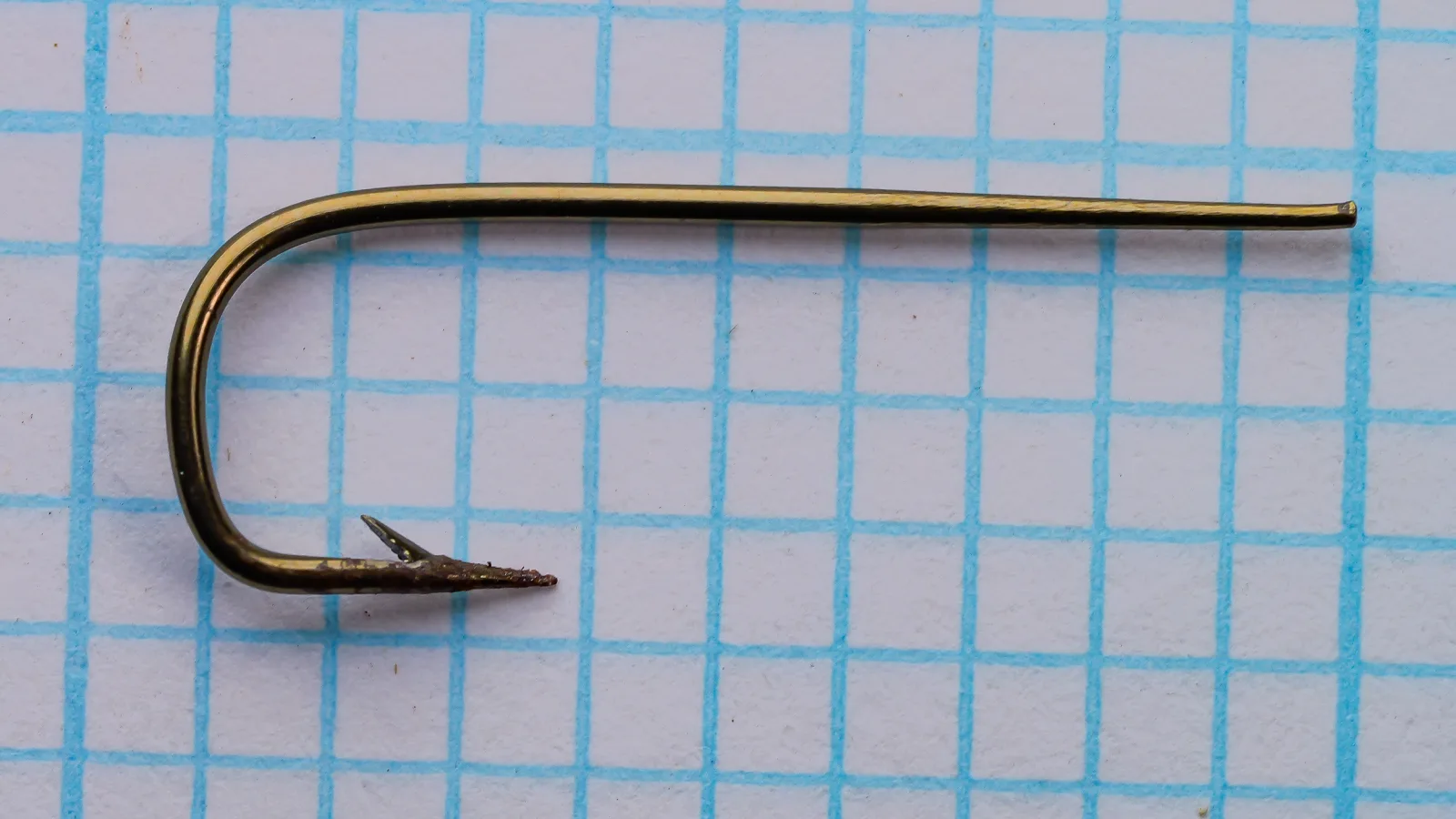
Design and Engineering The Partridge Sneck Taper is a classic British salmon and sea trout hook characterized by its distinct “sneck bend”—a design featuring a moderate offset and a rounded bottom that evenly distributes stress during a strike. Most notably, the hook features a “tapered blind eye.” Unlike modern loop-eye hooks or older flatted “spade” eyes, the shank of this hook smoothly tapers to a rounded point. This was a sophisticated engineering solution designed specifically for the fragile gut leaders of the early 20th century. Anglers would attach the gut using a specialized “locked loop” or “surgeon’s loop” knot, allowing the continuous taper to distribute the load gradually without creating sharp stress points that could fray or cut the line.
Historical ContextManufactured by Partridge of Redditch—a company renowned for its high-quality, hand-forged tackle—this hook represents a lost tradition in angling. The tapered blind eye was the dominant fastening method for salmon fishing throughout the late 19th and early 20th centuries. However, the design was rendered entirely obsolete by the 1950s and 1960s with the invention of synthetic nylon leaders and the universal adoption of standard eyed hooks. Today, the specialized knots required to fish these hooks are largely forgotten outside of historic tackle circles.
Collectability and Market Value Functionally, this model was used for both delicate fly presentations and bait fishing in low-water conditions. Today, it holds a collectability rating of 5.5 out of 10, with an estimated market value between $12 and $38. While surviving Partridge hooks are not incredibly rare, the webpage highlights that this specific documented Size 4 is unusually small for a salmon hook, adding to its rarity. Original packaging is the primary driver of its value; specimens retained in their original cream-colored, blue letterpress boxes with intact handwritten sizing are prized by historians and collectors seeking artifacts of the pre-nylon angling era.
Full-length profile of the Partridge Sneck Taper hook, size 4, showing the distinctive tapered blind eye, sneck bend geometry, and warm bronzed finish on a 1/10-inch measurement grid.
Photographic record
3 cataloged imagesSelect any record to load it above.
3 images shown
Partridge Sneck Taper Size 4 Bronzed ProfileFull-length profile of the Partridge Sneck Taper hook, size 4, showing the distinctive tapered blind eye, sneck bend geometry, and warm bronzed finish on a 1/10-inch measurement grid.Open originalPartridge Sneck Taper Size 4 Point DetailClose-up of the point and barb showing the superior (near-straight inner face) point geometry and short close-cut barb characteristic of salmon and sea trout hooks.Open originalPartridge Sneck Taper Size 4 Original PackagingOriginal packaging for the Partridge Sneck Taper, size 4, showing handwritten size designation in blue ink and printed 'SNECK TAPER.' on cream-colored cardboard stock, typical of early 20th century British tackle packaging.Open original
Technical profile
Eye
Blind — Tapered ShankTapered blind eye — the shank tapers to a smooth rounded point with no flattening or spade construction. Gut attached via loop tied around the taper. P
Wire
Heavy (1X Heavy), Round
Shank
2X Long — Tapered
Bend
Sneck, Standard gapDistinctive sneck bend with moderate offset and rounded bottom. Symmetrical wire set. P
Point
Superior (near-straight inner taper)Short, close-cut barb positioned approximately 3-4 wire diameters from the point. Angled slightly back toward the shank. Standard barb size for this era and size range. P
Finish
Bronzed — Confirmed (stated on packaging)Warm brown tone visible in photograph, confirming bronzed finish as stated on original packaging. Steel grain visible beneath coating. (P/V)
Hook specimen shows patina consistent with age, with warm bronzed tone throughout. No significant corrosion or pitting visible. Packaging shows light yellowing, age-related toning, and minor creasing consistent with long-term storage.
The sneck bend geometry provides an effective hook-set profile with the offset and rounded bottom distributing stress evenly during the strike. The superior (near-straight) point geometry maximizes penetration while the close-cut barb holds securely without excessive damage to delicate salmon and sea trout mouths, a key consideration in traditional catch-and-release practices. The standard-gauge wire offers adequate strength for fighting larger fish while remaining fine enough for delicate presentations to shy or selective fish in low-water conditions.
The tapered blind eye represents a sophisticated engineering solution to the problem of fastening gut leaders without mechanical weakness. Unlike a flatted (‘spade’) eye, which creates sharp stress points at the flats, the continuous taper distributes load gradually from the leader knot back through the shank. The smooth, rounded surface of the taper resists fraying and abrading gut material, which was particularly important given the relatively fragility of gut leaders compared to modern synthetics. The taper angle (typically 8–12 degrees) was chosen to provide secure mechanical grip without being so aggressive that it required excessive leader wrapping or risk of slipping.
The forged construction — evident from the distinct bend profile and the slightly irregular wire surface visible in close-up photographs — provided superior fatigue resistance compared to drawn or heat-treated wire. Forging aligned the steel’s crystal structure along the bend profile, strengthening it against repeated flexing during casting and playing of fish. This technique was labor-intensive but essential for the high-performance salmon hooks that Redditch makers were known for.
The Sneck Taper represents a consistent Partridge design across several decades of early 20th century production. The sneck bend — characterized by a rounded bottom and moderate offset — is a classic British salmon hook style, and the tapered blind eye was the standard fastening method for that era. Partridge offered the Sneck Taper in multiple sizes (typically No. 4 through 2/0) and a range of finishes (bronzed being the most common for salmon hooks, with some specialty runs in blued or japanned finishes).
The Sneck Taper did not receive a formal model code or catalog number in the modern sense — identification relied entirely on the model name, size designation, and finish. This naming convention persisted through the 1940s–1950s before modern SKU systems emerged. The design was not subject to major modifications during its production run, maintaining consistent bend geometry and wire gauge across its catalog life. Production likely continued through the 1950s, when tapered-eye hooks began to decline in market demand, eventually phased out in favor of eye-loop variants. The Sneck Taper exists primarily as a historical document of pre-war Redditch manufacturing rather than as part of a continuous modern product line.
Era and Packaging Dating
No barcode present (strong pre-1974 indicator). Handwritten size designation in blue ink, typical of early 20th century British tackle packaging. Cream-colored stock and blue letterpress printing consistent with 1900s-1930s hook card production. Simple wraparound packaging format typical of Redditch-era tackle prior to post-war cardboard improvements. Tapered blind eye construction was the dominant salmon hook style through 1940s but declined after introduction of nylon leaders. Typography and box construction suggest early 20th century manufacture, most likely 1900-1940 range.
The Lost Knot: Fishing Skills That Disappeared
The tapered blind eye required a specialized knot known as the 'locked loop' or 'surgeon's loop,' which was taught to every young angler learning traditional salmon fishing. Anglers would wrap their gut leader around the tapered shank, bring the end back through the loop, and cinch it tight, creating a permanent mechanical lock that could withstand hours of hard casting and fish-fighting. Fly-dressing manuals from the early 20th century dedicated entire pages to mastering this knot, and proficiency with it was considered a mark of serious craftsmanship. By the 1960s, the knot was nearly forgotten as nylon leaders and eyed hooks displaced the tapered-eye system entirely — today, most modern fly tiers have never encountered a tapered-eye hook and would be puzzled by the fastening method their grandfathers used routinely.
Design lineage and influence
The sneck bend family traces back to Redditch innovations of the mid-19th century. The sneck — distinguished by its offset and rounded bottom — sits between the more angular Limerick bend and the wider round-bottomed Sproat bend in the spectrum of classic British designs. Historical Redditch catalogs suggest the sneck family emerged around the 1870s–1880s as a refinement of earlier round-bottom geometries, offering better hook-set geometry while maintaining the smooth characteristics preferred for delicate presentations.
Partridge adopted the sneck design early and integrated it across multiple hook lines, including salmon, sea trout, and trout patterns. The sneck taper variant — combining the bend with tapered blind-eye construction — represents a synthesis of two longstanding traditions: the sneck’s proven bend geometry and the tapered eye’s superior performance for gut-leader fishing. Competing manufacturers including S. Allcock & Co., Edgar Sealey, and H. Milward & Sons all offered similar sneck patterns with tapered eyes, suggesting the design was an industry standard rather than a Partridge innovation.
The design’s influence extended into the modern era through survivors in the 1950s–1970s catalogs of transitional manufacturers. However, the tapered eye’s functional obsolescence with the advent of nylon leaders and universal eyed-hook adoption meant that the sneck taper design did not see significant downstream influence in modern fly-tying. Today, the sneck bend survives primarily in eye-loop variants (such as the modern Partridge Sproat), while the tapered-eye construction is relegated to specialist historic-tackle circles and does not influence contemporary hook design.
Best matchRelated by Attribute
Computed automatically from catalog data — updated as new hooks are added.
Matches: Bend, Shank, Gap, Eye, Eye Orient. +3 moreDiffers: Wire: Heavy (1X Heavy) vs Extra-Heavy (2X+); Point: Superior vs Hollow Point; Finish: Bronzed vs Blued +5 more
Matches: Bend, Shank, Gap, Eye Orient., Point +3 moreDiffers: Wire: Heavy (1X Heavy) vs Standard; Eye: Blind — Tapered Shank vs Blind — Marked Shank; Finish: Bronzed vs Black Japanned +4 more
Matches: Bend, Shank, Gap, Eye Orient., Finish +3 moreDiffers: Wire: Heavy (1X Heavy) vs Fine (1X Fine); Eye: Blind — Tapered Shank vs Blind — Marked Tapered Shank; Point: Superior vs Hollow Point +4 more
The Sneck Taper is a classic salmon and sea trout hook designed for both fly and bait presentations. The tapered blind eye was the traditional fastening method for gut-attached leaders in the pre-nylon era. This construction allowed anglers to tie the leader securely around the smoothly tapered shank without the mechanical weakness of an eye loop. The sneck bend geometry — with its offset and rounded bottom — provides effective hook-set geometry while the standard wire gauge offers a balance between strength and fineness for delicate presentations.
Secondary Applications
Bait fishing for salmon and sea trout; spey casting with traditional methods.
Classic Fly Patterns
Not typically used for fly tying (this is a traditional gut-eye bait and salmon hook).
Modern Equivalents
Hook
Match Quality
Notes
Partridge Sproat (eye-loop, modern production)
Good
Same manufacturer, similar sneck-family bend geometry, but with modern turned-down eye rather than tapered blind eye. Suitable for modern fly-tying applications.
Mustad 3665 Salmon (blind eye, discontinued)
Good
Norwegian equivalent with blind-eye tapered construction and salmon-appropriate geometry. No longer in production but occasionally found in old stock.
Tiemco TMC 7989 (modern tapered-eye recreation)
Moderate
Modern attempt to recreate traditional blind-eye salmon hooks; synthetic recreation of historic construction but different wire gauge and finish.
Collector notes
Rated 5.5/10 — uncommon despite its age; Partridge blind-eye hooks command genuine collector interest among salmon and sea trout specialists. Primary driver is scarcity of original packaging combined with the tapered-eye construction (now obsolete). Limiting factors include modest overall demand outside specialist circles and the fact that larger sizes (2/0–1/0) remain more available than size 4.
Reference value
$12 – $38 USD estimate
Packaging condition
Fair — significant wear, partially legibleRecorded specimen
Packaging format
GW-PAR-01Catalog code
Positive factors: Tapered blind-eye construction represents a historically important, now-obsolete fastening method that appeals to collectors of traditional salmon tackle and fly-dressing historians. Original Partridge packaging with handwritten size marking demonstrates authentic period provenance. The sneck bend is a classic, recognizable design with enduring collector appeal. Complete original packaging in any condition commands a meaningful premium over loose hooks.
Limiting factors: Size 4 is smaller than the typical salmon hook range (which peaks at 2/0–1/0), reducing demand among the core salmon-tackle collector base. The hook is not rare in absolute terms — surviving examples are uncommon but can be located with patient searching. Partridge production volumes were substantial, so no single size becomes truly scarce except in exceptional finishes or unusual packaging variants. Modern fly tiers show limited interest since tapered-eye construction is incompatible with current nylon-leader and synthetic-thread practices.
Most desirable variants: Original cards or packaging with intact, unmolested hooks. Size 2/0 and 1/0 command higher premiums than size 4. Any Partridge hook with legible manufacturer branding or retailer labels is more collectible than unmarked examples. Sealed or never-opened packaging significantly increases value.
Condition factors: Original packaging condition is the primary value driver — a card with all or most hooks intact commands 2–3× the value of loose hooks. Packaging yellowing and minor creasing are acceptable and period-authentic. Hooks showing patina are acceptable; active corrosion or pitting reduces value. Missing hooks deduct 10–15% per hook from the total card value.
Packaging
Handwritten size designation ('4') in blue ink on upper left of packaging. Text reads 'SNECK TAPER.' printed in blue type on cream stock. Simple wraparound cardboard box or envelope format, typical of early 20th century British hook packaging. No barcode present. Price or retailer markings not legible in image.
Market Value Notes
Low ($12): Good condition — original packaging opened, most or all hooks present, minor wear and yellowing acceptable, no significant corrosion on hooks.
High ($38): Excellent condition — original packaging sealed or near-sealed, all hooks present in perfect condition, minimal packaging wear, vivid handwritten markings still legible.
Premium factors: Complete original packaging (sealed vs. opened), full hook count, Partridge branding legibility, smaller sizes (4, 6) less common than larger 2/0–1/0 range, condition of handwritten size marking.
Platforms: eBay UK and US, specialist tackle dealers, Redditch tackle auctions.
Confidence: E estimated — limited recent sales data for this specific model; range reflects typical pricing for uncommon Partridge blind-eye cards of similar vintage and condition.
Where to Find
eBay UK (search 'Partridge Sneck Taper' or 'Partridge blind eye'), specialist UK tackle dealers in Redditch area, Castwell and other online vintage tackle forums, regional UK tackle auctions and antique fairs.
Preservation
Storage and Preservation
Store in a cool, dry environment away from moisture and direct light. The bronzed finish develops a natural dark patina over time, which collectors typically consider desirable and authentic — do not attempt to polish it away. Original packaging should be preserved as-is; the handwritten size marking and cream-colored stock are period-authentic indicators of age and provenance. Retain the hooks on the original card or in original packaging rather than loose to preserve collectibility and add significant value premium. Avoid contact with other metals to prevent galvanic corrosion. If the hooks show any surface oxidation, store them in an acid-free envelope with silica gel to prevent further corrosion. Do not apply any oils or solvents to the finish without specialist advice, as these can damage the patina layer.
Marking Analysis
Handwritten Markings and Dating
The size designation ‘4’ is handwritten in blue ink on the upper left of the packaging. This handwritten marking is characteristic of early 20th century British hook packaging, when manufacturers and retailers often added size or lot numbers by hand rather than printing them. The handwriting appears to be in a clerical hand, consistent with office or shop marking rather than manufacturing line work. The blue ink tone and slightly faded appearance suggest the marking was made at the time of original packaging, not added later. The legibility and positioning of this marking is a key authenticity indicator and adds to the collectibility of the package — faded or illegible handwritten markings are less desirable but still acceptable. The presence of this handwritten element is strong evidence for a production date in the 1900–1940 range, before offset printing became standard for size designation on all hook packaging.
Size Note
Size No. 4 in Context
Size No. 4 is smaller than typical for salmon and sea trout hooks, which historically peaked in the 2/0 to 1/0 range. This size may have been used for smaller sea trout, finnock (immature sea trout), or as a lighter presentation in low-water conditions. Size 4 in this sneck-taper pattern is less commonly encountered than the heavier 2/0–1/0 sizes, which were the commercial standard for Scottish and English salmon rivers. The tapered-eye construction on size 4 was equally valid but may have been ordered less frequently by anglers who preferred heavier wire and larger gaps for big fish. This size-range scarcity increases the collectibility of the documented specimen relative to larger sizes.
Additional
Packaging Text and Printing
The packaging clearly reads ‘SNECK TAPER.’ in blue letterpress type on cream stock. This simple, direct model naming is typical of early Redditch tackle identification — no elaborate series designations, no product codes, no marketing copy. The absence of any retailer branding, catalog number, or manufacturer attribution beyond the model name on the visible side suggests either that additional text appears on the reverse (not shown) or that the manufacturer name was printed on a separate label or cover. The ‘SNECK TAPER.’ nomenclature matches contemporary Partridge of Redditch catalogs from the 1920s–1940s period. No printed price, no barcode, no postal code in modern format. The plain cream cardboard construction and blue letterpress printing are consistent with pre-war British industrial tackle packaging, prior to the shift to full-color offset printing that began in the 1950s.
Additional
The Tapered Blind Eye: A Lost Fastening Tradition
The tapered blind eye was the dominant salmon and sea trout hook fastening method throughout the 19th and early 20th centuries. Unlike modern eye-loop hooks, the tapered-eye design required the angler to tie the leader (typically gut, later silk or nylon) directly around the smoothly tapered shank using a dedicated loop knot. This construction offered several advantages in its era: the taper provided a secure, mechanical lock for gut leader material without requiring a metal eye ring, which could catch and fray delicate gut strands. The tapered design also reduced the overall weight of the hook — an important consideration when fly casting long, light leaders. The smooth roundness of the taper prevented the leader from being cut or abraded, a major advantage over earlier flatted (‘spade’) eye constructions.
By the 1950s, the development of nylon leaders and the near-universal adoption of eyed hooks made the tapered blind eye obsolete. Modern fly tiers and anglers abandoned this design entirely, and it is now found only on vintage hooks and in the practices of a small group of traditionalist salmon fishers and historic-tackle enthusiasts. The Partridge Sneck Taper survives as a tangible record of this lost fastening tradition — each hook represents not just a fish-catching tool but a complete fastening system that required specialized knot knowledge and careful leader preparation. Collectors who appreciate the history of fly-fishing gear often seek out tapered-eye hooks specifically for this reason, valuing them as functional artifacts of an older angling culture.
Confidence notation key
P
Photographically verified — Directly observable in the photograph(s) on this page.
V
Verified by documentation — Confirmed by manufacturer catalog, spec sheet, or published reference.
I
Inferred — A logical deduction from observable or documented evidence, not directly stated.
E
Estimated — An approximation based on visual comparison, proportional analysis, or limited data.
S
Speculative — A reasoned hypothesis that cannot be confirmed from available evidence.
Unnotated claims are the compiler’s synthesis; see Sources. All photographs on garrenwood.com are taken on a measurement grid where each square equals 1/10 inch (0.1″ / 2.54 mm).