
At-a-Glance Summary
The Mustad 7799 is a double-offset kirby fly hook manufactured by O. Mustad & Son of Gjøvik, Norway, designated for salmon and sea trout fishing with wet flies and streamers. The model is distinguished by its heavy forged wire, pronounced kirby offset, and hollow point geometry — specifications documented on the original cream-colored insert label pasted to the sales card.
Size 4/0 is a saltwater and large streamer size typical of commercial salmon fly applications during the mid-twentieth century. The straight ring eye, heavy gauge, and forged construction all point to a hook intended for larger fish and heavier tying materials. The packaging card format and letterpress printing are consistent with early-to-mid twentieth century Mustad manufacturing; the absence of a barcode suggests production before the 1970s.
This model represents Mustad’s commercial standardization of the kirby bend for the European salmon market. The 7799 remains available in modern production under the Mustad name, though vintage specimens in original packaging are increasingly scarce as older stock is consumed or discarded. Collectors value original cards with intact label printing and complete hook counts.
Photography
Identification
| Manufacturer | mustad |
| Model / Code | 7799 |
| Full Name | Mustad 7799 Double Kirby |
| Size Documented | 4/0 |
| Estimated Era | c. 1920s-1960s |
| Country of Origin | Norway |
Technical Specifications
| Eye Type | straight_ring |
| Eye Notes | Straight-sided ring eye with consistent diameter, formed by wrapping the shank wire into a complete loop P. The eye is small relative to shank diameter, consistent with salmon fly construction of the era. |
| Wire Gauge | Heavy (1X Heavy) |
| Wire Profile | Forged (laterally compressed) — forged construction confirmed |
| Shank Length | Standard |
| Bend Family | Kirby (offset) — offset / kirbed |
| Bend Notes | Deep, rounded kirby offset with pronounced hook-in profile characteristic of O. Mustad's interpretation of the kirby bend family P. The point is reversed (offset to the right, viewed from eye toward tip). Wire set is clean through the bend without excessive twist or flattening. |
| Point Style | Hollow Point (concave inner face) |
| Gap Width | Standard |
| Barb | Short, close-set barb positioned at the bend transition, typical of Mustad forged construction of the period P. Barb angle is perpendicular to the point taper. |
| Finish | Bronzed — Confirmed (stated on packaging) |
| Finish Notes | Warm brown bronzed tone confirmed on original packaging label V. The photographed specimen displays light patination consistent with age and storage; the bronze finish shows steel grain texture beneath the coating, typical of Mustad bronzing process P. |
| Condition | Specimen hooks show no active corrosion or pitting. Packaging card shows light creasing and foxing consistent with 1920s-1960s paper stock; label remains legible with clear printing. |
The hollow point is Mustad’s designation for a concave inner face geometry formed during the forging process. This inward-curving taper concentrates pressure at the point and can facilitate penetration compared to a blunt or flat-faced point. The heavy wire gauge (approximately 0.055″-0.065″) provides the strength needed for large fish and abrasion resistance against coarse materials and rocky streambeds.
The kirby offset places the point reversed (to the right, viewed from the eye looking down the shank). This geometry was historically favored for wet flies in European tradition, where the offset was believed to aid in hooking and holding fish when pulled at angles. The forged construction — indicated on the label and visible in the wire profile — involves heating and hammering to create a unified bend with integral strength greater than a simple wire bend.
Technical Measurements
Size measured: (unspecified). Method: Grid-derived from photograph (1/10" grid).
| Dimension | Value |
|---|---|
| Overall Length | ~1.55"-1.75" (~39-44 mm) E |
| Shank Length | ~1.05"-1.25" (~27-32 mm) E |
| Gap Width | ~0.45"-0.55" (~11-14 mm) E |
| Bend Depth | ~0.60"-0.75" (~15-19 mm) E |
| Wire Diameter | ~0.055"-0.065" (~1.4-1.65 mm) E |
| Shank-to-Gap Ratio | ~2.0-2.5 : 1 |
Measurements derived from gridded photograph of size 4/0 specimen. Shank counted at approximately 11-12 small grid squares (0.1" each); gap width at approximately 5-5.5 squares. Bend depth estimated from profile curvature. Heavy wire gauge limits precise measurement due to reflection; range reflects moderate uncertainty. Physical calipers recommended for production specification confirmation.
Historical Context
Era and Packaging Dating
No barcode present on packaging — strong indicator of pre-1974 manufacture. Letterpress printing on cream label stock is consistent with early-to-mid twentieth century printing methods; offset lithography became standard later. The Art Deco border pattern on the orange card is typical of 1920s-1950s design. The Oslo-Norway address without a postal code is consistent with packaging from before standardized postal systems were widely adopted in Norwegian commercial printing. Phone number formatting (if visible) and paper stock quality all align with 1920s-1960s production. The straight ring eye and heavy forged construction reflect design standards established by Mustad in the inter-war period and maintained through the 1960s. This specimen is most likely 1930s-1950s based on label style and printing technique.
The term 'Shaughnessy' (spelled O'Shaughnessy on Mustad packaging) refers to a different hook bend entirely — yet Mustad's 7799 label credits it as a 'Mustad-Double Kirby Hook with a single Hollow Point O'Shaughnessy Hook brazed on.' This appears to describe a two-hook lure rig or a compound hook assembly popular in early-twentieth-century salmon fishing, where a smaller point hook was brazed below the main bend. The original 7799 design may have been a dual-hook configuration that was later simplified to the single-point version documented here.
Design Lineage and Influence
Related by Attribute
| Silhouette | Hook Model | Match | Analysis | |
|---|---|---|---|---|
| Not documented No. 2/0 — Kirby Tapered | 85% |
Matches: Bend, Shank, Wire, Gap, Finish +4 more Differs: Eye: straight_ring vs Other; Point: Hollow Point vs Superior; Shank Feat.: Plain vs Plain, Tapered |
Compare | |
| 180 F No. 4/0 (size four-aught) — No. 180 F Kirby | 77% |
Matches: Bend, Shank, Wire, Gap, Offset +2 more Differs: Eye: straight_ring vs Blind — Flatted; Point: Hollow Point vs Superior; Finish: Bronzed vs Black Japanned +2 more |
Compare | |
| No. 1770 No. No. 1 — Kirby Carlisle Hooks | 73% |
Matches: Bend, Wire, Gap, Forging, Offset +2 more Differs: Shank: Standard vs 1X Long; Eye: straight_ring vs Other; Point: Hollow Point vs Superior +2 more |
Compare | |
| K6M No. 3/0 — Kirby Minnow Turned Ends | 70% |
Matches: Bend, Wire, Gap, Point, Finish +4 more Differs: Shank: Standard vs 2X Long; Eye: straight_ring vs Other; Application: Wet Fly, Salmon, Sea Trout vs Wet Fly, Streamer |
Compare | |
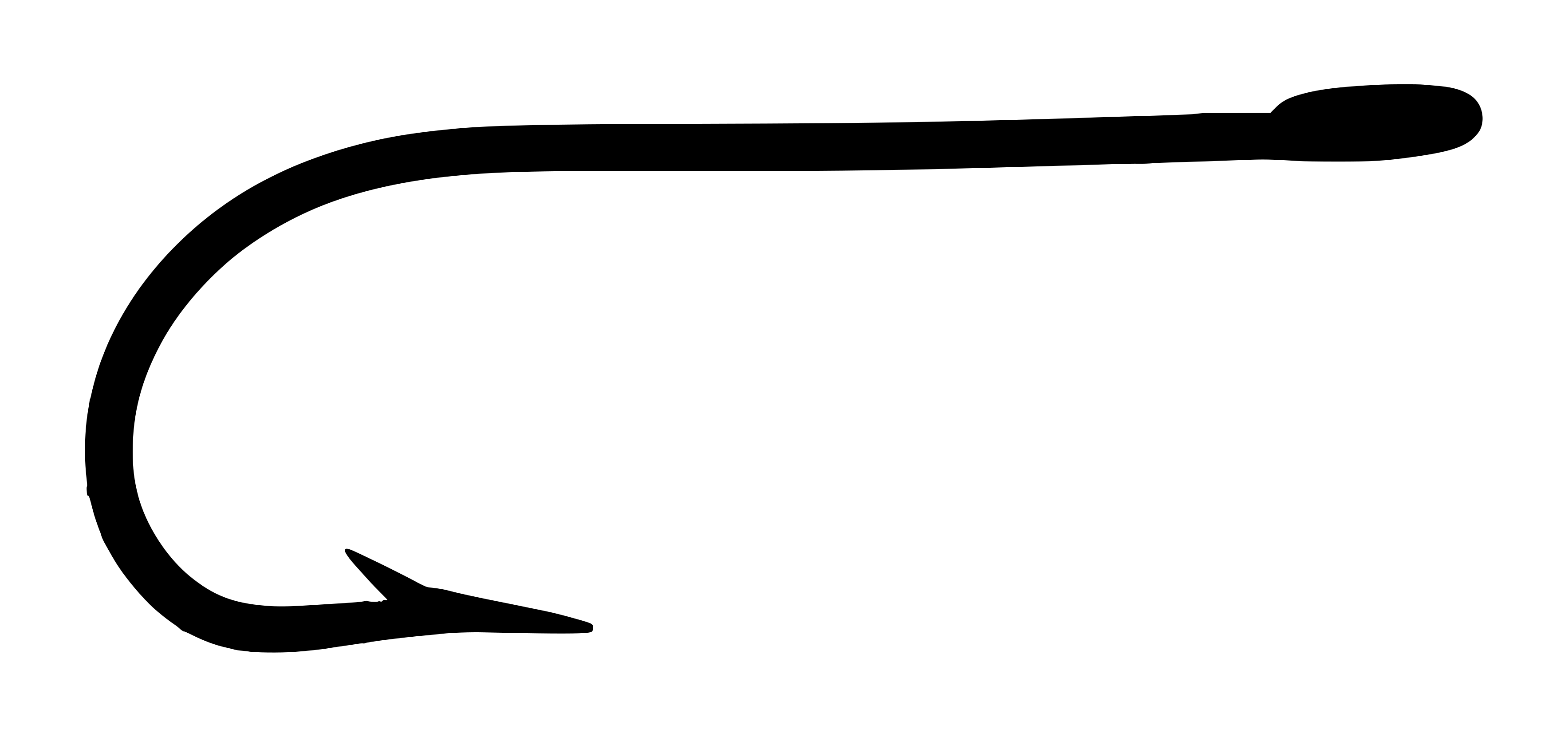
|
3135 No. Not specified on visible packaging (P) — 3135 Best Kirby Hooks | 69% |
Matches: Bend, Shank, Gap, Offset, Shank Feat. +1 more Differs: Wire: Heavy (1X Heavy) vs Standard; Eye: straight_ring vs Ball Eye; Point: Hollow Point vs Superior +3 more |
Compare |
Usage, Fly Patterns, and Equivalents
Primary Application
The 7799 was designed as a salmon and sea trout fly hook for wet fly dressings and medium to larger streamer patterns. The heavy forged wire and double-offset kirby geometry provide strength for larger fish and the distinctive hooked-in profile allows for efficient hook setting with traditional wet fly presentations. The straight ring eye accommodates leader knots without requiring a loop eye.
Secondary Applications
Light saltwater applications, large nymphs, spey casting variants
Classic Fly Patterns
Named patterns specifically associated with this hook. Leave blank if none formally documented. Do not speculate — only include patterns with a confirmed association.
Modern Equivalents
| Hook | Match Quality | Notes |
|---|---|---|
| Mustad 36890 | Very Good | Same manufacturer, kirby family, ring eye, salmon/sea trout application; modern nickel finish and tighter tolerances; direct commercial successor |
| Tiemco 7989 | Good | Japanese equivalent kirby offset, hollow point, ring eye; lighter wire gauge; comparable wet fly salmon application |
Collectability and Value
| Rarity | Uncommon |
| Market Value (USD) | $8 – $28 |
| Packaging Format | mustad-card-early |
What makes it collectible: Original packaging with intact letterpress label, the double-offset kirby geometry, heavy forged construction, and documented early-twentieth-century manufacture by a major Norwegian industrial maker. Complete cards with all six hooks intact and minimal label wear command premiums among collectors of salmon fly heritage and Mustad historical documentation.
What limits the rating: The 7799 remains in modern production under the Mustad brand, which suppresses vintage price premiums. Larger sizes (2/0, 3/0, 4/0) are more common than small sizes in original packaging. Many cards are found with missing hooks or damaged labels, which significantly reduces value. The model lacks the rarity of craft-era Redditch makers or pre-war blind-eye variants.
Most desirable variants: Original cards with complete hook counts and legible labels; sizes 6/0 and larger are scarcer and command higher premiums; bronzed finish cards are more sought than later nickel-plated variants. Sealed or near-sealed cards with original tissue are rarely encountered and can command 2-3x the value of opened cards with missing hooks.
Condition factors affecting value: Label printing clarity (creasing or water damage significantly reduces value), hook count completeness (each missing hook deducts $2-4), card surface condition (foxing and staining are acceptable; torn areas are not), and original wrapper or envelope presence (adds 50% premium if intact).
Packaging
Single-card format with straight-sided paper construction. Orange-red background with decorative Art Deco geometric border pattern printed in black. Upper section bears printed Mustad & Son maker's mark key logo in black. The label is a separate cream-colored insert pasted to the card face, with black letterpress printing. Label text includes: O. Mustad & Son / Manufacturers / Oslo - Norway / Qual. 7799 Superior / Mustad-Double Kirby Hooks / With a single / Hollow Point / O'Shaughnessy Hooks / brazed on. / Rustproof / Made in Norway / 1/4 Gr. No. [hook count]. Edge borders show die-cut decorative patterns. No barcode present. Paper stock is light cardboard. Handwritten size designation visible on card.
Market Value Notes
Low ($8): Good condition — opened card, 4-5 hooks present, light label wear, minor card creasing<br />
High ($28): Excellent condition — sealed or near-sealed card, all 6 hooks present, crisp label printing, minimal wear<br />
Premium factors: Complete hook count, original wrapper or tissue intact, crisp label printing, absence of creasing or foxing, larger sizes (6/0 and up)<br />
Platforms: eBay UK and US, occasional specialist tackle dealer listings, European fishing heritage auctions<br />
Confidence: E estimated — based on limited recent sales data for this specific model in original packaging; modern production availability suppresses vintage values compared to discontinued designs
Where to Find
eBay UK periodic listings (typically £6-20 GBP); occasional appearance at European tackle fairs and auctions in Scandinavia; specialist vintage hook dealers and online retailers with Mustad archives; uncommon on eBay US due to Norwegian export patterns.
Storage and Preservation
Store in a cool, dry environment away from moisture and salt spray. The bronzed finish is susceptible to patina development and surface oxidation with humidity exposure; collectors typically consider warm patina desirable on vintage stock. Keep the original card packaging intact rather than removing hooks — the label and card design are integral to the specimen’s historical and collector value.
Avoid contact with copper, brass, or dissimilar metals, which can induce galvanic corrosion on the steel. Store horizontally in a drawer or cabinet away from direct sunlight, which can fade the orange card printing. If the label shows water damage or foxing, do not attempt chemical cleaning — age-appropriate patina is preferable to abrasive restoration. Original tissue wrapping or kraft envelope, if present, should be preserved in situ.
Packaging Label Analysis
Source: Original Mustad 7799 sales card label, cream-colored insert with letterpress printing, Oslo-Norway address
The cream-colored insert label affixed to the sales card contains the definitive product specification: ‘Mustad-Double Kirby Hooks With a single Hollow Point O’Shaughnessy Hooks brazed on.’ This text is significant because it describes a compound hook assembly — a primary kirby-pattern hook with a smaller secondary hook point brazed or soldered to the bend. This two-hook lure configuration was common in early-twentieth-century salmon and pike fishing, particularly in Scandinavia and Britain.
The phrase ‘brazed on’ indicates the secondary point was mechanically attached by brazing (a type of metal joining using brass as filler) rather than integral forging. By the mid-twentieth century, this compound design appears to have been simplified or discontinued, with later 7799 versions featuring a single point. The label’s retention of the ‘brazed on’ text despite the change in construction suggests packaging stock may have been used up gradually, or the specification line was outdated.
The weight designation ‘1/4 Gr.’ (quarter grain) is a specific metric used in salmon fly hook sizing — related to pull strength and wire gauge rather than counting. The notation ‘Made in Norway’ confirms Gjøvik production, consistent with Mustad’s consolidation of manufacturing in their primary Norwegian facility during the 1920s-1950s.
Handwritten Marks on Card
A handwritten size designation ‘4/0’ is visible on the card face in what appears to be period pencil or ink. The handwriting style — simple numerals with consistent weight and no flourish — is consistent with warehouse or retail stock marking from the early-to-mid twentieth century. This type of marking was common on fly hook cards when they arrived in bulk from manufacturers and were individually marked by the receiving retailer for inventory purposes.
No manufacturing date or lot code is visible in the handwritten marks. The marking does not appear to be a later collector addition; the pencil or ink has weathered consistently with the paper stock. Such marks are typical of original-era commercial packaging and add to the authenticity of the specimen without detracting from value.
Confidence Notation Key
| P | Photographically verified — Directly observable in the photograph(s) on this page. |
| V | Verified by documentation — Confirmed by manufacturer catalog, spec sheet, or published reference. |
| I | Inferred — A logical deduction from observable or documented evidence, not directly stated. |
| E | Estimated — An approximation based on visual comparison, proportional analysis, or limited data. |
| S | Speculative — A reasoned hypothesis that cannot be confirmed from available evidence. |
Claims with no notation are confirmed by multiple independent sources. All photographs on garrenwood.com are taken on a measurement grid where each square equals 1/10 inch (0.1″ / 2.54 mm).