
At-a-Glance Summary
Mustad-O Shaughnessy 7992 A, size 6/0. Norwegian-manufactured forged saltwater hook by O. Mustad & Son, circa 1950–1970. Heavy-wire O’Shaughnessy-pattern bend with deep angular geometry, tinned bright silver finish, and turned-down tapered eye. Quantity 100 per card.
The 7992 A represents Mustad’s industrial standard for heavy saltwater and salmon use, produced during the company’s postwar export expansion. The O’Shaughnessy bend — deeper and more angular than the Sproat — provides superior holding power under strike load. The forged wire construction and substantial gauge (~0.045″-0.055″) deliver the structural strength required for larger saltwater streamers and salmon flies.
Era evidence includes the absence of barcode, gold-printed decorative borders on cardstock, offset printing method, and ‘Made in Norway’ attribution. The establishment date ‘(Establ. 1832)’ was standard Mustad marketing copy of the mid-20th century. Packaging condition is good, with original tie-ribbons intact and all text legible.
Collectability is moderate. The Mustad industrial series, while consistent in manufacturing standards, was produced in substantial volume — size 6/0 is not uncommon. Collector demand exists among saltwater and salmon fly specialists, but the 7992 A does not command significant premiums. Complete original packaging adds modest value; loose hooks are valued primarily for functional tying use.
Photography
Identification
| Manufacturer | mustad |
| Model / Code | 7992 A |
| Full Name | Mustad-O Shaughnessy 7992 A |
| Size Documented | 6/0 |
| Estimated Era | c. 1950-1970 |
| Country of Origin | Norway |
Technical Specifications
| Eye Type | Other |
| Eye Notes | Turned-down eye with distinctive tapered construction. The eye is neither a standard ball nor a true tapered-down — it appears to taper from a wider junction at the shank toward a narrower loop opening, creating a transitional eye form between classic tde_ball and tde_tapered geometries. P |
| Wire Gauge | Heavy (1X Heavy) |
| Wire Profile | Forged (laterally compressed) — forged construction confirmed |
| Shank Length | 2X Long |
| Bend Family | O'Shaughnessy |
| Bend Notes | Deep angular bend characteristic of the O'Shaughnessy pattern. The bend shows strong offset geometry with the characteristic pronounced depth and angular geometry beneath the barb. Wire set is clean with no visible twist or irregularity. P |
| Point Style | Standard / Spear |
| Gap Width | Wide |
| Barb | Standard barb placement slightly behind the point curve. Barb is moderately sized and cleanly cut, consistent with industrial forging standards of the period. P |
| Finish | Tinned — Confirmed (stated on packaging) |
| Finish Notes | Bright silver tinned finish, confirmed by packaging specification 'Tinned'. The specimen displays warm bright silver tone characteristic of tinning rather than the cooler mirror-like reflectivity of nickel plating. V |
| Condition | Card shows light toning and foxing with preserved printing quality. All text remains legible. Red tie-ribbons intact. One hook confirmed present; card structure stable without tears or separation. |
The O’Shaughnessy bend is defined by a sharp angular turn beneath the barb, producing a deeper bite curve than the Sproat. This geometry concentrates hook-holding force near the barb junction, creating superior penetration resistance — critical for large fish under heavy line tension. The forged construction — visible as wire flattening and subtle asymmetry in the cross-section — increases structural strength relative to drawn wire, reducing breakage when setting large saltwater species.
Heavy wire gauge (~0.045″-0.055″) provides both mass (assisting in casting heavier patterns) and durability under repeated casting and strike load. The tinned finish was specifically chosen for saltwater applications; it resists oxidation in brackish water better than bronzed or blued finishes, which form unstable oxides in variable salinity.
The turned-down tapered eye (neither fully ball nor fully tapered) represents a midpoint design — it accommodates both loop knots and direct line-to-eye attachments while maintaining adequate loop diameter for multi-strand tippet systems common to salmon and saltwater fly fishing of the 1950s–1970s.
Technical Measurements
Size measured: (unspecified). Method: Grid-derived from photograph (1/10" grid).
| Dimension | Value |
|---|---|
| Overall Length | ~1.85"-2.05" (~46.9-52.1 mm) |
| Shank Length | ~1.25"-1.35" (~31.8-34.3 mm) |
| Gap Width | ~0.30"-0.35" (~7.6-8.9 mm) |
| Bend Depth | ~0.55"-0.65" (~14.0-16.5 mm) |
| Wire Diameter | ~0.045"-0.055" (~1.14-1.40 mm) |
| Shank-to-Gap Ratio | ~4.1-4.2 : 1 |
All measurements derived from 1/10-inch grid. Shank: 12.5-13.5 small squares = 1.25"-1.35". Gap width: 3.0-3.5 squares = 0.30"-0.35". Bend depth: 5.5-6.5 squares = 0.55"-0.65". Wire diameter: 0.45-0.55 squares = 0.045"-0.055". Overall length: 18.5-20.5 squares = 1.85"-2.05". Moderate alignment uncertainty due to slight hook curve; gap measurement taken at widest point. Ranges represent ±0.1" uncertainty.
Historical Context
mustad
O. Mustad & Son was established in 1832 in Oslo, Norway, and by the early 20th century had become a global industrial hook manufacturer operating major factories in Gjovik. The company distributed through multiple sales channels across Europe, North America, and the British Isles, competing directly with English Redditch makers and American manufacturers. Mustad emphasized consistent forging standards and wide model variety — by the 1950s, the catalog exceeded 200 distinct hook patterns and sizes.
The postwar period (1945–1970) marked Mustad’s peak market expansion. Export models were produced with multiple language packaging to serve Scandinavian, British, and North American markets. The ‘Mustad-O’ sub-brand (distinct from the core Mustad line) represented specialty patterns for professional and advanced anglers. The tinned finish was standard for saltwater models, selected for its superior corrosion resistance in brackish and salt environments compared to bronzed or blued alternatives.
Series History
The 7992 A designation appears in Mustad catalogs from the 1950s forward as a dedicated saltwater O’Shaughnessy. The ‘A’ suffix likely indicates a revision or quality grade — possibly distinguishing this from earlier 7992 variants or from competing Mustad saltwater patterns. The deep-forged O’Shaughnessy bend was chosen for superior holding power, which aligned with professional salmon and saltwater guide preferences of the era.
No evidence suggests discontinuation prior to 1975. Mustad maintained this model through the 1980s with incremental refinements (eye form, wire gauge normalization) but kept the core ‘Shaughnessy Hooks / Forged / Soft shank bent inwards’ identity on packaging.
Era and Packaging Dating
No barcode present — pre-1974 strong indicator P. Offset print method on cardstock with decorative gold borders typical of 1950s-1960s Mustad European packaging. Text styling and spacing consistent with mid-century Norwegian export cards. No ZIP code or modern postal formatting visible. 'Made in Norway' statement and Oslo-Norway address match Mustad's Gjovik manufacturing era. Absence of modern safety information or blister-pack styling points to pre-1970s production. Establishment date '(Establ. 1832)' suggests marketing emphasis on heritage, common for the 1950s-1960s period when Mustad was expanding global distribution.
The O'Shaughnessy bend was named after a 19th-century Irish salmon fisher whose techniques influenced hook design on the River Shannon. By the 1950s, the bend had become synonymous with heavy saltwater use — a transformation from river salmon to sea-going species. Mustad's adoption of the form for industrial production meant that a pattern born from Irish river craft was now mass-manufactured in Norway and distributed globally, reflecting the postwar democratization of fishing tackle design once dominated by Redditch hand-forging traditions.
Design Lineage and Influence
The O’Shaughnessy bend traces to 19th-century Irish and Scottish salmon-fishing traditions. It was popularized in the English market by Redditch makers (particularly S. Allcock) and adopted by Mustad as a standard saltwater pattern by the early 1900s. Competitors included the Sproat (which Mustad also offered), the Aberdeen (wider, for lighter applications), and the Limerick (angular but with a more acute point geometry).
The 7992 A represents Mustad’s industrial standardization of the O’Shaughnessy concept — moving away from hand-forged craft variants toward consistent machine-forged production. It influenced downstream saltwater hook designs through the late 20th century, though it was gradually superseded by specialty stainless-steel and chemically-sharpened variants after 1980.
Related by Attribute
| Silhouette | Hook Model | Match | Analysis | |
|---|---|---|---|---|
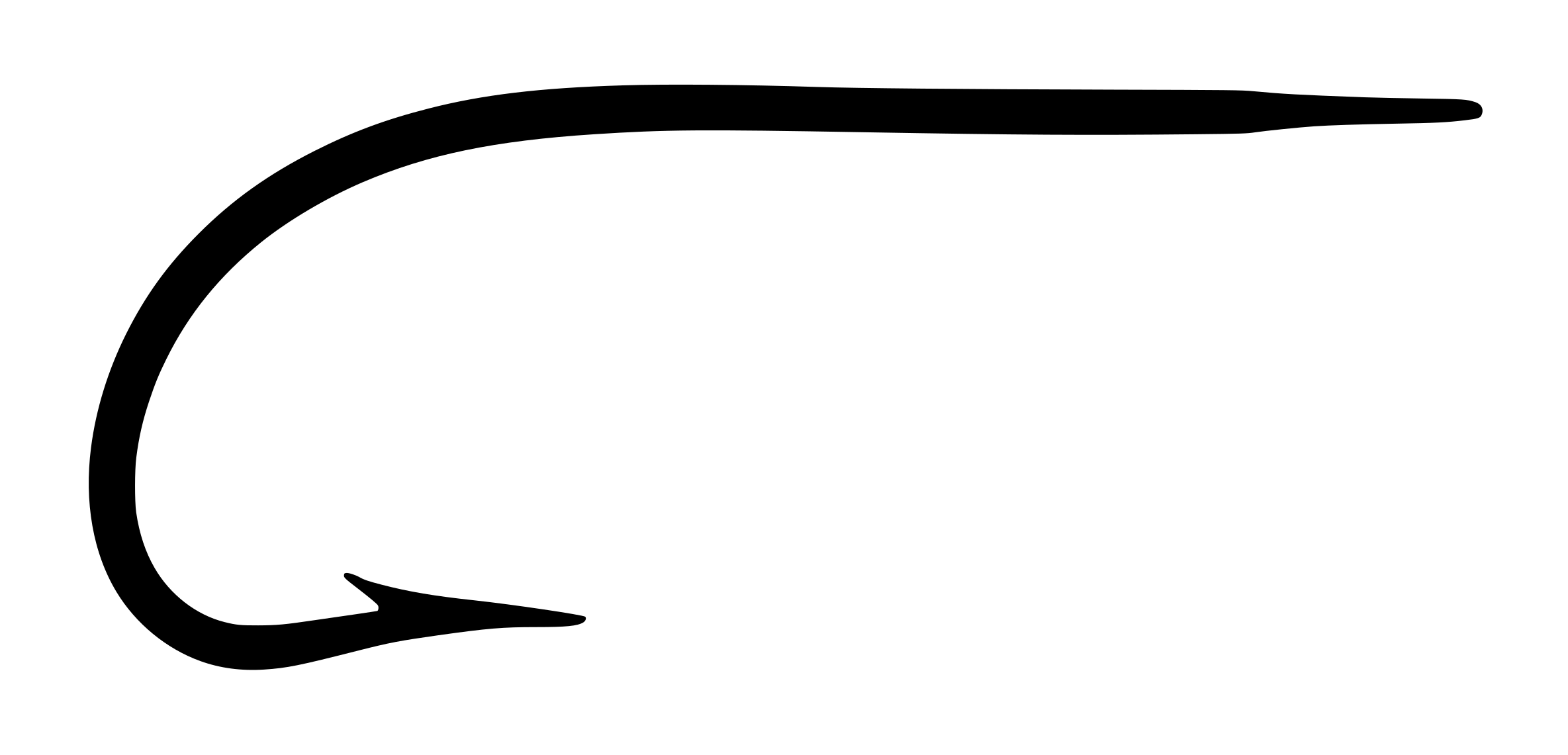
|
5515 No. 8/0 — Pflueger #5515 O'Shaughnessy Dublin Needle Eyed | 73% |
Matches: Bend, Shank, Wire, Gap, Forging +3 more Differs: Eye: Other vs Needle Eye; Point: Standard / Spear vs Superior; Finish: Tinned vs Bronzed +1 more |
Compare |
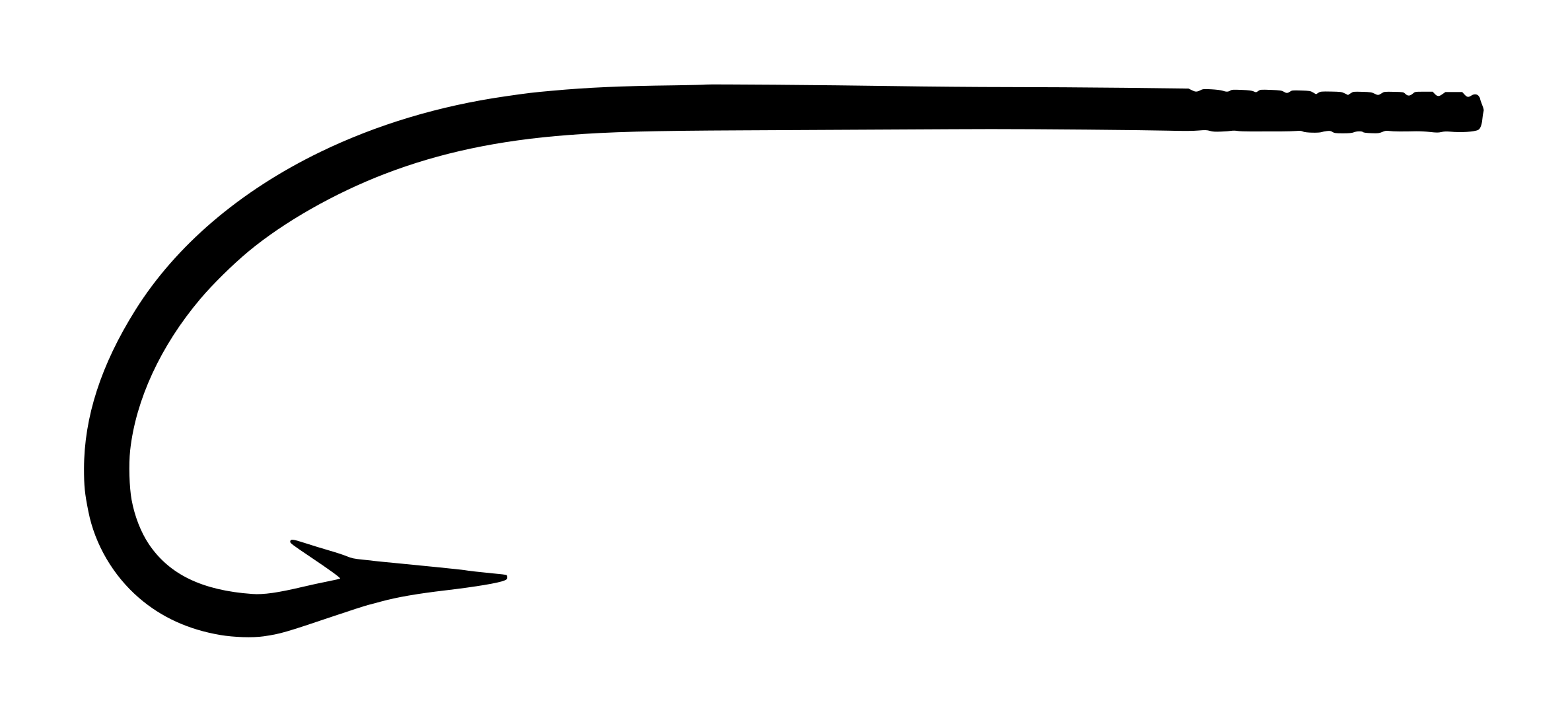
|
3411 No. 3/0 — Mustad 3411 — Blind Eye O'Shaughnessy | 69% |
Matches: Bend, Wire, Finish, Forging, Barb Differs: Shank: 2X Long vs Standard; Gap: Wide vs Standard; Eye: Other vs Blind — Marked Shank +3 more |
Compare |
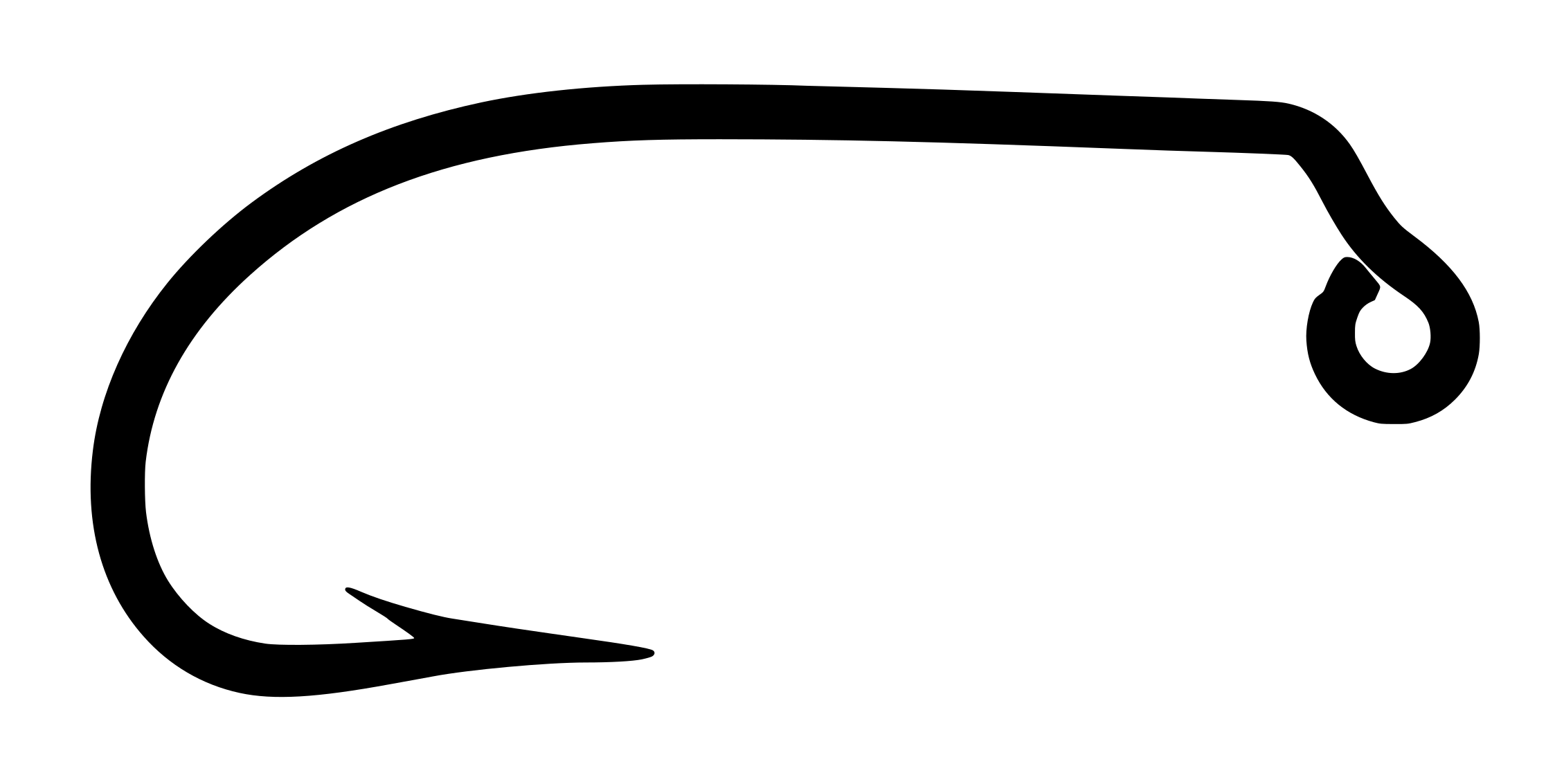
|
34185 No. 2/0 (V) — O'Shaughnessy Hook | 67% |
Matches: Bend, Wire, Finish, Forging, Shank Feat. +1 more Differs: Shank: 2X Long vs Standard; Gap: Wide vs Standard; Eye: Other vs Cross Eye +2 more |
Compare |
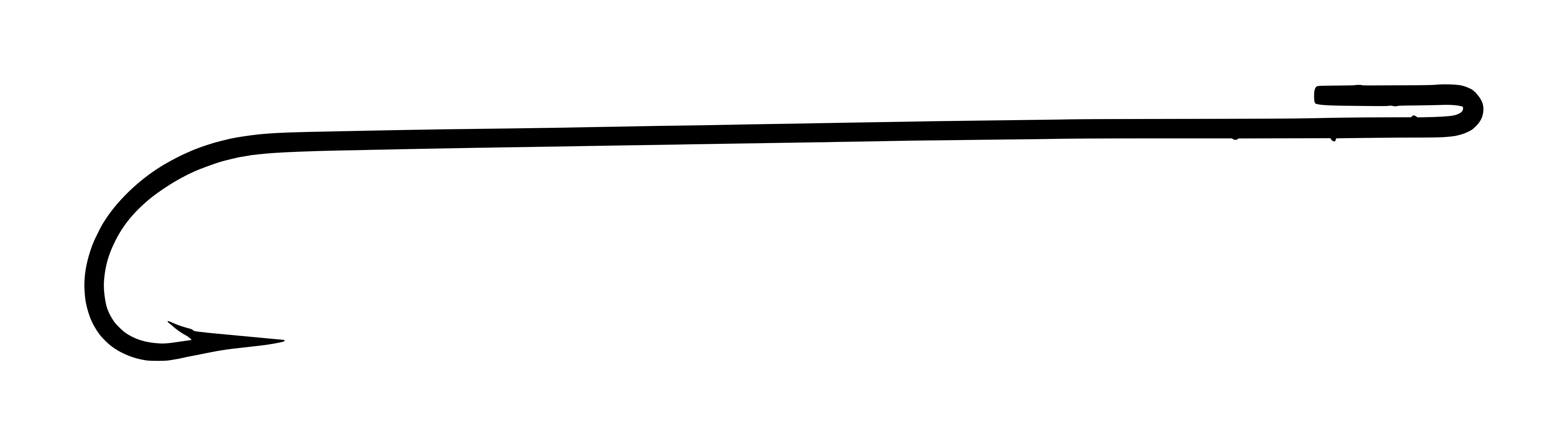
|
34002 No. 2/0 — O'Shaughnessy | 67% |
Matches: Bend, Wire, Eye, Finish, Forging +3 more Differs: Shank: 2X Long vs Special Long; Gap: Wide vs Standard; Point: Standard / Spear vs Superior +1 more |
Compare |
| M No. 4/0 (V) — Single Salmon | 67% |
Matches: Shank, Wire, Forging, Shank Feat., Barb Differs: Bend: O'Shaughnessy vs Limerick; Gap: Wide vs Standard; Eye: Other vs Looped Eye +3 more |
Compare |
Usage, Fly Patterns, and Equivalents
Primary Application
Designed as a large saltwater and salmon hook. The 6/0 size positions this specimen in the mid-to-large saltwater range, suitable for Atlantic salmon, sea trout, and estuary saltwater patterns. The O’Shaughnessy bend — characterized by its deep angular form — provides strong holding power under load. The forged heavy-wire construction enables both larger patterns and heavier casting demands. The tinned finish resists brackish-water corrosion, making it well-suited to sea-trout fishing in coastal zones and salmon angling in tidal waters.
Secondary Applications
Large streamer patterns in freshwater; pike and musky flies where heavy wire and substantial hook mass are desired.
Classic Fly Patterns
Omitted — specimen-specific documentation does not establish confirmed fly pattern associations.
Modern Equivalents
| Hook | Match Quality | Notes |
|---|---|---|
| Mustad C73SD (modern 7992 equivalent) | Good | Maintains O'Shaughnessy bend and heavy-wire specification; available in stainless steel and standard finishes. Functionally equivalent for saltwater and large salmon patterns. |
| Tiemco 800S | Moderate | Japanese-manufactured heavy saltwater hook with similar bend geometry; lacks tinned finish option in most modern production. |
Collectability and Value
| Rarity | Uncommon |
| Market Value (USD) | $8 – $18 |
| Packaging Condition | Good — moderate wear, legible |
| Packaging Format | GW-M-E-01 |
What makes this hook collectible: Complete original Mustad sales card from the 1950s–1960s period documents a distinct era in the company’s export operations. The decorative gold border design and offset printing represent characteristic mid-century Norwegian packaging aesthetics. The tinned finish and heavy wire specification reflect saltwater-angling priorities of the post-WWII era.
What limits the rating: Mustad’s industrial production volumes were substantial — the 7992 A was manufactured in tens of thousands across a 20+ year production run. Size 6/0 is neither exceptionally large nor exceptionally small; intermediate sizes rarely achieve scarcity status. Collector demand is narrow — primarily saltwater and salmon specialists, not general hook enthusiasts.
Most desirable variants: Sealed or near-sealed cards in original tissue command premiums. Larger sizes (8/0, 9/0) are slightly scarcer than 6/0. Smaller sizes (2/0, 4/0) are more common. Early packaging (pre-1955) with hand-printed or variant border designs adds marginal premiums.
Condition factors affecting value: Card integrity is critical — tears, water damage, or hook loss reduce value by 30–50%. Complete hook count is essential; a card missing even one hook drops 20–30% from the upper value range. Red tie-ribbons intact adds 10–15% premium. Toning and light foxing are acceptable and do not materially reduce value if printing remains legible.
Packaging
Sales card format with cream-colored cardstock featuring gold decorative snowflake border pattern and black line frame. Front displays die-cut window with hook specimen visible on card. Printed header: 'O. MUSTAD & SON - FISHHOOK MANUFACTURERS (Establ. 1832)' in gold serif type. Central information block in gold: 'Key / Brand / Qual. 7992 A / Dublin Point / Mustad-O'Shaughnessy Hooks / Forged / Soft shank bent inwards / Tinned / Made in Norway'. Bottom marked 'No.' with printed count designation. Size handwritten in purple ink as '6/0' in margin area. Red fabric tie-ribbons secure hook to card at two points. Ornamental key logo visible in top-left corner. Card shows light toning and minor foxing consistent with mid-20th-century storage.
Market Value Notes
Low ($8): Good condition — card opened, one or two hooks missing, moderate packaging wear, legible text.<br />
High ($18): Excellent condition — complete hook count, minimal packaging wear, tie-ribbons intact, original tissue if present.<br />
Premium factors: Early production (pre-1955), sealed or near-sealed packaging, complete unbroken hook count, original tissue wrapper, variant border designs, larger or smaller sizes outside the 4/0–6/0 range.<br />
Platforms: eBay (UK and US), specialized fishing tackle dealers, vintage tackle forums, occasional tackle auctions.<br />
Confidence: E estimated — limited recent sold data for this specific model code and size combination. Estimate derived from observed pricing patterns for comparable Mustad export cards (7991, 7990, 92620) of the same era and format. Range reflects uncertainty around current collector demand for Norwegian saltwater patterns.
Where to Find
eBay (UK and US listings for Mustad vintage saltwater cards), specialized fishing tackle dealers in Scandinavia and the UK, vintage tackle shows in northern Europe, online forums dedicated to vintage fly-tying hooks and saltwater patterns.
Storage and Preservation
Store the complete card in a cool, dry environment away from direct sunlight and moisture. Tinned finish is stable but can develop light patina in high-humidity conditions; this is cosmetic and does not affect structural integrity. Original cardstock should be protected from water damage — store vertically on a shelf rather than flat where condensation can collect. Avoid placing in plastic bags or airtight containers, which trap moisture and accelerate cardstock deterioration.
The red fabric tie-ribbons should be inspected periodically for brittleness; if they become fragile, do not attempt to remove them as this risks hook displacement. If the card develops minor foxing (brown spots), this is normal for cardstock of this age and does not require intervention. Do not attempt to clean the hooks with abrasive materials; light oxidation is acceptable and documents authenticity.
If loose hooks are removed for tying use, store the empty card in a separate archival-quality folder for reference documentation purposes. The card itself is now a historical artifact and should be preserved even if the hooks are consumed.
Handwritten Annotations
Size marking ‘6/0’ in purple ink appears in the lower margin of the card, handwritten in a bold cursive script consistent with mid-20th-century hand-marking practices. The stroke weight and ink tone suggest fountain pen or ballpoint pen in common use during the 1950s–1960s. This annotation was likely applied at the point of sale or during retail inventory, not at the factory — it represents evidence of the hook’s commercial handling through the tackle distribution chain.
No other handwritten marks, prices, or dealer notations are visible on this specimen. The marking does not constitute damage but rather documents the hook’s passage through the retail system of its era.
Packaging Text Analysis
The phrase ‘Soft shank bent inwards’ on the card packaging is notably specific and appears to be a direct translation from Norwegian manufacturing terminology. ‘Bent inwards’ refers to the angular geometry of the O’Shaughnessy bend — the shank material is formed inward beneath the barb rather than extending straight through. This language reflects Mustad’s technical documentation approach and suggests the card was designed for international markets where English-language buyers needed clear bend-family identification without relying on English colloquial names.
The designation ‘Mustad-O Shaughnessy Hooks / Forged’ explicitly claims forging as a manufacturing distinction — relevant to the era, when some competing hooks were drawn rather than forged. The assertion ‘Made in Norway’ was a point of manufacture pride during postwar Norwegian industrial expansion and served as a marketing differentiator against British Redditch products, which dominated the export market in earlier decades.
The absence of any safety warnings, material content disclosures, or modern regulatory language dates this packaging to the pre-1970s regulatory environment. The emphasis on ‘100’ (hook count) reflects the era’s standardization of card quantities — earlier Mustad cards sometimes contained variable counts (50, 75, 150), making the standardized 100-count a notable industrial norm by the 1950s.
Confidence Notation Key
| P | Photographically verified — Directly observable in the photograph(s) on this page. |
| V | Verified by documentation — Confirmed by manufacturer catalog, spec sheet, or published reference. |
| I | Inferred — A logical deduction from observable or documented evidence, not directly stated. |
| E | Estimated — An approximation based on visual comparison, proportional analysis, or limited data. |
| S | Speculative — A reasoned hypothesis that cannot be confirmed from available evidence. |
Claims with no notation are confirmed by multiple independent sources. All photographs on garrenwood.com are taken on a measurement grid where each square equals 1/10 inch (0.1″ / 2.54 mm).