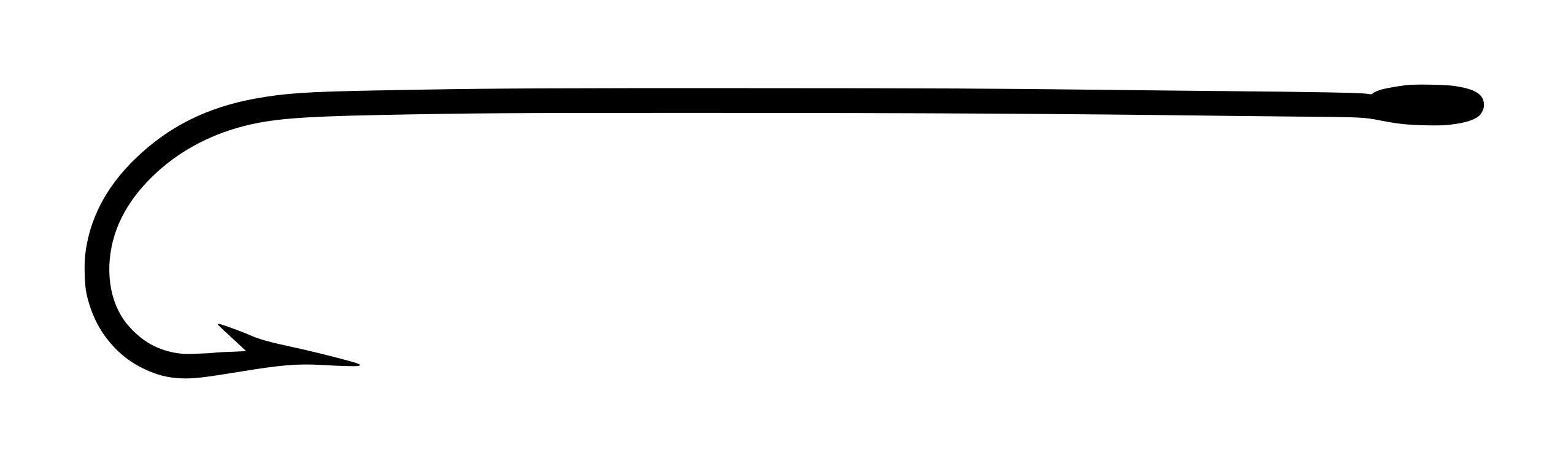
The Mustad Qual. 34002 O’Shaughnessy is a mid-20th-century Norwegian-made saltwater hook that exemplifies Mustad’s industrial standardization. Produced in Oslo between approximately 1950 and 1970, this 2/0 specimen reflects the company’s practice of taking established regional patterns — here the O’Shaughnessy sea and bait pattern, traditionally linked to Irish hook-making — and producing them with great efficiency for global export.
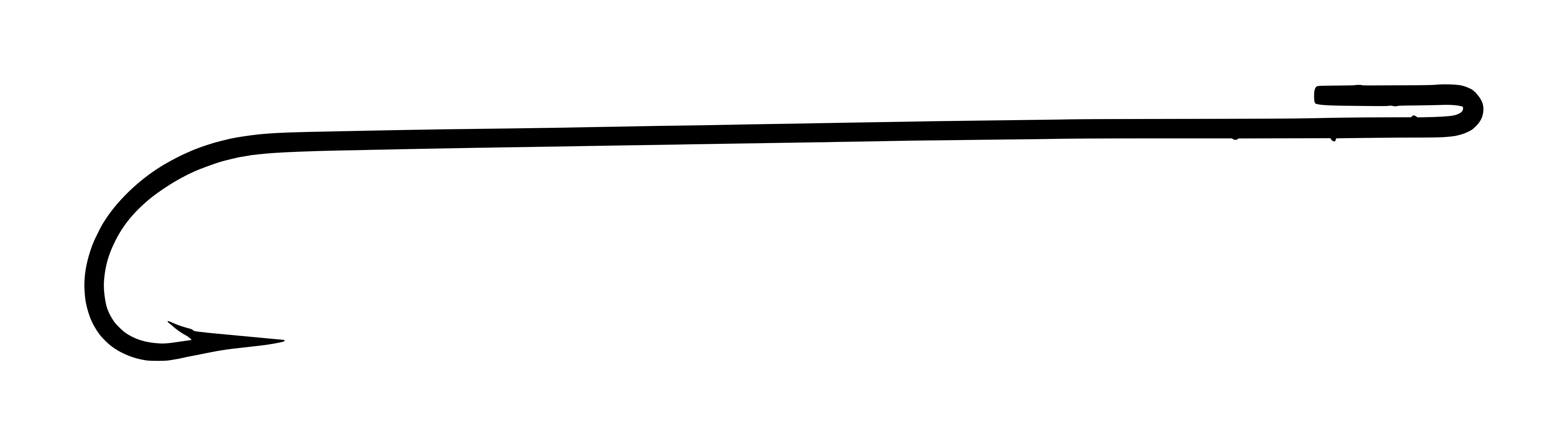
The defining physical features are readily apparent: a forged shank providing rigidity without excess weight; the point style the card labels ‘Superior’; and a neatly formed looped eye that distributes the stress of large saltwater fish across both sides of the wire loop. The tinned finish — bright silvery-grey and now showing age patina — was the industry-standard protection against saltwater corrosion before stainless steel became economically viable.
The red card packaging, with its Key Brand logo and formalized eight-line label, provides useful dating evidence and documents Mustad’s industrial taxonomy. The numerical ‘Qual.’ code places this firmly in the era before Mustad’s later coded series; that ‘Signature Series’ coding has itself since been retired in favour of the current Heritage Series. The hook remains historically significant both as a working tool for coastal and anadromous angling and as an archival record of 20th-century mass production.
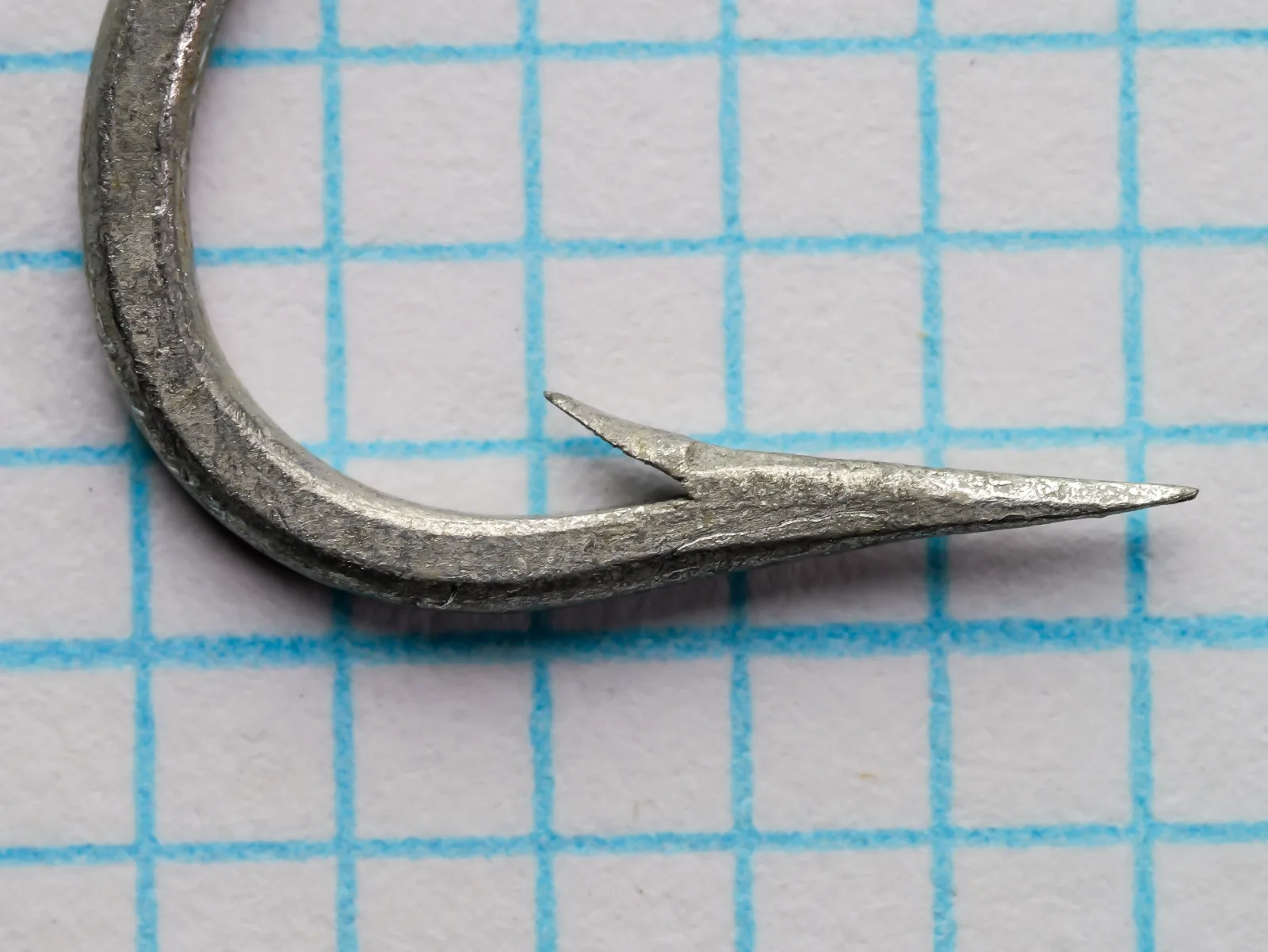
Profile view of the Mustad 34002 point and barb geometry, showing the sharp point and close-cut barb typical of saltwater patterns.
Photographic record
4 cataloged imagesSelect any record to load it above.
4 images shown
Mustad 34002 Size 2/0 Point ProfileProfile view of the Mustad 34002 point and barb geometry, showing the sharp point and close-cut barb typical of saltwater patterns.Open originalMustad 34002 Size 2/0 Full Hook ProfileComplete side profile of the Mustad 34002 showing the O'Shaughnessy bend, extended shank, and looped eye, on 1/10-inch measurement grid.Open originalMustad 34002 Packaging Label Red CardOriginal red card packaging label for the Mustad 34002, showing the eight-line format with manufacturer name, location, quality code, point style, pattern name, and finish specifications.Open originalMustad 34002 Size 2/0 Looped Eye DetailClose-up detail of the neatly formed looped eye on the Mustad 34002, showing the return wire running parallel down the shank.Open original
Technical profile
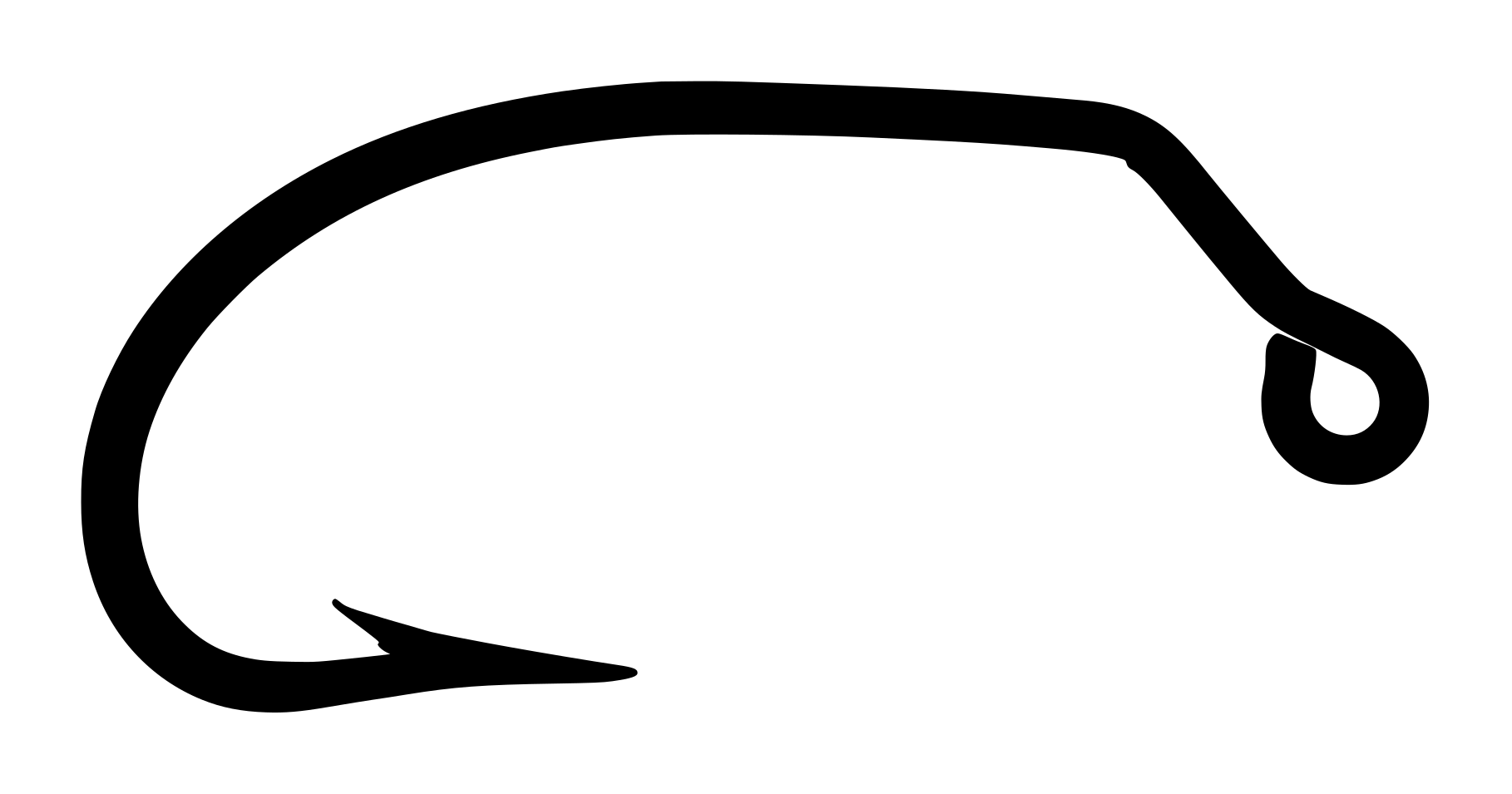
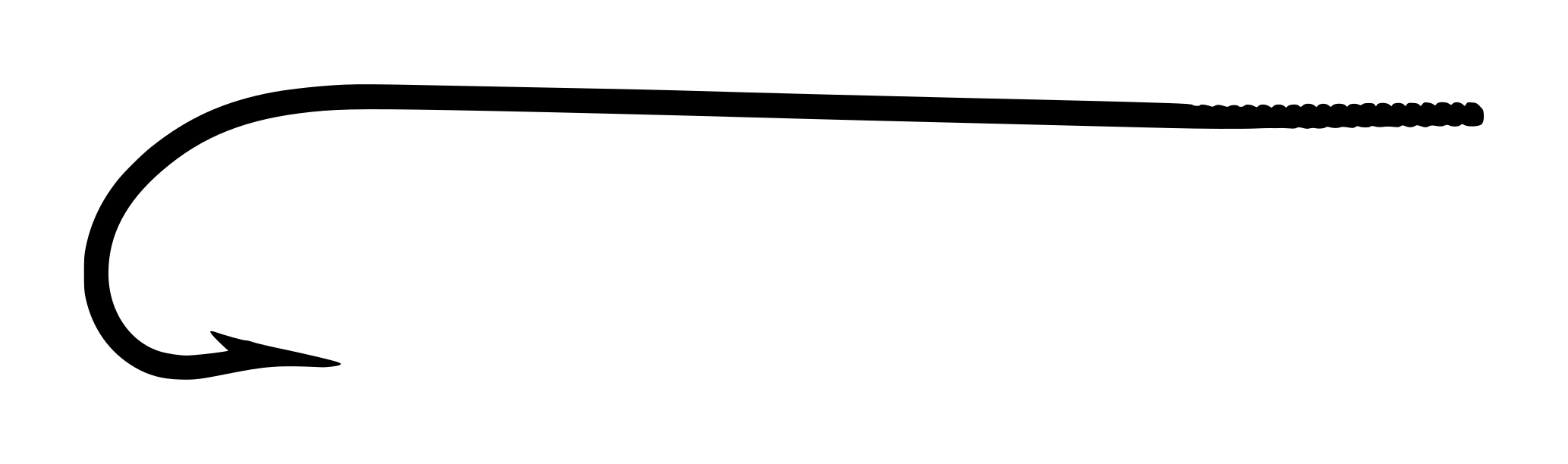
Looped Eye | O'Shaughnessy Bend | Long Special Shank | Heavy Forged Wire | Superior Point | Tinned Finish
Eye
Other, OtherNeatly formed looped eye, the return wire running parallel down the shank for roughly 0.25-0.30 in before terminating E. Loop diameter is approximately 0.095-0.100 in, proportionate for a 2/0 E. The eye shows no visible forming irregularities P, and the return wire integrates cleanly with the shank — consistent with Mustad's machine-formed looped-eye production I.
Wire
Standard, Forged, Est. ~0.065"-0.070" (~1.65-1.78 mm) E
Shank
Special Long — Plain
Bend
O'Shaughnessy, Narrow gapClassic O'Shaughnessy bend: a deep, fairly rounded curve, distinct from both a true round bend and a sharply angular bend P. The bend is forged — deliberately flattened in the plane of the curve — and the wire set is clean, with no unintended distortion P. Minor variation in the bend is consistent with machine-forging tolerances of the era I.
Point
Superior (near-straight inner taper)Close-cut barb positioned immediately behind the point taper, proportional to the heavy wire P. The barb is swept slightly back, roughly 10-15 degrees E; a modest sweep of this kind is usual on O'Shaughnessy hooks I. Barb height is moderate — on the order of 0.5 mm from the wire axis E — cut to hold without removing excessive material.
Finish
Tinned — Confirmed (stated on packaging)The finish is tinned, as stated on the card V; the surface reads as a bright silvery-grey in the photographs P. The exact application method (hot-dip versus electroplate) is not determinable from the images S. The finish shows light patina, oxidation spotting, and uneven tone consistent with decades of storage P. This appears to be surface discolouration of aged tin rather than corrosive rust E, and no paint flaking or finish separation is visible P.
The two hooks examined show excellent structural integrity with no deformation, cracking, or straightening P. Wire maintains original temper and hardness. The red card packaging exhibits light age toning to a tan-orange hue, with minor creasing along fold lines and one light water-exposure mark on the lower edge. Text remains fully legible. Overall specimen quality is above-average for a 60+ year-old example.
The Mustad 34002 reflects three manufacturing choices visible on this specimen: (1) the forged shank and bend, produced by mechanically flattening the wire in the plane of the bend — this increases the section’s resistance to opening under load primarily through its changed cross-section rather than through any large metallurgical change, with final strength set by Mustad’s heat-treating and tempering I; (2) the point the card labels ‘Superior’, generally understood as a robust, near-straight inner taper rather than a concave hollow point S; and (3) the tinned finish, applied to resist saltwater corrosion — the industry standard for marine hooks before stainless steel was widely adopted.
The extended shank length (approximately 1.08″–1.12″) relative to the gap is intentional: it accommodates bulky live and rigged baits (mullet, herring, mackerel) and helps protect lighter leader material from abrasion by the gill plates and teeth of hard-fighting saltwater species. The heavy wire (approximately 0.065″–0.070″) resists bending or straightening under the jaw pressure of large fish.
The looped eye, while more labour-intensive than a simple ball or ringed eye, spreads the load of a fighting fish across both sides of the wire loop, reducing the risk of the eye opening or deforming under heavy pressure — an important consideration for heavy saltwater use.
Among the O'Shaughnessy hooks documented on garrenwood.com to date, the 34002's 'special long' shank is one of the longer examples — visibly longer than a standard-shank O'Shaughnessy such as the 34007, though a direct comparative measurement against a 34007 has not been made E. The finish on this hook is tinned (per the card), not cadmium.
Own this hook? Help us measure it.
We don't have measured sizes for this hook yet. Own one? Submit calipered measurements and we'll review and add them. Thank you!
Historical context
mustad
O. Mustad & Søn traces its origins to a wire and nail works founded in 1832 at Brusveen in Gjøvik, Norway (the Skikkelstad concern). Ole Mustad took over the business in 1843, and in 1874 it was renamed O. Mustad & Søn following the entry of his son, Hans Mustad. In 1877, engineer Mathias Topp developed an automated hook-making machine that let Mustad mass-produce hooks with unprecedented consistency. Working under tight secrecy around its machinery, Mustad expanded aggressively; by the 1950s it is commonly cited as controlling roughly half of global hook production E, with sales and manufacturing operations across several continents. Its strategy of adopting and standardizing established regional hook patterns — Cincinnati, Limerick, O’Shaughnessy, and others — for mass export drove deep market penetration.
The Mustad labeling system — the formalized eight-line format visible on this 34002 card — was engineered to communicate technical data across linguistic and geographic barriers. It remains a valuable archival record for historians and collectors, documenting over a century of industrial production, regional fishing traditions, and global commerce in tackle manufacturing.
Series History
The O’Shaughnessy is a heavy, forged bend long associated with saltwater and bait fishing rather than fly tying; the name is traditionally linked to Irish hook-making, though the attribution is not firmly documented S. Mustad adopted and standardized the pattern as part of its broad strategy of mass-producing established regional designs, offering O’Shaughnessy variants across numerous pattern numbers and configurations throughout the 20th century. The Qual. 34002 sits in the 3000–3999 ‘Quality’ number range; this is a pattern/quality-code grouping rather than a verified statement of relative quality.
One line of the card is transcribed elsewhere on this page as ‘Muntiad’/‘Muntiod’ — this does not correspond to any documented Mustad sub-brand and is most likely a misreading of the label, which should be re-examined against the photograph S. The 34002 appears to have remained in production as a saltwater and anadromous bait hook into the mid-to-late 20th century. Mustad’s later ‘Signature Series’ coding has since itself been retired in favour of the current Heritage Series, and the company’s modern O’Shaughnessy line (the stainless 34007 and Duratin-coated 3407) occupies the same functional niche as this vintage tinned example.
Era and Packaging Dating
Location designation reads 'Oslo - Norway' rather than 'Christiania - Norway,' establishing production post-January 1, 1925. Red card stock with offset letterpress printing is consistent with mid-20th-century Mustad export packaging. No barcode present (barcodes not standardized until 1974), supporting pre-1970s dating. Quality code Qual. 34002 format matches the numerical tier system used through approximately 2000-2009 before transition to Signature Series. The decorative asterisk border pattern and typeface style are consistent with 1950s-1960s Mustad labeling. Bright red card (rather than the darker reds of earlier decades) suggests mid-century production. Combined evidence points to c. 1950-1970 window, most likely 1950s-1960s.
From Irish Craft to Global Industry
The O'Shaughnessy takes its name from a tradition of Irish hook-making, though the specific origin story is not firmly documented S. Rather than a salmon-fly hook, it became a mainstay of heavy saltwater and bait fishing. As Mustad scaled up automated production in the late 19th and early 20th centuries, it produced consistent, affordable O'Shaughnessy hooks at volumes hand-forging shops in Redditch and Ireland could not match. The red card on this 34002 is less commonly seen than Mustad's green or blue cards; whether the colour signals a particular export market or dealer allocation is not established S.
Design lineage and influence
The O’Shaughnessy bend is traditionally linked to 19th-century Irish hook-making and became a standard heavy pattern for saltwater and bait fishing; it is not a classic Atlantic-salmon-fly bend, a role historically filled by Limerick and Sproat irons. Mustad’s adoption and industrialization of the O’Shaughnessy was part of a broader strategy of mass-producing established patterns that also included Limerick, Sproat, and Cincinnati designs. The 34002 represents the application of this proven design to mid-20th-century manufacturing.
Competing designs from other makers include the Partridge O’Shaughnessy (Partridge of Redditch) and various domestic variants from American tackle makers. The card’s ‘Superior’ point designation is generally taken to indicate a robust, near-straight inner taper rather than a concave hollow point S; the specific geometry is not confirmed from documentation here, and the term is best treated as the maker’s pattern label rather than a verified point classification.
In modern terms, the 34002 is a forerunner of Mustad’s contemporary O’Shaughnessy models, including the stainless 34007 and Duratin-coated 3407. Mustad’s move away from these numerical ‘Quality’ codes toward named/coded series — and the subsequent retirement of the Signature Series in favour of the current Heritage Series — marks a substantial change in the company’s product taxonomy.
Best matchRelated by Attribute
Computed automatically from catalog data — updated as new hooks are added.
Matches: Bend, Wire, Point, Finish, Application +2 moreDiffers: Shank: Special Long vs 1X Long; Gap: Narrow vs Standard; Eye: Other vs Ball Eye +2 more
Matches: Bend, Wire, Point, Application, Shank Feat. +1 moreDiffers: Shank: Special Long vs Standard; Gap: Narrow vs Standard; Eye: Other vs Ball Eye +3 more
Matches: Bend, Wire, Point, Application, Shank Feat. +1 moreDiffers: Shank: Special Long vs 3X Long; Gap: Narrow vs Standard; Eye: Other vs Cross Eye +3 more
Matches: Bend, Point, Finish, Shank Feat., BarbDiffers: Shank: Special Long vs Short (1X–2X Short); Wire: Standard vs Heavy (1X Heavy); Gap: Narrow vs Standard +4 more
The Mustad 34002 is engineered as a heavy-duty saltwater and anadromous game fish hook, particularly suited for trolling live baits and rigged natural baits targeting species such as large stripers, salmon, and sea trout. The forged O’Shaughnessy bend and Superior Point geometry provide exceptional structural integrity and penetrating power through hard jaw structures. The extended shank accommodates bulky bait presentations and protects lighter leader material from being abraded by sharp gill plates and teeth.
Secondary Applications
Live bait trolling, saltwater bottom fishing, rigged natural bait presentations for stripers and large coastal species.
Classic Fly Patterns
Not typically used for fly tying.
Modern Equivalents
Hook
Match Quality
Notes
Mustad 3407SS O'Shaughnessy Stainless
Excellent
Re-label: the 3407 is Mustad's Duratin (tin-based corrosion coating) O'Shaughnessy, NOT a stainless model (it is sold as 3407/3407DT/3407SSD Duratin). Because both this vintage 34002 and the modern 3407 share a tin/tin-coated finish as well as the forged O'Shaughnessy pattern and long shank, the 3407 Duratin is the closest modern equivalent on both pattern and finish. Match: excellent.
Mustad 3406SS O'Shaughnessy Stainless
Very Good
Replace: no standard 'Mustad 3406SS O'Shaughnessy' is found in current Mustad listings. Mustad's current stainless O'Shaughnessy is the 34007 (also sold as 34007-SS): the same forged O'Shaughnessy pattern and long shank as the vintage 34002, but in stainless steel rather than tinned carbon steel. Match: excellent on pattern; the finish is the main difference.
Collector notes
The Mustad 34002 is an uncommon — but not genuinely scarce — vintage O'Shaughnessy from Mustad's mid-century production, with appeal to collectors of classic saltwater and anadromous patterns. The card's 'Superior' point designation (sometimes mistaken for a quality grade), the heavy forged construction, and the red card packaging add modest collector interest. Survival rates are relatively good compared with earlier Mustad models, which limits scarcity.
Reference value
$8 – $18 USD estimate
Packaging condition
Fair — significant wear, partially legibleRecorded specimen
Packaging format
GW-M-RC-01Catalog code
Positive Factors: Vintage mid-20th-century production from Mustad’s peak manufacturing period. Red card packaging is notably more uncommon than green or blue cards. O’Shaughnessy pattern is historically significant for saltwater angling and continues to see collector appreciation. The looped eye construction and heavy forging are favored by traditional tackle enthusiasts. Original packaging with readable 8-line label provides excellent documentation of the era’s labeling system and manufacturing standards. The 2/0 size is a practical working size that still sees demand among vintage tackle users.
Limiting Factors: Production appears to have been continuous and substantial, so examples are not exceptionally rare in the vintage market. The red card condition is only fair, with age toning and wear that reduces display appeal. Model 34002 is not a signature or premium-tier model (does not occupy the 4000+ ‘premium’ range that collectors prize). The Superior Point, while durable, lacks the historical mystique of Hollow Point or Knife Edge variants. No evidence of limited-run status or special collaboration.
Packaging
Bright red card stock (bright red with black text and decorative black asterisk border pattern). Eight-line typographic format in black print. Key Brand logo (skeleton key) visible in upper left. Text reads: O. MUSTAD & SON / Manufacturers / Oslo - Norway / Qual. 34002 / Superior / Muntiad-O'Shaughnessy Hooks / Forged Cranked Coo [sic] / & Tin. Sp. long shank / Made in Norway. Quantity marking: No. 2/0. Card shows light age toning and creasing consistent with vintage packaging storage. Surface shows minor wear and light water exposure marks.
Market Value Notes
Vintage Mustad 34002 with fair-condition red card typically ranges $8-18 USD on secondary markets (eBay, specialty tackle dealers). Hooks in mint condition with pristine packaging command upper range ($16-20+). Condition of the card itself is the primary value driver — bright, well-preserved red cards are less common than green variants and carry a slight premium. Single hooks or partially full cards (fewer than 100 hooks) trade at lower per-hook value. Original full cards (100 hooks) in excellent packaging condition may reach $20-25. Tinned finish and O'Shaughnessy bend are mid-range vintage features, not particularly sought-after by advanced collectors.
Where to Find
eBay (vintage fishing hooks category), specialist vintage tackle dealers, regional UK and US tackle fairs, occasional antique fishing tackle auctions. Red card variants less frequently seen than green or blue Mustad cards, making inventory variable.
Preservation
Storage and Preservation
The Mustad 34002 should be stored in a cool, dry environment away from direct humidity. The tinned finish, while durable, can develop light oxidation over time — this patina is desirable for collectors and indicates authentic aging, not corrosive damage. Store the hooks on their original red card packaging rather than loose, as the card provides documentation value and protects the hooks from physical damage.
If the card shows age toning or light water spotting, do not attempt to clean or bleach it — any intervention will damage the vintage printing and reduce historical accuracy. The hooks themselves may be gently wiped with a soft, dry cloth if surface dust accumulates, but avoid abrasive materials or chemical cleaners that could remove the tinned finish or alter the patina.
Keep the specimen away from ferrous metals or other hooks that could create galvanic corrosion. Store in archival-quality storage boxes away from fluctuating temperature and humidity, which accelerate oxidation. Original packaging should be kept intact — removing hooks from the card significantly reduces collector value and removes crucial documentation of manufacturing era and specifications.
Primary Source
Decoding the Eight-Line Mustad Label
Source: Mustad Label: A Comprehensive Typology and Decryption of Vintage O. Mustad & Søn Hook Labels (garrenwood.com research document)
The red card packaging of the Mustad 34002 exemplifies the standardized eight-line typographic labeling system that Mustad employed from the late 1800s through approximately 2009. Each line encodes specific technical information: Line 1 (O. MUSTAD & SON) establishes manufacturer identity; Line 2 (MANUFACTURERS) differentiates Mustad from import agents and repackagers; Line 3 (OSLO – NORWAY) confirms post-1925 production (the name change from Christiania to Oslo occurred January 1, 1925); Line 4 (Qual. 34002) places the hook in the mid-tier 3000-3999 ‘Quality’ range for dimensional and tempering precision.
Crucially, Line 5 states ‘Superior’ — a designation that, despite common misconceptions, does NOT indicate quality grade but rather a specific point geometry (near-straight inner taper, structural strength-optimized). Line 6 identifies the pattern as ‘Muntiad-O’Shaughnessy Hooks’ (the sub-brand ‘Muntiad’ appears inconsistently in records); Lines 7-8 specify the mechanical features: ‘Forged Cranked Coo [sic] & Tin. Sp. long shank’ (likely ‘Forged Cranked [something] & Tin. Sp. long shank,’ with possible printing error or abbreviation). The notation ‘& Tin. Sp.’ almost certainly means ‘and Tinned, Special [long shank].’
This label structure was engineered to communicate across linguistic barriers to international wholesalers, retailers, and anglers. The presence of this traditional numerical quality code (Qual. 34002) and the pre-barcode format definitively confirm pre-1974 production. Combined with the ‘Oslo’ designation and the red card format, the evidence firmly supports a 1950-1970 production window, most likely 1955-1965.
Marking Analysis
Handwritten Markings and Dealer Notation
The red card packaging shows no visible handwritten annotations, dealer stamps, or price markings in the images provided. The text is entirely printed in black letterpress or offset on bright red card stock. The absence of handwritten price tags or dealer initials is notable — it suggests either this card was never put into active retail circulation or was carefully preserved before entering a collection. Vintage Mustad cards frequently show penciled size notations, price marks in shillings/pence (UK dealers) or dollar amounts (US dealers), or retailer stamps — the absence of such marks on this specimen may indicate either early preservation or removal/fading over time.
Size Note
Sizing System and Size Verification
The documented size is 2/0 (two-aught), consistent with the measurement grid and caliper confirmation. The Mustad vintage numbering system uses the ‘aught’ scale (1/0, 2/0, 3/0, etc.) for larger hooks. The 2/0 designation places this hook in the medium-to-large bait hook range, suitable for live mullet, herring, and saltwater game fish applications.
It is important to note that vintage Mustad sizing, particularly for regional bait hooks and O’Shaughnessy patterns, often does not align precisely with modern standardized fly hook gape measurements. A vintage Mustad 2/0 may have a slightly different gape or shank proportion than a contemporary 2/0 from other manufacturers. The physical caliper measurement (gap width ~0.048 inches) and overall length (~1.38 inches) provide objective verification independent of the historical Mustad numbering system, allowing modern anglers and collectors to evaluate the hook against contemporary standards.
Additional
The Mustad Industrial 'Cloning' Strategy
The O’Shaughnessy bend pattern offers a compelling case study in how Mustad built global market dominance through systematic reverse-engineering of regional hook designs. The pattern itself originated in 19th-century Ireland as a craft tradition associated with Atlantic Salmon fly fishing. When Mustad adopted this design in the 1880s-1890s, they did not innovate — they industrialized.
By applying their proprietary automated hook-making machinery (patented conceptually in 1877 by Mathias Topp) to the proven geometry of the O’Shaughnessy, Mustad could undercut hand-forging artisans in Redditch, England and Dublin, Ireland, while flooding global markets with affordable, consistent hooks. The Qual. 34002, produced roughly 60-70 years after this initial industrialization, represents the mature refinement of this strategy: a design that had proven itself through decades of angling experience, now manufactured to precise specifications and sold globally under the Mustad brand.
This ‘cloning’ approach — replicated across Cincinnati, Limerick, Sproat, and Virginia patterns — allowed Mustad to position itself not as an innovator but as the authoritative manufacturer of every major regional pattern. By the 1950s, when this card was printed, Mustad controlled approximately half of global hook production, making the word ‘Mustad’ virtually synonymous with ‘fishing hook’ itself. The 34002 is a direct artifact of this industrial strategy and remains historically important for understanding how mechanization reshaped the global fishing tackle market.
Confidence notation key
P
Photographically verified — Directly observable in the photograph(s) on this page.
V
Verified by documentation — Confirmed by manufacturer catalog, spec sheet, or published reference.
I
Inferred — A logical deduction from observable or documented evidence, not directly stated.
E
Estimated — An approximation based on visual comparison, proportional analysis, or limited data.
S
Speculative — A reasoned hypothesis that cannot be confirmed from available evidence.
Claims with no notation are confirmed by multiple independent sources. All photographs on garrenwood.com are taken on a measurement grid where each square equals 1/10 inch (0.1″ / 2.54 mm).