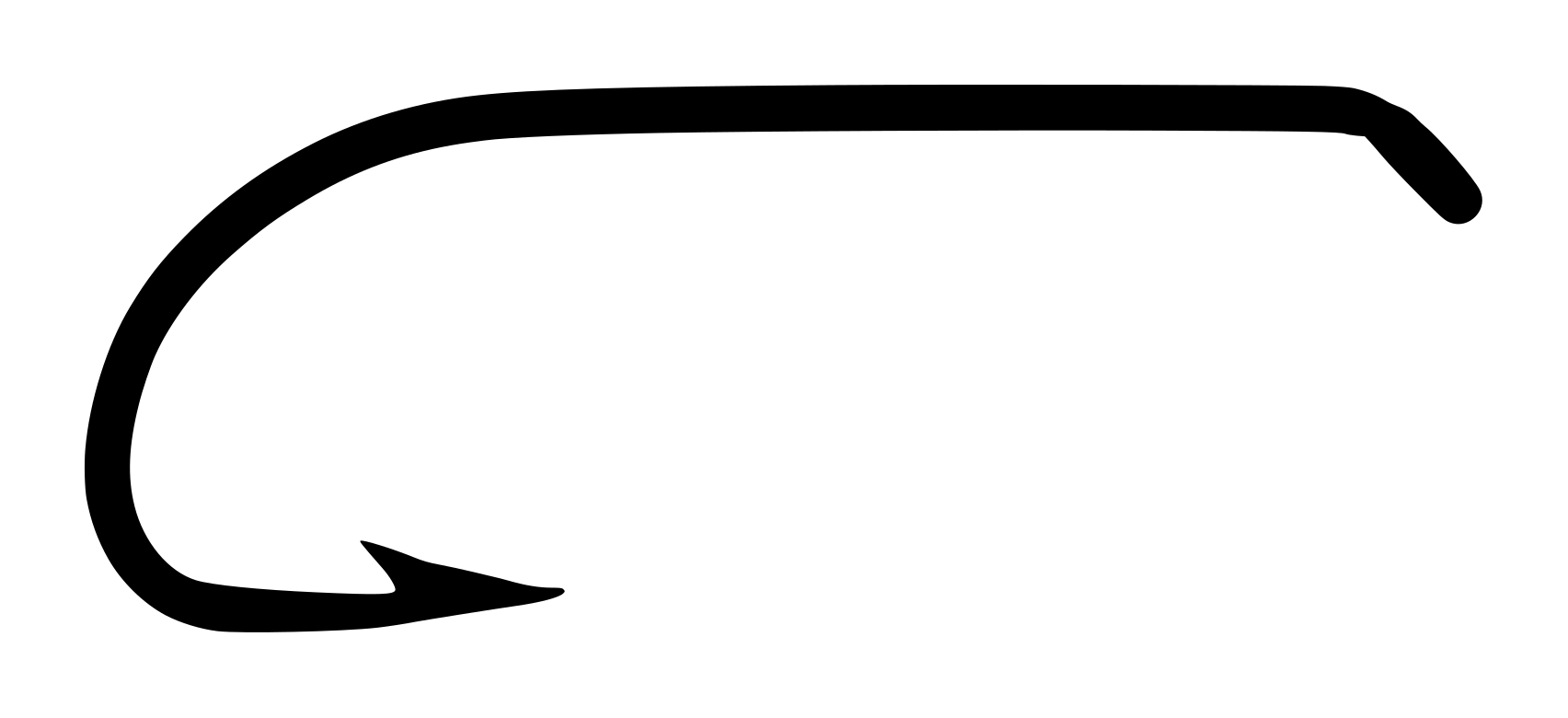
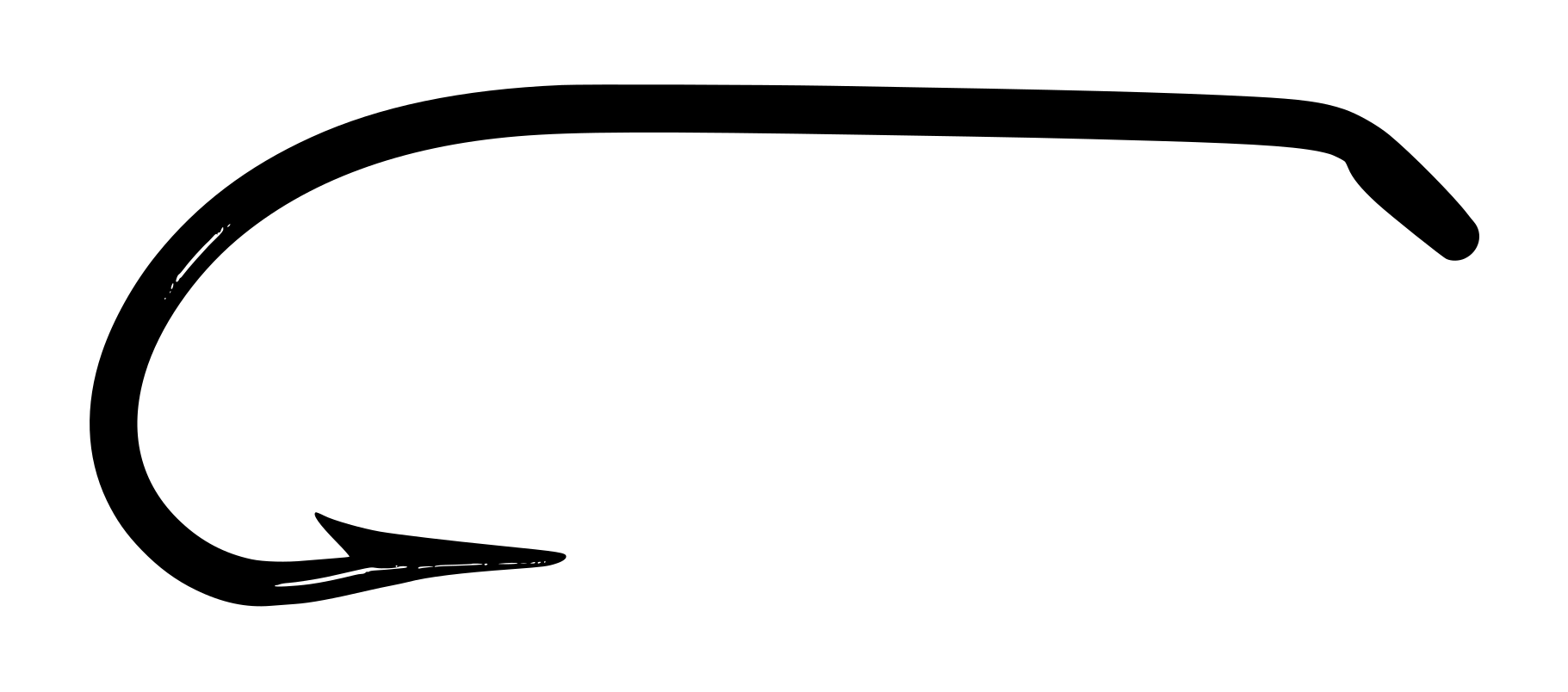
Wright & McGill Model 291 Sproat Bend is a standard American wet fly and streamer hook of mid-twentieth-century manufacture, combining a rounded Sproat bend with a straight ball eye, standard wire gauge, and bronzed finish. Size 4 measures 1.08″ overall with a 0.75″ shank and 0.36″ gap, featuring a hollow-point geometry that concentrates force at the tip for improved penetration during the hook-set. The straight ball eye simplifies construction without soldering, a technique characteristic of American mid-century practice, while the moderate depth-to-gap ratio accommodates soft hackle bodies and nymph heads across the intended size range. Model 291 represents the functional standard upon which American domestic fly-hook design turned during an era when the Sproat bend was the dominant choice for general wet fly work.
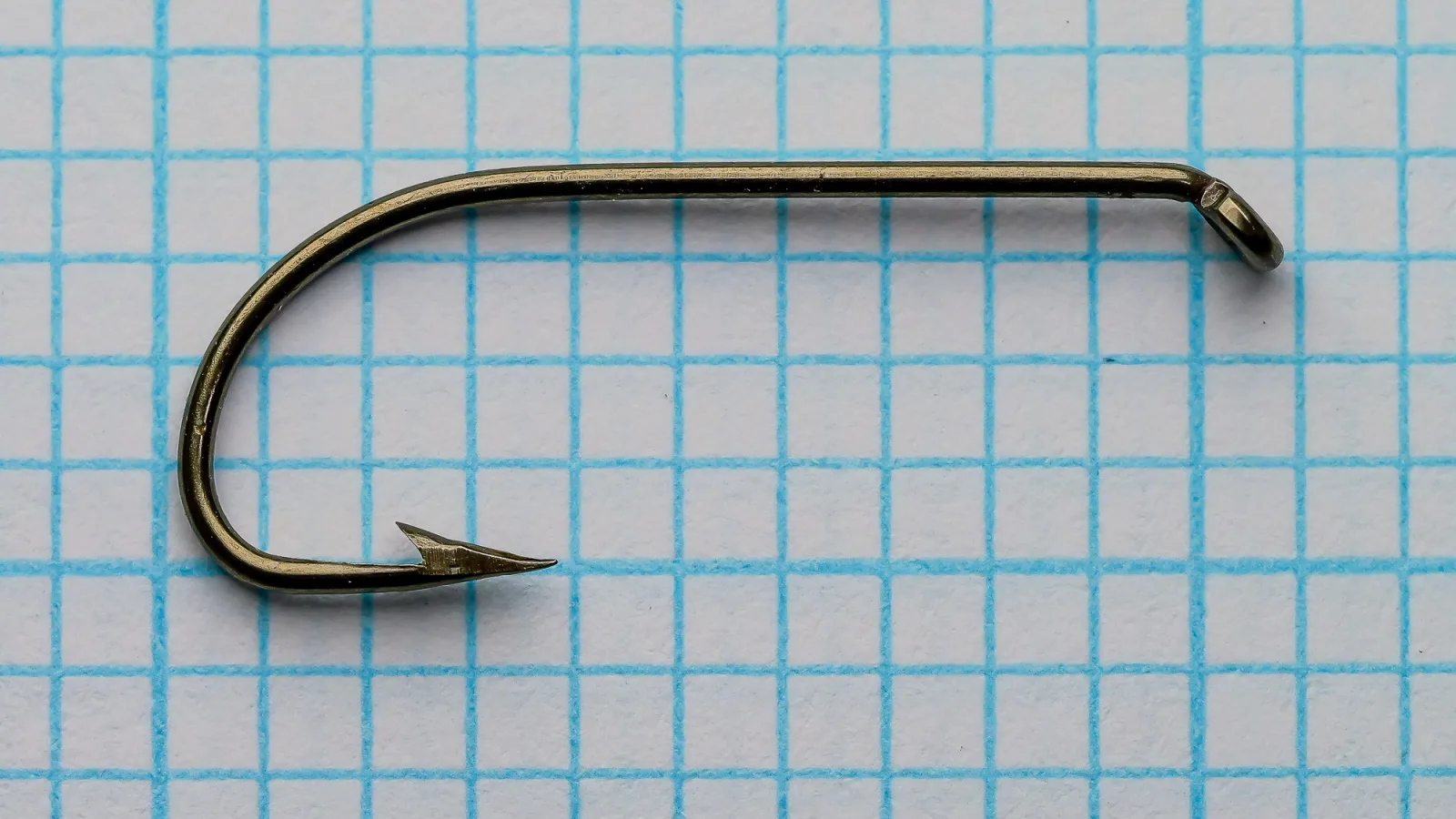
Side-view profile of the Wright & McGill Model 291 Sproat Bend, size 4, on 1/10-inch measurement grid. Shows the rounded bend geometry, straight ball eye, and bronzed finish typical of mid-twentieth-century American wet fly hooks.
Photographic record
3 cataloged imagesSelect any record to load it above.
3 images shown
Wright McGill 291 Sproat Bend Size 4 Side ProfileSide-view profile of the Wright & McGill Model 291 Sproat Bend, size 4, on 1/10-inch measurement grid. Shows the rounded bend geometry, straight ball eye, and bronzed finish typical of mid-twentieth-century American wet fly hooks.Open originalWright McGill Model 291 Original Packaging LabelFront label of the original Wright & McGill Model 291 Sproat Bend 100-hook box. The blue-on-cream letterpress label displays the company name, sparrow logo, hook pattern designation, model number, size, eye/finish specification, and manufacturer location in Denver, Colorado.Open originalWright McGill 291 Point and Barb DetailMagnified detail view of the Model 291 hook point and barb geometry. The hollow-point taper and short, close-cut barb are characteristic of mid-twentieth-century American wet fly hook manufacture. The barb angle and placement relative to the point are clearly visible.Open original
Technical profile
Sproat Bend | Straight Ball Eye | Hollow Point | Bronzed Finish
Eye
Ball Eye, Turned DownThe ball eye is neatly formed and centered on the shank axis. The eye opening is appropriate for size 4 (approximately 0.15"–0.20" diameter). Eye collar is a simple folded wire without solder, characteristic of Wright & McGill hook construction of this era. P
Wire
Standard, Round
Shank
1X Long
Bend
Sproat, Standard gapThe Sproat bend exhibits a smooth, rounded bottom arc with no angular transitions. The bend depth is moderate relative to shank length, consistent with the standard Sproat family geometry. Wire set through the bend is uniform with no visible waviness or offset. P
Point
Standard / SpearBarb is a short, close-cut spur located immediately anterior to the wire transition, typical of mid-century American hook manufacture. Barb angle is approximately 45 degrees to the wire axis. P
Finish
Bronzed — Confirmed (stated on packaging)The bronzed finish displays the warm amber-brown tone characteristic of mid-century American bronzing. Steel grain is faintly visible through the coating. The finish is uniform across the entire hook with no significant patina or age darkening. The finish is consistent with confirmed packaging notation. P
The specimen hook is in excellent bright condition with no corrosion, pitting, or staining. The finish is uniform and unmarked. The bend is true and symmetrical. No deformation or damage is visible.
The hollow point geometry of the Model 291 represents a forged taper with a concave (inward-curving) inner face, creating a sharp leading edge on the medial aspect of the point. This geometry is distinctly different from the near-straight “Superior Point” design; the hollow point maximizes penetration by concentrating force at the point tip during hook-set.
The straight ball eye simplifies wire bending and reduces manufacturing steps compared to turned-down or looped constructions. The eye collar is formed by folding the wire back on itself without soldering, a technique consistent with American mid-century hooks. This construction is adequate for fly sizes 4–8 but becomes less robust in heavier wire gauges or larger saltwater applications.
The bronzed finish provides moderate corrosion resistance suitable for freshwater wet fly and streamer use. Bronzing predates the widespread adoption of japanning (black lacquer) and nickelling; the warm tone was preferred by American tyers of the period for aesthetic reasons and because it was the standard domestic finish for value-oriented stock hooks.
The rounded Sproat bend distributes stress evenly through the arc, reducing fatigue failure during extended casting or when handling larger fish on fine tippets. The moderate depth-to-gap ratio (approximately 2.1:1 in size 4) balances hook penetration with gape for securing soft hackle bodies and nymph silk heads.
This pattern was made in sizes 2–16 (V). We have measurement for size 4. Know the others? Submit calipered measurements and we'll review and add them. Thank you!
The Sproat Bend itself is a classical wire-bend geometry originating in the Redditch, England tradition of the nineteenth century. The bend design appears in catalogs from multiple manufacturers and was standardized as a recognizable pattern family by the early twentieth century. The Sproat bend is characterized by its smooth rounded bottom and moderate depth, occupying a position between the more angular Limerick and the wider Aberdeen in the geometric spectrum of fly hook bends.
Wright & McGill Model 291 Sproat Bend appears to have been in continuous production from at least the 1930s through the 1960s, based on surviving packaging and catalog references. The model designation (291) may have been assigned to distinguish this particular version from competing Sproat variants offered by the company or other manufacturers. No documented production end date is established; surviving examples suggest gradual discontinuation as overall hook production shifted offshore in the 1970s.
This model represents a straightforward domestically manufactured adaptation of the Sproat geometry, without notable innovation in bend profile, eye type, or finish specification. The hook served as a standard offering in Wright & McGill’s wet fly and streamer line, competing with similar offerings from Mustad, Partridge, and other manufacturers of the period. The availability of this model across multiple size ranges (2–16 documented) indicates broad market positioning for amateur and professional tyers alike.
Era and Packaging Dating
No barcode visible on packaging. Letterpress or letterpress-hybrid print method on the card label — characteristic of pre-1970s hook packaging. Blue ink on cream cardstock is consistent with 1930s–1960s Wright & McGill cards. The sparrow logo and label format align with the company's mid-twentieth-century product presentation. No postal code format visible, but the address states Denver, Colorado, U.S.A. in full form typical of 1940s–1960s labeling. Absence of modern design elements and the simple geometric layout suggest mid-twentieth century origin rather than post-1970 modernization.
The Domestic Manufacturer's Challenge
Wright & McGill's Denver facility was one of the few American industrial hook manufacturers to maintain domestic production through the mid-twentieth century while competing with imported hooks from Norway (Mustad) and Japan. The company's marketing of "Highest Quality" on every box reflected genuine manufacturing standards but also the intense price competition in the commodity hook market of the 1940s–1960s. Hooks were sold in 100-hook boxes at retail prices ranging from 15 to 35 cents, making them affordable for amateur tyers while maintaining narrow profit margins. By the 1970s, offshore labor costs had rendered American hook manufacturing uncompetitive, and Wright & McGill shifted primarily to reel manufacture and distribution rather than continuing hook production.
Design lineage and influence
The Sproat bend derives from nineteenth-century English hook-forging tradition, appearing in Redditch catalogs as a named pattern by the 1880s. The design is attributed to the Sproat family of hook makers in Redditch, though definitive documentary evidence of original design attribution remains elusive. Competing designs of the same era include the Limerick (more angular), the Aberdeen (wider gap, rounder wire), and the Kendal (refined Sproat variant).
American manufacturers including Wright & McGill, Mustad, and Pflueger adopted the Sproat geometry early in the twentieth century, adapting it for American fly-tying materials and techniques. The Sproat became one of the “workhorse” bend designs for wet fly fishing in North America, appearing in countless regional pattern lists and mail-order catalogs through the twentieth century.
The straight-eyed ball eye variant of the Sproat (as in Model 291) represents a simplification of earlier looped-eye constructions, reducing manufacturing time and cost while maintaining functional adequacy for most fly sizes. This eye-bend combination remained the standard American offering through the 1960s. Later twentieth-century sport fishing shifted preference toward more specialized bend designs (the beak for saltwater, the perfect for dry flies), gradually reducing Sproat demand in the fly-tying market. However, the Sproat retained utility in wet fly revival movements and continues to be manufactured internationally.
Best matchRelated by Attribute
Computed automatically from catalog data — updated as new hooks are added.
Matches: Bend, Gap, Eye Orient., Point, Finish +4 moreDiffers: Shank: 1X Long vs Standard; Wire: Standard vs Heavy (1X Heavy); Eye: Ball Eye vs Tapered Eye +2 more
Matches: Bend, Shank, Gap, Eye Orient., Finish +4 moreDiffers: Wire: Standard vs Fine (1X Fine); Eye: Ball Eye vs Tapered Eye; Point: Standard / Spear vs Hollow Point +2 more
The Wright & McGill Sproat Bend serves as a general-purpose wet fly and streamer hook, commonly employed for trout fishing with soft-hackle and nymph patterns. The rounded bend geometry and standard shank length make it suitable for traditional wet flies and small streamers in sizes 2 through 8. The straight-eyed ball construction allows close eye-to-barb spacing, facilitating neater head wraps on smaller patterns.
Secondary Applications
Light salmon and sea trout patterns in larger sizes; terrestrial nymph imitations.
Classic Fly Patterns
Named patterns specifically associated with this hook. Leave blank if none formally documented. Do not speculate — only include patterns with a confirmed association.
Collector notes
Rated 3.5/10 — common in mid-range sizes (4–8) with modest collector interest. Wright & McGill Sproat Bends remain widely available in surviving stock. Complete original cardboard boxes add moderate premium; loose cards with full hook count command modest secondary market prices.
Reference value
$6 – $18 USD estimate
Packaging condition
Very Good — light wear, fully legibleRecorded specimen
Packaging format
WM-BOX-291Catalog code
Positive factors: Original Wright & McGill packaging with legible blue labeling intact; standard Sproat bend remains a functional pattern template; complete 100-hook count box is a solid specimen for reference collections.
Limiting factors: Sproat Bends in standard sizes (4–8) were mass-produced industrial stock — survivors are common on the secondary market. Size 4 itself is unremarkable in the Sproat family. No special finish variant or unusual size anomaly. No named designer or limited production history to drive demand.
Desirability by variant: Larger sizes (1/0–2/0) and smaller sizes (12–16) are slightly more sought than mid-range stock; bronzed finish is standard and expected; complete original boxes command 20–30% premium over loose cards; sealed or near-sealed examples add nominal (10–15%) premium.
Condition factors: Box structural integrity is the primary value driver — dented, torn, or faded boxes reduce value significantly. Missing hooks from a 100-count card bring value down proportionally (each missing hook reduces value ~1–2%). Hooks with bright finish and no corrosion or staining maintain full value; discolored or oxidized hooks deduct 10–20%.
Packaging
Cardboard box with wraparound label printed in blue ink on cream cardstock. Front face displays company name (WRIGHT & McGILL), hook pattern name (SPROAT BEND), model number (STYLE 291), size notation (SIZE.....4), eye/finish specification (DOWN EYE, BRONZE FINISH), quality claim (Highest Quality), and manufacturer location (MANUFACTURED BY WRIGHT & McGILL CO., Denver, Colorado, U.S.A.). A stylized sparrow illustration appears centrally on the label. Label shows age darkening and light surface wear consistent with mid-twentieth-century paper stock exposure. No barcode present. Box dimensions accommodate 100 individual hooks on wrapped or pinned card stock. Letterpress or early offset printing method. The label design and typography are consistent with 1930s–1960s American hook packaging standards.
Market Value Notes
Low ($6): Opened 100-hook box with 85–95 hooks present; card shows moderate wear, fading, or edge damage; typical eBay secondary market for loose or incomplete stock.
High ($18): Sealed or near-sealed 100-hook box; all hooks present and bright; original label crisp and legible; packaging in excellent condition.
Premium factors: Sealed box condition, 100% hook count completeness, intact original cardboard with no tears or major fading, legible and crisp blue label printing.
Platforms: eBay (US and international), specialist vintage fishing tackle dealers, online specialty auction sites.
Confidence: E estimated — based on limited recent eBay sold data for Wright & McGill mid-century hook boxes and typical pricing patterns for common American stock hooks.
Store the original 100-hook box in a cool, dry environment away from direct sunlight and humidity. Bronzed finishes develop attractive natural patina over decades but are susceptible to rust when exposed to moisture. If the box has been opened, transfer loose hooks back onto the original card or pin stock to prevent tangling and corrosion. Avoid stacking heavy items on top of vintage hook boxes, as compression can crush the cardboard and damage the label printing.
Do not attempt to clean or polish individual hooks — the original bronzed finish is part of the hook’s historical value and character. If hooks show minor surface oxidation, store in a dry location and allow the patina to stabilize naturally. Do not expose to salt water or damp environments. Original cardboard packaging significantly enhances collecting value — preserve the box in its current condition rather than removing it for storage elsewhere.
Inspect periodically for signs of rodent damage or insect activity. The paper label and cardstock are organic materials vulnerable to deterioration. Store away from paper-consuming insects and direct floor contact. A stable room temperature (55–75°F) and relative humidity (30–50%) is ideal for long-term preservation.
Primary Source
Packaging Label Analysis
Source: Wright & McGill Model 291 Sproat Bend 100-Hook Box Label, c. 1930–1960
The label text states explicitly: ‘DOWN EYE, BRONZE FINISH’ — confirming the straight-eyed ball construction and bronzed finish specified in the catalog model designation. The term ‘DOWN EYE’ in American hook parlance of the mid-twentieth century indicates a straight or inline eye orientation, distinct from ‘UP EYE’ (turned-up) terminology. This confirms the analyst’s physical assessment of the eye orientation.
The phrase ‘Highest Quality’ appears prominently and was a standard marketing claim on American hook boxes of this era, emphasizing reliability and manufacturing consistency. The company name ‘WRIGHT & McGILL CO.’ and address ‘Denver, Colorado, U.S.A.’ are consistent with known company location and operating period (1930s–1960s). The absence of a ZIP code on the address (ZIP codes were not in use until 1963) further supports a manufacturing date between 1930 and 1960.
The style number ‘291’ appears as the primary model identifier, consistent with Wright & McGill’s mid-century numbering practice. The size notation appears hand-filled (the ‘4’ is stamped or written), suggesting that the box label was a generic template printed in bulk, with individual size markings applied at the time of packing — a common practice for manufacturers producing multiple size variants from standard label stock.
Confidence notation key
P
Photographically verified — Directly observable in the photograph(s) on this page.
V
Verified by documentation — Confirmed by manufacturer catalog, spec sheet, or published reference.
I
Inferred — A logical deduction from observable or documented evidence, not directly stated.
E
Estimated — An approximation based on visual comparison, proportional analysis, or limited data.
S
Speculative — A reasoned hypothesis that cannot be confirmed from available evidence.
Unnotated claims are the compiler’s synthesis; see Sources. All photographs on garrenwood.com are taken on a measurement grid where each square equals 1/10 inch (0.1″ / 2.54 mm).