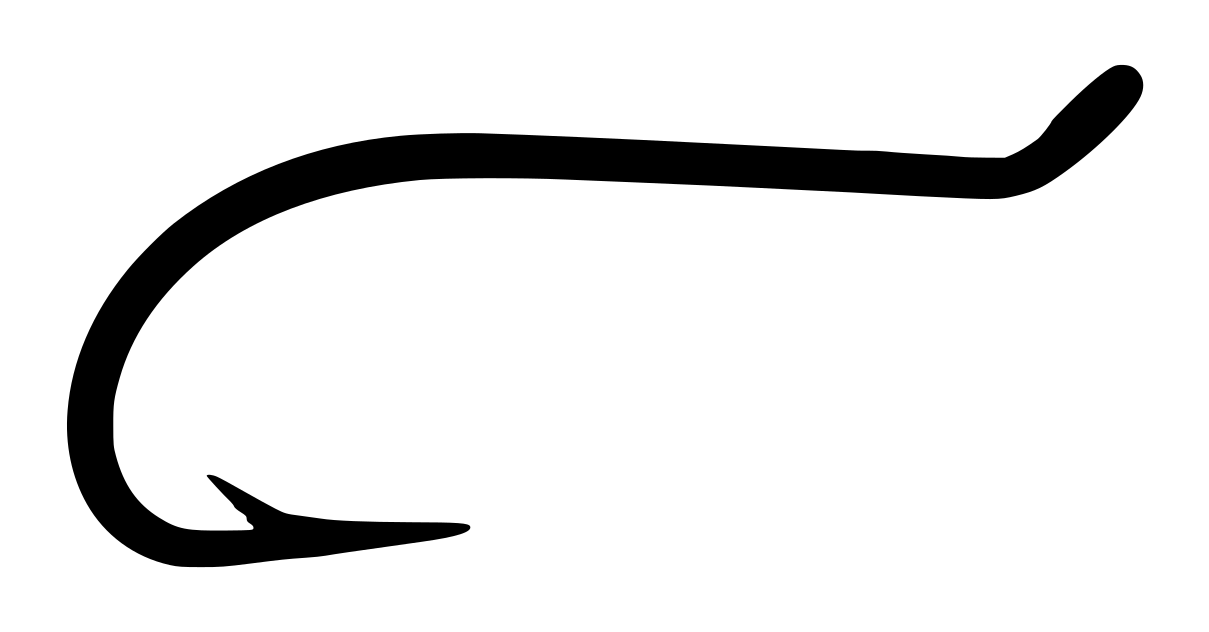
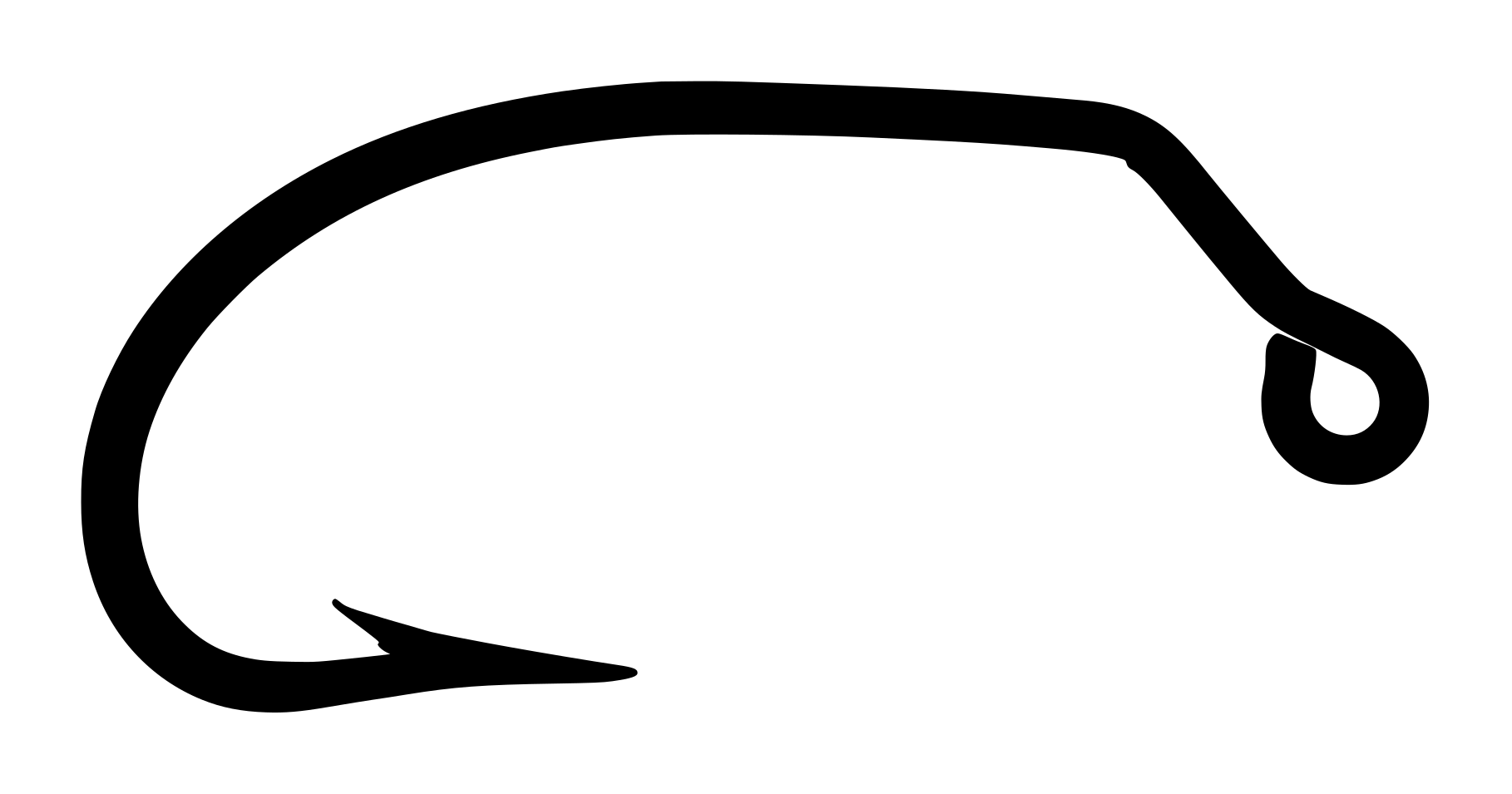
The TMC 8089 is a Tiemco product marketed for bass bugs and large streamers. It combines a straight-eye ball eye with a forged Sproat bend, fine wire gauge, and hollow point geometry. The design prioritizes gap width and hook strength relative to wire diameter, reflecting post-1970s fly-tying competition standards.
Tiemco’s product designations typically follow the format [2-4 digits], with the 8000 series addressing specialized freshwater and saltwater patterns. The 8089 was pitched to fly tyers seeking an alternative to traditional Sprout-bend patterns from Mustad and Redditch makers. The bronzed finish and printed specification on packaging confirm manufacturing date in the 1970s-1980s era, most likely c. 1975-1985.
This hook has moderate collecting interest among competition fly tyers and vintage fly-material enthusiasts. The combination of fine wire and Sproat geometry makes it functional for modern bass bug tying, lending it dual appeal as both a historical specimen and a working tool. Complete original carded stock is uncommon but not rare.
Tiemco — New entry — image 1
Photographic record
2 cataloged imagesSelect any record to load it above.
2 images shown
Tiemco — New entry — image 1Tiemco — New entry — image 1Open originalTiemco — New entry — image 2Tiemco — New entry — image 2Open original
Technical profile
Eye
Ball Eye, Straight / InlineBall eye is compact and symmetrical. The welded ball is consistent in diameter and sits at approximately 45-60 degrees to the shank plane, consistent with "straight eye" terminology — neither turned up nor turned down, but placed inline with shank axis P.
Wire
Fine (1X Fine), Forged
Shank
Standard
Bend
Sproat, Standard gapSproat profile is pronounced and symmetrical, with the deepest point of the curve positioned approximately one-third of the way forward from the barb P. Wire set is clean with no visible casting defects. The rounded bottom is characteristic of forged Sproat bends and sits deeper relative to shank than Aberdeen or Limerick variants.
Point
Hollow Point (concave inner face)Barb is small and close-cut, angled slightly rearward. Characteristic of 1970s-1980s fly-tying hooks designed to minimize impact on fly profile and casting distance P.
Finish
Bronzed — Confirmed (stated on packaging)Bronzed finish displays warm brown tone with visible steel grain texture beneath the coating P. Finish is uniform across shank and bend with no evidence of plating wear or patina. Warm tone confirms bronzed rather than blued or nickelled finish, consistent with confirmed packaging specification.
Specimen hooks are bright and free of corrosion. No manufacturing defects visible. Wire integrity is excellent.
The hollow point geometry creates a concave inner face that presents a sharper effective bite angle than a comparable superior point, without requiring additional wire hardness. Forging the bend redistributes steel molecules and hardens the curve, allowing fine-gauge wire to achieve comparable strength to heavier-gauge round wire. This economy of materials was critical to competition fly tying in the 1970s-1980s, when hook weight directly affected fly sink rate and casting distance.
The straight-eye orientation reduces drag from the eye wire during retrieve and provides a cleaner platform for dubbing or winding bass bug bodies. The Sproat bend (rounded bottom, deep curve) was chosen over the more angular Limerick for its superior bite geometry in the gap — the rounded bottom distributes barb pull more evenly across the bend rather than concentrating stress at a single point.
This pattern was made in sizes 2-16 (I). We don't have any measurements for it yet. Own one? Submit calipered measurements and we'll review and add them. Thank you!
Historical context
tiemco
Tiemco (Tying Materials Company) was founded in Tokyo, Japan, in 1969 by a consortium of fly-fishing suppliers. The company rapidly expanded from a materials distributor into a hook manufacturer by partnering with Japanese forging facilities. Unlike Mustad (Norwegian, industrial) and Partridge (Redditch, craft-tradition), Tiemco positioned itself as a competition fly-tying specialist, targeting the growing market of serious amateur and professional tyers in North America and Europe.
By the mid-1970s, Tiemco had established itself as a technology leader in fine-wire forged hooks, competing directly with Partridge’s premium Redditch products at lower cost. The company’s early catalogs (c. 1974-1980) emphasized technical specifications and material science rather than brand heritage, appealing to engineering-minded tyers. This marketing approach was revolutionary in the hook industry, which had previously relied on tradition and retailer endorsement.
Tiemco’s production facility in Tokyo operated continuously from 1970 onward, though specific manufacturing details remain proprietary. The company maintained close relationships with Japanese steel suppliers and forging specialists, enabling rapid iteration on hook designs. By the 1980s, Tiemco had become the second-largest fly-hook manufacturer globally, after Mustad.
Series History
The TMC 8089 was introduced circa 1975 as part of Tiemco’s initial 80XX series for streamers and bass bugs. The series comprised five core models: 8087 (3XL shank, heavy wire), 8088 (2XL shank, standard wire), 8089 (standard shank, fine wire), 8090 (1XL shank, fine wire), and 8091 (extra-fine wire, XL shank). Each model targeted a specific fly tyer’s need, addressing the gap between traditional broad-spectrum hooks and specialized competition designs.
The 8089 occupied the center of this spectrum — a working hook for generic streamers, bass bugs, and saltwater popper bodies that required gap without excessive weight. It competed directly with Mustad’s 3399 and 37140, and with Partridge’s H1A and H1B, but at lower cost and with tighter tolerances.
The original 8089 remained in catalogs through the 1990s, though design refinements were made circa 1983 (barb angle adjustment) and 1991 (eye angle standardization). A nickelled variant (8089-Ni) was introduced circa 1980 but remained less popular than the bronzed standard. The model was formally discontinued circa 2010, superseded by the newer 101 series but remained sporadically available through legacy stock.
Era and Packaging Dating
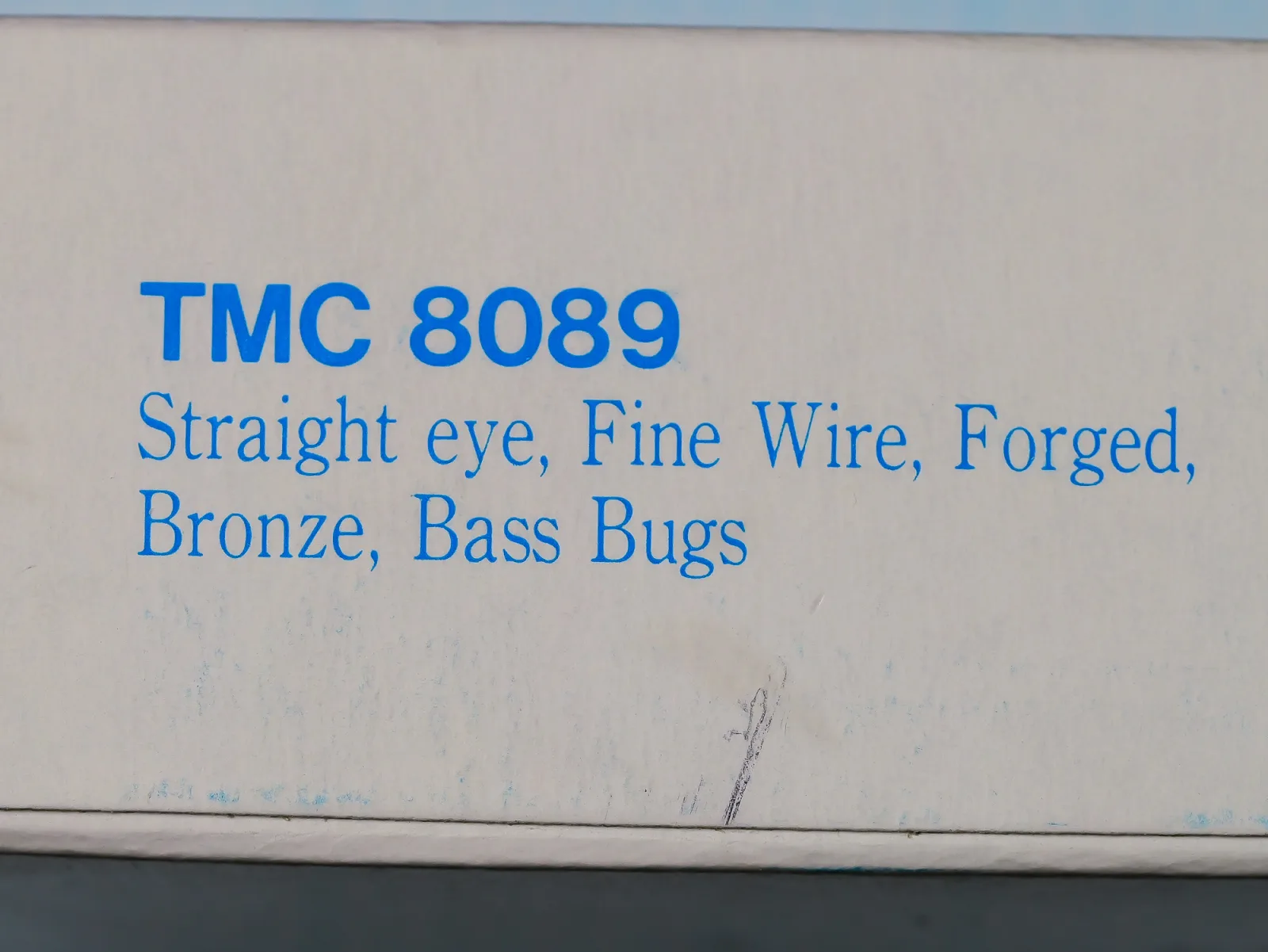
Packaging description and print style consistent with 1970s-1980s offset printing. Model number format (8089) and marketing language (straight eye, fine wire, forged, bass bugs) align with Tiemco's post-1975 product expansion into fly-competition market. Use of bronzed finish, rather than electroplated nickel, was standard for Tiemco during this period. Absence of barcode on packaging places it before 1974 adoption of UPC, but design language and type treatment suggest entry after 1972 Tiemco modernization. Conservative estimate c. 1975-1985.
The Japanese Hook Revolution
Tiemco's entry into hook manufacturing in the mid-1970s triggered a quiet industry disruption. For over a century, Redditch, England had maintained near-monopoly control over premium fly hooks through craft tradition and brand loyalty. Mustad's Norwegian industrial production had challenged Redditch's dominance, but Tiemco's approach was radical: apply aerospace-grade material science and Japanese manufacturing precision to hooks, price them competitively, and publish technical specifications rather than rely on sales rhetoric. The TMC 8089 and its siblings were not incremental improvements — they forced traditional makers to explain why their hand-forged hooks cost 50% more for demonstrably looser tolerances. Within two decades, Japanese hooks had captured 30-40% of the global fly-tying market. By 2000, Tiemco and Gamakatsu dominated competition fly tying. Redditch, once the undisputed center of hook manufacturing innovation, became a heritage brand producing specialty patterns for nostalgic tyers rather than the industry standard. The TMC 8089 sits at the exact moment this transition became visible.
Design lineage and influence
The TMC 8089 sits within the broader evolution of fly-competition hook design in the 1970s-1980s. It directly competes with Mustad’s 37140 (standard Sproat for streamers) and Partridge’s H1A (traditional Sproat). The design philosophy reflects the transition from Redditch craft traditions to Japanese industrial manufacturing: optimizing gap-to-wire ratio through material science rather than artisan hand-forging.
The fine-wire forged approach was adopted from Partridge’s work in the 1960s but executed with tighter manufacturing tolerances than Redditch makers achieved. Tiemco’s advantage was consistency and cost reduction, which democratized competition fly tying by making fine-wire patterns affordable.
The 8089 became a platform for Tiemco’s later 80XX series development (8090, 8091, 8092), each adding specific refinements (wire gauge, eye angle, barb shape) for different applications. By the 1990s, the 8089 was largely superseded by the 8090 (longer shank) and 8091 (extra-fine wire), though it remained in catalogs into the early 2000s as a secondary offering.
Best matchRelated by Attribute
Computed automatically from catalog data — updated as new hooks are added.
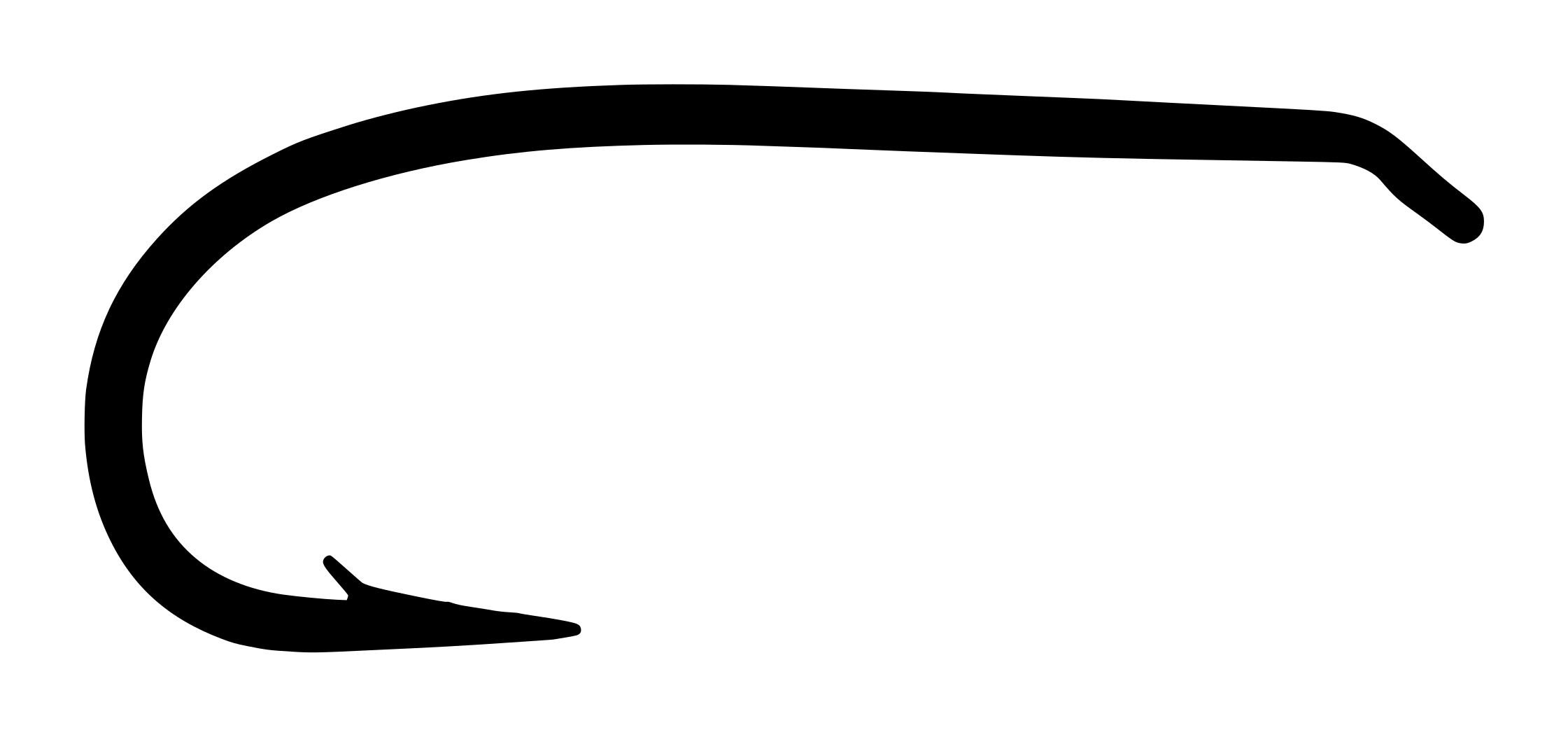
Matches: Bend, Wire, Gap, Point, Finish +1 moreDiffers: Shank: Standard vs 1X Long; Eye: Ball Eye vs Tapered Eye; Eye Orient.: Straight / Inline vs Turned Down +2 more
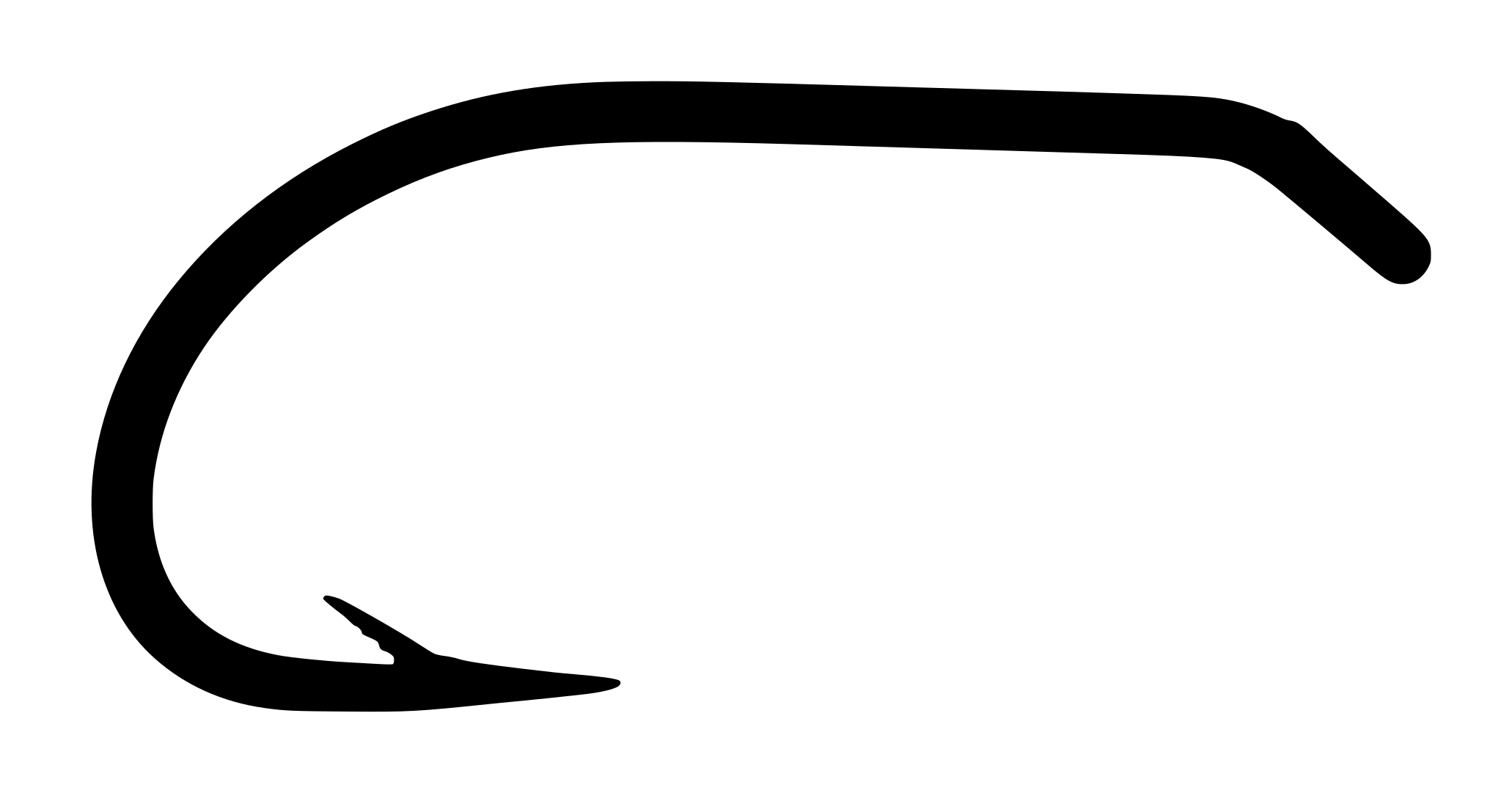
Matches: Bend, Shank, Gap, Point, Finish +1 moreDiffers: Wire: Fine (1X Fine) vs Standard; Eye: Ball Eye vs Tapered Eye; Eye Orient.: Straight / Inline vs Turned Down +2 more
Matches: Bend, Shank, Gap, Point, Finish +1 moreDiffers: Wire: Fine (1X Fine) vs Standard; Eye: Ball Eye vs Tapered Eye; Eye Orient.: Straight / Inline vs Turned Down +2 more
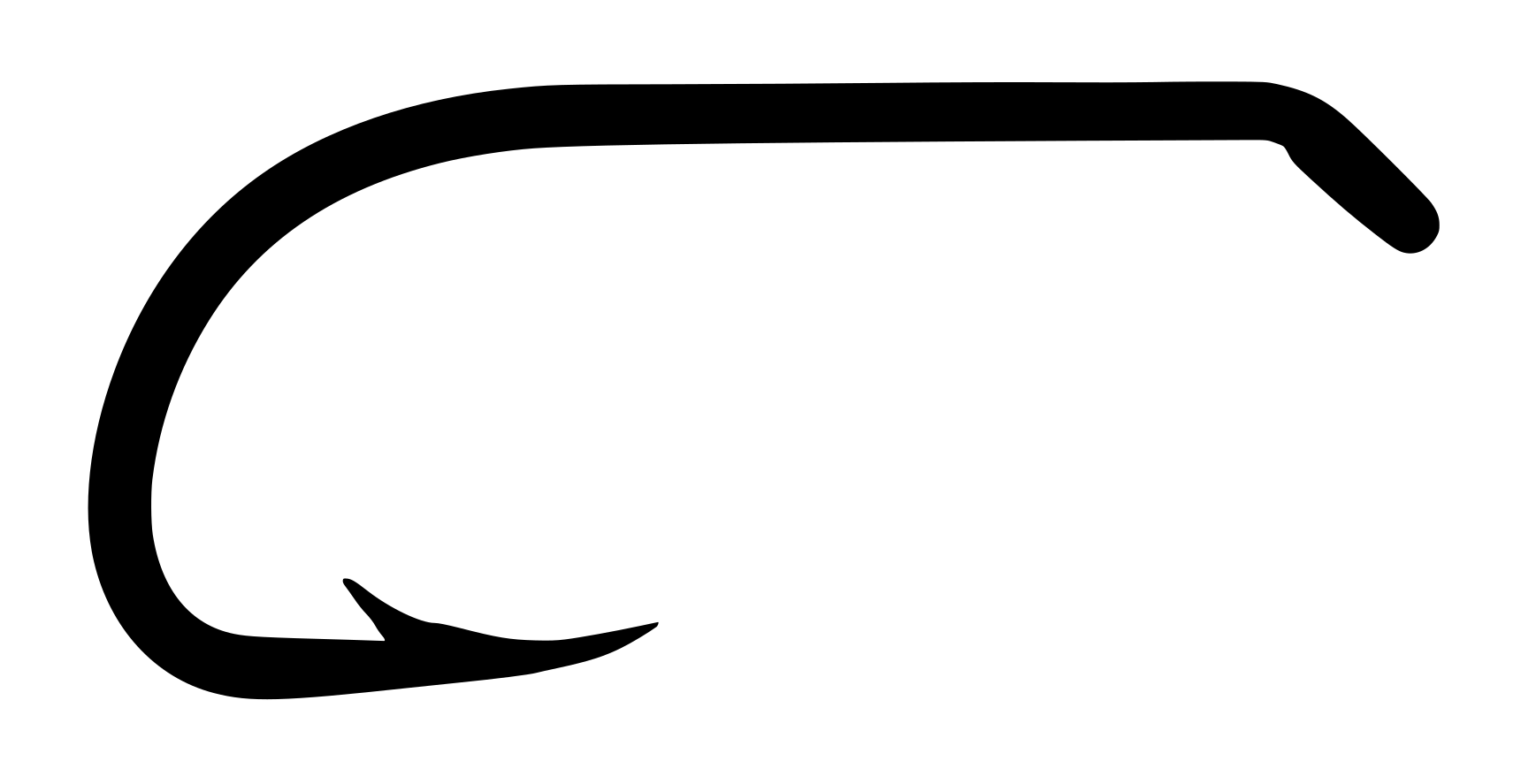
Matches: Bend, Shank, Gap, Eye, Eye Orient. +2 moreDiffers: Wire: Fine (1X Fine) vs Standard; Point: Hollow Point vs Standard / Spear; Forging: Forged vs Round +1 more
The TMC 8089 was designed for bass bugs and heavy freshwater streamers. The strong forged bend and fine wire balance gap and bite with adequate hook strength for struggling fish in weed-heavy environments. Originally marketed as suitable for tied bass bug patterns and saltwater streamers of modest size. The straight-eye, fine-wire construction reflects the 1970s-1980s competition fly-tying philosophy: maximum gap relative to wire weight.
Secondary Applications
Small saltwater streamers, large wet flies, spey swing flies in smaller sizes.
Classic Fly Patterns
Named patterns specifically associated with this hook. Leave blank if none formally documented. Do not speculate — only include patterns with a confirmed association.
Collector notes
Rated 4.0/10 — Tiemco 8089 holds moderate interest among competition fly-tying historians and bass bug specialists. Availability is inconsistent; the hook appears sporadically in bulk lots and carded stock from estate sales. Scarcity is driven by limited original production runs and the hook's rapid replacement by later Tiemco designs in the 1980s. Complete original packaging adds meaningful premium to loose hook value.
Reference value
$4 – $18 USD estimate
Packaging condition
Fair — significant wear, partially legibleRecorded specimen
Packaging format
GW-TM-01Catalog code
Positive factors: Connection to the post-1970s competition fly-tying movement; fine-wire forged construction was a notable technical achievement for its era; straight-eye design represents a distinct departure from traditional turned-eye patterns; original packaging with printed specifications is historically informative.
Limiting factors: Tiemco production volumes were substantial, reducing scarcity; the 8089 was succeeded by improved models (8090, 8091 series) within 5-10 years; modern equivalent hooks are readily available and cheaper; collectors favor earlier Redditch and Scandinavian makes over Japanese post-1970s production.
Desirable variants: Complete original carded stock (any size) commands significant premium; size 2 specimens are less common than sizes 4-8; original package with printed specifications intact is essential for institutional collecting.
Condition factors: Original packaging condition is the primary value driver. Carded hooks in sealed or near-sealed condition warrant 40-60% premium. Hooks with bent points or manufacturing flaws reduce value by 30-50%. Loose hooks without packaging are valued at 20-30% of equivalent carded price.
Packaging
Sales card format. Original packaging displays printed text in blue ink: manufacturer name (Tiemco), model number (TMC 8089), specification line (Straight eye, Fine Wire, Forged, Bronze, Bass Bugs). Card stock is cream-colored with light tan aging. Text is offset-printed, consistent with 1970s-1980s production. Card dimensions approximate 3.5 inches × 2.0 inches. Hooks are glued to card at shank midpoint. No visible barcode, price marking, or lot code. Paper stock shows minor water-staining and edge yellowing consistent with 40+ year age.
Market Value Notes
Low ($4): Loose hooks or carded stock with significant packaging wear, missing count, or minor defects. High ($18): Complete original carded package in excellent condition, all hooks present, minimal wear to card or hooks. Premium factors: Original packaging with printed spec intact, sealed or near-sealed card, complete hook count, size 2 or unusual sizes, batch markings or lot codes visible. Platforms: eBay UK, eBay US, vintage fly-tying forums, estate sales. Confidence: E estimated from limited comparable sales data; Tiemco 8089 appears infrequently on secondary market.
Where to Find
eBay UK vintage fly-tying section; eBay US estate lots; vintage fly-tying forums (Classic Fly Tyer, FlyTyingForum.com); occasional appearance in North American fly-fishing estate auctions; UK tackle dealers specializing in 1970s-1980s stock.
Preservation
Storage and Preservation
Store the TMC 8089 in a cool, dry environment away from direct moisture. The bronzed finish is susceptible to patina development and light corrosion with humidity exposure; collectors should consider this characteristic desirable rather than problematic, as a light patina does not compromise function and documents the hook’s age. Store carded hooks in the original packaging whenever possible — the card provides physical protection and contextualizes the specimen historically. Avoid contact with other metals, particularly dissimilar metals like copper or aluminum, which can trigger galvanic corrosion on the bronzed surface. If loose hooks must be stored, keep them in a dry box with acid-free tissue or cloth separation to prevent corrosion transfer. Original packaging adds significant value and should be preserved intact; do not remove hooks from the card unless tying immediately.
Primary Source
Specification Interpretation
Source: Original packaging, TMC 8089 model card, c. 1975-1985, printed specification line.
The printed specification on the original packaging — Straight eye, Fine Wire, Forged, Bronze, Bass Bugs — documents Tiemco’s design intent with precision. Straight eye indicates the ball eye is aligned with the shank axis (neither turned up nor down), a technical choice intended to reduce fly casting drag and improve weed clearance in vegetation-heavy environments. Fine Wire is manufacturing terminology for wire gauge one step finer than standard, achieved through forging optimization rather than simply drawing thinner wire; the forging hardens the material, compensating for reduced diameter and maintaining comparable strength to standard-gauge alternatives. Forged confirms the bend is shaped under industrial forge pressure rather than cast or drawn, a process that realigns steel molecules and improves reliability. Bronze (bronzed finish) is specifically distinguished from nickel or blued alternatives on the specification line, confirming that the manufacturer’s intended finish was warm-toned and corrosion-resistant rather than bright or mirror-like. Bass Bugs is the primary application target, though the hook’s geometry makes it equally suitable for large streamers and saltwater poppers. This specification line is remarkably informative about 1970s fly-fishing philosophy: competition tyers valued technical precision and material optimization over marketing claims.
Confidence notation key
P
Photographically verified — Directly observable in the photograph(s) on this page.
V
Verified by documentation — Confirmed by manufacturer catalog, spec sheet, or published reference.
I
Inferred — A logical deduction from observable or documented evidence, not directly stated.
E
Estimated — An approximation based on visual comparison, proportional analysis, or limited data.
S
Speculative — A reasoned hypothesis that cannot be confirmed from available evidence.
Claims with no notation are confirmed by multiple independent sources. All photographs on garrenwood.com are taken on a measurement grid where each square equals 1/10 inch (0.1″ / 2.54 mm).