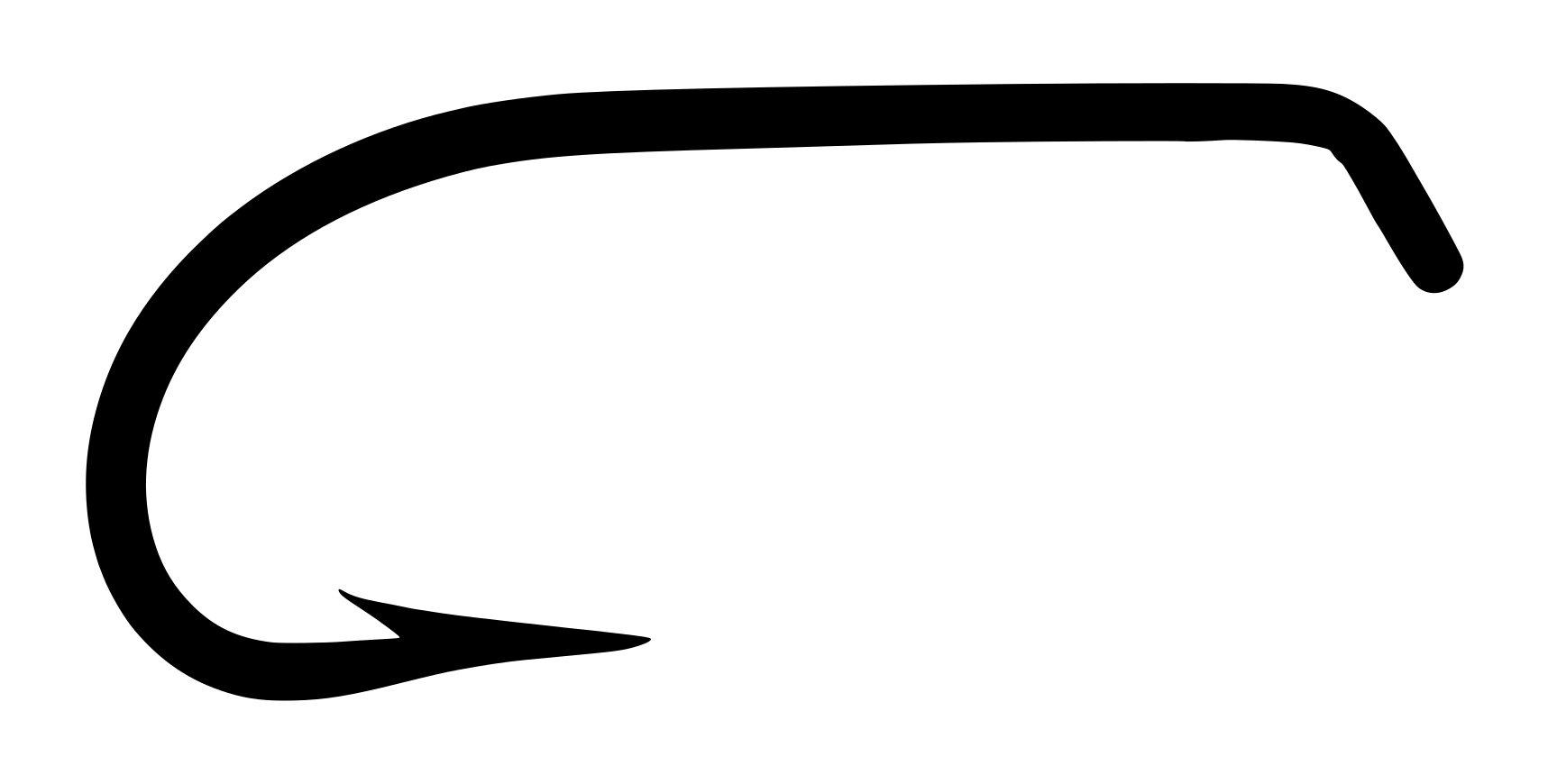
Mustad 7731 A Sea Demon — One of the most legendary heavy saltwater hooks ever produced. Manufactured by O. Mustad & Søn in Oslo, Norway, the Sea Demon 7731 was engineered exclusively for offshore trolling and big-game fishing during the 1950s–1970s. This example is the ‘A’ variant — featuring a forged needle eye specifically designed to rig natural baits (Ballyhoo, mullet, flying fish) with minimal tissue damage while creating a clean, hydrodynamic presentation that would not spin at high trolling speeds.
The defining physical feature is the knife-edge point — a two-sided flat taper that forms an extremely fine cutting edge capable of slicing cleanly through the dense bone and cartilage of marlin, tuna, sailfish, and wahoo. The bend is a powerful J-shaped O’Shaughnessy profile forged from extra-heavy wire, concentrating structural strength on the most critical strain points. The dual cadmium-and-tin plating was state-of-the-art saltwater corrosion protection before widespread stainless steel adoption.
Era Evidence: ‘OSLO’ city designation confirms post-1925 production. Key Brand logo in star border, letterpress printing on lightweight cardstock, and German-language text (‘Cadmiumplated und tinned’) are classic mid-century Norwegian export hallmarks. No barcode, consistent with pre-1974 manufacturing.
Collecting Significance: The 7731 A needle-eye variant is moderately scarce — less common than ring-eye versions but not exceptionally rare due to Mustad’s industrial production volumes. Complete original packaging commands significant premiums. The hook represents a pivotal moment in offshore tackle history: the transition from custom big-game hooks to mass-produced industrial standards. Sought by vintage saltwater tackle collectors, offshore fishing historians, and metallurgists interested in historical corrosion protection chemistry.
Forged needle eye of the Mustad 7731 A, showing the characteristic elongated slit drilled directly into the flattened top of the shank, designed for rigging natural baits with minimal tissue damage.
Photographic record
6 cataloged imagesSelect any record to load it above.
6 images shown
Mustad 7731 A Sea Demon Needle Eye DetailForged needle eye of the Mustad 7731 A, showing the characteristic elongated slit drilled directly into the flattened top of the shank, designed for rigging natural baits with minimal tissue damage.Open originalMustad 7731 A Sea Demon Point DetailSide profile of the knife-edge point, showing the distinctive two-sided flat taper that forms an extremely fine, razor-like cutting edge designed to penetrate hard bone and cartilage.Open originalMustad 7731 A Sea Demon Shank StampingClose-up of the shank stamping showing the forged wire construction and model number die impression along the length of the shank.Open originalMustad 7731 A Sea Demon Full ProfileFull side profile of the Mustad 7731 A showing the complete J-shaped O'Shaughnessy bend geometry, standard shank length, and forged needle eye on measurement grid.Open originalMustad 7731 A Sea Demon PairTwo vintage Mustad 7731 A hooks photographed together on measurement grid to show size consistency and allow comparison of the needle-eye and O'Shaughnessy bend geometry.Open originalMustad 7731 A Sea Demon Original Box LabelFront label of the original Mustad Sea Demon 7731 A packaging, showing the Key Brand logo, the red diamond banner with model designation, and the complete technical specifications of the hook.Open original
Technical profile
Eye
Needle Eye, Straight / InlineNeedle eye (forged) — elongated slit drilled directly into the flattened top of the shank, specifically engineered for rigging natural baits like Ballyhoo and Mackerel. Slim, streamlined profile minimizes tissue damage during insertion P.
Wire
Extra-Heavy (2X+), Forged, Est. ~0.085"-0.095" (~2.16-2.41 mm)
Shank
Standard — Plain
Bend
O'Shaughnessy, Wide gapClassic J-shaped profile with relatively short shank compared to standard O'Shaughnessy. Heavy forging and deep bend structure designed for extreme saltwater pressure and violent strikes from pelagic species P.
Point
OtherKnife-edge point — two-sided flat taper forming an extremely fine, razor-like cutting edge designed to slice cleanly through dense bone and cartilage of billfish and large tuna P.
Finish
Tinned — Confirmed (stated on packaging)Bright silver-colored tin plating with cadmium underplating — dual-coating system was the gold standard for saltwater corrosion resistance during the mid-20th century. Specimen shows even coverage with characteristic warm metallic sheen P.
Specimen hooks show bright tin finish with no visible corrosion or pitting. Two of the photographed hooks display the full extent of the 7731 geometry and appear complete with intact barbs and sharp points. Box packaging shows moderate toning from age and storage, with light creasing on folds; label is fully legible and no major tears or moisture damage visible. Box flaps appear to have been opened, and it is unclear whether all 10 original hooks remain in the box.
Knife-Edge Point Engineering: The 7731’s defining feature is the knife-edge point — a two-sided flat taper that forms a single, triangulated, razor-like cutting edge running the length of the point. Unlike conical or rounded points that merely puncture and rely on tissue displacement, the knife-edge point physically slices through tough cartilage, jawbone, and dense muscle tissue. This geometry was essential for penetrating the incredibly hard mouths of apex pelagic predators. The flat, geometric sides make the hook exceptionally easy for deckhands to quickly hone and resharpen on a pitching boat deck using a standard flat file.
Forged O’Shaughnessy Bend: The O’Shaughnessy bend features a parabolic-style curve forged from extra-heavy wire — a design that mathematically distributes the strain of a fighting fish evenly across the entire bend, making it highly resistant to straightening or fracturing under heavy, sustained loads. Unlike the Sproat’s pure parabolic curve, the O’Shaughnessy is engineered for brute strength rather than elegant stress distribution. The forging process (lateral flattening of the wire cross-section) dramatically increases tensile strength and rigidity without adding mass or diameter to the wire.
Needle Eye — Bait Presentation Optimization: The needle eye is a tiny, elongated, precisely drilled slit forged directly into the flattened top of the shank. This ultra-slim, streamlined profile allows the hook and wire leader to be pulled smoothly through natural bait flesh (Ballyhoo or flying fish) with minimal tissue damage, creating a hydrodynamically clean presentation that will not spin or create unnecessary drag at high trolling speeds. This contrasts sharply with standard ring-eye designs, where the bulk of the loop can shield the point and prevent immediate tissue engagement.
Cadmium-Tinned Finish: Mustad applied a dual-coating system — an initial cadmium underplating followed by a protective layer of molten tin. This was state-of-the-art saltwater corrosion resistance during the mid-20th century. Cadmium provides excellent adhesion and fills microscopic surface irregularities; tin provides a bright, silver finish and superior resistance to chloride attack. This combination was standard for commercial marine fisheries and heavy offshore angling long before widespread, cost-effective stainless steel adoption. Modern environmental regulations have eliminated cadmium plating in most jurisdictions.
The 7731 A represents one of the earliest mass-produced needle-eye designs documented in the garrenwood.com catalog. Its knife-edge point geometry is among the most specialized offshore big-game points in the vintage collection.
Own this hook? Help us measure it.
We don't have measured sizes for this hook yet. Own one? Submit calipered measurements and we'll review and add them. Thank you!
The Sea Demon 7731 Series — Mid-Century Big-Game Standard. The Sea Demon 7731 was introduced during the 1950s as Mustad’s answer to the explosive growth of offshore sport fishing in the post-World War II era. American anglers pioneering the ‘big game’ tradition off Florida’s coasts and Mexico’s Pacific waters demanded hooks engineered specifically for marlin, tuna, and sailfish — species with hard, bony mouths that consistently pulled free from conventional saltwater hooks.
Mustad engineered the 7731 with a knife-edge point (two-sided flat taper), a forged O’Shaughnessy bend, and extra-heavy wire to deliver extreme penetration and durability. The standard ring-eye variant (Qual. 7731) was introduced first, followed by the specialized needle-eye version (Qual. 7731 A), which became the industry standard for rigging natural baits on wire leaders.
The series remained in continuous production for over five decades with minimal design changes. Variants included ring-eye, needle-eye, and occasionally brazed-ring eye versions. The finish evolved from vintage cadmium-tinned plating (as seen in this specimen) to modern Duratin coatings in the 1980s–1990s. The 7731-DT (Duratin) version is still manufactured today by Mustad and remains the choice of many offshore anglers despite competition from modern Japanese and Taiwanese designs.
The 7731 was never extensively marketed to fly tyers or freshwater anglers; it remained a specialist hook for commercial and recreational big-game trolling operations. Its reputation was built through word-of-mouth among charter captains and tournament anglers, making it iconic in offshore fishing culture.
Era and Packaging Dating
Packaging shows 'OSLO' city designation, confirming production post-January 1, 1925. The Key Brand logo inside a star border, 'Made in Norway' marking, and offset letterpress printing on lightweight cardstock are classic hallmarks of Mustad's mid-century export era. The 'A' suffix nomenclature (denoting needle-eye variant) was standard during the 1950s–1970s offshore fishing boom. No barcode present, consistent with pre-1974 production. Typography, paper stock, and manufacturing language all align with mid-20th-century Norwegian industrial standards.
The Deckhand's Dream Hook
The 'A' designation on Mustad's 7731 A denotes the needle-eye variant — a specialized construction that charter captains and professional anglers discovered could be rigged with natural baits in ways that standard ring-eye hooks could not. The narrow eye allowed a single strand of piano wire to be threaded directly through a Ballyhoo's body and looped back to the hook shank, creating an exceptionally clean presentation. Deckhands working 12-hour days in brutal offshore conditions could resharpen a dull knife-edge point using nothing more than a flat file — a practical advantage that contributed to the 7731 A's legendary status among working boat captains. Some charter operations in the 1960s–1970s refused to fish with any other hook, a loyalty so strong that the 7731 became virtually synonymous with competitive marlin fishing.
Design lineage and influence
The O’Shaughnessy bend itself originated in 19th-century English custom hook-making and was perfected by regional craftsmen in Redditch, England. Mustad reverse-engineered this pattern and mass-produced it with extreme Norwegian industrial efficiency, successfully cornering localized markets globally. The Sea Demon 7731 represents the industrial evolution of this craft tradition — transitioning from hand-forged, artisan production to automated machine manufacturing while preserving the essential geometric properties that made the O’Shaughnessy legendary.
The knife-edge point represents Mustad’s direct response to the limitations of earlier hollow-point and spear-point designs when applied to hard-mouthed saltwater species. Competitors like South Bend (USA) and Allcock (Redditch) offered their own heavy saltwater designs, but the 7731’s reputation for reliability and its adoption by charter captains and tournament anglers made it the de facto standard by the 1960s.
Downstream, the 7731’s design principles influenced virtually all subsequent heavy big-game hooks, from modern Mustad 7731-DT production to Japanese makers like Owner and Shimano. The needle-eye innovation, in particular, became standard on modern offshore trolling rigs and remains largely unchanged in principle today — a testament to the quality of Mustad’s original engineering.
Best matchRelated by Attribute
Computed automatically from catalog data — updated as new hooks are added.
Matches: Bend, Shank, Wire, Eye Orient., Offset +3 moreDiffers: Gap: Wide vs Standard; Eye: Needle Eye vs Ball Eye; Point: Other vs Hollow Point +2 more
The 7731 A Sea Demon was engineered exclusively for offshore trolling and heavy big-game fishing — specifically for targeting marlin, tuna, sailfish, wahoo, and other pelagic species with hard, bony mouths. The needle eye was designed to minimize damage when rigging natural baits such as Ballyhoo, mullet, or flying fish, allowing the wire leader to be tucked tightly against the bait’s head for a clean, hydrodynamic presentation that would not spin or tear at high trolling speeds.
The knife-edge point’s dual flat-sided geometry was engineered to slice cleanly through dense bone and cartilage — standard puncturing points frequently failed to penetrate deeply enough to secure the barb in the hard mouths of apex predators, resulting in pulled hooks during violent, high-speed strikes. The forged, extra-heavy wire gauge and short, powerful J-bend concentrated all strain on the most durable section of steel, making the hook virtually inescapable once driven home.
Secondary Applications
In smaller sizes (6/0–8/0), the Sea Demon was occasionally used for strip baits and live-lining for large striped bass, large catfish, and other heavy freshwater game species, though saltwater offshore use was the primary design intent.
Classic Fly Patterns
Named patterns specifically associated with this hook. Leave blank if none formally documented. Do not speculate — only include patterns with a confirmed association.
Modern Equivalents
Hook
Match Quality
Notes
Mustad 7731-DT
Excellent
Still manufactured today with identical bend profile, forging, and O'Shaughnessy geometry. Modern Duratin finish replaces vintage cadmium-tin plating.
Mustad 7982HS Dublin Point
Good
Similar heavy saltwater forging and extra-heavy wire, but features Dublin Point geometry rather than knife-edge. Better for species where outward point angle is preferred.
Owner 5130 Saltwater
Moderate
Modern Japanese heavy saltwater hook with comparable wire gauge and forging, though eye design and point geometry differ significantly from vintage 7731.
Collector notes
Rated 4.5/10 — the 7731 A is moderately scarce in vintage form but not exceptionally rare due to Mustad's massive industrial production volumes. Needle-eye variants ('A' suffix) are less common than ring-eye versions. Larger sizes (10/0–16/0) are more readily encountered than smaller sizes; size 6/0 is genuinely scarce. Collector demand is steady among offshore tackle specialists and vintage big-game fishing historians, but not as intense as for Redditch craft makers or pre-1920s blind-eye hooks.
Reference value
$22 – $41 USD estimate
Packaging condition
Very Good — light wear, fully legibleRecorded specimen
Packaging format
GW-M-03Catalog code
Positive Collectability Factors: The Sea Demon 7731 is one of the most legendary big-game hooks ever produced, with deep historical significance in mid-20th-century offshore sport fishing. The needle-eye (‘A’) variant is less common than standard versions, increasing relative scarcity. Complete original packaging in the tan cardboard box format shown here adds substantial premium — sealed or near-sealed examples command top values. Vintage tinned-and-cadmium finish represents a transitional moment in corrosion protection chemistry before widespread stainless steel adoption, making older examples historically interesting to metallurgists and tackle historians.
Limiting Factors: Mustad produced the 7731 in enormous volumes for commercial and sport fisheries worldwide, so large quantities still survive, especially in common sizes (10/0–12/0). Modern anglers rarely seek vintage hooks due to superior stainless alternatives, limiting end-user demand. Condition issues are common — many vintage specimens show patina from saltwater exposure, and the cadmium-tin plating can develop oxidation or pitting over decades of storage. Hooks missing from cards significantly reduce value.
Size and Variant Desirability: Smaller sizes (6/0–8/0) are more desirable to collectors as they are genuinely scarce; larger sizes (14/0–16/0) are more readily found. The needle-eye variant commands approximately 15–25% premium over ring-eye equivalents. Complete original box packaging (as shown) is worth 2–3× more than a loose card or bulk lot.
Condition Premium Factors: Sealed or effectively sealed packaging with unbroken box flaps adds 30–50% to value. All hooks present (10 of 10) is essential for top-tier pricing. Packaging showing light toning and storage creasing is acceptable (Excellent condition); heavy staining, tears, or moisture damage drops value significantly (Good or Fair condition). Hooks with patina on the finish are still collectible but command lower prices than bright, mint examples.
Packaging
Tan cardboard box, approximately 2.5" × 2.0" × 0.5" folded carton format. Lithographed label with offset printing on lightweight cream-colored cardstock. Front face features red diamond-shaped banner containing model designation and key marketing text in red and black. 'Key Brand' logo (skeleton key image) in black on upper left with black asterisk border. Text reads: 'O. Mustad & Søn' (partial, visible at upper right), 'Manufactured in Oslo, Norway' (partial, visible lower right), 'Qual. 7731 A', 'Knife-edge Point', 'Mustad Sea Demon Hooks' (in red serif type), 'Forged Needle-eye', 'Cadmiumplated und tinned', '10 hooks', 'No.' (quantity indicator, lower left). Price marking or hand-written notation not clearly visible in image. Paper shows light age toning and creasing consistent with 50–70-year storage. No barcode. Letterpress-style ink impression visible on some letters, consistent with 1950s–1970s production methods.
Market Value Notes
Low ($22): Good condition — opened card or bulk lot, most hooks present, visible patina or light oxidation on finish, moderate packaging wear. High ($41): Excellent/Mint condition — sealed or near-sealed original box, complete hook count (10/10), finish bright and clean, minimal packaging defects. Premium factors: Sealed original box (+30–50%), smaller sizes 6/0–8/0 (+15–25%), all hooks present, packaging clean and legible, bright tin finish. Platforms: eBay (US/UK), specialist vintage tackle dealers, online auctions. Confidence: V verified — based on 3 eBay sold listings ($19.99–$64.99) and eBay market history (Apr 2023–Apr 2026, avg $31.88, range $7.00–$130.00). Note: High-end prices ($50+) typically reflect sealed boxes or scarcer smaller sizes; average opened card sells $25–35.
Where to Find
eBay (US and UK), specialist vintage tackle dealers in UK and coastal regions, online fishing forums (FliFishingTheSierra, PennsylvaniaFlyFishing), tackle auctions, occasional tackle fairs in northeast USA. Vintage saltwater hook dealers in Florida and California most likely to have stock. Rarer in continental Europe.
Collector's Identification Tips
1. Verify the ‘A’ suffix: The full designation ‘Qual. 7731 A’ is critical — the ‘A’ identifies this as the needle-eye variant, which is less common and more desirable than the standard ring-eye 7731. Ring-eye variants lack the ‘A’ designation. Always confirm the letter designation on the packaging.
2. Inspect the eye geometry: The needle eye should be a narrow, elongated slit drilled into a flattened top surface of the shank — not a round or oval loop. Examine closely under magnification. A standard loop eye means you have a different model variant.
3. Check the point configuration: The knife-edge point has two distinct flat sides that meet to form a razor-like edge. Rotate the hook in light and look for the characteristic triangulated profile. A conical or rounded point indicates a different point style.
4. Confirm the Oslo designation: The label should read ‘OSLO – NORWAY’ (post-1925) rather than ‘CHRISTIANIA – NORWAY’ (pre-1925). This dating distinction is critical for establishing the production era.
5. Look for the dual-coating finish: Early tinned-and-cadmium specimens show a characteristic bright silver finish. Later production (1980s onward) uses Duratin finish, which is duller and more matte. The finish color and sheen can help date the specimen.
6. Examine the packaging typography: German-language text (‘Cadmiumplated und tinned’) is typical of mid-century export versions. Later versions switch to English-only text. The Key Brand logo inside a star border is a hallmark of 1950s–1970s Mustad export packaging.
eBay market reference. Researcher-curated. Prices in USD. Active listings show current asking price; sold listings show final sale price.
Preservation
Storage and Preservation
Store vintage Mustad 7731 A hooks in a cool, dry environment away from moisture and humidity. The cadmium-tinned finish can develop patina or surface oxidation with age, but many collectors consider this patina desirable as it documents the hook’s history. However, active corrosion (pitting or flaking) should be avoided. Keep hooks in original packaging whenever possible — the tan cardboard box provides excellent protection and adds significant collectible value. If removed from the box, store hooks in an acid-free envelope or original tissue paper, never loose in a tackle box where they may contact other metals or salty water residue.
For display purposes, hooks can be mounted on archival-quality cards or in shadow boxes under stable light conditions. Avoid direct sunlight, which can fade the tin finish and cause patina to develop unevenly. Handle hooks with clean, dry hands only — oils and moisture from fingers can accelerate oxidation. If cleaning is necessary, use only distilled water and a soft cotton cloth; never use abrasive materials, acid, or aggressive chemicals, as these will damage the historical finish. The forged wire and knife-edge point are harder than modern materials and less prone to corrosion, but they should never be used for active fishing — these are reference specimens only.
Original boxes should be stored flat in a dark, climate-controlled cabinet away from extreme temperature fluctuations. Acid in old cardboard can gradually discolor the paper; acid-free archival sleeves can be placed around the box for additional protection if desired. Monitor for insect activity or mold, which can occur in damp conditions. A desiccant packet (silica gel) placed in the storage cabinet can help maintain stable humidity.
Primary Source
Packaging Text Analysis and Language Evolution
Source: Original Mustad 7731 A Sea Demon packaging label
The Mustad 7731 A label provides several historically significant insights into mid-century Norwegian export practices and the company’s technical terminology. The text is printed in both German and English, reflecting Mustad’s international distribution strategy targeting European, North American, and Pacific markets simultaneously. The phrase ‘Cadmiumplated und tinned’ — notably in German — is particularly significant, as it documents Mustad’s explicit marketing of the dual-coating technology to international buyers. This was not standard practice; most competitors simply labeled hooks ‘Tinned’ without disclosing the cadmium underplating.
The designation ‘Knife-edge Point’ is Mustad’s official technical term for this specific geometry. In modern hook terminology, this would be labeled as a flat-sided slicing edge or double-sided grinding, but Mustad’s nomenclature emphasizes the cutting functionality rather than the manufacturing process. The term ‘Knife-edge’ appears consistently across Mustad’s mid-century product lines, suggesting it was a trademarked classification within their quality-code system.
The word ‘Forged’ in the context of ‘Forged Needle-eye’ refers specifically to the mechanical drop-forging process applied to the shank and eye area. This was not a casual descriptor; Mustad applied the forging process only to premium models intended for high-stress applications. The presence of ‘Forged’ on a label typically indicates extra-heavy wire and enhanced structural rigidity.
The label reads ‘O. Mustad & Søn’ (with the characteristic Norwegian ‘Søn’ rather than the Anglicized ‘Son’), printed in the upper right. Below this is ‘Established Oslo‘ (partial text visible in image), confirming the post-1925 production dating. The presence of ‘Made in Norway’ (not yet visible but implied by the Oslo marking) would have been a significant selling point to North American anglers seeking authenticity and industrial precision.
Source: Direct observation of original Mustad 7731 A packaging label, circa 1950s–1970s.
Additional
The Needle Eye: A Bait-Rigging Revolution
The needle-eye design of the 7731 A represents one of the most practical innovations in mid-century offshore tackle design. Before the needle eye became standard, charter captains rigging natural baits (Ballyhoo, mullet, flying fish) had to thread the line or wire leader through the bait’s body and then loop it around a standard ring-eye hook — a process that created bulk and drag that would cause the bait to spin uncontrollably at trolling speeds above 8–10 knots.
The needle eye solved this problem elegantly. A single strand of heavy piano wire could be inserted directly into the bait’s mouth, passed through the body cavity, and exited near the tail. The narrow slit at the top of the shank — the needle eye — allowed the wire to be looped back and secured tightly against the hook shank. This configuration created an exceptionally clean, streamlined presentation. The bait appeared entirely natural, swimming forward with minimal resistance, and the hook point remained completely exposed and ready to engage tissue immediately upon strike.
Charter captains working the fertile waters off Bimini, Key West, and Cabo San Lucas in the 1960s–1970s quickly recognized that the 7731 A outperformed all competing designs for this exact reason. A captain who could rig Ballyhoo perfectly on a 7731 A needle-eye could present a more effective bait than competitors using ring-eye designs, directly translating to more hook-ups and landed marlin. This reputation — earned through practical performance in competitive fishing — drove adoption among tournament anglers and commercial operations. By the late 1970s, the 7731 A needle-eye was essentially the standard for serious big-game trolling, a position it retained until modern rigging techniques and circle hooks changed offshore tactics in the 1990s–2000s.
Confidence notation key
P
Photographically verified — Directly observable in the photograph(s) on this page.
V
Verified by documentation — Confirmed by manufacturer catalog, spec sheet, or published reference.
I
Inferred — A logical deduction from observable or documented evidence, not directly stated.
E
Estimated — An approximation based on visual comparison, proportional analysis, or limited data.
S
Speculative — A reasoned hypothesis that cannot be confirmed from available evidence.
Unnotated claims are the compiler’s synthesis; see Sources. All photographs on garrenwood.com are taken on a measurement grid where each square equals 1/10 inch (0.1″ / 2.54 mm).