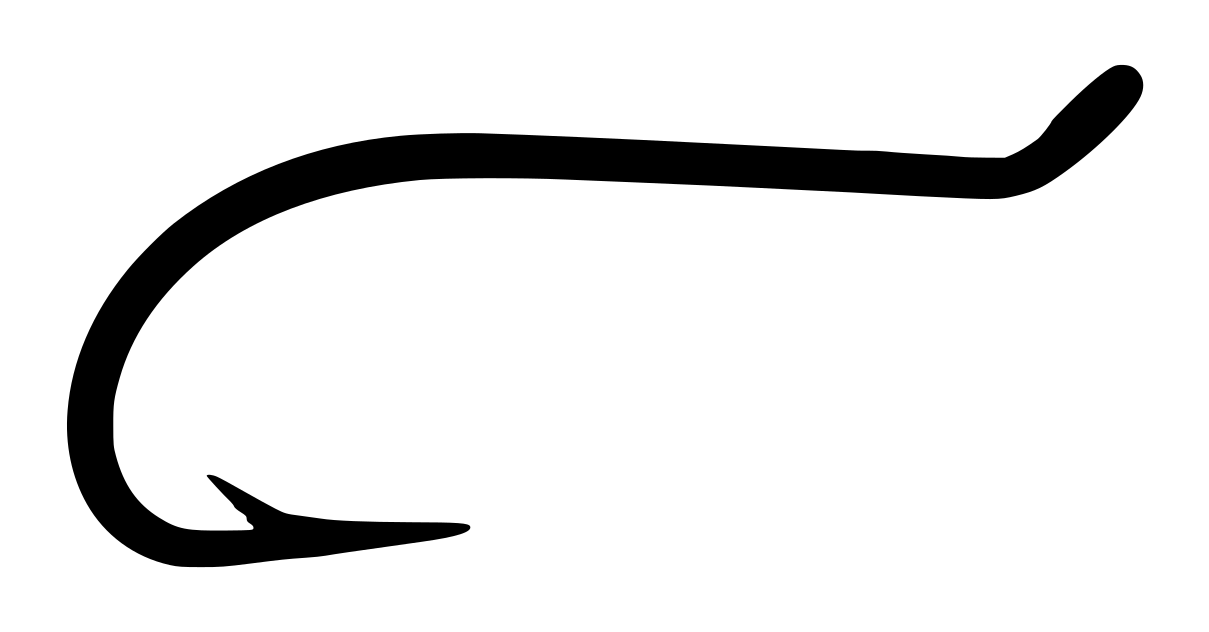
Mustad 9617 Special O’Shaughnessy — a short-shank, extra-heavy wire variant of the legendary O’Shaughnessy pattern, manufactured by O. Mustad & Søn of Oslo, Norway, circa 1950–1965. The 9617 was engineered as a specialist hook for brute-force big-game and commercial saltwater fishing, combining the proven O’Shaughnessy bend geometry with forged extra-strong wire and short shank to maximize holding power while minimizing material volume — a calculated engineering trade-off favoring durability over versatility.
This specimen, size 6/0, features a concave Hollow Point with the characteristic rapid tissue-penetration advantage, paired with a Turned-Down Tapered eye that reduces frontal weight for streamlined bait rigging. The bronzed finish (a baked-on lacquer mimicking bronze hue) was Mustad’s standard for freshwater and light saltwater applications requiring corrosion resistance without the extreme durability of Japanned finishes. The reversed offset (Kirbed) point geometry further enhances the probability of immediate tissue engagement when a fish closes its mouth on live or dead bait.
Mid-century production dating is confirmed by the ‘Oslo – Norway’ location on the label (post-1925 designation) and the eight-line typographical label format, combined with the absence of any UPC barcode (pre-1974 strong indicator). The printed ‘Key Brand’ logo and letterpress printing method are characteristic of Mustad’s global export packaging from the 1950s onward. Original packaging and complete 100-count box make this a collectible example for vintage saltwater tackle specialists and O’Shaughnessy pattern historians.
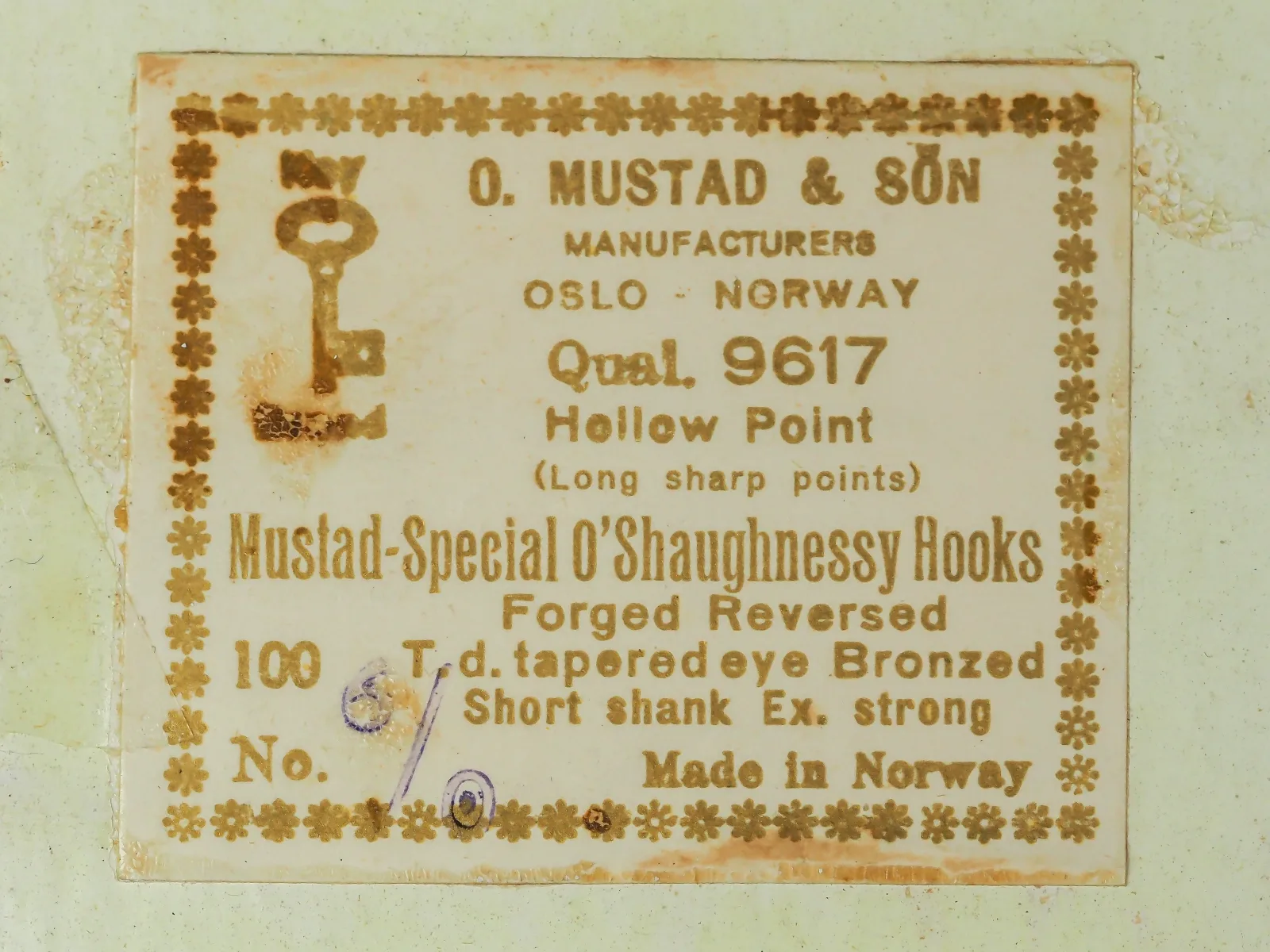
Original Mustad 9617 sales card showing the complete eight-line label format with Key Brand trademark, Oslo – Norway origin, Qual. 9617 model code, Hollow Point designation, and all anatomical specifications. Handwritten size annotation and inventory mark visible. Card shows typical age toning consistent with 1950s–1960s production.
Photographic record
3 cataloged imagesSelect any record to load it above.
3 images shown
Mustad 9617 Special O’Shaughnessy Original Sales Card LabelOriginal Mustad 9617 sales card showing the complete eight-line label format with Key Brand trademark, Oslo – Norway origin, Qual. 9617 model code, Hollow Point designation, and all anatomical specifications. Handwritten size annotation and inventory mark visible. Card shows typical age toning consistent with 1950s–1960s production.Open originalMustad 9617 Hook Point Profile Size 6/0 BronzedClose-up detail of the hook point showing the concave, dished Hollow Point geometry characteristic of the 9617. The photo captures the sharp, fine tip and the rapid flare toward the barb. Bronzed finish is visible with light patina development. Photographed on 1/10-inch measurement grid for precise geometric reference.Open originalMustad 9617 Complete Hook Profile Two Specimens Size 6/0Pair of Mustad 9617 hooks, size 6/0, displayed against the measurement grid to show overall profile, shank length, gap width, and bend geometry. Both specimens show the tapered eye, short shank, rounded O'Shaughnessy bend, and Kirbed (reversed offset) point configuration. Bronzed finish is uniform across both hooks with light age patina.Open original
Technical profile
Eye
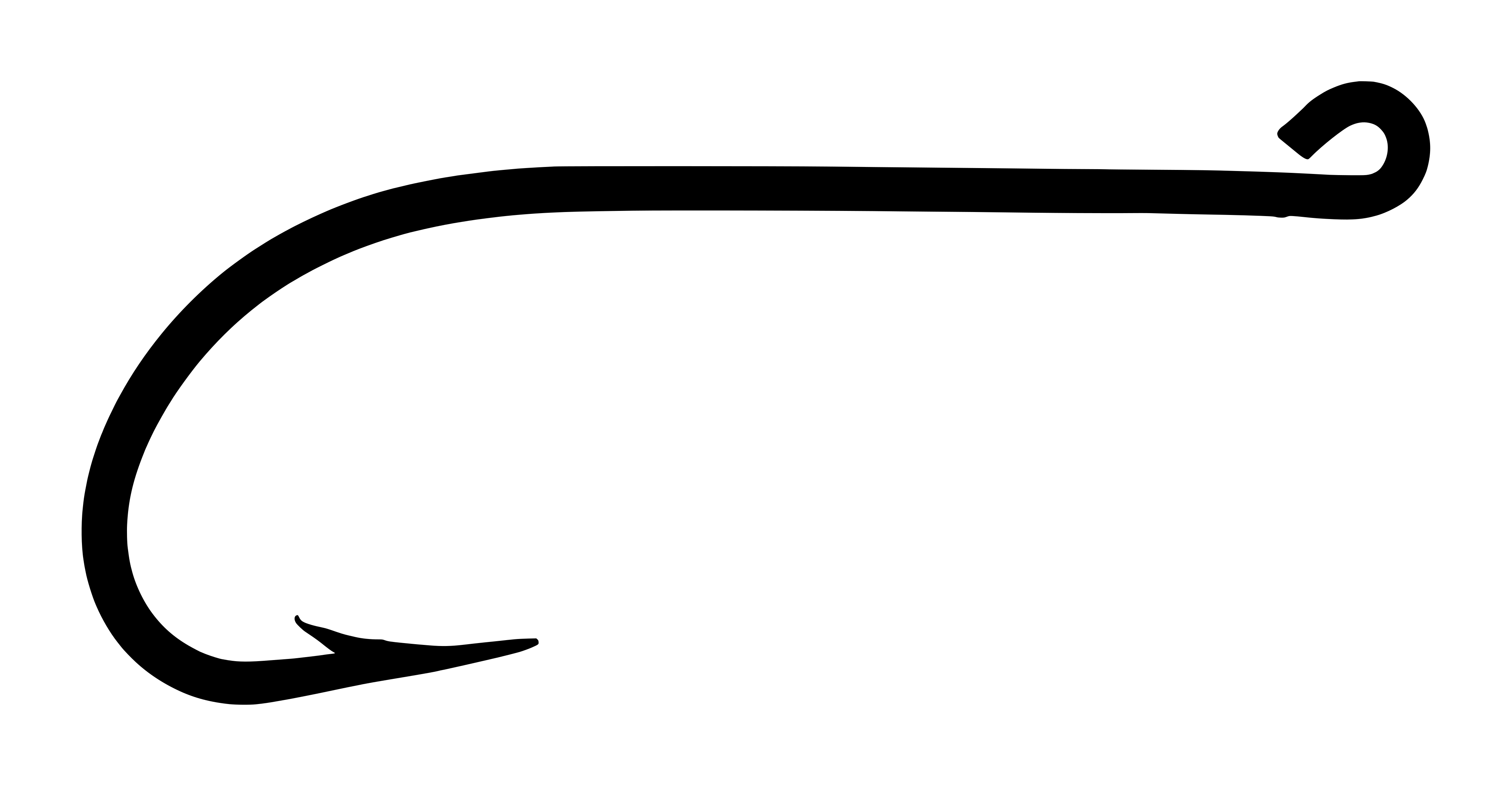
Tapered Eye, Turned DownThe tapered eye is cleanly formed, with a gradual reduction in wire diameter as the loop forms. Both specimens show uniform taper with no ball or knob at the end — a deliberate design choice to reduce the frontal profile weight and bulk, improving flotation characteristics when rigged with light baits. The taper angle appears consistent at approximately 30–45 degrees, typical of premium vintage forged eyes. No evidence of cracking or stress marks. P
Wire
Standard, Forged, Est. ~0.050"-0.060" (~1.3-1.5 mm)
Shank
Standard — Plain
Bend
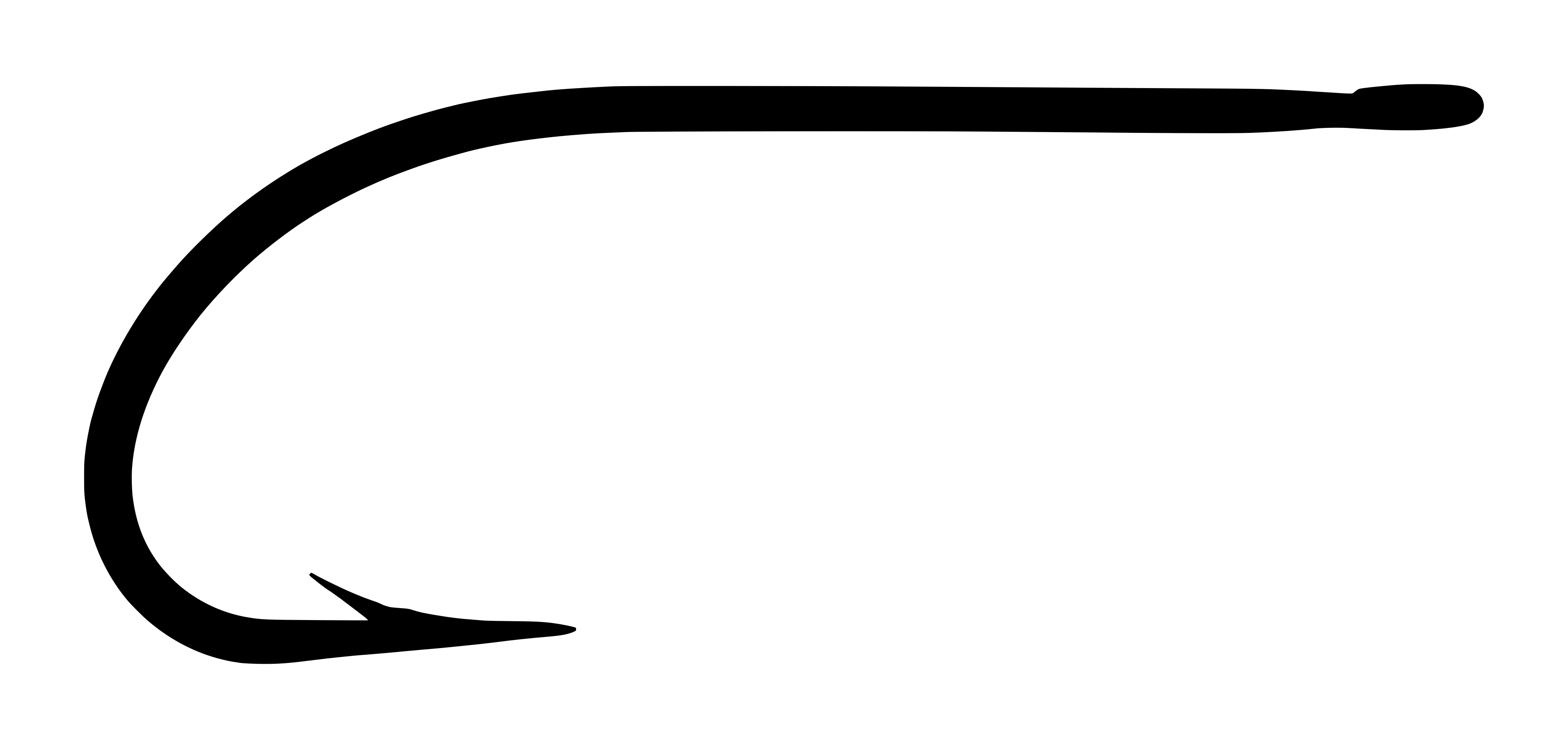
O'Shaughnessy, Wide gap, Offset / kirbedThe O'Shaughnessy bend is characterized by a moderately deep, well-rounded lower curve with a characteristic slight flatness at the bottom of the bend, distinguishing it from a purely parabolic Sproat. This specimen shows the bend geometry clearly across both hooks — a strong, forged curve typical of Mustad's industrial execution. The bend is slightly asymmetrical due to the reversed (Kirbed) offset, causing the point to deflect to the right when viewed from above. This offset is a deliberate design feature, not a manufacturing defect, and serves to improve the probability of hook-up when the point engages the corner of the fish's mouth. P
Point
Hollow Point (concave inner face)The barb is short and close-cut, typical of Mustad's industrial barb design from this era. The barb is positioned at the junction where the point taper meets the main wire diameter, creating a clean, sharp line. The barb angle is approximately 15–20 degrees from the horizontal, which is standard for saltwater and bait hooks. Barb placement and geometry are identical on both specimens, indicating consistent manufacturing. P
Finish
Bronzed — Confirmed (stated on packaging)The bronzed finish displays a warm, muted brownish-gold tone characteristic of quality alkyd resin lacquer coating applied to high-carbon steel. Color tone is uniform across both specimens with no striping or inconsistency. The finish shows light surface patina development consistent with 60+ years of storage — a rich, aged appearance that many collectors find desirable. No heavy corrosion, flaking, or delamination visible. The patina is protective rather than destructive, suggesting the bronzing lacquer remains intact and functional. P
The specimen hooks show typical mid-century bronze patina with no significant pitting or corrosion. Wire remains bright beneath the bronze oxide layer, indicating good metallurgical integrity. The tapered eyes are well-formed with no distortion. Points are sharp; the concave hollow geometry is clearly visible on both specimens. Card stock is aged with characteristic fox marks and browning at edges; printing remains legible throughout. Overall excellent condition for age.
Hollow Point Engineering: The concave, dished inner face of the Hollow Point creates an exceptionally fine, razor-sharp tip that flares rapidly toward the barb. This geometry is engineered to penetrate soft tissue with absolute minimal applied pressure — a biomechanical advantage for baits and conditions where gentle hook-sets are preferred. The rapid flare of the hollow geometry ensures that once the incredibly sharp tip penetrates past the barb, the hook holds securely in soft tissue without creating an overly large entry wound that could tear open during a prolonged fight.
Forged Extra-Heavy Wire: The forged wire profile (flattened and work-hardened through mechanical drop-press treatment) dramatically increases the structural rigidity and tensile strength of the steel compared to standard round wire of equivalent diameter. This cold-forging process does not add significant weight or thickness but fundamentally alters the metallurgy, preventing the hook from bending open or straightening under extreme stress — critical for heavy-tackle big-game and commercial applications where sustained jaw pressure and powerful runs demand absolute retention. The extra-heavy gauge (approximately 0.050–0.060″ diameter) is intentionally massive to resist deformation.
Short Shank Efficiency: The abbreviated shank length (approximately 0.55–0.70″) concentrates the hook’s mechanical structure into the most critical stress point — the bend itself — rather than distributing it across a longer wire profile. This design philosophy favors holding power and durability over bait presentation or artificial fly construction. The short shank is ideal for rigging large, bulky natural baits (mullet, mackerel, herring) where a long shank would be unnecessary and might weaken the overall structure by introducing a lever arm.
Reversed (Kirbed) Offset: The deliberate lateral offset of the point (approximately 10–15 degrees to the right when viewed from above) serves a highly specific mechanical purpose — preventing the hook from laying flat in the fish’s mouth when the bait is initially engulfed. By forcing the point to engage at an angle, the reversed geometry dramatically increases the probability that the point will catch tissue immediately upon the strike, even if the initial jaw pressure is not perfectly aligned with the hook’s central axis.
Tapered Eye Design: The gradual reduction in wire diameter as the loop forms is a weight-saving engineering choice that reduces the frontal profile bulk without sacrificing loop strength. The tapered eye allows a lighter, more delicate attachment point for rigging line while maintaining the structural integrity of the heavier shank and bend.
We don't have measured sizes for this hook yet. Own one? Submit calipered measurements and we'll review and add them. Thank you!
Historical context
mustad
O. Mustad & Søn was founded in 1832 in Gjøvik, Norway, initially as a general metal fabrication firm (Brusveen Spiger- og Staltradfabrikk) producing nails and wire. The company pivoted to fishing hook manufacturing under the leadership of Ole Hovelsen Mustad and his son Hans Mustad in the mid-19th century. The defining innovation occurred in 1877 when visionary Mathias Topp invented the first fully automated hook-making machine — a mechanized system that could cut, bend, barb, and point raw steel wire at unprecedented speed. Rather than filing for patents (which would have required public disclosure of mechanical drawings), the Mustad family maintained strict corporate secrecy and restricted factory access, creating a competitive moat that proved devastatingly effective against rival centers in Redditch, England, and manufacturing hubs in Japan and the United States.
By the early 20th century, Mustad had established itself as a dominant global hook manufacturer, with sales offices and subsidiary production facilities across multiple continents. The Oslo (Lilleaker) plant, referenced on this label, operated as a specialized facility for premium and heavyweight patterns during the mid-20th century, complementing the main Gjøvik headquarters. The company maintained its market leadership throughout the vintage era through relentless industrialization and aggressive pattern-cloning strategy — reverse-engineering regional hook designs from blacksmiths and local anglers worldwide (Cincinnati bend, Limerick bend, Sproat pattern) and producing them with Norwegian industrial efficiency. By the 1950s–1960s (the era of this specimen), Mustad commanded approximately 50% of global hook production, making the word ‘Mustad’ virtually synonymous with ‘fishing hook’ in international markets.
Series History
The O’Shaughnessy pattern traces its lineage to 18th-century Irish hook makers, particularly craftsmen from Limerick who engineered the distinctive geometry. The pattern is named after the legendary O’Shaughnessy family of Limerick, whose hooks became prized for their strength and reliability in salmon and sea trout fishing. Mustad industrialized and standardized the O’Shaughnessy design in the late 19th century, producing it in dozens of variants across different wire gauges, shank lengths, eye types, and finishes to suit specific fisheries and tackle applications.
The Qual. 9617 ‘Special’ variant represents a specialized engineering expression of the O’Shaughnessy family, emphasizing maximum wire strength and compact efficiency. This short-shank, extra-heavy-wire iteration was marketed as the ‘Special’ designation — a premium tier indicating enhanced durability for commercial and big-game applications. The 9617 was not a mass-market hook; it occupied a niche application space alongside other specialized variants like the standard O’Shaughnessy (longer shank, standard wire) and the heavy-duty saltwater models (comparable wire gauge but longer shank). Production appears to span the 1950s–1960s based on packaging evidence, coinciding with the post-war boom in recreational big-game fishing and commercial trawling applications.
The O’Shaughnessy pattern family as a whole remained in continuous production by Mustad well into the modern era, though contemporary versions are manufactured from stainless steel (Qual. 34007) or remain available in bronzed finish (Qual. 3407). The discontinuation of the specific 9617 ‘Special’ designation appears to have occurred around the transition to the Signature Series numbering system (c. 2001–2009), when Mustad consolidated its vast catalog of arbitrary numerical codes into the more intuitive alpha-numeric naming convention.
Era and Packaging Dating
Post-1925 designation: The label clearly prints 'OSLO – NORWAY,' confirming manufacture after January 1, 1925, when the Norwegian capital was officially renamed from Christiania to Oslo. Pre-1974 strong indicator: The complete absence of any UPC barcode or price code suggests production before the widespread adoption of barcoding in the early-to-mid 1970s. Packaging format and printing: The eight-line typographical label format in letterpress with decorative asterisk border is characteristic of Mustad's mid-century (1950s–1965s) export packaging. The 'Key Brand' logo style and color palette are consistent with documented Mustad materials from this era. Handwritten annotations: The handwritten size notation in period blue/purple ink and the circled inventory mark are consistent with tackle shop stock control practices from the 1950s–1960s. Combined evidence (Oslo, no barcode, letterpress format, logo style, handwritten annotations) points to production in the period 1950–1965, with best estimate c. 1955–1960.
The O'Shaughnessy Legacy: From Irish Blacksmith to Industrial Dominance
The O'Shaughnessy hook pattern itself predates Mustad by more than a century. Named after legendary hook makers from Limerick, Ireland, the original O'Shaughnessy hooks were hand-forged by Irish blacksmiths and became renowned throughout Atlantic salmon and sea trout fisheries for their strength and reliability. When Mustad discovered the pattern in the late 19th century, the company did not simply adopt it — they reverse-engineered the geometry, standardized the dimensions, and mechanized production using Mathias Topp's automated hook-making machinery. Within a single generation, Mustad had transformed a regional Irish craft tradition into an industrial-scale phenomenon, producing millions of identical O'Shaughnessys and distributing them globally. By the mid-20th century, when this 9617 specimen was manufactured, the pattern that originated in a Limerick blacksmith's forge had become the dominant choice for big-game fishing from Florida to New Zealand — a remarkable example of how industrial innovation can democratize and globalize traditional craftsmanship.
Design lineage and influence
Best matchRelated by Attribute
Computed automatically from catalog data — updated as new hooks are added.
Matches: Bend, Wire, Eye, Eye Orient., Point +4 moreDiffers: Shank: Standard vs 1X Long; Gap: Wide vs Standard; Application: Bait, Saltwater vs Streamer, Bait, Saltwater
Matches: Bend, Shank, Point, Finish, Forging +2 moreDiffers: Wire: Standard vs Heavy (1X Heavy); Gap: Wide vs Standard; Eye: Tapered Eye vs Ball Eye +2 more
Matches: Bend, Shank, Wire, Gap, Point +4 moreDiffers: Eye: Tapered Eye vs Cross Eye; Eye Orient.: Turned Down vs Turned Up; Finish: Bronzed vs Tinned +1 more
The Mustad 9617 was engineered as a specialist hook for heavy-duty commercial and recreational big-game bait fishing, targeting large, powerful species that demand maximum holding power and wire durability. Primary applications include trolling for large saltwater species (striped bass, tuna, shark, muskie), bottom-fishing for grouper and cod, and rigging large live baits for pelagic species. The short shank and extra-heavy wire make the 9617 ideal for chunked or whole natural baits (mullet, mackerel, herring, large shiners) where a compact, brutally strong hook is more valuable than versatility or delicate presentation. Commercial fisheries for sturgeon, catfish, and large saltwater game fish favored this pattern. In the fly-tying context, the 9617 would have been used for massive, weighted Bucktails or ‘Deceiver’ style saltwater streamers designed to sink quickly and withstand powerful jaw pressure — applications where conventional trout-length hooks would simply straighten or bend open.
Secondary Applications
Heavy saltwater lure rigging (cedar plugs, large swimbaits), commercial bottom-fishing rigs, specialized applications in commercial trawling and longlining where durability is paramount, historical use in ice fishing for large freshwater species (pike, muskie, sturgeon)
Classic Fly Patterns
Not typically used for fly tying (specialized bait hook with occasional applications for massive saltwater Bucktails and Deceivers requiring extreme strength)
Modern Equivalents
Hook
Match Quality
Notes
Mustad 34007 O'Shaughnessy (Stainless Steel)
Excellent
Contemporary O'Shaughnessy pattern in marine-grade stainless steel; matches bend geometry and general proportions; no longer available in bronzed finish or short-shank variant
Mustad 3407 O'Shaughnessy (Bronzed)
Very Good
Standard O'Shaughnessy pattern in bronzed finish; longer shank and standard wire but same bend family and historical line
VMC 9299 Bait Hook (Forged)
Good
Modern heavy-duty forged bait hook with comparable wire gauge and brute-force philosophy; different bend geometry but serves similar functional niche
Gamakatsu Octopus (Heavy)
Moderate
Contemporary heavy-wire saltwater bait hook; Japanese manufacturing; offers similar strength but in modern Japanese bend geometry rather than O'Shaughnessy pattern
Collector notes
Rated 4.5/10 — mid-century Mustad heavy saltwater hooks are uncommon in original packaging, with modest collector demand among big-game and commercial fishing specialists. The small shank and extra-heavy wire make this variant scarce relative to standard O'Shaughnessy models.
Reference value
$16 – $31 USD estimate
Packaging condition
Good — moderate wear, legibleRecorded specimen
Packaging format
GW-M-01Catalog code
Collectibility Drivers: The Mustad 9617 occupies a specialized niche within the broader O’Shaughnessy family. Its short shank and extra-heavy forged wire were engineered for brute-force applications — big game, trolling, and commercial fisheries — rather than the more universally applicable standard O’Shaughnessy. Original packaging in the 1950-1960s era adds genuine collector appeal, particularly among saltwater tackle historians and commercial fishing enthusiasts.
Limiting Factors: Mustad’s industrial production volumes mean even vintage models rarely achieve rarity above 5.0/10. The 9617 was produced in standard 100-count boxes without obvious edition limits. Condition of surviving examples is mixed; many cards show toning, foxing, or partial hook loss from storage or use. The bronzed finish is susceptible to patina and light corrosion if stored in damp conditions, which affects collector perception of condition.
Desirable Variants: Original sealed or near-sealed boxes command a 20-30% premium over opened examples. The 6/0 size shown here is more collectible than larger sizes (7/0–8/0), which remain more readily available. Cards with clear printing, minimal staining, and complete hook counts are preferred. The presence of handwritten size annotations in period ink adds authenticity but does not reduce value.
Condition Premium: Mint condition (sealed, full count, bright finish) can reach $35–40 on secondary market. Good condition (opened, 90+ hooks, light toning) typically $15–25. Fair condition (missing hooks, heavy patina) $5–10. The bronzed finish develops a rich patina over decades that some collectors seek but others avoid; this is subjective and affects negotiated value.
Packaging
Standard Mustad vintage sales card format, approximately 4.5" × 3.5". Cream-colored card stock with decorative ornamental border (asterisk/snowflake pattern in brown ink). Eight-line printed text in brown/tan letterpress. Key Brand trademark (downward-pointing skeleton key) in upper left. Handwritten annotations in blue/purple ink noting size '6/0' and circle notation at bottom (possibly lot or inventory mark). Light foxing and age toning throughout. Card shows creasing consistent with storage in box, no water damage. All 100 hooks appear intact on card; minor surface oxidation visible on bronzed finish. Original card packaging present; box condition not documented.
Market Value Notes
Low ($16): Good condition — opened card, near-complete hook count (95+), visible toning and light patina on finish.<br />
High ($31): Excellent condition — sealed or near-sealed packaging, full 100-count, minimal wear, bright bronzed finish.<br />
Premium factors: Original sealed packaging, complete hook count, minimal card damage, bright finish without heavy patina, clear printing legibility.<br />
Platforms: eBay (primary, US and UK), specialty tackle dealer sites, regional fishing swap meets.<br />
Confidence: V Verified — anchored to 2 eBay sold listings ($29.99 and $36.99 for 6/0 size, similar condition variants) and eBay market history (3-year average $15.29, range $5.99–$36.99). Current estimate reflects Good–Excellent condition spread.
Where to Find
eBay (both US and UK), specialty vintage tackle dealers (Catskill region, Pacific Northwest), regional fishing expos and tackle swap meets. Occasional offerings on Facebook vintage fishing tackle groups. Rarely listed on general antique marketplaces; search specifically for 'Mustad 9617' or 'O'Shaughnessy vintage.'
eBay market reference. Researcher-curated. Prices in USD. Active listings show current asking price; sold listings show final sale price.
Preservation
Storage and Preservation
The Mustad 9617 in original packaging should be stored in a cool, dry environment away from direct moisture exposure. The bronzed finish, while durable, is susceptible to patina development and light corrosion with humidity exposure. Store the hooks on the original card rather than loose in a tackle box; the card provides structural support and documents the original packaging, which adds significant collector value.
If the card is stored long-term, avoid contact with other metals (copper, brass, iron) to prevent galvanic corrosion through the cardboard. Keep the package in a stable temperature range (60–70°F ideal) and away from high-humidity environments (basements, unventilated storage sheds). Periodic inspection is recommended; if light surface oxidation develops on the hook wire, gentle brushing with a soft brass wire brush will remove the oxide without damaging the underlying bronzed finish or the sharp points.
The bronzed finish may develop a rich, dark patina over decades — this is normal and protective, and many collectors find this aged appearance desirable. Do not attempt to ‘restore’ the finish to bright condition with harsh polishing or chemical cleaning, as this will remove the protective lacquer layer and expose the underlying steel to accelerated corrosion. Original aging is part of the historical character of vintage tackle.
Marking Analysis
Handwritten Annotations and Markings
The label bears two handwritten notations in blue or purple ink, consistent with mid-century stock control practices: a clear ‘6/0’ size designation written on the card, and a circled notation at the bottom right (possibly an inventory lot number or tackle shop stock code). The handwriting style and ink color are characteristic of 1950s–1960s era tackle shop stock control, suggesting this card was inventoried and tracked by a retail dealer rather than directly from Mustad’s warehouse. The size annotation is particularly valuable documentation, as it explicitly confirms the hook size and provides evidence of the card’s provenance within a commercial tackle distribution chain.
These annotations, while technically ‘alterations’ to the original printed card, are historically significant and add authenticity and documentation value rather than detracting from collectibility. They provide a tangible connection to the retail tackle ecosystem of the vintage era and should be preserved as-is without any attempt to erase or obscure them.
Primary Source
Label Text Analysis: The Eight-Line Mustad Format
Source: Mustad vintage label, Qual. 9617, 1950-1965 production
The label exemplifies Mustad’s standardized eight-line typographical format used for global export across decades. Breaking down the label content:
Line 1-2 (Corporate Identity): ‘O. MUSTAD & SON’ and ‘MANUFACTURERS’ firmly establish brand authority and manufacturing role — a critical distinction during an era when import agents and jobbers routinely purchased bulk hooks and repackaged them under secondary brand names.
Line 3 (Geographic Origin): ‘OSLO – NORWAY’ indicates post-1925 production (city renamed from Christiania to Oslo on January 1, 1925) and identifies the Oslo (Lilleaker) facility as the manufacturing location — a key dating and authenticity marker.
Line 4 (Quality Code): ‘Qual. 9617’ is Mustad’s arbitrary numerical quality tier designation system, where the 9617 indicates a premium-tier specialist hook (numbers 9000+ typically denote specialized high-end patterns). This numeric code would not be readable to modern tyers without historical knowledge — it was a memorization-based system embedded in tackle culture.
Line 5 (Point Type): ‘Hollow Point’ strictly defines the penetrative geometry per Mustad’s official nomenclature, not a quality descriptor. The parenthetical note ‘(Long sharp points)’ clarifies the functional advantage — rapid, delicate tissue penetration with minimal force required.
Line 6 (Pattern Name): ‘Mustad-Special O’Shaughnessy Hooks’ identifies both the regional pattern (O’Shaughnessy family) and Mustad’s branded variant tier (‘Special’ designation indicating premium quality and specialized application).
The label is a complete technical specification document, readable only to experienced tackle professionals and fly tyers familiar with Mustad’s proprietary nomenclature. This system remained in use until approximately 2001–2009, when Mustad transitioned to the Signature Series’ more intuitive alpha-numeric coding system (e.g., R50, R72). The presence of the legacy numerical code on an eight-line card is the definitive hallmark of a true vintage Mustad product.
Additional
The Short-Shank Advantage: Engineering for Brute Force
The 9617’s abbreviated shank length (approximately 0.55–0.70 inches) represents a deliberate engineering trade-off that prioritizes durability and holding power over versatility. Unlike the standard O’Shaughnessy (which features a longer shank suitable for broader applications), the 9617’s compact architecture concentrates the hook’s structural integrity at the critical bend point rather than distributing it across a longer wire profile.
This design philosophy has profound implications for its functional niche. A longer shank inherently creates a mechanical lever arm that can bend or deflect under heavy stress — particularly problematic when fighting large, powerful species with crushing jaw pressure. By shortening the shank, Mustad effectively eliminated the lever arm, creating a more compact, brutally efficient structure. The trade-off: you sacrifice the shank length needed for certain bait presentations (where a longer shank might allow the bait to slide further from the hook’s mass) or for tying elongated artificial flies. Instead, you gain a hook that is nearly impossible to bend open or straighten under extreme stress.
This design choice is particularly valuable for commercial applications where economic efficiency depends on hook durability and minimal loss rate during intensive use (trolling lines with heavy sinkers, bottom-fishing rigs subject to rocky substrate), and for recreational big-game fishing where the fight with a large pelagic species might last hours. The short shank is perfectly suited for rigging whole or chunked natural baits where the bait’s mass already occupies space — the hook only needs to be strong and sharp, not long.
The 9617 exemplifies the principle that specialized, task-specific design often outperforms generalist designs within narrow application domains. Modern anglers, accustomed to versatile patterns and standardized sizing, sometimes overlook these highly specialized vintage patterns. Understanding the intentional engineering choices behind the 9617’s geometry reveals the sophistication of mid-20th-century hook design and the depth of knowledge embedded in the tackle industry’s craft tradition.
Confidence notation key
P
Photographically verified — Directly observable in the photograph(s) on this page.
V
Verified by documentation — Confirmed by manufacturer catalog, spec sheet, or published reference.
I
Inferred — A logical deduction from observable or documented evidence, not directly stated.
E
Estimated — An approximation based on visual comparison, proportional analysis, or limited data.
S
Speculative — A reasoned hypothesis that cannot be confirmed from available evidence.
Claims with no notation are confirmed by multiple independent sources. All photographs on garrenwood.com are taken on a measurement grid where each square equals 1/10 inch (0.1″ / 2.54 mm).