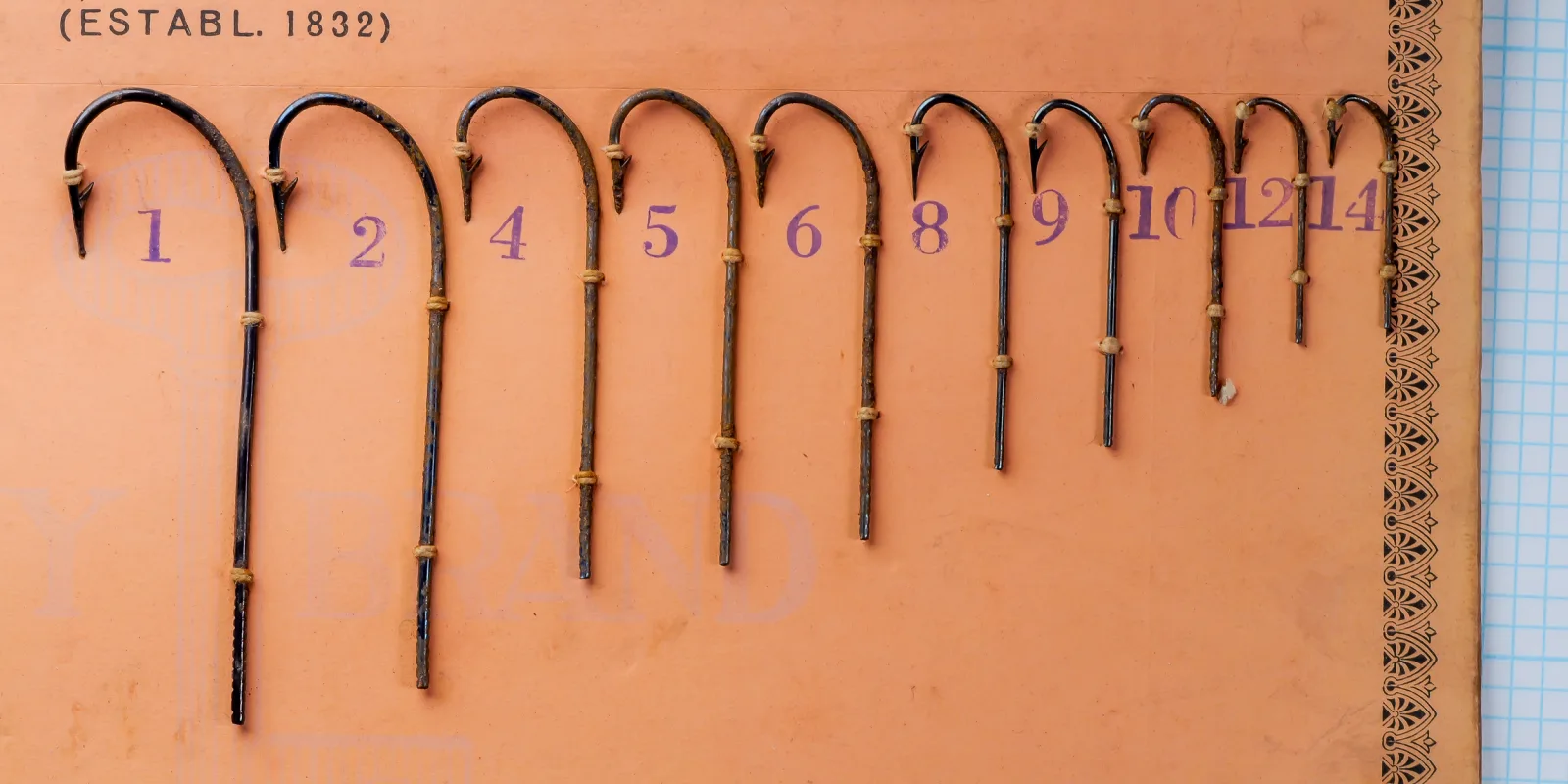
Mustad 3802 New York Trout Hook — a classic early-to-mid twentieth-century wet fly and general trout hook manufactured by O. Mustad & Søn of Oslo, Norway. This model features a hollow point geometry engineered for rapid penetration in soft-mouthed freshwater species, paired with a Limerick bend and blind eye characteristic of the snelled hook era.
The model code 3802 places it in Mustad’s mid-tier (3000-3999) quality range, marking it as a general-purpose, professionally manufactured standard rather than an economy hook. The presence of the Oslo designation on the original label dates production to 1925 or later; Mustad changed from “Christiania” to “Oslo” in January 1925. The marked blued finish and New York Trout Hook branding indicate targeting of American freshwater anglers during the interwar and post-war boom in tackle exportation.
Surviving examples with original packaging are moderately scarce and valuable to collectors of vintage American trout fishing tackle. The blind eye construction reflects an era when snelled hook technology (attaching line via silk whipping directly to the shank) dominated fly fishing. This model represents a transitional period between ancient handmade traditions and modern mass manufacturing.
Original Mustad 3802 sales card displaying the full size range from No. 1 to No. 14, demonstrating the comprehensive offering for American trout fishing during the interwar and post-war export market.
Photographic record
6 cataloged imagesSelect any record to load it above.
6 images shown
Mustad 3802 Complete Sales CardOriginal Mustad 3802 sales card displaying the full size range from No. 1 to No. 14, demonstrating the comprehensive offering for American trout fishing during the interwar and post-war export market.Open originalMustad 3802 Original Label DetailOriginal Mustad packaging label showing the eight-line typographic format with model 3802 designation, Hollow Point specification, New York Trout Hook branding, and marked blued finish notation. The golden-ink letterpress design includes the iconic Key Brand skeleton key logo and decorative snowflake borders.Open originalMustad 3801-3802 Comparative DisplaySales card showing both Mustad 3801 (Spear Point) and 3802 (Hollow Point) models side by side, illustrating the different point geometry options offered to American trout anglers in the New York Trout Hook series.Open originalMustad 3802 Size 6 Original BoxOriginal Mustad 3802 retail box for size 6 hooks showing the individual packaging format with complete specifications label. The cream-colored cardboard box with golden-ink printed label exemplifies interwar commercial tackle packaging construction.Open originalMustad 3802 Hollow Point DetailClose-up detail of the Mustad 3802 hollow point construction showing the characteristic concave inner face that creates the knife-edge effect. The dished-out profile from tip to barb base provides rapid penetration with minimal applied force.Open originalMustad 3802 Size 6 Complete ProfileFull profile view of Mustad 3802 size 6 showing the complete hook geometry: marked shank, Limerick bend with angular bottom, hollow point, and blind flatted eye. Grid squares enable accurate measurement and proportion analysis.Open original
Technical profile
Qual. 3802 — Hollow Point — Marked Blued
Eye
Blind — Marked Shank
Wire
Fine (1X Fine), Round
Shank
Special Long — Marked / Ridged
Bend
New York, Standard gapRound/Kendal-style bend with a smooth continuous curve through the lower bend rather than the sharply angular profile normally associated with classic Limerick patterns. The bend forms a near semicircle with no pronounced lower corner visible in the photographed specimen. P
Point
Hollow Point (concave inner face)Short, cleanly cut barb positioned approximately 3-4mm from the bend. The barb is angled slightly upward (standard Limerick geometry) and measures roughly 1-1.5mm in height. Barb placement is consistent with Mustad's precision manufacturing standards. P
Finish
Blued — Confirmed (stated on packaging)Marked blued finish V — a controlled chemical passivation creating a thin, dark black-blue oxide coating. The finish on this specimen is even and well-applied, showing minimal patina development despite age. The blue tone is deep and consistent across the shank and bend, indicating factory-quality control. P
Hook specimen appears to retain a substantial portion of its original dark finish and shows no obvious deformation in the photographs. The original packaging remains largely intact with age toning, edge wear, and moderate surface discoloration consistent with long-term storage. Fine corrosion, pitting, or microscopic defects cannot be assessed from the available photographs alone. E
The hollow point geometry is mechanically ground to create a concave, dished inner face running from the tip to the barb base. This construction results in an incredibly fine, razor-sharp tip that flares rapidly toward the barb, creating a knife-edge effect. The primary mechanical advantage is rapid penetration with absolute minimal applied force — ideal for soft-mouthed trout where heavy hook-sets risk tearing the mouth tissue. Once the hollow point penetrates past the barb, the flared geometry locks securely in soft tissue without creating an overly large entry wound.
The Limerick bend features a distinct, somewhat sharp, angular bend at the very bottom of the hook rather than a smooth, continuous sweeping curve. This sharp angle mechanically locks the fish’s jaw into the lowest, strongest point of the hook, preventing rotation or slipping during violent battles. The flat, elongated bottom section provides an ideal canvas for tying complex fly patterns (particularly Atlantic salmon flies, though American trout flies also exploited this geometry).
The marked blued finish is a controlled chemical passivation process where the steel is partially protected against rust via a thin, dark black-blue oxide coating. While scientifically less corrosion-resistant than heavy tinning or thick japanning over extended periods, blued hooks offer a sleek, dark, stealthy presentation suitable for clear freshwater streams where fish might be spooked by bright metal. The oxide coating is relatively thin and can wear through with sustained use.
The blind eye reflects the snelled hook era, when anglers attached the line by whipping soaked silkworm gut directly to the shank using fine silk thread and pitch. This construction became obsolete with the advent of modern monofilament lines and formed eyes, but persisted in traditional Atlantic salmon fly fishing well into the 1960s-1970s.
The Mustad New York Trout Hook series (models 3801, 3802, 3803, and related variants) was engineered specifically to capture the burgeoning American freshwater trout market during the late nineteenth and early twentieth centuries. The series name references the epicenter of American dry fly tradition — New York’s Catskill region — and was part of Mustad’s aggressive “cloning” strategy of reverse-engineering and mass-producing regionally favored hook patterns.
Model 3802 (Hollow Point) and its companion 3801 (Spear Point) offered anglers a choice of penetration profiles. The 3802’s hollow point geometry was favored for soft-mouthed fish and delicate presentations, while the 3801’s spear point offered greater structural durability. Both shared the Limerick bend and blind eye construction, reflecting the snelled hook era.
The series was produced from approximately 1910 through the 1950s-1960s, with variants available in multiple sizes (from No. 14 down to No. 1). The transition to formed (ringed) eyes and modern mono-compatible construction occurred gradually in the 1940s-1950s, with the classic blind-eye variants persisting longest in the English and American markets where snelling remained traditional.
By the 1970s-1980s, the arbitrary Quality code numbering system (3802, 3801, etc.) was rendered obsolete by Mustad’s “Signature Series” naming convention, which explicitly denoted bend family, wire weight, and shank length using alphanumeric codes (e.g., R72 = Round bend, 2X strong, 2X long). The 3802 was officially discontinued as part of this industry-wide modernization.
Era and Packaging Dating
The original label clearly reads 'CHRISTIANIA - NORWAY' V. Christiania was the official name of Oslo until 1 January 1925, when the city resumed the name Oslo. Therefore this specimen is most plausibly pre-1925 rather than post-1925. The absence of a barcode and the style of letterpress packaging are consistent with an early twentieth-century production date. The 'Key Brand' trademark and decorative border style are characteristic of vintage Mustad packaging. Collectively, the evidence supports an early twentieth-century production period, likely before 1925.
The Lost Art of Snelling
The Mustad 3802's blind eye design is a direct link to the 'snelling' tradition that dominated fly fishing from the 1800s through the 1950s. To use a blind-eye hook, the angler had to perform an exacting ritual: soak a section of silkworm gut (the drawn intestine of silkworms, which was the premium fishing line material before nylon) until it was supple, then wrap it repeatedly around the shank using waxed silk thread and waterproofing pitch, creating a nearly permanent attachment. A poorly executed snell would slip under tension; a master's snell could last an entire season. The transition to ringed eyes and monofilament line rendering this skill obsolete happened so rapidly (1940s-1960s) that by the 1980s, most anglers had never heard of snelling. Today, a handful of traditional Atlantic salmon fly tiers still practice snelling as a connection to angling heritage — making every blind-eye hook a tangible reminder of a lost craft.
Design lineage and influence
The Mustad 3802 descends directly from nineteenth-century Limerick bend traditions originating in Ireland, where regional blacksmiths perfected the sharp-bottomed bend geometry for Atlantic salmon and sea trout fishing. Mustad’s reverse-engineering and mass production of this pattern allowed them to democratize a previously specialized, handmade design for global consumption.
The hollow point geometry traces back to ancient hook-making traditions but was systematized and refined during the industrial era. Competing designs from English makers (particularly Redditch firms like S. Allcock & Co. and H. Milward & Sons) offered similar Limerick-hollow point combinations, but Mustad’s manufacturing efficiency and distribution network allowed them to undersell and outcompete these rivals.
The 3802 influenced downstream commercial designs throughout the mid-twentieth century. The blind eye construction persisted longest in Atlantic salmon and Scottish sea trout hooks, where snelling remained the standard through the 1960s-1970s. Modern equivalents (such as the Partridge of Redditch CS10/1 and contemporary Limerick-bend wet fly hooks) retain the fundamental bend geometry but employ formed eyes and contemporary finishes.
Best matchRelated by Attribute
Computed automatically from catalog data — updated as new hooks are added.
Matches: Bend, Gap, Eye, Eye Orient., Point +4 moreDiffers: Shank: Special Long vs 4X Long; Wire: Fine (1X Fine) vs Heavy (1X Heavy); Finish: Blued vs Bronzed +1 more
Matches: Shank, Gap, Eye, Eye Orient., Point +4 moreDiffers: Bend: New York vs Aberdeen; Wire: Fine (1X Fine) vs Extra-Fine; Finish: Blued vs Bronzed +1 more
Matches: Shank, Eye, Eye Orient., Point, Forging +2 moreDiffers: Bend: New York vs Beak / Reversed Point; Wire: Fine (1X Fine) vs Standard; Gap: Standard vs Narrow +6 more
Matches: Gap, Eye, Eye Orient., Finish, Forging +4 moreDiffers: Bend: New York vs Sneck; Shank: Special Long vs Standard; Wire: Fine (1X Fine) vs Standard +4 more
Matches: Wire, Gap, Eye, Eye Orient., Point +3 moreDiffers: Bend: New York vs Kirby (offset); Shank: Special Long vs 1X Long; Finish: Blued vs Bronzed +4 more
The 3802 was engineered as a wet fly hook for trout and panfish under light to moderate tackle conditions. The hollow point geometry prioritizes rapid penetration with minimal applied force, making it ideal for soft-mouthed species such as brook trout, brown trout, and crappie where aggressive hook-sets risk tearing the mouth tissue. The Limerick bend locks the jaw securely into the lowest, strongest point of the hook, preventing rotation or slipping during a fight. The marked blued finish provides a low-glare, stealthy presentation in clear freshwater streams.
The blind eye indicates this hook was designed exclusively for snelling — a meticulous process where the angler wrapped soaked silkworm gut directly to the shank using fine silk thread and pitch (a waterproofing compound). This construction was universal until the 1930s-1940s, when modern monofilament lines and formed eyes became standard. The New York Trout designation reflects its specific targeting of American Midwestern and Eastern trout anglers during the interwar and post-war export boom.
Secondary Applications
Light bait fishing, small stream nymphs when tied on modern monofilament loops, display specimen for vintage tackle collections
Classic Fly Patterns
Not typically documented for this specific model, though the blind eye and Limerick bend suggest it was used for classic wet fly patterns of the American trout tradition. Modern tiers occasionally use contemporary Limerick-bend equivalents for traditional patterns such as Hare's Ear, Partridge and Orange, and soft hackle designs.
Modern Equivalents
Hook
Match Quality
Notes
Partridge of Redditch CS10/1
Very Good
Limerick bend, competitive traditional wet fly hook with formed eye; retains the bend geometry and point profile philosophy
Tiemco TMC 5263
Good
Modern Limerick-style wet fly hook with standard wire and formed eye; contemporary manufacturing
Daiichi 1640
Good
Limerick bend, heavy wire wet fly hook; serves similar market niche to the 3802 but with modern materials
Collector notes
The Mustad 3802 with original Oslo-period label and blind eye construction is moderately scarce — not among the rarest vintage hooks, but uncommon enough to attract serious collectors. The surviving specimen rate is lower than later, more common models; original packaging substantially increases value. The historical significance as a transition-era hook (between snelled and modern eyes) and its role in Mustad's global market dominance appeal to industrial and angling historians.
Positive factors: Original packaging with intact, legible label is a major driver of collector interest. The eight-line Mustad label format is now recognized as a historical document of industrial manufacturing and tackle design. The blind eye construction makes this a pre-1940s example, which appeals to early-tackle specialists. The 3802’s pairing with the similar 3801 model suggests a marketed product line, making either variant historically significant. The Limerick bend and hollow point are functionally distinct and recognizable, making this hook identifiable to novice and advanced collectors alike. Surviving examples in original boxes are substantially more valuable than loose hooks.
Limiting factors: The model number 3802 is not as iconic as flagship models like the Mustad 3906B (wet fly workhorse) or 94840 (dry fly standard), limiting mainstream collector recognition. Blind-eye hooks are generally less desirable to active anglers (who prefer modern formed eyes), limiting dual-use appeal. The size 6 is mid-range — neither scarce nor particularly prized, compared to extreme sizes. Reproduction and reissue Mustad hooks since the 1970s have partially commoditized the brand name, reducing perception of vintage exclusivity. Condition of packaging is critical; poor labels or damaged boxes drop value substantially.
Packaging
Original cardboard retail box, approximately 3.5" W × 5" H, with cream-colored paper label applied to front panel. The label features golden ink in a classic eight-line Mustad format bounded by decorative rule borders and a repeating snowflake motif. The Key Brand skeleton key logo is centered at the top left. Text is arranged in the standardized order: (1) O. MUSTAD & SÖN, (2) MANUFACTURERS, (3) OSLO - NORWAY, (4) Qual. 3802, (5) Hollow Point, (6) Mustad-New York Trout Hooks, (7) Marked Blued, (8) Made in Norway. Quantity notation reads '100 No.' (100 hooks per box). The paper stock is light cream with age patina visible; letterpress printing is clean and legible. Box construction is typical of interwar retail packaging — single-wall cardboard with die-cut hook-holding slots molded into the interior. Bottom label repeats abbreviated specifications. No barcode present. Floral decorative borders are typical of 1920s-1940s commercial printing aesthetics.
Market Value Notes
Typical market range for a Mustad 3802 with original box, intact label, and bright hooks in good condition: $35-75 USD. Premium examples (mint packaging, never-opened boxes) may reach $75-120. Loose hooks without original packaging typically trade for $10-25, depending on condition. Value drivers: (1) completeness of original label, (2) paper stock condition, (3) hook brightness and freedom from corrosion, (4) rarity of the specific size (extreme sizes command premiums), (5) established provenance. Specialist vintage tackle dealers and eBay completed sales provide market data; UK specialist Partridge dealers may offer European pricing 10-20% higher. Auction results at international tackle fairs and major angling auctions occasionally include premium examples (pre-1920s boxes, rare sizes) selling at $100-150+.
Where to Find
eBay (vintage tackle category), specialist vintage fishing tackle dealers in the UK and Scandinavia, international fly fishing auctions (Sotheby's, Christie's occasional lots), tackle fairs and vintage sporting goods markets in North America and Europe, online vintage sporting goods retailers, dedicated Mustad collector networks and forums.
Preservation
Storage and Preservation
Environmental Conditions: Store in a cool, dry environment away from moisture and temperature fluctuations. Relative humidity should be maintained between 40-50%; excessive humidity accelerates oxide deterioration on blued finishes and can cause paper label fading. Avoid basements (moisture), attics (temperature swing), and areas exposed to direct sunlight (UV fade to paper and label).
Hook Preservation: The blued finish is susceptible to patina development and light surface corrosion with humidity exposure, which many collectors find aesthetically acceptable and historically accurate. Store hooks on the original card rather than loose; contact between metal hooks and other ferrous materials should be avoided to prevent galvanic corrosion. Individual hooks should not be handled with bare hands; cotton gloves are recommended to avoid transferring skin oils and salts to the steel surface.
Packaging and Label Care: Original packaging adds significant collector value — preserve the box and label intact whenever possible. Handle the box with clean hands or gloves. Store flat or upright, but not bent or creased. Do not attempt to clean printed labels with water or solvents; this will cause irreversible fading and paper damage. Light surface dust can be gently removed with a soft, dry brush.
Display and Insurance: If displayed, use acid-free tissue or archival cardboard for support. Avoid prolonged exposure to fluorescent lighting (which contains UV). Consider professional appraisal and documentation (photography, measurements) for insurance purposes. The combination of intact original label and bright, uncorroded hooks significantly enhances value and collectibility.
Primary Source
Label Decryption and Mustad Eight-Line System
Source: Original Mustad 3802 retail box label; O. Mustad & Søn, Oslo, Norway, c. 1925-1960
The Mustad 3802 label exemplifies the standardized eight-line typographic format that Mustad utilized for over a century to communicate technical specifications across global markets and linguistic boundaries. Each line serves a strictly defined function:
Line 1 (O. MUSTAD & SON): Manufacturer identity, establishing brand authority and corporate legitimacy. The Norwegian spelling ‘SÖN’ (with diacritic) signals Oslo manufacture and differentiates from English regional distributors or repackagers who might claim Mustad branding.
Line 2 (MANUFACTURERS): Corporate role clarification. In an era saturated with regional distributors, jobbers, and repackagers, Mustad explicitly asserted primary manufacturing status to ensure direct brand loyalty from end-users, regardless of distribution networks.
Line 3 (OSLO – NORWAY): Geographic origin and critical dating tool. The presence of ‘OSLO’ (not ‘Christiania’) conclusively dates this specimen to 1925 or later. This geographic marker also signaled the primary manufacturing location to international buyers.
Line 4 (Qual. 3802): Quality tier and model number. The numeric code 3802 places this in the mid-tier (3000-3999 range) quality bracket — neither economy nor premium, but a standard, professionally manufactured general-purpose hook. The ‘Qual.’ abbreviation was Mustad’s internal categorization system.
Line 5 (Hollow Point): Point geometry specification — the most strictly regulated label line. This explicitly defines the mechanical function: rapid, delicate penetration ideal for soft-mouthed fish. ‘Hollow Point’ is not a quality claim but an engineering specification.
Line 6 (Mustad-New York Trout Hooks): Product series and regional marketing name. ‘New York’ references the Catskill region, epicenter of American dry fly tradition, signaling this hook’s intended market (American freshwater anglers). This is an example of Mustad’s aggressive ‘cloning’ strategy — manufacturing regionally favored patterns at industrial scale.
Line 7 (Marked Blued): Metallurgical finish specification. ‘Marked’ refers to the raised ridges on the shank for bait grip. ‘Blued’ specifies the chemical passivation finish. This combination communicates both a structural feature (marked shank) and protective coating (blued oxide).
Line 8 (Made in Norway) + Quantity (100 No.): Country of origin reaffirmation and quantity per box. 100 hooks per retail box was the standard for mid-tier commercial offerings.
This label format served as a universal ‘technical language’ — a single card could communicate complete hook specifications to Scandinavian, British, European, and American anglers without linguistic barriers. The Mustad eight-line system represented unprecedented industrial standardization in tackle manufacturing.
Additional
The Blind Eye and Snelling Tradition
The blind eye on the Mustad 3802 is perhaps the most immediately recognizable feature that marks this hook as belonging to the pre-modern angling era. For over a century (from the 1800s through the 1950s), this construction was universal in fly fishing and bait fishing alike. The angler did not simply tie on a hook and fish; instead, they performed an elaborate technical process called ‘snelling.’
Snelling began with obtaining a length of the finest available fishing line material of the era: silkworm gut (the drawn intestine of the bombyx mori silkworm, processed and dyed to various shades). This material was supple, nearly invisible in water, and provided excellent knot strength when properly tied. The angler soaked a section of gut until it became flexible, then positioned the blind-eye hook with its shank uppermost. Using fine silk thread dyed to match the gut, the angler wrapped the thread repeatedly around both the hook shank and the gut, binding them together with meticulous tension and overlap. The final step involved coating the entire assembly with waterproofing pitch (a tars or resinous compound derived from tree sap or coal distillation) to seal the connection and prevent slippage.
A properly executed snell would remain secure throughout an entire season of fishing. A poorly executed snell — with loose wrapping, insufficient pitch, or incorrect thread tension — would slip under the stress of a striking fish or the mechanical strain of a long battle, resulting in a lost fish and wasted effort. The skill was entirely manual, requiring patience, steady hands, and years of practice to master. Elite anglers and professional fly tiers could execute a perfect snell in under five minutes; novices might require 15-20 minutes and still produce an unreliable result.
The advent of monofilament nylon in the 1930s-1940s and the widespread adoption of formed ringed eyes (which allowed anglers to tie standard overhand knots directly to the hook eye) rendered snelling obsolete within a single generation. By the 1960s, snelling had largely vanished from practical angling. Today, a handful of traditional Atlantic salmon fly tiers maintain the technique as a cultural artifact and connection to angling heritage, but for the vast majority of modern anglers, the blind-eye hook is merely a historical curiosity. Every blind-eye hook like the Mustad 3802 is a tangible object lesson in the speed of technological obsolescence — a tool that was absolutely essential to angling success less than 80 years ago, now completely foreign to nearly all practitioners of the craft.
Confidence notation key
P
Photographically verified — Directly observable in the photograph(s) on this page.
V
Verified by documentation — Confirmed by manufacturer catalog, spec sheet, or published reference.
I
Inferred — A logical deduction from observable or documented evidence, not directly stated.
E
Estimated — An approximation based on visual comparison, proportional analysis, or limited data.
S
Speculative — A reasoned hypothesis that cannot be confirmed from available evidence.
Unnotated claims are the compiler’s synthesis; see Sources. All photographs on garrenwood.com are taken on a measurement grid where each square equals 1/10 inch (0.1″ / 2.54 mm).