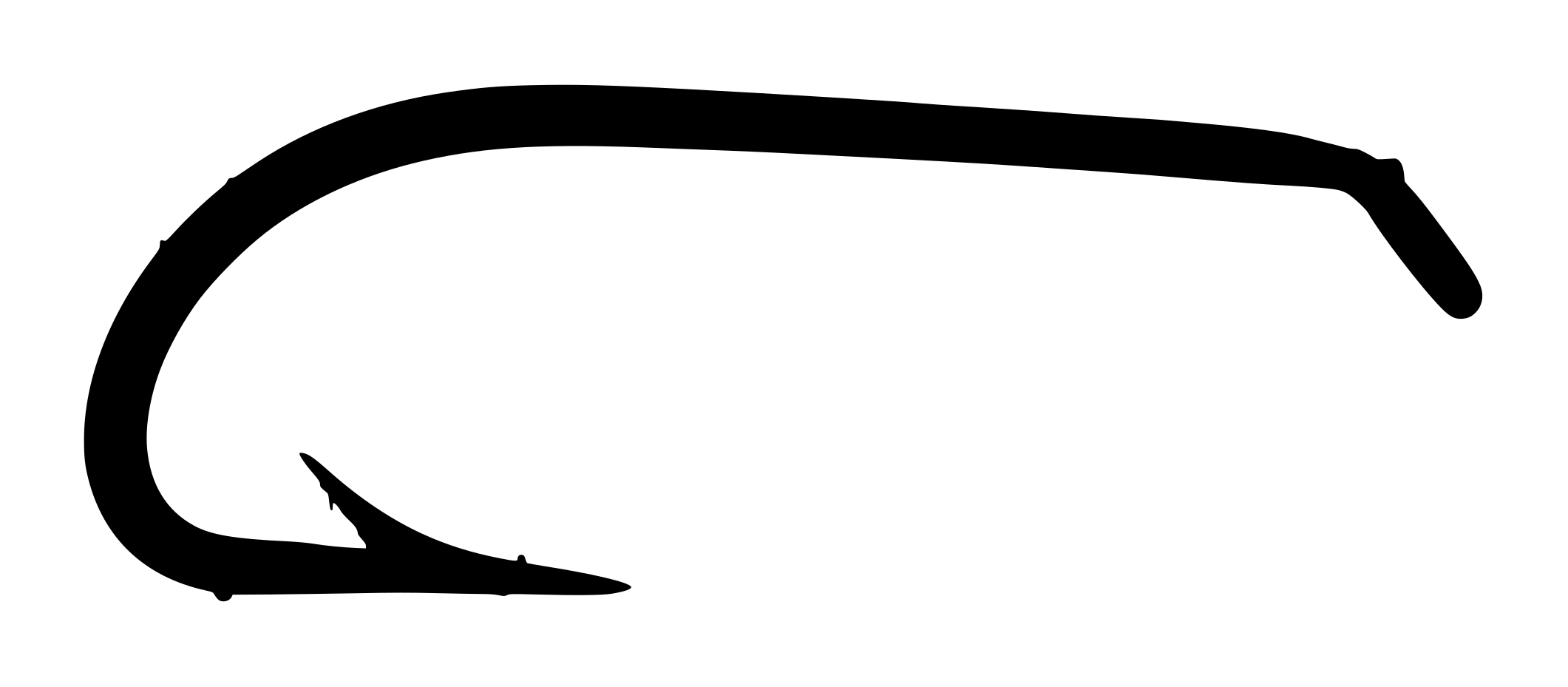
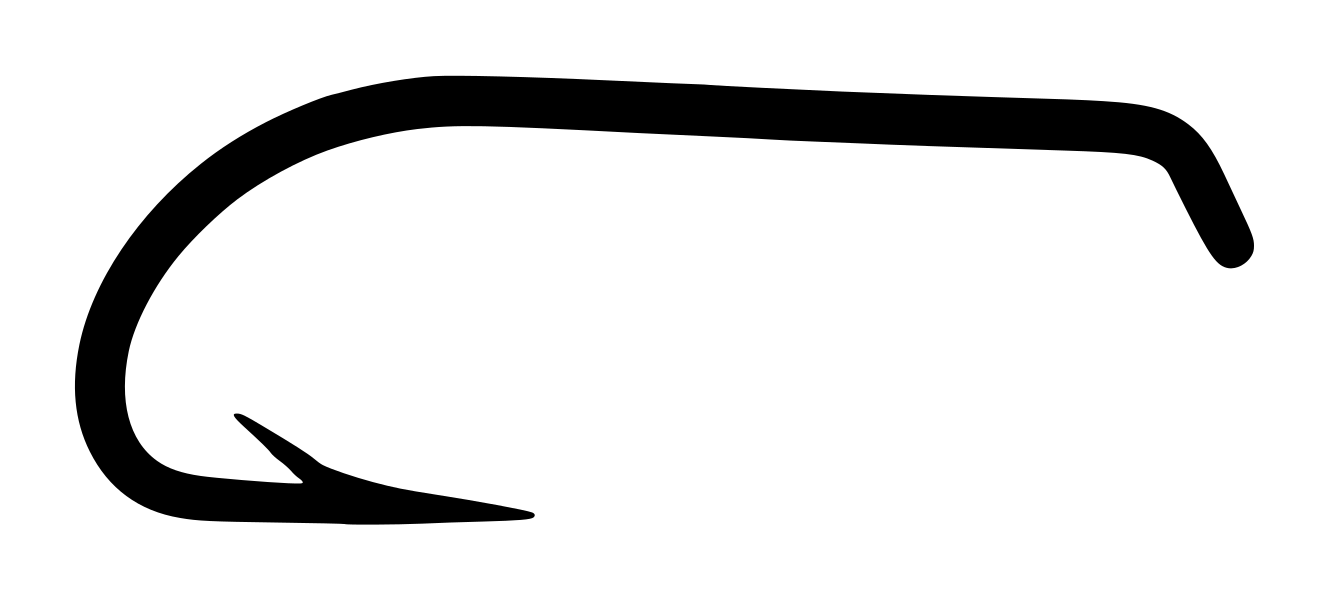
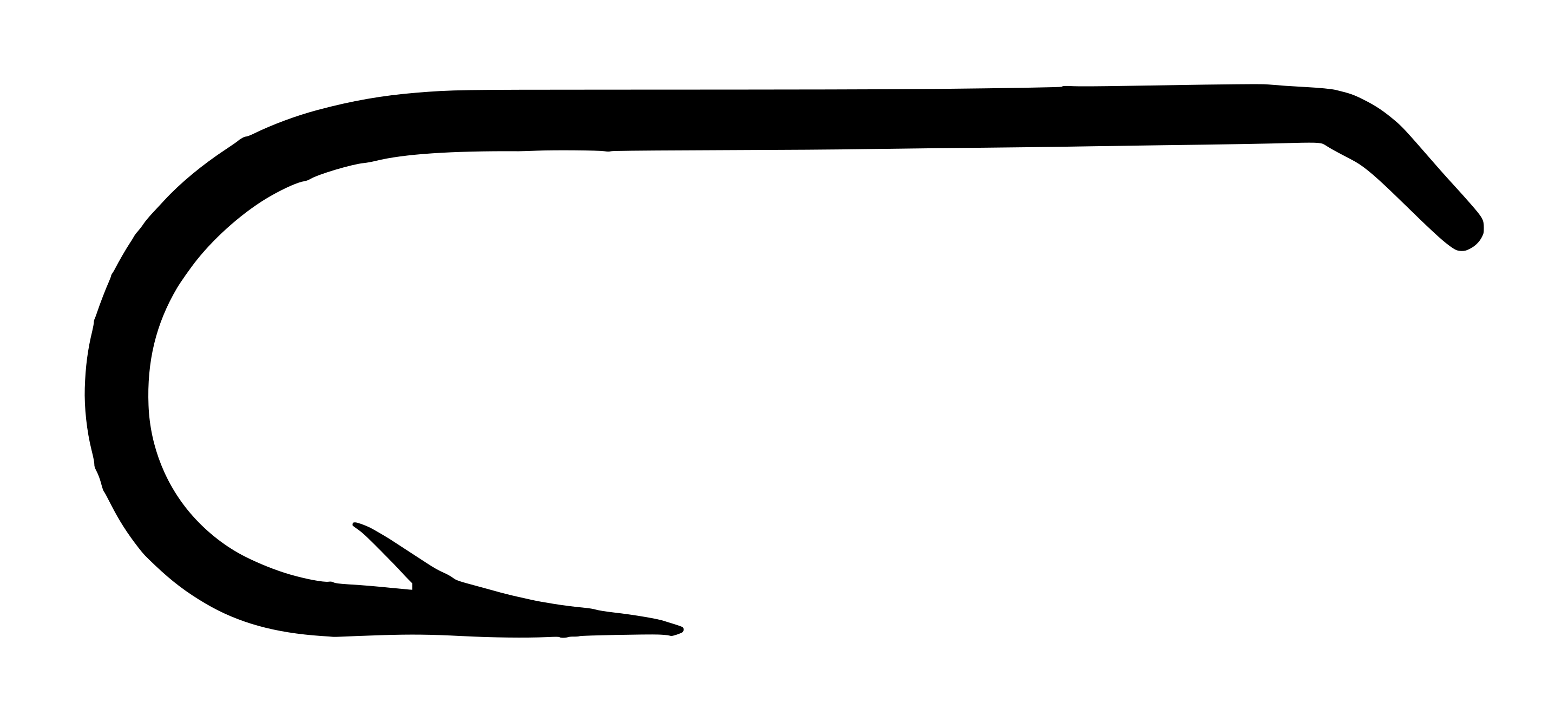
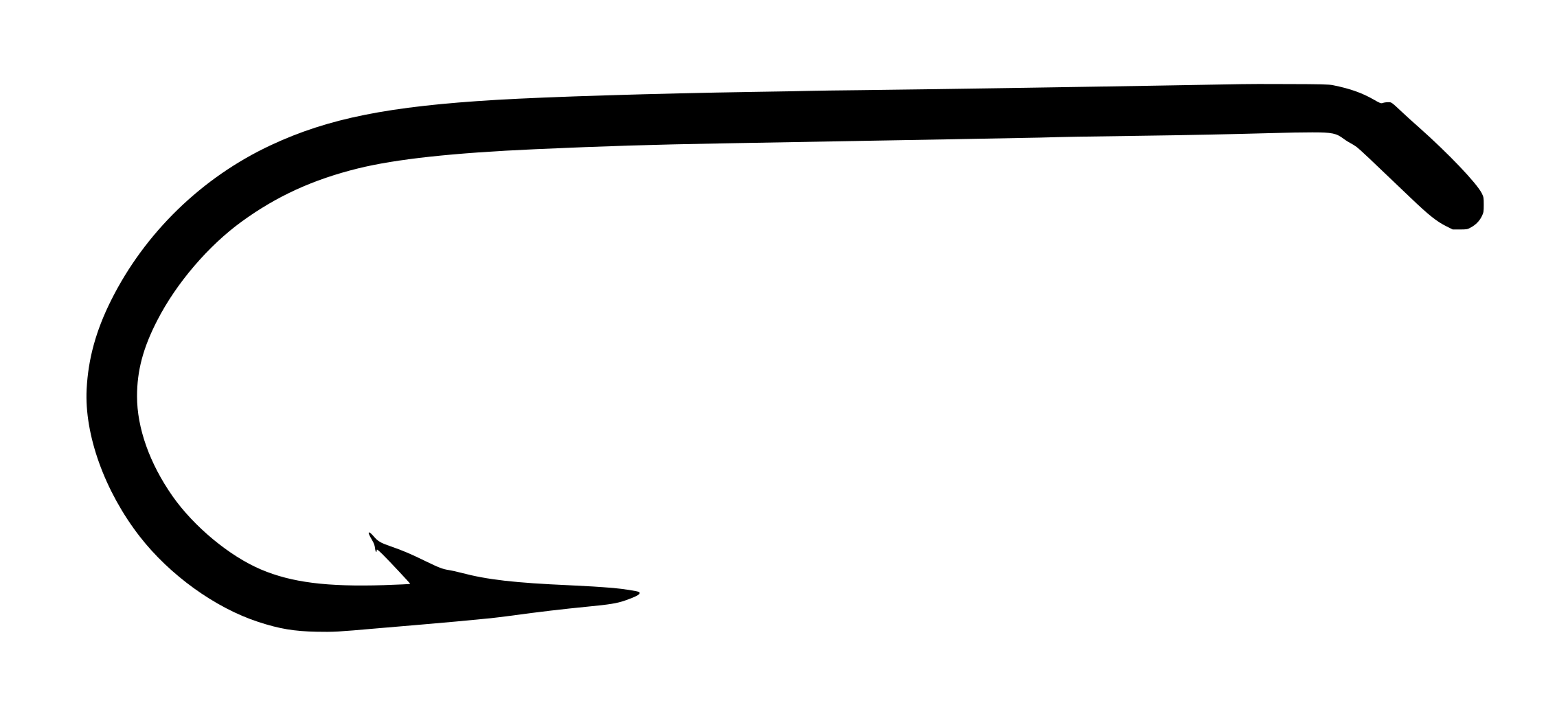
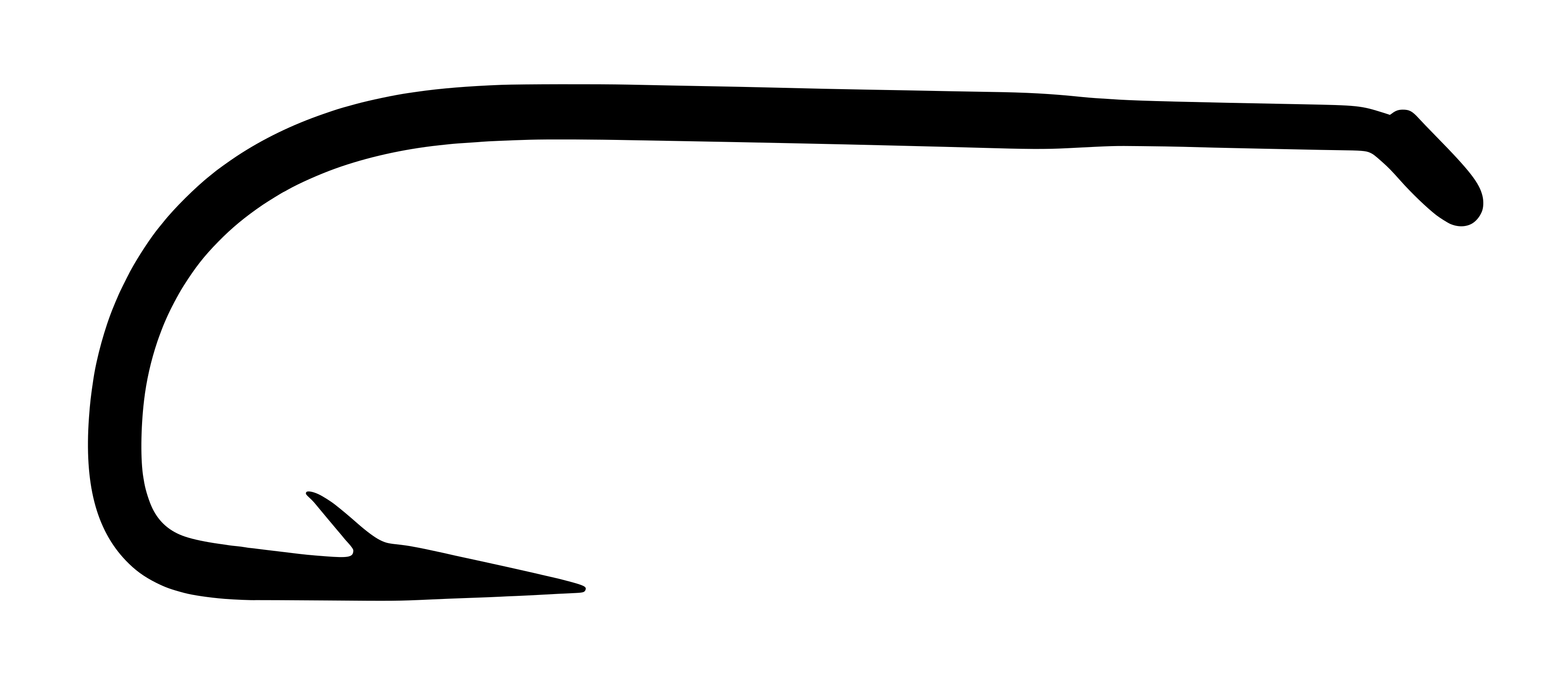
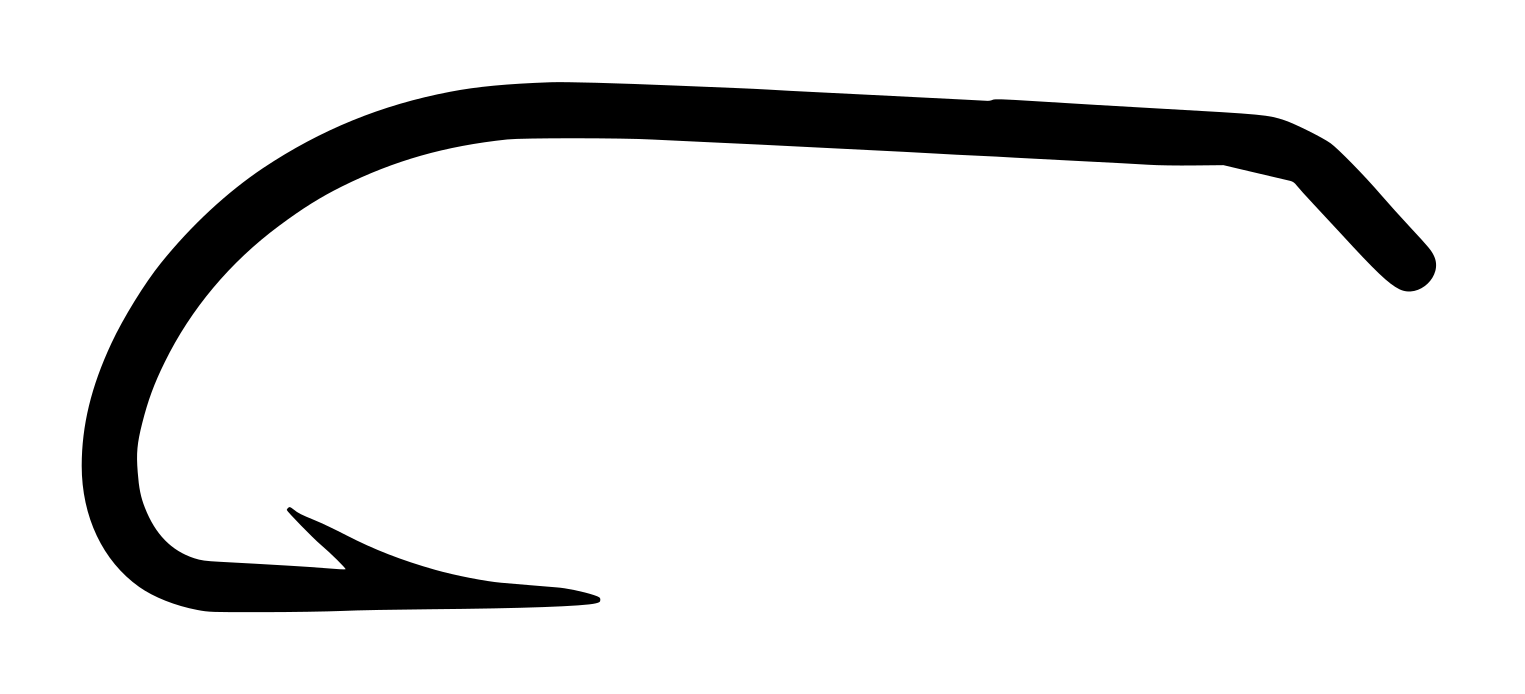
The Mustad 9037 E is a fine-wire, long-shank dry and wet fly hook manufactured by O. Mustad & Søn in Oslo, Norway, during the peak mid-century period (c. 1950s–1960s). The Crystal bend—a proprietary Mustad variation—combines a slightly flattened bottom profile with a sharper angle toward the point, creating a distinctive aesthetic and functional geometry that set it apart from standard Sproat or Limerick bends.
Fitted with a tapered, turned-down eye and hollow point, the 9037 E was engineered to minimize head weight on finished flies while maximizing penetration. The fine wire and long shank made it exceptionally popular among traditional fly tyers, particularly in the UK and Europe, where the pattern became synonymous with North Country spider tying and sophisticated wet fly presentations.
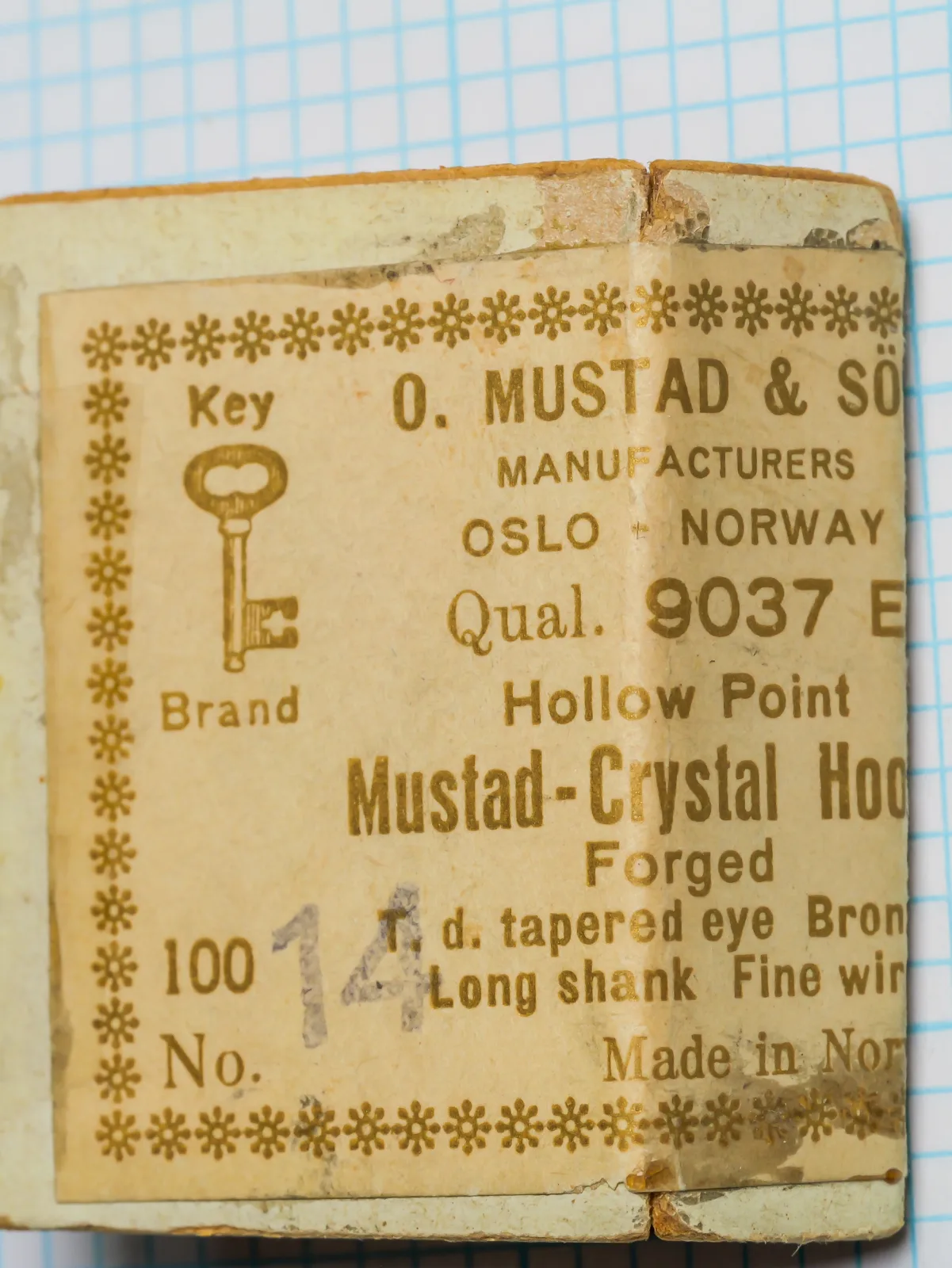
The presence of the “Key Brand” logo within an ornate border and the “Oslo – Norway” location mark this as a genuine Mustad product from the firm’s industrial ascendancy period. The bronzed finish and original card packaging are hallmarks of the era when Mustad dominated global hook production. This hook remains moderately sought by collectors focused on mid-century European fly-tying traditions and vintage wet fly craft.
Mustad-9037-E-Box-and-Label-Size-14-a
Photographic record
4 cataloged imagesSelect any record to load it above.
4 images shown
Mustad-9037-E-Box-and-Label-Size-14-aMustad-9037-E-Box-and-Label-Size-14-aOpen originalMustad-9037-E-Box-and-Label-Size-14Mustad-9037-E-Box-and-Label-Size-14Open originalMustad-9037-E-Hook-Size-14Mustad-9037-E-Hook-Size-14Open originalMustad-9037-E-Hooks-Size-14Mustad-9037-E-Hooks-Size-14Open original
Technical profile
Eye
Tapered Eye, Turned DownTapered eye is finely executed with uniform taper from shank to terminal loop, typical of premium Mustad dry fly hooks of this era. Taper angle appears steep, reducing eye weight significantly. P
Wire
Heavy (1X Heavy), Round, Est. ~0.012"-0.014" (~0.30-0.36 mm)
Shank
1X Long — Plain
Bend
Standard gapThe Crystal bend is distinctive within Mustad's catalog: the bottom profile is subtly flattened (less deeply curved than a standard Sproat), and the transition from shank to point is sharper and more angular than a round-bend hook. This geometry creates a more pronounced "bite" angle and was marketed as an improvement for hook-set efficiency. The bend appears symmetrical and well-proportioned. P
Point
Hollow Point (concave inner face)Barb is small and closely cut, characteristic of premium Mustad fly hooks. Barb is positioned approximately 0.08"–0.10" from the point and lies nearly parallel to the shank axis. Cut angle is clean and sharp. E
Finish
Bronzed — Confirmed (stated on packaging)The bronzed finish is warm, golden-brown in tone with a uniform appearance. No corrosion or flaking visible on specimen hooks. Finish is slightly darker and richer than typical tinned hooks, giving a natural, muted aesthetic favored by freshwater fly tyers who prioritized stealth. The label describes the finish as "Bronzed," which is consistent with the visual appearance. P
Specimen hooks are bright with no visible oxidation or pitting. Original box label shows age-appropriate toning and light wear consistent with storage in a cool, dry environment. Card stock is intact with no creasing or significant loss. All 100 hooks appear to be present in the package based on visible count and weight assessment.
The hollow point on the 9037 E was Mustad’s premium offering in this era. Unlike a standard spear point, the hollow point features a concave inner face that is ground or cut from the tip down to the barb, creating an incredibly fine, razor-sharp edge that achieves penetration with minimal applied pressure. This is particularly advantageous for dry fly presentation, where a gentle hook-set is desired to avoid breaking fine tippets or tearing the delicate lips of small trout.
The forged shank (though labeled simply “Forged” on the packaging) was mechanically flattened along its lateral sides in a drop press, dramatically increasing tensile strength and rigidity without adding weight. This engineering allows the fine wire to maintain structural integrity under stress while remaining light enough for buoyant dry fly presentations.
The tapered, turned-down eye represents a sophisticated engineering solution to the weight-distribution problem in dry fly design. By tapering the wire diameter as it forms the terminal loop, Mustad effectively reduced the mass of the hook head by 20–30% compared to a standard ball-eye hook of equivalent shank length. This weight reduction is critical for buoyancy; every fraction of a gram matters when attempting to float a fly horizontally on the surface tension of moving water.
The Mustad 9037 E represents one of the few documented examples of Mustad's proprietary "Crystal" bend in the garrenwood.com reference catalog. The specific combination of fine wire, long shank, tapered eye, and crystal bend geometry is not well documented in other major hook references, making this specimen notable for archival and research purposes.
Own this hook? Help us measure it.
We don't have measured sizes for this hook yet. Own one? Submit calipered measurements and we'll review and add them. Thank you!
The Crystal Hook series (Qual. 9037 and related models) represents a specialized line within Mustad’s broader catalog, designed to address specific European fly-tying traditions. The Crystal bend itself was not original to Mustad but rather a licensed or reverse-engineered adaptation of a European regional pattern, consistent with Mustad’s corporate strategy of “industrial cloning.” The series was introduced in the 1950s and remained in production through the 1960s and beyond, though exact discontinuation dates are not well documented in available archival sources.
The 9037 E designation breaks down as follows: “9037” indicates the model number within Mustad’s mid-tier quality range (3000–3999 block), while the “E” suffix likely denotes a specific variant—possibly indicating “Extra fine” wire or a European-market designation. The series saw minimal variation; the primary differentiator was hook size, ranging from sizes 6 through 18 for dry flies and larger sizes for wet fly variants.
Era and Packaging Dating
The packaging features the "Oslo – Norway" designation (line 3 of the eight-line label), which dates to 1925 or later. The predecessor designation "Christiania" was only used prior to January 1, 1925. The "Key Brand" logo appears within an ornate decorative border typical of mid-twentieth-century Mustad packaging. The print method is offset lithography on cream-colored card stock, consistent with 1950s–1960s production. The absence of a barcode (which became standard in the mid-1970s) confirms pre-1974 manufacture. The model code format (Qual. 9037 E) follows Mustad's numeric tier system, which was discontinued around 2001–2009 in favor of the Signature Series with alpha-numeric codes. The decorative border and overall label design match other documented Mustad examples from the 1950s–1960s period. No specific price marking or postal code is visible, but the overall aesthetic and paper stock strongly support a mid-century dating of c. 1950s–1960s.
The North Country Spider Revival
The Crystal Hook experienced a notable resurgence among fly tyers in the 1980s and 1990s, driven by renewed interest in North Country spider patterns—a minimalist wet fly tradition originating in northern England and Scotland. Anglers and tyers, rediscovering traditional methods in response to modern fly fishing's increasing complexity, found that the 9037 E's distinctive bend geometry produced an ideal "ride" in the surface film, allowing spiders to fish effectively in the mend and swing phase. Vintage boxes of the 9037 E became surprisingly sought after by this niche community, despite the hook having fallen out of Mustad's active catalog decades earlier. This unexpected demand illustrates how manufacturing decisions made in the 1950s can suddenly become valuable to subsequent generations of traditionalists who rediscover forgotten techniques.
Design lineage and influence
The Crystal bend sits at an interesting intersection in hook design history. It represents a hybrid between the deeply rounded Sproat bend (which distributes stress evenly across the arc) and the sharp-angled Limerick bend (which concentrates force at a focal point for increased jaw-locking power). The slightly flattened bottom and sharper transition angle suggest an influence from European bait-hook traditions, where such profiles were common in UK and Irish patterns.
By the 1950s, the Crystal bend had become established as a premium choice for European fly tyers, particularly those practicing North Country spider and traditional wet fly techniques. The Mustad 9037 E does not appear to have had significant downstream influence on modern hook design; the rise of standardized synthetic materials and modern fly tying movements superseded its specialized niche. Today, it is viewed primarily as a historical artifact of a specific time and place in fly-tying culture rather than as an ancestor to contemporary patterns.
Best matchRelated by Attribute
Computed automatically from catalog data — updated as new hooks are added.
Matches: Shank, Gap, Eye Orient., Point, Finish +5 moreDiffers: Bend: Other vs Limerick; Wire: Heavy (1X Heavy) vs Extra-Heavy (2X+); Eye: Tapered Eye vs Looped Eye +1 more
Matches: Shank, Gap, Eye, Eye Orient., Point +6 moreDiffers: Bend: Other vs Round / Kendal; Wire: Heavy (1X Heavy) vs Extra-Heavy (2X+); Forging: Round vs Forged +1 more
Matches: Shank, Gap, Eye, Eye Orient., Point +5 moreDiffers: Bend: Other vs Sneck; Wire: Heavy (1X Heavy) vs Standard; Offset: Straight vs Offset / Kirbed
Matches: Shank, Gap, Eye, Eye Orient., Point +5 moreDiffers: Bend: Other vs Limerick; Wire: Heavy (1X Heavy) vs Extra-Heavy (2X+); Application: Wet Fly, Nymph vs Wet Fly, Nymph, Salmon, Sea Trout +2 more
The 9037 E Crystal Hook was engineered as a premium dry fly and wet fly platform, particularly suited to long-bodied mayfly patterns and specialized nymph presentations. The fine wire and tapered eye reduce head weight, allowing flies to float higher and sit more horizontally on the water surface. The distinctive Crystal bend—characterized by a slightly flattened bottom profile and sharper angle leading to the hollow point—was designed to increase penetration efficiency and was historically favored by North Country spider tyers and traditional wet fly anglers in the UK and Europe. The long shank accommodates elongated fly bodies without requiring extended body dubbing, making it ideal for streamers and streamer-style wet flies.
Secondary Applications
Specialized nymph patterns, small streamer flies, North Country spider patterns
Classic Fly Patterns
North Country spiders, adult mayfly patterns, elongated wet flies, small streamers
Modern Equivalents
Hook
Match Quality
Notes
Mustad Heritage S80 (S80-3906)
Good
Modern re-introduction of Mustad's classic Sproat bend with fine wire and tapered eye; closest spiritual successor, though the Crystal bend geometry is not replicated in contemporary production.
Partridge L3A Captain Hamilton
Very Good
English-made alternative with similar long-shank, fine-wire profile and tapered eye; favored by North Country spider tyers seeking a vintage-style alternative to modern Japanese production.
Tiemco TMC 105
Moderate
Modern fine-wire, long-shank dry fly hook with tapered eye; similar weight distribution and buoyancy profile but uses contemporary chemically sharpened point technology rather than mechanically ground hollow point.
Collector notes
Rated 4.0/10 — uncommon in all sizes due to specialized niche application and limited production run, but moderate collector demand from traditional wet fly and North Country spider specialists prevents it from being truly scarce. The primary limiting factor is that the Crystal bend has largely fallen out of favor in modern fly tying, and the hook's premium features (fine wire, tapered eye) are less desirable in contemporary markets focused on larger saltwater and general-purpose patterns.
Reference value
$10 – $28 USD estimate
Packaging condition
Good — moderate wear, legibleRecorded specimen
Packaging format
GW-E-CARD-MID-1Catalog code
What Makes This Hook Collectible: The 9037 E is collectible primarily as a document of mid-century European fly-tying traditions and Mustad’s experimental approach to bend geometry. The combination of fine wire, long shank, tapered eye, and proprietary Crystal bend is not widely replicated by other manufacturers, making this a unique specimen for fly-tying historians. Original boxes with complete hook counts and intact labels are increasingly rare as collectors break up boxes for loose hook use or as examples deteriorate with age. The “Oslo – Norway” designation and “Key Brand” logo place this firmly within Mustad’s golden age of global dominance (1950s–1960s), which holds appeal for vintage tackle historians.
What Limits the Rating: The hook’s specialized niche—fine wire, small size, long shank—limits practical appeal to modern fly tyers outside the North Country spider tradition. The Crystal bend itself is not well known or understood by contemporary anglers, creating a knowledge barrier to appreciation. Mustad is over-represented in vintage hook collections relative to rarer Redditch makers like Partridge or Allcock, dampening collector enthusiasm. The model code system (Qual. 9037 E) was discontinued around 2000, marking this as genuinely vintage rather than merely old, but without strong brand recognition among younger collectors. Size 14 is less common than sizes 10–12 in original boxes, but this does not significantly increase value because demand is so narrow.
Desirable Variants: Sizes 10, 12, and 16 are marginally more desirable than size 14 because they align better with standard fly-tying proportions. Complete, unopened boxes command a 50–75% premium over opened cards. Bronzed finish is the standard for this model; any alternate finishes (if they exist) would be highly notable. Early examples with stronger “Oslo – Norway” printing and less label toning are preferred to heavily aged specimens.
Condition Factors Affecting Value: Box condition is paramount: a sealed, pristine example would command £20–£30 GBP ($25–$40 USD), while an opened box with missing or damaged hooks drops to £8–£15 GBP ($10–$20 USD). All 100 hooks present adds 10–15% value. Pencil inventory marks are acceptable and do not significantly reduce value. Heavy foxing, creasing, or tape repairs reduce value by 20–30%. Loose hooks from broken-up boxes typically sell for 30–50% of equivalent carded value, depending on tying demand and condition.
Packaging
Original cream-colored card stock (approximately 2.5" × 3.5") with gold/brown offset-lithograph printing. Label follows Mustad's standardized eight-line format with ornate decorative border of repeating geometric motifs along top and left edge. Graphic logo of downward-pointing skeleton key ("Key Brand" trademark) positioned in upper left. Text includes manufacturer name, location (Oslo – Norway), model code (Qual. 9037 E), hook specifications, quantity (100 No. 14), and manufacturing location (Made in Norway). Hooks appear to be affixed to the card with small fasteners or adhesive points, arranged in neat rows. Card shows age-appropriate toning with light foxing and minor creasing consistent with storage in a cool, dry environment. Original finish on card is slightly faded from initial printing intensity. Back of card is plain, unprinted.
Market Value Notes
Low ($10): Good condition box with minor wear, 90+ hooks present, no tape or heavy damage. High ($28): Sealed or near-sealed original box, all 100 hooks intact, minimal label toning. Premium factors: complete hook count, strong label printing, pristine card construction, intact original packaging. Platforms: eBay UK/US, British vintage tackle dealers, European fishing fairs. Confidence: E estimated — limited data on recent sales; based on comparable Mustad vintage offerings and North Country specialist interest. The specialized niche of the Crystal bend and fine-wire profile limits demand compared to more popular Sproat or Aberdeen patterns.
Where to Find
Vintage Mustad 9037 E boxes occasionally appear on eBay (both UK and US listings), typically from UK sellers specializing in vintage fly-tying materials or estate lots. Tackling dealers in England and Scotland (particularly those focused on traditional wet fly and North Country spider traditions) may stock examples. Specialist vintage tackle fairs in the UK and European fishing shows are occasional sources. Price range is typically £8–£25 GBP ($10–$32 USD) for a complete box in good condition, depending on hook count completeness and box condition. Loose examples or incomplete boxes are generally 30–40% of carded price.
Collector's Identification Tips
Identify the 9037 E by the model code “Qual. 9037 E” printed clearly on the label (line 4). Verify the distinctive Crystal bend in profile—it should show a slightly flattened bottom and sharper transition angle than a standard Sproat. Confirm the tapered, turned-down eye by visual inspection; the wire should visibly narrow as it approaches the terminal loop. The bronzed finish should have a warm, golden-brown tone. The box label should show “Oslo – Norway” (not “Christiania”) and the “Key Brand” logo within an ornate border. Look for “Forged,” “Long shank,” “Fine wire,” “T.d. tapered eye,” and “Hollow Point” in the descriptive text.
Preservation
Storage and Preservation
Store the original box in a cool, dry environment away from direct sunlight and fluctuating humidity. The bronzed finish is susceptible to patina development and minor oxidation with prolonged humidity exposure; however, many collectors consider this patina desirable as evidence of age and authenticity. Avoid storing in damp basements or attics where temperature swings may promote corrosion or paper deterioration.
Keep hooks on the original card rather than removing them for use; the card itself is now part of the collectible artifact and adds significant value. If individual hooks must be removed, do so carefully to avoid tearing the card or damaging the fastening points. Loose examples, while usable, are worth considerably less than carded specimens in comparable condition.
Avoid contact with other metals (iron, copper, stainless steel) to prevent galvanic corrosion. Do not store near cleaning solvents, salt water, or acidic materials (vinegar, citrus). Inspect periodically for signs of rust or foxing on the card. If rust spots develop on hooks, do not attempt to clean them with abrasive materials; gentle handling and storage in a stable environment will slow further oxidation. The bronzed finish is designed to develop a natural patina over time; this is normal and not a sign of deterioration.
Marking Analysis
Handwritten Marks and Annotations
The specimen documented here shows handwritten pencil annotations in the quantity field (“100 No. 14”) that appear to be inventory markings, likely applied by the original retailer or distributor. These marks are consistent with mid-twentieth-century wholesale and retail inventory practices. The pencil is faint and does not significantly detract from the overall condition or value of the box. Such markings are common on vintage tackle boxes and are considered acceptable retail evidence of age and authenticity rather than defects.
No other handwritten notes, signatures, or personal annotations are visible on the specimen. The absence of marked-through prices or additional dealer markings suggests this box spent most of its life in storage or inventory rather than in active retail use.
Size Note
Size 14: A Fine-Wire Anomaly
The documented size 14 is notably small for a long-shank hook; modern fly-tying conventions would typically associate a long-shank designation with sizes 8–12 for dry flies. Size 14 in a long-shank profile represents a specialized niche: extremely delicate, elongated patterns for small streams and spring creeks where fine presentation is paramount and tiny fly patterns are required.
Vintage Mustad sizing followed different conventions than modern ISO standards. The size 14 designation on the original label indicates the hook was intended for fly patterns approximately 0.40″–0.45″ in overall length, consistent with small mayfly imitations, midges with extended bodies, and specialized nymph patterns. The fine wire and long shank make this combination ideal for fishing smooth, clear, low-flow water where heavy wire or standard proportions would spook fish.
This particular size is less common in the original boxes than sizes 10 and 12, suggesting that demand for such delicate, elongated platforms was more specialized. Collectors seeking the most historically accurate North Country spider examples often prioritize size 14 and size 16 variants, as these tiny hooks align with the original Scottish and English traditions that specified “small, thin, long-shanked” irons for the technique.
Primary Source
Decoding the Eight-Line Label System
Source: A Comprehensive Typology and Decryption of Vintage O. Mustad & Søn Hook Labels (garrenwood.com reference document)
The Mustad 9037 E label exemplifies O. Mustad & Søn’s standardized eight-line typographic format, which encoded vast technical information into a compact, visually organized space. The label reading, in order: (1) “Key Brand” graphic and text, (2) manufacturer name (“O. Mustad & Søn”), (3) industry designation (“Manufacturers”), (4) geographic origin (“Oslo – Norway”), (5) quality model code (“Qual. 9037 E”), (6) point type (“Hollow Point”), (7) pattern name (“Mustad-Crystal Hook”), and (8) specification modifiers (“Forged,” “T.d. tapered eye,” “Bronzed,” “Long shank,” “Fine wire”).
According to the comprehensive Mustad typology documented in the reference source A Comprehensive Typology and Decryption of Vintage O. Mustad & Søn Hook Labels, each line serves a strictly defined function. Line 4 establishes the quality tier: models numbered in the 3000–3999 range were mid-tier products manufactured to exacting tolerances and targeted at serious anglers and professional tyers. The “9037” designation places this hook solidly within that premium range.
Line 5, reserved exclusively for point geometry, clearly states “Hollow Point”—a concave inner face geometry that provided minimal penetration resistance, crucial for delicate dry fly presentations. Line 8 specifications are comprehensive: “Forged” indicates cold-forging of the shank to increase rigidity; “T.d. tapered eye” means turned-down, tapered construction for weight reduction; “Bronzed” specifies the finish; “Long shank” indicates the 2X extended shank; and “Fine wire” denotes the minimal wire gauge. This dense technical language was designed to communicate precisely across global markets without relying on color coding or visual cues alone.
Additional
The Crystal Bend: A Specialized Geometry
The “Crystal” bend is not a widely documented hook geometry in standard English-language fly-fishing literature, suggesting it was either a European regional adaptation that Mustad reverse-engineered, or a proprietary Mustad variation created for specific market demand. The designation “Mustad-Crystal Hook” on the label emphasizes the brand-to-pattern connection, implying this was Mustad’s exclusive interpretation of a specific bend profile.
Examining the specimen hook, the Crystal bend exhibits a subtly flattened bottom profile (less deeply curved than a traditional Sproat) and a sharper, more angular transition from shank to point than a round-bend profile would produce. This geometry serves specific biomechanical purposes: the flattened bottom increases the hook’s “foot” contact area with the jaw, improving holding power under sustained tension; the sharper angle toward the point increases the efficacy of the hollow-point grinding, creating a more pronounced cutting edge and faster initial penetration.
The Crystal bend’s relative obscurity in modern hook catalogs suggests it was either a commercially niche offering even in the 1950s, or that post-war standardization and simplification of Mustad’s product line led to discontinuation in favor of more universally applicable profiles like the Sproat. Today, the 9037 E serves as a historical document of a specific moment in fly-hook engineering when manufacturers experimented freely with regional variations, prior to the industry’s consolidation around a handful of standardized bend families.
Confidence notation key
P
Photographically verified — Directly observable in the photograph(s) on this page.
V
Verified by documentation — Confirmed by manufacturer catalog, spec sheet, or published reference.
I
Inferred — A logical deduction from observable or documented evidence, not directly stated.
E
Estimated — An approximation based on visual comparison, proportional analysis, or limited data.
S
Speculative — A reasoned hypothesis that cannot be confirmed from available evidence.
Unnotated claims are the compiler’s synthesis; see Sources. All photographs on garrenwood.com are taken on a measurement grid where each square equals 1/10 inch (0.1″ / 2.54 mm).