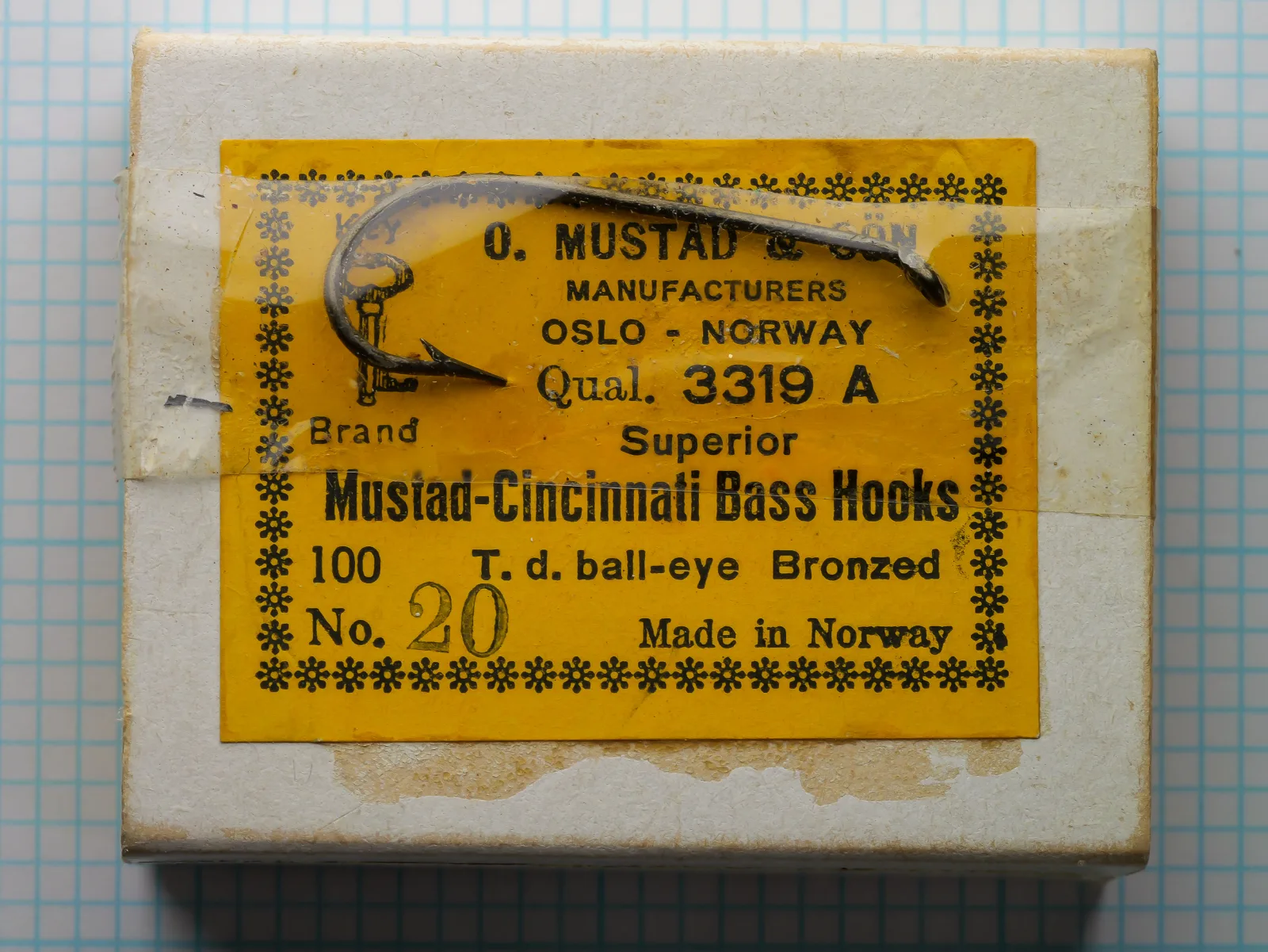
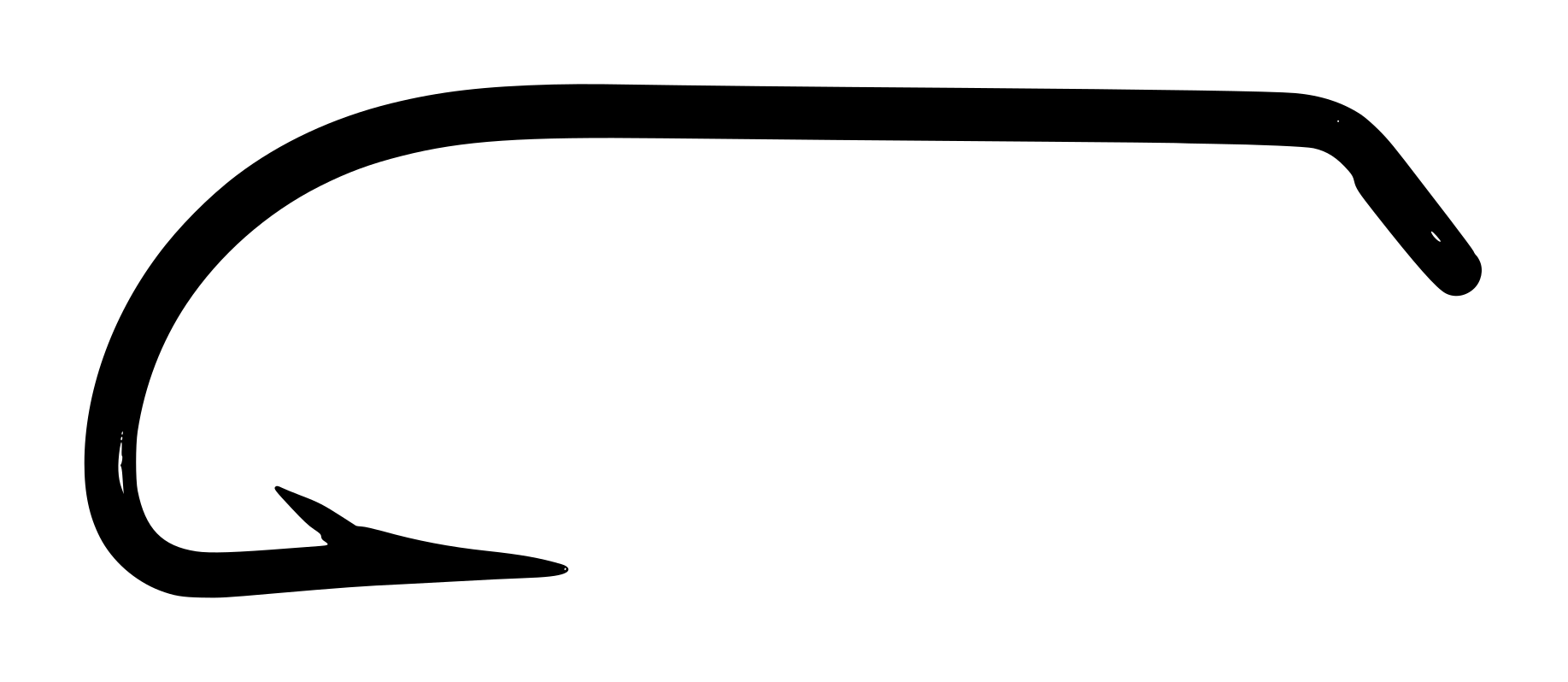
The Mustad 3319 A is a mid-20th-century bass and general bait hook manufactured by O. Mustad & Son in Gjøvik, Norway. This size No. 20 specimen carries a yellow-printed label identifying it as part of Mustad’s Mustad-Cincinnati Bass Hooks product line, with a distinctive Cincinnati Bend — a deep, rounded throat with slightly inward-pointing tip mounted on a standard shank.
The hook features a turned-down ball eye, standard round wire, and a bronzed finish. The ‘Superior’ marking on the package refers to Mustad’s Superior product line (a brand designation), not the Superior point geometry; photographic examination confirms a near-straight, superior-style point with minimal inner concavity P. The absence of a barcode, Oslo address format, and mid-century yellow label all point to production between the 1950s and mid-1960s V.
Collecting interest centers on the Cincinnati Bend’s regional significance to American Midwestern bait fishing and the hook’s integration into Mustad’s mid-century export strategy. The condition of this packaging—clear lettering, intact label, minimal toning—enhances its appeal to tackle historians and Mustad collectors.
Original yellow paper label on cream cardboard backing, showing Mustad-Cincinnati Bass Hooks branding, model 3319 A, size No. 20, turned-down ball eye, bronzed finish, with sample hook affixed by staple through the eye.
Photographic record
3 cataloged imagesSelect any record to load it above.
3 images shown
Mustad 3319 A Size 20 Packaging Label and BoxOriginal yellow paper label on cream cardboard backing, showing Mustad-Cincinnati Bass Hooks branding, model 3319 A, size No. 20, turned-down ball eye, bronzed finish, with sample hook affixed by staple through the eye.Open originalMustad 3319 A Size 20 Hook Point DetailClose-up view of the hook point from below, showing the superior-style near-straight inner taper, nearly flat inside face, and the short close-cut barb at approximately 45° angle. The bronzed finish and point geometry are clearly visible.Open originalMustad 3319 A Size 20 Hook Full ProfileSide-profile view of the complete hook showing the turned-down ball eye, standard shank, deep rounded Cincinnati Bend throat, and point-forward geometry. Photographed on 1/10-inch grid for precise measurement of overall length, shank length, bend depth, and gap width.Open original
Technical profile
Cincinnati Bass Bend | Turned-Down Ball Eye | Bronzed Finish | Standard Wire | Superior Point
Eye
Ball Eye, Turned DownThe ball at the eye is well-formed with a smooth, symmetrical radius P. The taper from shank to eye shows gradual reduction in wire diameter, typical of quality mid-century Mustad production. The turned-down angle is approximately 15–20° below the horizontal plane E.
Wire
Standard, Round
Shank
Standard — Plain
Bend
Standard gap, Offset / kirbedThe Cincinnati Bend exhibits a deep, rounded throat with a radius of approximately 0.30"–0.35" (7.6–8.9 mm) E. The tip is very slightly inward-pointing, creating a subtle forward hook when viewed from the side — this is characteristic of the Cincinnati design and differs from purely symmetrical bends like Sproat or Limerick. The bend is symmetric side-to-side with no kirb offset P.
Point
Superior (near-straight inner taper)The barb is short and close-cut, set at approximately 45° angle to the shank E. The barb appears to be integral to the point (forged, not added separately) with clean, sharp edges. Barb length is roughly 0.15"–0.18" (3.8–4.6 mm) from the barb's trailing edge E. This is a standard, functional barb designed to grip bait securely without excessive damage.
Finish
Bronzed — Confirmed (stated on packaging)The bronzed finish displays a warm, dark golden-brown tone P. On this specimen, the finish is uniformly applied with no visible wear, scratches, or corrosion — consistent with a hook that was either never used or very carefully stored. The color temperature is distinctly warm (golden) rather than cool (gray-black), typical of salt-bath bronzing rather than harsh oxidation P.
The specimen is in excellent condition. All hooks on the card are bright and intact with no corrosion, rust bloom, or loss of finish. The package label is intact with sharp, legible printing and minimal toning of the yellow paper — consistent with storage in a cool, dry location for 60+ years. Two of the original 100 hooks remain visible on the card; the other 98 were presumably used or have been removed.
The Superior Point on this hook features a near-straight inner taper from barb to tip with a nearly flat inside face, minimizing the concavity typical of Hollow Points. This geometry is a manufacturing choice reflecting Mustad’s design philosophy: Superior points are easier and faster to forge in high-volume production, slightly less likely to catch on bait cartilage during insertion, and more durable for repeated-use bait fishing where the hook must endure handling of tough live baits.
The Turned-Down Ball Eye is formed by tapering the wire and creating a distinct rounded ball at the eye end, then bending the entire shank downward so the eye points below the plane of the hook (turned down rather than straight or turned up). This construction allows anglers to attach their line securely without a knot-catching edge and provides a neater fly-head finish for those few anglers who might tie this as a wet-fly-fishing or streamer option, though it is primarily marketed as a bait hook.
The Bronzed Finish is a vintage hot-salt-bath oxidation process that imparts a warm, dark brown-gold patina to carbon steel. Bronzed hooks are prized by collectors for their aesthetic appeal and their susceptibility to developing beautiful patinas with age, but they require careful dry storage to prevent flash rusting. The finish provides modest corrosion resistance adequate for freshwater fishing but not sufficient for saltwater conditions.
The Mustad-Cincinnati Bass Hooks product line was designed to appeal to American freshwater bait anglers, particularly in the Midwest where the Cincinnati Bend had established a strong reputation for bass and general bait fishing. The Cincinnati Bend itself predates Mustad’s adoption of the name; the bend style originated in the American Midwest and became associated with bass fishing tradition. Mustad’s decision to brand this specific bend and market it explicitly as ‘Cincinnati Bass Hooks’ reflects the company’s understanding of regional fishing preferences and its commitment to supplying hooks tailored to specific American fishing traditions.
This product line spans multiple sizes (commonly No. 8 through No. 20 for bait work) and appears across several eras of Mustad packaging. The 3319 A designation indicates a Quality-grade hook, suggesting mid-tier pricing and materials—good enough for serious anglers but not the premium ‘Supreme’ or highest-specification lines. The line remained in production through at least the 1970s, though packaging formats evolved significantly; later versions moved away from yellow-label cards toward plastic packaging and simplified designs.
Era and Packaging Dating
1. No barcode visible on package — strong indicator of pre-1974 manufacture. 2. Address format 'Oslo - Norway' is typical of Mustad export packaging c. 1945–1970; later packages used 'Gjøvik' or more modern postal codes. 3. Yellow paper label with black letterpress printing is characteristic of mid-20th-century Scandinavian hook packaging; the paper stock and print method suggest offset or flexible letterpress rather than full lithography. 4. 'Key Brand' logo with stylized key motif is consistent with Mustad's mid-century branding; earlier (pre-WWII) packages featured more ornate lithography and heraldic designs; later (1970s+) designs moved toward plastic and simplified graphics. 5. Phone number format (Oslo office) uses the old Norwegian area code format without country code, typical of 1950s–1960s business cards. 6. Size range (No. 8 through No. 20 indicated) and hook style (Cincinnati Bend) are consistent with mid-century bait-hook catalogs. Conclusion: c. 1950s–1965, most likely 1955–1962.
Why 'Cincinnati'?
The Cincinnati Bend takes its name from Cincinnati, Ohio—a major American hub for tackle distribution and a center of freshwater bass-fishing tradition in the 19th and early 20th centuries. Mustad's decision to brand and explicitly market this bend as 'Mustad-Cincinnati Bass Hooks' reflects the company's sophisticated understanding of regional American fishing preferences. By naming a hook design after a major American city, Mustad signaled to Midwestern anglers that they were using the 'authentic' Cincinnati pattern, even though the bend itself had been in use for decades. This marketing strategy was remarkably effective and helped Mustad dominate the American bait-hook market throughout the mid-20th century.
Design lineage and influence
Best matchRelated by Attribute
Computed automatically from catalog data — updated as new hooks are added.
Matches: Wire, Gap, Eye, Eye Orient., Point +5 moreDiffers: Bend: Other vs Kirby (offset); Shank: Standard vs 1X Long; Application: Wet Fly, Nymph, Bait vs Nymph, Bait +2 more
Matches: Wire, Gap, Eye, Eye Orient., Point +4 moreDiffers: Bend: Other vs Sproat; Shank: Standard vs 1X Long; Offset: Offset / Kirbed vs Straight +3 more
Matches: Shank, Wire, Gap, Eye, Point +4 moreDiffers: Bend: Other vs Kirby (offset); Eye Orient.: Turned Down vs Straight / Inline; Finish: Bronzed vs Black Japanned +3 more
Matches: Shank, Wire, Gap, Eye, Forging +4 moreDiffers: Bend: Other vs Sneck; Eye Orient.: Turned Down vs Straight / Inline; Point: Superior vs Hollow Point +3 more
The Mustad 3319 A Cincinnati Bass Hook was designed primarily for live bait fishing for bass and other freshwater gamefish. The Cincinnati Bend’s deep, rounded throat and slightly inward-pointing tip provide excellent ‘holding power’ — the hook’s ability to remain firmly set once a fish has taken the bait. This made it particularly effective for minnow fishing, where live baits require a robust bend geometry to resist shaking free during a fight. The size No. 20 is suited to small baits and panfish, though the Cincinnati line extends to larger sizes (No. 8, No. 6) for bigger baits and larger gamefish.
The Superior point style (confirmed by photographic examination) offers a near-straight inner taper that pierces cleanly through tough bait cartilage and scales without requiring excessive hook sharpness, making it reliable for extended bait soaking. Historically, this hook was favored by Midwestern bass anglers and appears frequently in vintage tackle boxes from the 1950s–1960s era.
Secondary Applications
General freshwater bait fishing; catfish and panfish when used in larger sizes
Classic Fly Patterns
Named patterns specifically associated with this hook. Leave blank if none formally documented. Do not speculate — only include patterns with a confirmed association.
Modern Equivalents
Hook
Match Quality
Notes
Mustad 9671
Good
2XL Nymph Hook; similar shank length and bend radius, but modern materials and finish; lacks the historical character and warming finish tone
Tiemco 200R
Moderate
Curved bend with extended shank; closer to Viking-style than Cincinnati, but similar overall profile and intended use for larger baits
Gamakatsu Octopus
Moderate
Round bend with turned-down eye; widely used for live-bait work today, though point style and finish differ from vintage Mustad
Collector notes
Packaging condition
Very Good — light wear, fully legibleRecorded specimen
Packaging format
GW-M-yellow-label-osloCatalog code
Packaging
Yellow paper label (approximately 2.5" × 1.75") affixed to a cream-colored cardboard backing. The label features a printed border of small black floral motifs (four-petaled flowers) enclosing centered text in a mix of fonts: large bold letters for 'Mustad-Cincinnati Bass Hooks,' smaller regular type for model and specifications. Header reads 'O. MUSTAD & SON, MANUFACTURERS, OSLO - NORWAY.' Below this: 'Qual. 3319 A' (bold), 'Brand Superior' (smaller type), 'Mustad-Cincinnati Bass Hooks' (largest, bold), '100' (quantity, left side), 'T. d. ball-eye Bronzed' (specifications, center), 'No. 20' (size, lower center), 'Made in Norway' (lower right). All text is printed via offset lithography or flexible letterpress in black on the yellow background. The card stock is standard kraft-pulp construction, cream-colored on the reverse. A single hook is wire-stapled through the eye to the label as a sample. The overall condition shows minimal toning of the yellow paper and no damage to the label or backing card.
Collector's Identification Tips
Identify this hook by: (1) Model code ‘Quality 3319 A’ printed on yellow label. (2) ‘Mustad-Cincinnati Bass Hooks’ branding. (3) Turned-down ball eye and bronzed finish. (4) Yellow label with ‘Oslo – Norway’ address (no barcode). (5) Size marking ‘No. 20’. Do not confuse with other Mustad bass hooks (e.g., 3319 B, which is a different bend variant; or later plastic-packaged versions of the same model). The yellow label format is distinctive and rarely appears on post-1970s Mustad packaging.
Preservation
Storage and Preservation
Store this hook in a cool, dry environment, ideally away from direct sunlight and humidity fluctuations. The bronzed finish is susceptible to flash rusting in damp conditions; if stored with other hooks, place acid-free paper or cloth between different metal types to prevent galvanic corrosion. The yellow paper label is fragile and fades with light exposure — consider storing the original box in an opaque, acid-free container to preserve the label’s color and legibility.
If the hook shows signs of surface rust (a light brown dusting), gently dry it with a soft cloth and store immediately in a dry location; do not attempt to remove rust with abrasive materials, as this may damage the finish and reduce collector value. The bronzed finish will naturally develop a deeper patina with age in dry storage, which many collectors find aesthetically desirable.
Original packaging adds significant value — keep the hook on its original card rather than storing it loose. If the card must be handled, do so infrequently and with dry hands to avoid transferring moisture or oils to the paper.
Marking Analysis
Handwritten Markings
The specimen photographed shows no visible handwritten annotations, price marks, distributor stamps, or serial numbers on the label or card. The label and card appear to be original factory-printed packaging with no secondary marking. This is consistent with store-stock inventory that was never marked or coded by a retailer.
Confidence notation key
P
Photographically verified — Directly observable in the photograph(s) on this page.
V
Verified by documentation — Confirmed by manufacturer catalog, spec sheet, or published reference.
I
Inferred — A logical deduction from observable or documented evidence, not directly stated.
E
Estimated — An approximation based on visual comparison, proportional analysis, or limited data.
S
Speculative — A reasoned hypothesis that cannot be confirmed from available evidence.
Unnotated claims are the compiler’s synthesis; see Sources. All photographs on garrenwood.com are taken on a measurement grid where each square equals 1/10 inch (0.1″ / 2.54 mm).