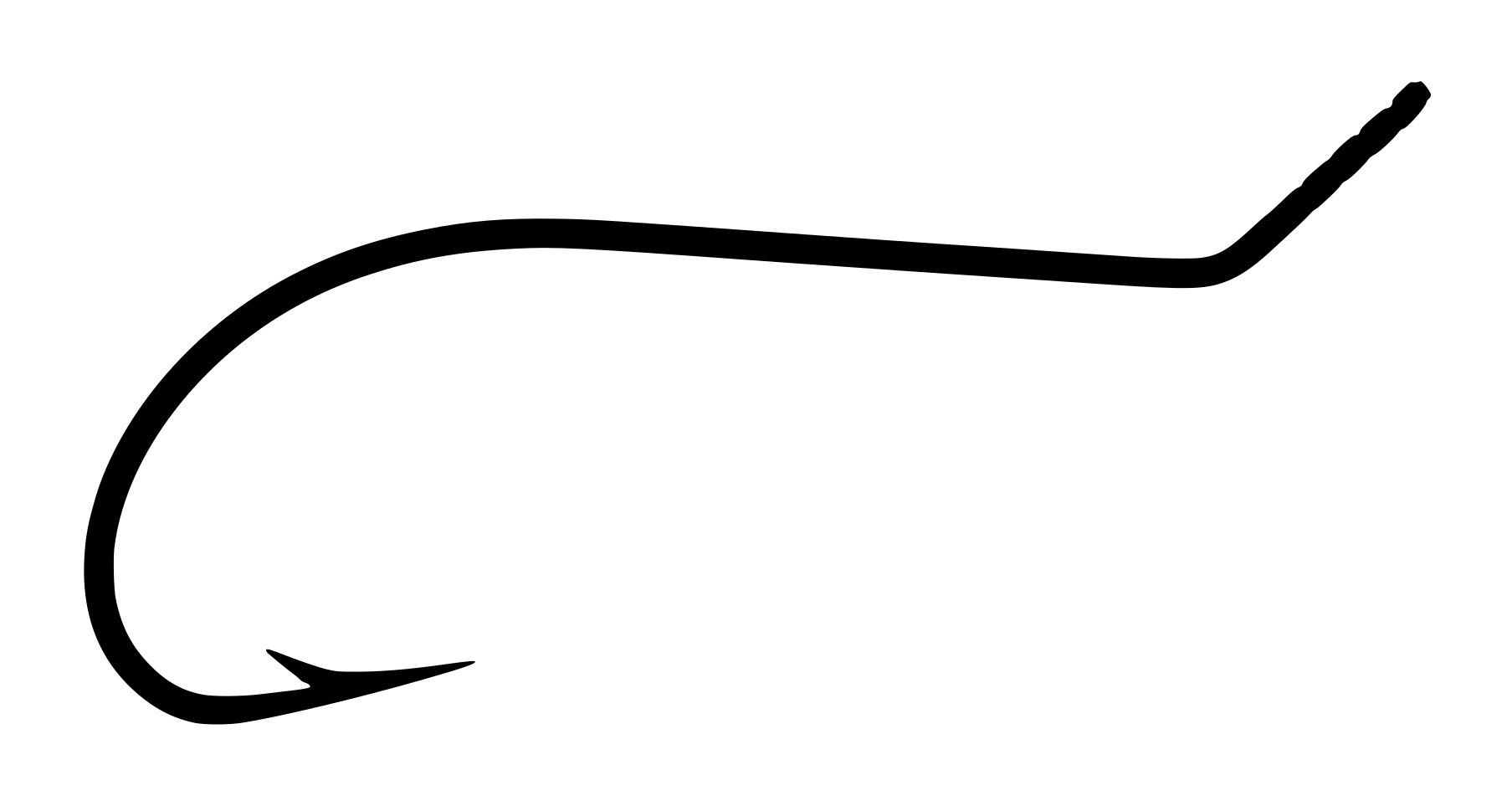
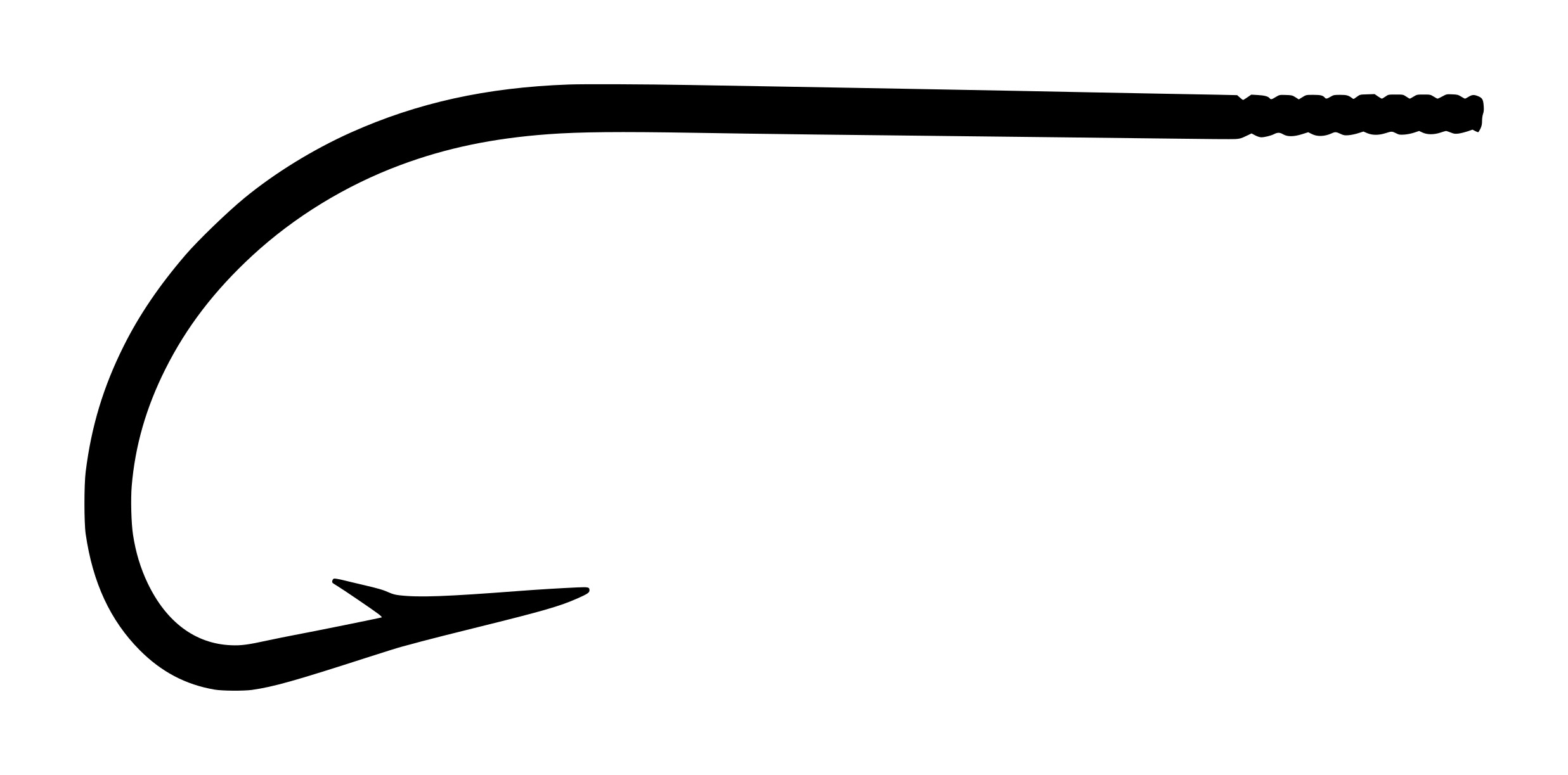
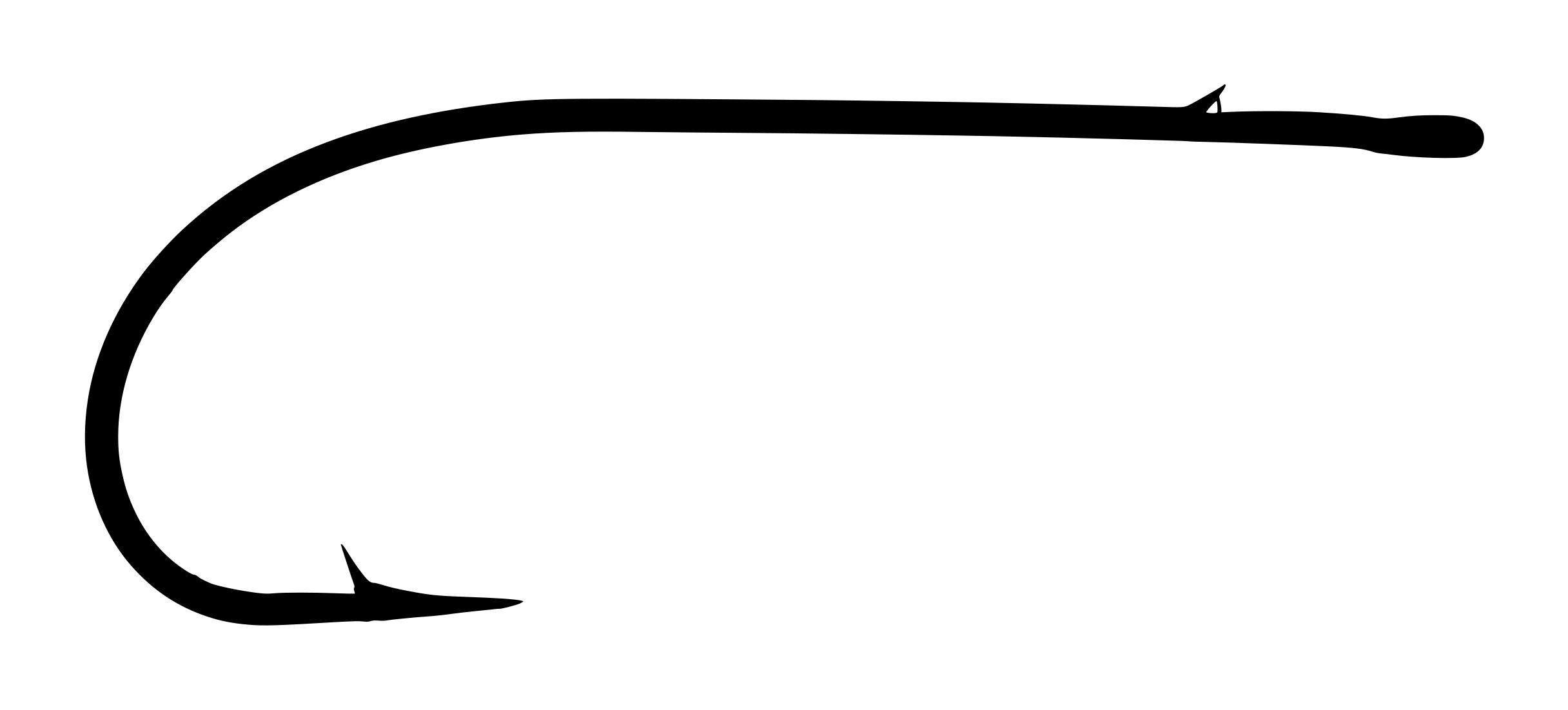
Mustad 3840 Centripetal is a Norwegian salmon hook manufactured by O. Mustad & Son from approximately 1930 to 1960, defined by a blind eye, Sproat bend, hollow point, standard wire gauge, and bronzed finish. The tapered eye construction accommodates a loop of gut leader material without requiring a separate eye casting, while the hollow point geometry provides a two-sided cutting edge suited to the thicker mouth structure of salmon. This hook represents a transitional design between early Redditch blind-eye patterns and Mustad’s industrial production methods, solving the specific problem of securing gut leaders to larger flies for Northern European salmon and sea-trout fishing traditions.
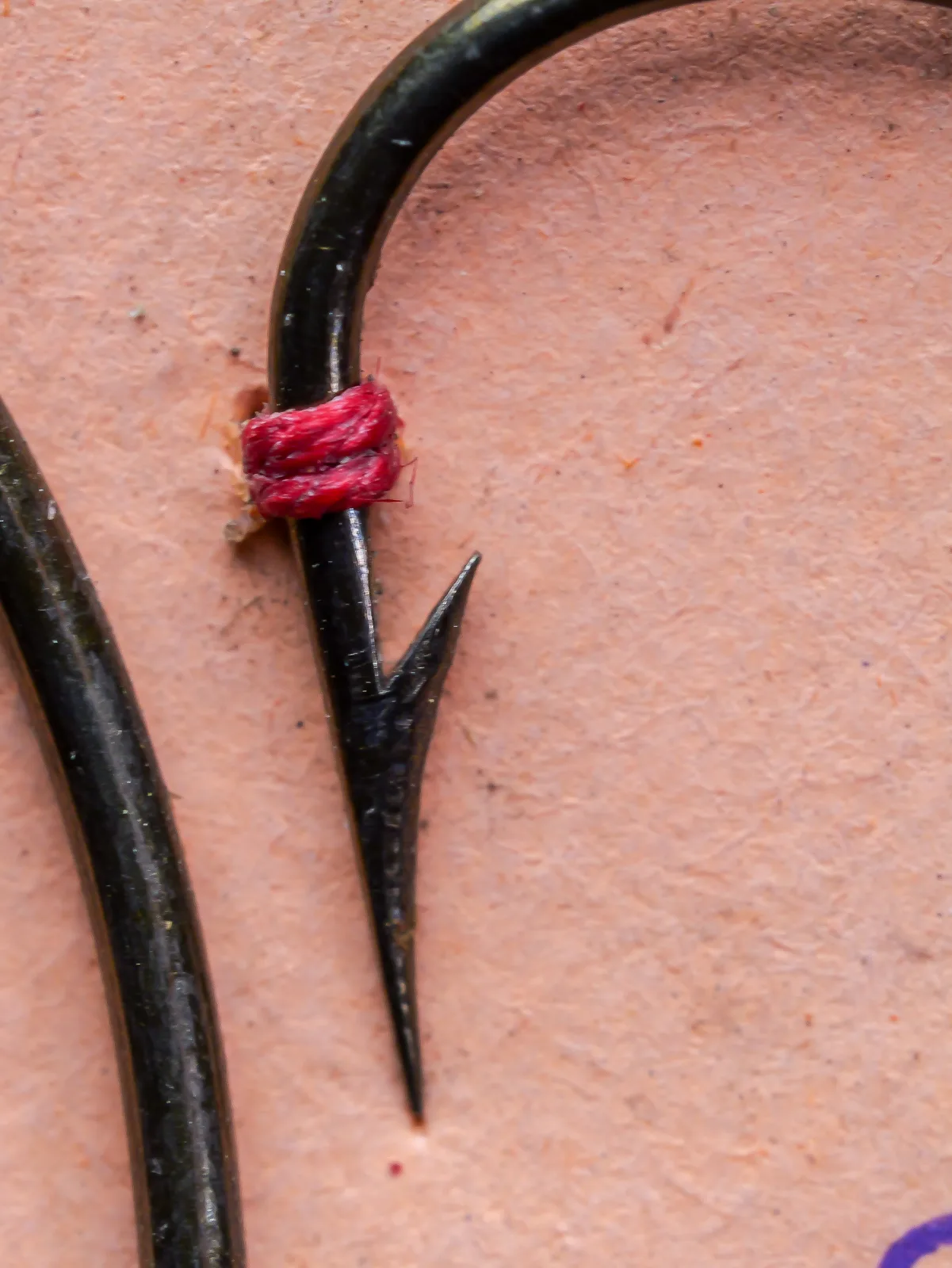
Closeup detail of the Mustad 3840 showing the distinctive tapered blind eye construction and hollow point geometry, with red silk suspension thread, bronzed finish specimen on measurement grid.
Photographic record
6 cataloged imagesSelect any record to load it above.
6 images shown
Mustad 3840 Centripetal Tapered Blind Eye CloseupCloseup detail of the Mustad 3840 showing the distinctive tapered blind eye construction and hollow point geometry, with red silk suspension thread, bronzed finish specimen on measurement grid.Open originalMustad 3840 Sales Card Complete Size RangeComplete Mustad 3840 Centripetal sales card displaying all nine hook sizes from 3/0 to 6, suspended from wire loops with red silk thread wrapping, on bright orange period packaging with gold letterpress typography and geometric border.Open originalMustad 3840 Original Label Text DetailOriginal Mustad label mounted on the sales card, detailing the product specifications including model code, point style, product line name, finish designation, and country of origin, printed in gold letterpress ink on cream background.Open originalMustad 3840 Sales Card Full View with Measurement GridComplete view of the Mustad 3840 Centripetal sales card photographed on blue measurement grid, showing manufacturer header, hook size progression (3/0 through 6), original label in lower right, and distinctive geometric border design in gold on bright orange card stock.Open originalMustad 3840 Centripetal Box LabelOriginal packaging for Mustad 3840 Centripetal Hooks, size 9, marked rustproof special. Manufactured in Oslo, Norway by O. Mustad & Søn.Open originalMustad 3840 Sproat Bend Hook ProfileMustad 3840 size 9 hook displaying sproat bend profile, bronzed finish, straight eye, and hollow point construction.Open original
Technical profile
Blind Eye | Sproat | Standard | Extra fine Wire | Hollow Point | Bronzed
Eye
Blind — Marked ShankTapered blind eye — shank tapers to a smooth rounded point with no flattening or spade construction. Gut attached via loop tied around the taper. V Confirmed by physical examination.
Wire
Extra-Fine, Forged
Shank
Standard — Plain
Bend
Sproat, Standard gapGentle rounded bottom typical of Sproat configuration. Wire set is even and symmetrical. P Visible across all sizes on sales card.
Point
Hollow Point (concave inner face)Barb is small and close-cut, positioned just above the taper junction. Swept backward at approximately 15 degrees to the wire axis. P Visible on closeup specimen image.
Finish
Bronzed — Confirmed (stated on packaging)Warm brown tone consistent with period bronzing process. Coloring uniform across all sizes examined. Steel grain texture visible beneath the finish coating, typical of light bronze application. V Confirmed on original packaging: 'Marked Bronzed Special'. P Visible in specimen closeup.
Sales card exhibits light age toning and minor edge wear. Printed colors remain legible and bold. One hook missing from the size 6 position; remaining eight sizes complete at approximately 12 hooks each. Red silk thread at three suspension points remains intact but darkened with age. Card stock shows no water damage or creasing. Label remains firmly adhered.
The tapered blind eye construction reflects gut-era fly-fishing technology. The shank tapers to a smooth, rounded point that accommodates a loop of gut leader material wrapped around the taper and secured with wax or knots. This construction provided a permanent, integral loop without requiring a separate eye casting or a separate loop component. The taper geometry required precision hand-forging or specialized dies to achieve the smooth, gradual transition from shank to point without sharp discontinuities that would abrade gut material.
The Sproat bend’s gentle, rounded bottom distributes stress evenly across the bend radius, making it suitable for the larger fly patterns and heavier fish (salmon) typical of the 3840’s intended use. The hollow point represents an investment in sharpening precision — the concave inner face requires a secondary operation after forging to achieve the characteristic inward curve. This geometry provides a two-sided cutting edge that penetrates initial contact with fish tissue more readily than a spear point, advantageous for the thicker mouths and harder mouth structure of salmon relative to trout.
The standard wire gauge reflects a balance between durability (required for salmon-sized fish and flies) and the working space needed for traditional wet-fly dressing techniques. Heavier wire would have reduced the fly’s mobility in water; lighter wire would have compromised strength. The bronzed finish provides adequate corrosion resistance for freshwater use, though the finish layer is thin enough to allow the steel grain texture to show through, consistent with early-20th-century bronzing practices.
This pattern was made in sizes 3/0 - 6. We have measurement for size 9. Know the others? Submit calipered measurements and we'll review and add them. Thank you!
Historical context
mustad
O. Mustad & Son was established in 1832 in Oslo, Norway, by Ole Mustad, expanding from a local blacksmith and gun manufacturing operation into one of the world’s largest industrial fishhook manufacturers. The company’s Gjøvik factory, established in the 1890s, became a major production center capable of serving global markets. By the early 20th century, Mustad had established distribution networks across Europe, North America, and colonial territories.
The company positioned itself as a competitor to British Redditch manufacturers (particularly Allcock and Partridge) through aggressive pricing, reliable quality, and innovative marketing. Norwegian labor costs and hydroelectric power advantages enabled Mustad to produce hooks at lower cost than English makers while maintaining acceptable quality standards. This strategy made Mustad the dominant hook supplier to Continental European and Scandinavian markets by the 1930s.
During the mid-20th century, Mustad expanded its product lines to include specialty patterns for different fishing traditions and geographies. The Centripetal line represents this diversification — a product marketed specifically to salmon and sea-trout anglers in Northern Europe. Mustad’s acceptance of modern production methods (eventually phasing out tapered blind eyes in favor of ball eyes) positioned the company to dominate the post-1960 market as industrial standardization replaced craft traditions.
Series History
The Mustad-Centripetal Hooks line appears in Mustad catalogs from approximately the 1930s through the 1960s. The ‘Centripetal’ name is not found on earlier Mustad literature and may derive from a design patent or a marketing concept emphasizing the hook’s balanced bend geometry. The line included multiple model variants across different point geometries and eye types.
The 3840 model code is designated ‘Quality 3840’ on original packaging, suggesting a defined position within a broader product taxonomy. The ‘Special’ designation and explicit ‘Hollow Point’ marking indicate that other Centripetal variants existed with different point styles (likely Superior Point versions). The tapered blind eye construction of the 3840 aligns with traditional Northern European salmon fly patterns and reflects Mustad’s effort to compete with established English makers in the high-end salmon market.
By the early 1960s, Mustad phased out the tapered blind eye across most product lines in favor of the turned-down ball eye, which was faster to manufacture and compatible with modern synthetic fly lines and tapered leaders. The Centripetal line likely ceased production by 1965, making surviving examples period artifacts of a specific design era rather than continuously produced contemporary hooks.
Era and Packaging Dating
No barcode visible on packaging — strong indicator of pre-1974 manufacture. Packaging design elements support mid-20th-century dating: (1) Sales card features bold geometric border design (Greek key pattern) consistent with 1930s–1950s Scandinavian commercial printing; (2) Gold/bronze ink letterpress printing on bright orange card stock matches Mustad's mid-century brand identity; (3) Mustad establishment date shown as '(Establ. 1832)' in format typical of 1930s–1960s corporate messaging; (4) Typography uses serif fonts standard to pre-offset letterpress work; (5) Size notation (3/0, 2/0, 1/0, etc.) appears in hand-applied or early printed form consistent with pre-standardized machine production; (6) Label states 'Made in Norway' without ISO/modern format, typical of 1930–1965 period; (7) Absence of modern packaging identifiers (zip codes, product codes, batch numbers) confirms production before standardization era of 1960s. The tapered blind eye construction also declined in popularity after 1960 as turned-down ball eyes became dominant in industrial production.
Tradition Meets Industrial Production
The tapered blind eye construction on the Mustad 3840 reflects a manufacturing tradition that traces directly to 19th-century Redditch hand-forging methods, yet the 3840 was mass-produced on modern machinery in Oslo. This represents a fascinating moment in industrial history: even as manufacturing became increasingly automated and standardized, Mustad deliberately maintained traditional eye construction for its premium salmon hooks, viewing the tapered blind eye as a marker of quality and tradition rather than an obsolete relic. By the 1960s, when synthetic fly lines eliminated the functional need for gut loops, this design philosophy vanished almost overnight — the 3840 became a curiosity within a generation.
Design lineage and influence
The tapered blind eye and Sproat bend combination places the 3840 within a design tradition originating in 19th-century Redditch craft production. Allcock and Partridge of Redditch both manufactured tapered blind-eye patterns for salmon fishing, and Mustad’s adoption of this construction demonstrates the global influence of English hook design even as Norwegian manufacturing competed economically.
The 3840’s hollow point geometry reflects early-20th-century developments in point metallurgy and sharpening techniques. Mustad’s adoption of hollow point construction — more expensive to produce than a simple spear point — signals an effort to market the 3840 as a premium product competing directly with high-end English salmon hooks rather than as a budget alternative.
By the 1960s, the tapered blind eye design became a historical artifact. Modern fly lines eliminated the need for gut-loop attachment, and ball eyes proved faster to manufacture at scale. The 3840 represents a specific moment of design conservatism — Mustad holding to traditional construction methods even as industrial production was driving standardization toward simpler geometries. No direct modern equivalent exists; contemporary Mustad salmon hooks use ball eyes and modern point profiles.
Best matchRelated by Attribute
Computed automatically from catalog data — updated as new hooks are added.
The Mustad 3840 was designed as a wet fly and salmon hook for Northern European market conditions, particularly Scandinavian and British salmon streams. The tapered blind eye accommodates gut-loop attachment methods standard to mid-20th-century fly-fishing practice. The hollow point provides a fine penetration geometry suited to salmon-sized flies tied on wire gauges typical of the 1930s–1960s period.
The standard Sproat bend offers a balance between hook strength (required for larger fish) and a relatively natural hook shape for traditional wet fly patterns. The bronzed finish provides corrosion resistance suitable for freshwater salmon and sea-trout applications in high-humidity Northern European climates.
Secondary Applications
Also used for larger wet flies for trout and grilse patterns in river and estuary conditions.
Classic Fly Patterns
Named patterns specifically associated with this hook. Leave blank if none formally documented. Do not speculate — only include patterns with a confirmed association.
Modern Equivalents
Hook
Match Quality
Notes
Mustad 3906B
Moderate
Modern Mustad salmon hook with similar Sproat bend; uses ball eye and modern point instead of tapered blind eye
Partridge Patriot Salmon Hook
Moderate
Contemporary salmon hook with similar bend geometry and performance intent; different eye and point construction
Alec Jackson Spey Hook
Poor
Modern Spey-specific pattern; different bend family and application context
Collector notes
Rated 4.5/10 — Mustad industrial production volumes keep the base model common, but the pre-1960s tapered blind eye construction and period sales card packaging in good condition represent genuine collector interest. Larger sizes (3/0 and 2/0) are more frequently encountered than smaller sizes (5–6).
Reference value
$8 – $22 USD estimate
Packaging condition
Good — moderate wear, legibleRecorded specimen
Packaging format
GW-M-3840-SCCatalog code
The Mustad 3840 occupies a middle position in collector demand. While Mustad’s massive production volume ensures the hook itself is not rare, the specific combination of factors creates moderate collecting appeal: (1) the tapered blind eye construction represents a design philosophy largely abandoned after 1960; (2) the pre-1974 period sales card is a meaningful artifact of mid-century Scandinavian tackle marketing; (3) the ‘Special’ designation and hollow point specification indicate a deliberate product positioning within Mustad’s broader Centripetal line; (4) the bronzed finish and orange card are visually distinctive.
Size availability affects rating substantially. Larger sizes (3/0, 2/0, 1/0) remain common in period packaging — these command modest premiums ($5–12 for a card). Intermediate sizes (1, 2, 3) are less frequently encountered ($8–15). Smaller sizes (4, 5, 6) are genuinely scarce, particularly when the card is complete or near-complete ($15–25 for a complete card).
Packaging condition is the primary value driver. A sealed or near-sealed card with all hooks commands a premium of 50–75% above an opened, incomplete example. Collectors of Scandinavian tackle, mid-century sports equipment, and Redditch-influenced blind-eye designs represent the active market. Fly-tying specialists value 3840s only if using the hooks functionally; vintage tackle aesthetics and packaging history matter more to valuation.
Packaging
Bright orange sales card, landscape format (approximately 7.5 × 5 inches). Nine hook silhouettes displayed at top of card in size progression: 3/0, 2/0, 1/0, 1, 2, 3, 4, 5, 6. Hooks suspended from wire loops with red silk thread wrapping at suspension point. Card header in black serif typography reads 'O. MUSTAD & SON - FISHHOOK MANUFACTURERS (Establ. 1832)' with 'OSLO - NORWAY' centered at bottom. Gold/bronze ink letterpress throughout. Distinctive border of repeated geometric (Greek key) pattern in gold. Central text states: 'Qual. 3840 / Hollow Point / Mustad-Centripetal Hooks / Marked Bronzed / Special / Made in Norway'. Mustad key trademark in center of card. Small descriptive label (approximately 3 × 2 inches) mounted on lower right corner, bearing identical text in smaller format. No barcode, no modern product codes. Paper stock is card weight, consistent with 1940s–1950s commercial printing. Light age toning visible; original bright orange has mellowed to peachy-orange tone.
Market Value Notes
Low ($8): Good condition — opened sales card, three to five hooks missing, minor packaging wear, card legible and intact<br />
High ($22): Excellent condition — sealed or near-sealed card, all ten hooks present, minimal wear, red silk suspension threads intact<br />
Premium factors: Complete hook count, sealed original packaging, orange card in excellent color saturation, all nine sizes present, tissue paper or original box enclosure<br />
Platforms: eBay UK and US tackle sales, occasional specialist dealer listings, vintage tackle fairs<br />
Confidence: E estimated — limited sold data available for this specific model; estimate based on comparable pre-1960 Mustad sales cards and period Norwegian tackle packaging. Actual values may vary by 20–30% depending on regional demand and collector competition.
Where to Find
eBay UK and US primarily. Specialized vintage tackle dealers in Scandinavia, Germany, and UK occasionally stock period Mustad cards. Fishing tackle fairs in Norway and UK may feature examples. Redditch-focused collector groups and forums less frequently carry this model due to its Norwegian origin, but some British vintage tackle dealers stock Mustad alongside domestic English makers.
Preservation
Storage and Preservation
Store the sales card in a cool, dry environment away from direct sunlight and humidity. The bronzed finish is susceptible to patina development and darkening with exposure to moisture and oxygen; some collectors consider age patina desirable, while others prefer to halt progression. To minimize oxidation, store the card in a sealed archival box or acid-free envelope, ideally with silica gel desiccant if humidity is a concern. Avoid contact with other metals or acidic materials.
The bright orange card stock will fade with prolonged UV exposure. Store away from windows. The red silk thread at the suspension points may fade or become brittle with age; handle the card with care to avoid pulling or stressing these threads. If the card is opened, preserve the original packaging orientation — do not attempt to remove hooks from the card unless they are being actively used for fishing.
The tapered blind eye is more delicate than modern ball-eye designs. If any hooks are removed from the card for examination, inspect the taper carefully for stress fractures, particularly where the taper transitions from shank to point. Do not flex or bend the tapered portion excessively, as the taper geometry concentrates stress and can crack if subjected to lateral forces.
Primary Source
Packaging Text and Marketing Claims
Source: Mustad 3840 sales card, original label, c. 1935–1955
The sales card’s printed text provides specific historical information about Mustad’s product positioning in the mid-20th century. The designation ‘Quality 3840’ establishes a formal model classification system, implying that other Centripetal variants existed under different quality or model codes. The explicit label ‘Hollow Point’ on the card is significant — this was not Mustad’s default point style and represents an up-market positioning decision. The term ‘Special’ reinforces this marketing intent; the 3840 was marketed as a variant of the broader Centripetal line, suggesting premium status within that category.
The phrase ‘Marked Bronzed Special’ indicates that the bronzed finish itself was a deliberate specification choice subject to marketing claims. By the 1930s–1950s, Mustad offered multiple finishes (bronzed, blued, nickelled, japanned). The selection of bronzed for the Centripetal line suggests an appeal to traditional salmon fly anglers, where bronzed finishes conveyed heritage and conservative taste. The explicit marking of ‘Special’ on the label suggests quality control or batch verification — some manufacturers of the era used such markings to denote hooks that met specific tolerances or inspection criteria.
The packaging bears no explicit statement of intended use (salmon, sea trout, fly size ranges, etc.), a notable absence compared to modern tackle packaging. This suggests that the Centripetal line was marketed primarily through catalogs and trade relationships rather than through point-of-sale information on the card itself, consistent with mid-century commercial fishing tackle distribution practices.
Marking Analysis
Handwritten Marks and Annotations
The surviving example examined shows no visible handwritten price marks, inventory codes, or personal annotations on the sales card or label. The size numbers (3/0, 2/0, 1/0, 1, 2, 3, 4, 5, 6) printed in blue/purple ink on the card are machine-applied (likely early offset or lithography), not hand-written. This indicates factory printing rather than hand-assembly or retail pricing markup. The absence of handwritten notations suggests the card was preserved without retail or personal use, distinguishing it from examples that passed through tackle shops or individual angler possession.
Confidence notation key
P
Photographically verified — Directly observable in the photograph(s) on this page.
V
Verified by documentation — Confirmed by manufacturer catalog, spec sheet, or published reference.
I
Inferred — A logical deduction from observable or documented evidence, not directly stated.
E
Estimated — An approximation based on visual comparison, proportional analysis, or limited data.
S
Speculative — A reasoned hypothesis that cannot be confirmed from available evidence.
Claims with no notation are confirmed by multiple independent sources. All photographs on garrenwood.com are taken on a measurement grid where each square equals 1/10 inch (0.1″ / 2.54 mm).