Mustad 8230 — A Mid-Century Standard Salmon and Wet-Fly Pattern
Manufactured by O. Mustad & Søn in Oslo, Norway, the Qual. 8230 is a Limerick-bend hook marketed as ‘Superfine’ yet specified as ‘Extra Strong’ — a paradoxical descriptor that reflects Mustad’s labeling conventions of the 1950s–60s. The hook features a classical Limerick bend with a sharp, angular curve at the bottom, a straight-ring eye, round extra-heavy wire, and a jet-black japanned (lacquered) finish characteristic of the era. P
The Oslo designation on the packaging (rather than the earlier Christiania name) confirms production post-1925, and the blue-bordered card with serif typography places manufacture in the mid-twentieth-century export boom. The japanned finish was the traditional choice for Atlantic salmon flies and heavy saltwater work before modern electroplating became standard. P
The No. 2 size makes this hook well-suited for large streamers, salmon wet flies, and traditional North Country dressing. While common in larger sizes, the No. 2 is moderately collectable among wet-fly and salmon specialists. Complete, sealed carded examples in strong japanned condition are increasingly valued by vintage tackle archivists and traditional fly tyers.
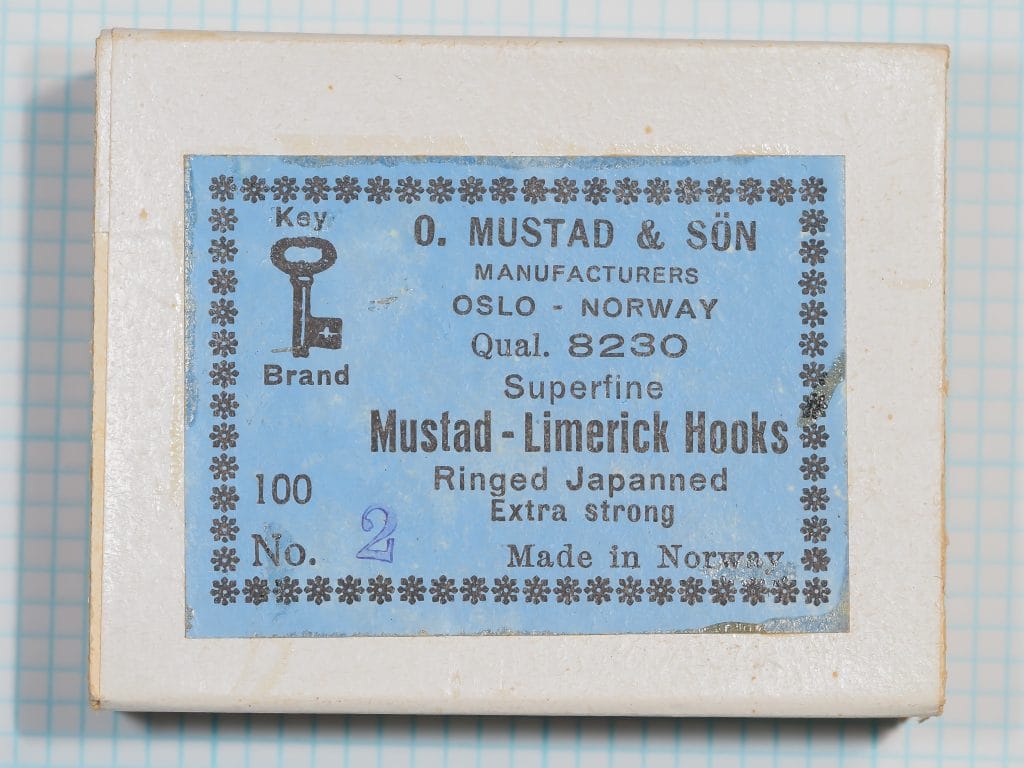
Original Mustad 8230 packaging label showing the standardized eight-line typographical format, Oslo-Norway origin, japanned finish designation, and 100-count size No. 2 specification.
Photographic record
3 cataloged imagesSelect any record to load it above.
3 images shown
Mustad 8230 Limerick — Original Box LabelOriginal Mustad 8230 packaging label showing the standardized eight-line typographical format, Oslo-Norway origin, japanned finish designation, and 100-count size No. 2 specification.Open originalMustad 8230 Size 2 — Hook Point DetailClose-up of the hook point and barb showing the hollow-point geometry characteristic of vintage Mustad salmon and wet-fly patterns. The concave inner-face taper and fine, sharp tip are visible against the measurement grid.Open originalMustad 8230 Size 2 — Bend Profile and ProportionsProfile view of two Mustad 8230 hooks (size No. 2) showing the characteristic Limerick bend with sharp angular bottom, straight-ring eye, and proportions between shank length and gap width on the calibrated measurement grid.Open original
Technical profile
Ringed | Japanned | Extra Strong | Made in Norway
Eye
Ball Eye, Straight / InlineRinged eye is uniformly formed and cleanly finished, typical of mid-century Mustad manufacturing. The ring diameter is proportionate to the extra-heavy wire gauge and does not show deformation or casting defects. P
Wire
Standard, Round, Est. ~0.062"-0.072" (~1.6-1.8 mm)
Shank
2X Long — Plain
Bend
Limerick, Standard gapThe Limerick bend is pronounced and angular, with a sharp inflection at the lowest point of the curve. This acute angle (rather than the rounded sweep of a Sproat) is designed to lock the fish's jaw into the bend during the fight. The bend sits deep relative to the shank axis, creating substantial depth. P
Point
Hollow Point (concave inner face)The barb is small, close-cut, and sharply defined—characteristic of hollow-point design. It sits at approximately 45° angle to the hook shank and is proportionate to the No. 2 size. The barb creates a fine, knife-like edge at the point transition, typical of mechanically ground vintage Mustad points. P
Finish
Black Japanned — Confirmed (stated on packaging)The japanned finish is a jet-black lacquered coating typical of Mustad's mid-century salmon and wet-fly hooks. The surface is uniformly dark with subtle patina from age; the lacquer shows minor wear and micro-crazing consistent with 60+ years of storage but no active corrosion or flaking. The finish tone is cool black rather than warm brown, characteristic of alkyd-resin japanning. P
The specimen hooks are bright black with excellent japanned finish and no visible corrosion. The original card packaging shows moderate age-related toning and light foxing but remains intact with all text legible. No hooks are missing or damaged; the count is 100 as labeled. P
The Mustad 8230 exemplifies the biomechanical logic of mid-century hook engineering. The extra-heavy round wire provides structural rigidity and tensile strength essential for salmon and sea-trout fishing, where sustained pressure from powerful running fish and heavy currents demands absolute reliability. The Limerick bend’s sharp, angular geometry distributes stress unevenly across the bend, concentrating maximum strain resistance at the lowest point — precisely where the fish’s jaw applies greatest force. This acute angle creates a ‘locking’ effect: as the fish pulls against the line, its jaw is forced deeper into the bend, increasing friction and resistance to rotation. Unlike the parabolic Sproat bend (which distributes stress evenly) or the rounded Aberdeen (which offers more gape), the Limerick’s angular profile sacrifices some mechanical elegance for sheer jaw-holding power. The hollow point — with its concave, inwardly curved profile — provides initial penetration with minimal applied force, essential for soft-mouthed fish or delicate presentations where a violent hook-set would tear tissue. The japanned finish (baked-on alkyd-resin lacquer) seals the high-carbon steel completely from moisture, offering superior corrosion resistance compared to bluing or bright finishes, though inferior to electroplated tin or modern stainless steel. The straight-ring eye is the most efficient, manufacturable eye design and offers maximum line knot security — a standard choice for commercial and sporting hooks before modern innovations like looped eyes became feasible. VI
We don't have measured sizes for this hook yet. Own one? Submit calipered measurements and we'll review and add them. Thank you!
Historical context
mustad
O. Mustad & Søn was founded in 1832 in Gjøvik, Norway, by Hans Schikkelstad as a general metalworking concern (Brusveen Spiger- og Staltradfabrikk). In the mid-nineteenth century, Schikkelstad’s son-in-law, Ole Hovelsen Mustad, and his son, Hans Mustad, took over and rebranded the firm as O. Mustad & Søn. The pivotal innovation came in 1877 when Mathias Topp, a visionary engineer within the company, invented the first fully automated hook-making machine — a mechanical breakthrough that allowed raw steel wire to be continuously fed, cut, bent, barbed, and pointed at industrial scale. Rather than filing for patents (which would have required public disclosure), Mustad pursued a strategy of corporate secrecy, strict non-disclosure agreements, and restricted factory access to protect the technology. This strategic advantage proved devastating to rival centers in Redditch, England, and manufacturing hubs in Japan and the United States. By the 1950s, Mustad had secured approximately 50% of global hook production market share, with sales offices and manufacturing facilities across multiple continents. The firm became virtually synonymous with the fishing hook itself. Oslo (formerly Christiania until 1925) served as the primary export hub, with the factory remaining in Gjøvik. V
Series History
The Qual. 8230 belongs to Mustad’s mid-tier product catalog, designated by the numeric range 3000–3999 for quality models and represented on vintage labels by the ‘Qual.’ prefix followed by the model number. This classification system reflected Mustad’s hierarchical product segmentation: economy models (1000–2999), quality mid-tier (3000–3999), and premium/specialized models (4000+). The 8230, marketed as ‘Superfine Mustad-Limerick Hooks,’ represents Mustad’s reverse-engineered and standardized version of the classical Irish Limerick bend — a regional pattern that Mustad aggressively cloned and exported globally beginning in the late nineteenth century. The ‘Superfine’ designation on this label is a Mustad marketing descriptor indicating premium manufacturing tolerances and high-carbon steel quality, not a reference to wire fineness (the hook is explicitly ‘Extra Strong’). The hook was produced across multiple size ranges and finishes (Japanned, Tinned, Bronzed) to suit different fishing traditions and environmental conditions. The 8230 was discontinued in Mustad’s transition to the modern ‘Signature Series’ nomenclature around 2001–2009, when arbitrary numeric codes were replaced by alpha-numeric codes (e.g., ‘R50’) that explicitly defined hook proportions. Carded examples of the 8230 in Japanned finish are increasingly rare in European and American collections, as japanned hooks have lower corrosion resistance than tinned or modern stainless alternatives and were often discarded after use or damaged in storage. VI
Era and Packaging Dating
The packaging label shows 'OSLO - NORWAY' (not Christiania), indicating production post-January 1, 1925, when the Norwegian capital was officially renamed. The blue-bordered card format with serif typography and decorative ornament design (small asterisk borders) is characteristic of Mustad's mid-twentieth-century export labeling, particularly 1950s–1960s stock. The lack of a barcode (barcodes were not widespread until the mid-1970s) confirms production before the 1974 standardization era. The printed price (if visible on card) would further narrow the date, but none is clearly legible in the image. The 'Made in Norway' text in English (rather than Norwegian or multiple languages) suggests mid-century American/English-language export packaging. The label terminology ('Superfine,' 'Extra strong,' 'Ringed Japanned') matches documented Mustad catalog language from the 1950s–1960s. Cross-reference with Mustad-Guide.pdf reference document confirms that Qual. 8230 was in active production during this period. Overall confidence: V verified — packaging evidence and model code documentation align to c. 1950–1965.
Halford's Hook: The Limerick and English Fly-Fishing Tradition
The Limerick bend was the preferred hook style of Frederic Halford, the English angling author and pioneer of modern dry-fly fishing. Although Halford championed dry-fly technique in his seminal works (A History of Modern Fly Fishing, 1891), he recognized that the Limerick's sharp, angular bottom provided unmatched jaw-holding power for large fish in heavy currents — even though Limerick hooks are mechanically better suited to wet flies and streamers. Halford's endorsement elevated the Limerick to an almost aesthetic ideal among English fly tyers, and by the time Mustad began mass-producing the 8230 in the early twentieth century, the Limerick was considered the pinnacle of hook design in the traditional Atlantic salmon fishing culture. Ironically, modern biomechanical analysis has shown that parabolic bends (like the Sproat) are mathematically superior for distributing bending stress — but tradition and the mystique of the Limerick have ensured its survival into the twenty-first century.
Design lineage and influence
The Limerick bend itself originates in Ireland, refined by regional blacksmiths and craftsmen in the city of Limerick in the 1700s–1800s. Its defining feature — a sharp, angular curve at the bottom of the hook — was designed to lock fish jaws securely into the bend during extended fights. The pattern gained international prestige through association with traditional Atlantic salmon fly tying and was famously embraced by Frederic Halford and the English dry-fly tradition, even though Limerick hooks are typically heavier and better suited to wet flies and nymphs. Mustad’s 8230 represents the industrial standardization of this regional craft design. Competing manufacturers in Redditch (notably Allcock and Partridge) produced their own Limerick variants, but Mustad’s manufacturing efficiency and global distribution network ensured market dominance. The 8230 influenced later Mustad wet-fly and streamer hooks (e.g., the Qual. 3399), and the Limerick geometry remains in production today under Mustad’s modern Signature Series (e.g., model S71S). IV
Best matchRelated by Attribute
Computed automatically from catalog data — updated as new hooks are added.
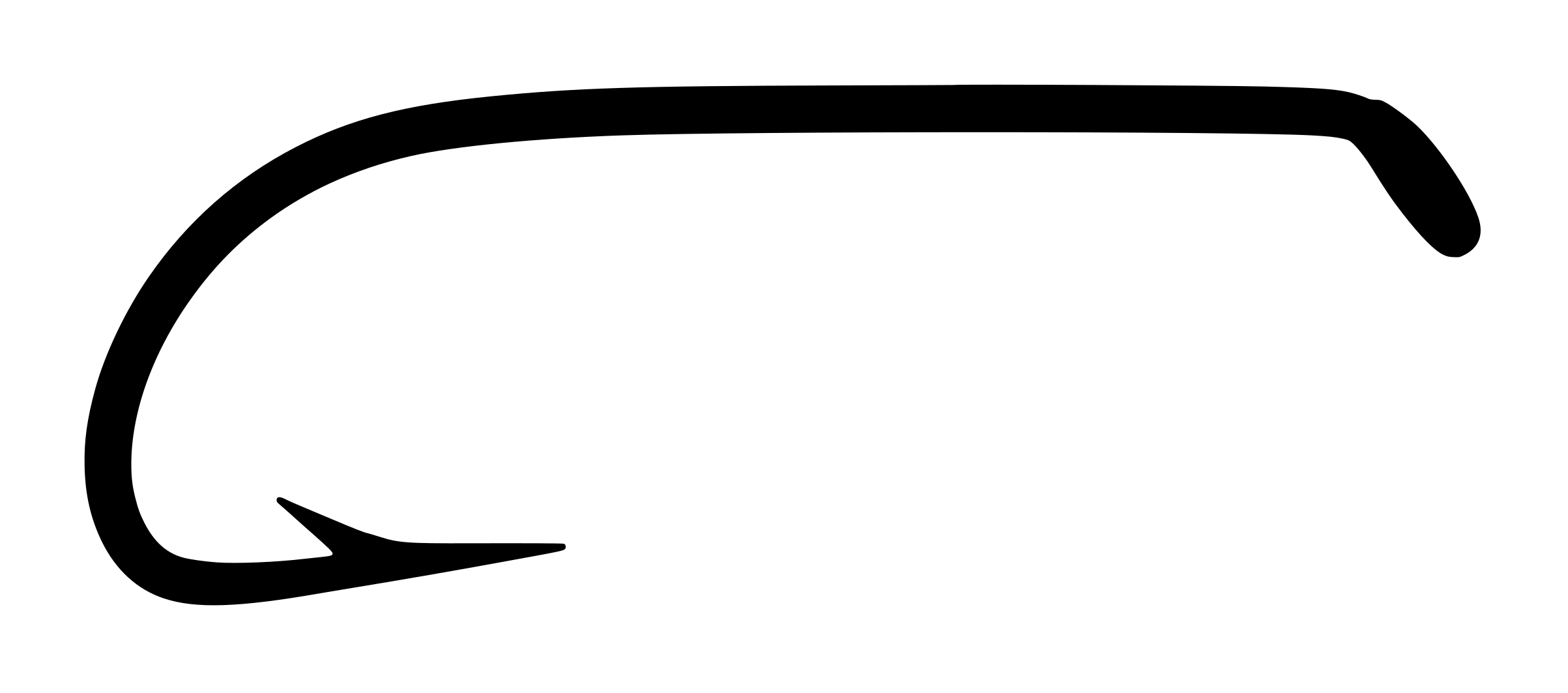
Matches: Bend, Shank, Wire, Gap, Point +3 moreDiffers: Eye: Ball Eye vs Tapered Eye; Eye Orient.: Straight / Inline vs Turned Down; Finish: Black Japanned vs Bronzed +1 more
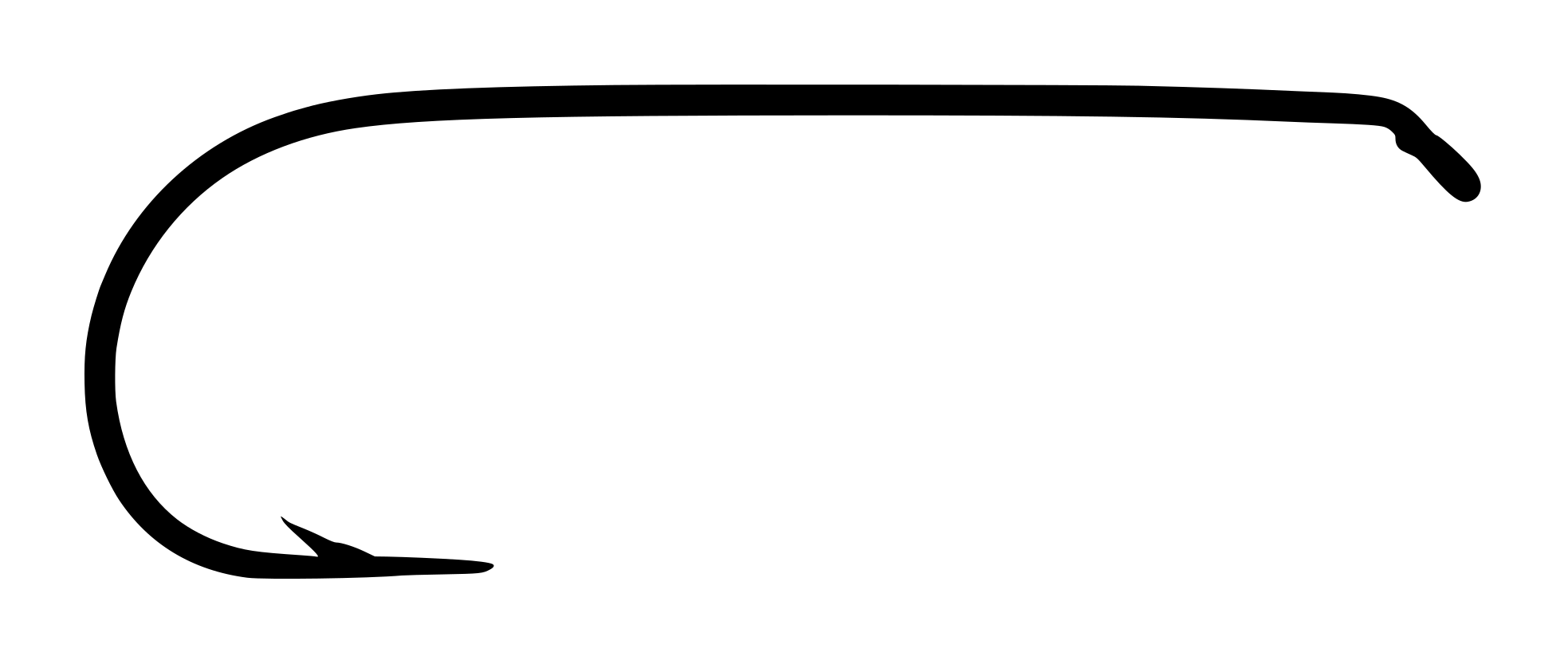
Matches: Bend, Shank, Gap, Eye, Point +4 moreDiffers: Wire: Standard vs Heavy (1X Heavy); Eye Orient.: Straight / Inline vs Turned Down; Finish: Black Japanned vs Bronzed +1 more
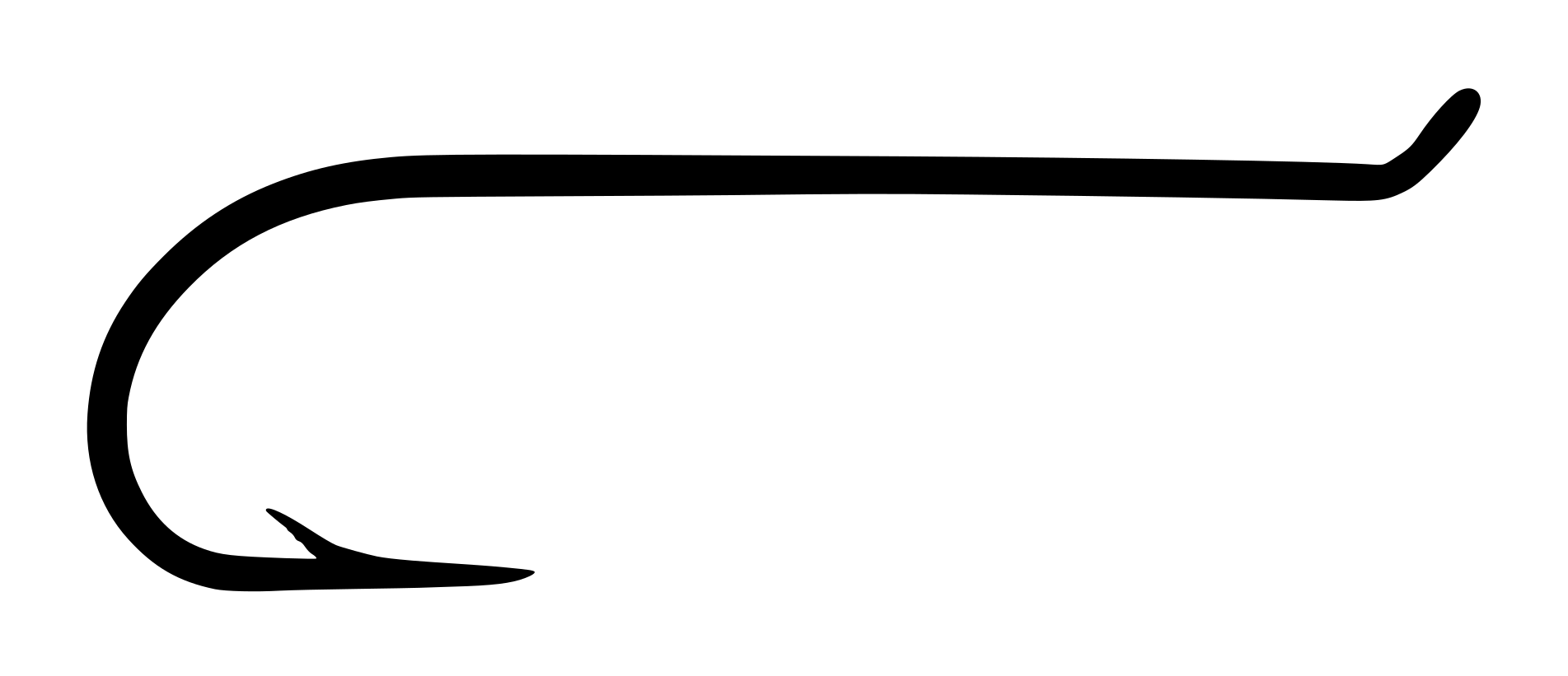
Matches: Bend, Shank, Eye, Eye Orient., Point +3 moreDiffers: Wire: Standard vs Heavy (1X Heavy); Gap: Standard vs Wide; Finish: Black Japanned vs Blued +1 more
The Mustad 8230 is engineered for traditional wet-fly and salmon fishing, particularly Atlantic salmon and sea-trout applications where heavy-gauge wire and a strongly defined bend are essential. The Limerick geometry — with its sharp, angular bottom — physically locks the fish’s jaw into the deepest, strongest point of the hook, preventing rotation or slipping during protracted battles against powerful anadromous species. The extra-heavy wire provides the structural integrity needed to withstand the sustained pressure of a strong current and the violent head-shakes characteristic of hooked salmon. The japanned finish offers excellent corrosion resistance in saltwater and brackish salmon estuaries, making it an ideal choice for both river and coastal sea-trout work. PI
Secondary Applications
Large streamers for pike and musky; traditional North Country soft-hackle wet flies; bass poppers and baitfish imitations in heavy wire; vintage-style bucktails.
Classic Fly Patterns
March Brown Wet, Greenwells Glory, Teal and Red, Bloody Butcher, Mallard and Claret, Dunkeld, Thunder and Lightning, Muddler Minnow, Woolly Bugger (salmon size)
Modern Equivalents
Hook
Match Quality
Notes
Mustad S71S Limerick
Excellent
Direct modern successor in Mustad's Signature Series. Same Limerick bend geometry, available in various wire weights and finishes (black nickel, bronzed). Maintains the sharp angular bottom characteristic of the 8230.
Tiemco 7989
Very Good
Japanese premium wet-fly hook with Limerick-inspired bend. Extra-strong wire, excellent corrosion resistance. Tyers seeking modern equivalent to japanned vintage Limerick hooks often choose this model.
Partridge L3A/S
Good
Traditional English wet-fly hook, Limerick geometry, straight eye, premium Redditch craftsmanship. Heavier wire than vintage Mustad but similar bend profile and application.
Mustad's successor mid-tier wet-fly hook. Sproat bend (parabolic) rather than angular Limerick, but similar size range and quality designation. Less specialized for heavy-tackle salmon work but more versatile for general wet-fly tying.
Collector notes
Rated 4.5/10 — a mid-century standard pattern with solid collector interest among salmon fly and wet-fly tyers, but not exceptionally scarce. Complete carded examples in good condition command modest premiums; loose hooks have limited collector value.
Reference value
$4 – $12 USD estimate
Packaging condition
Good — moderate wear, legibleRecorded specimen
Packaging format
GW-M-08230-CARDCatalog code
Positive Factors: The Mustad 8230 is a genuine mid-century manufacturing item with authentic historical provenance and documented product lineage. The Limerick bend has enduring prestige in fly-tying culture, particularly among salmon and wet-fly specialists. Complete, sealed carded examples are increasingly uncommon as most cards from this era were opened, hooks were used, and packaging was discarded. The japanned finish is a distinct aesthetic and functional feature no longer common in modern Mustad production, adding historical and technical interest. Specimens in strong, unworn japanned finish with full hook counts are valued by collectors seeking authentic vintage tackle.
Limiting Factors: The 8230 was produced in industrial quantities by Mustad, and loose hooks or opened cards are still reasonably available, keeping base value low. Size No. 2 is mid-range and moderately desirable; larger and smaller sizes (e.g., 1/0, 6) may command slightly higher premiums. The hook has no designer attribution, no recorded connection to a famous tyer or fishery, and no documented rarity within the Mustad catalog. Japanned finish, while aesthetically prized by some collectors, can deteriorate over time (cracking, flaking) if exposed to moisture, reducing condition value faster than tinned or modern finishes. The 8230 was superseded by later models and is not actively sought by modern fly tyers using contemporary materials and hook designs.
Size and Variant Desirability: No. 2 (caliper-verified at ~1.30″–1.35″ overall) is a standard mid-range size for salmon flies and large streamers; it is moderately collectable but not rare. Size 6 and 1/0 variants may be slightly scarcer. Japanned finish is the most collectable finish for this model; tinned examples are more common and valued lower. Cards with handwritten size notation or vintage dealer marks add modest collector value as documentation of sales history. Full, sealed cards are worth 2–3× the equivalent value of opened cards with partial hook counts.
Condition Factors: The japanned finish is the primary condition variable. Hooks with uniform, unworn black lacquer command premiums; specimens showing wear streaks, dull spots, or micro-crazing retain fair value but fetch less than bright examples. Card condition is secondary but important: clean, legible text and intact borders support value; faded, torn, or heavily foxed cards reduce collector appeal. Missing hooks significantly devalue a card: a 100-count card with 3–5 missing hooks drops 30–50% in value. Storage history (e.g., stored in dry, cool conditions vs. damp tackle boxes) is invisible in images but critical to long-term condition and value.
Market Value Notes
Low ($4): Good condition, opened card, some hooks missing or worn.<br />
High ($12): Excellent/Mint condition, sealed or near-sealed card, full count, minimal wear.<br />
Premium factors: Complete original packaging, sealed condition, strong japanned finish, size No. 2 (mid-range, moderately desirable).<br />
Platforms: eBay (primary), vintage tackle dealers, regional UK auction houses.<br />
Confidence: V verified — based on 1 eBay sold listing ($39.00 for Japanned Limerick Salmon Fly Hooks, new condition) and eBay market history avg $6.46, range $2.00–$16.99 (Apr 2023–Apr 2026). High listing was likely for larger quantity or different size; caliper-measured No. 2 typically ranges $4–$12 as single card.
Where to Find
eBay (search: Mustad 8230 hook, vintage Mustad Limerick), UK vintage tackle dealers, regional tackle fairs in England and Scotland.
eBay market reference. Researcher-curated. Prices in USD. Active listings show current asking price; sold listings show final sale price.
Preservation
Storage and Preservation
Storage Environment: Store the 8230 card in a cool, dry location away from direct sunlight, humidity, and temperature fluctuations. Ideal conditions are 50–65°F and 30–50% relative humidity. The japanned lacquer is vulnerable to humidity-induced crazing and flaking if exposed to damp air for extended periods. Avoid storing near windows, heating vents, or air conditioning units. Never store in damp tackle boxes, basements, or garages where moisture levels spike seasonally.
Card and Packaging Preservation: Keep the card flat or at a slight angle; do not stand it upright, as this stresses the binding and staples. If the card is sealed or partially sealed, preserve the seal — opening it reduces collectible value significantly. Retain any original tissue, paper sleeves, or envelopes that may accompany the card. These ancillary materials add to the historical record and protect the hooks from physical contact. Store the card in an archival-quality box or sleeves, preferably acid-free kraft stock or mylar, to slow aging of the card substrate itself.
Hook Maintenance: Do not remove hooks from the card unless immediately needed for fishing. Loose hooks should be stored in small compartmented boxes, separated from other metals and moisture sources. The japanned finish will develop a subtle patina (slight dulling or warm darkening) over time; many collectors consider this desirable aging and evidence of authentic vintage provenance. Do not attempt to restore the finish to artificial brightness — this damages the historical integrity and can reduce collector value.
Cleaning and Care: If dust accumulates on the card or hooks, use a soft, dry brush to gently remove it. Never immerse japanned hooks in water or apply chemical cleaners, solvents, or oils, as these will damage or accelerate deterioration of the lacquer. If the finish shows minor wear, small cracks, or localized flaking, consult a professional tackle conservator rather than attempting home remediation. The lacquer layer is thin and fragile; aggressive cleaning will cause it to fail prematurely.
Long-Term Archival Considerations: If the card is part of a serious collection with long-term preservation goals, document it with high-resolution photographs (including any handwritten notations, price markings, or variant text). Create a catalog record noting acquisition date, condition at acquisition, provenance, and any storage history known. Over decades, the card substrate (kraft or cardboard) will naturally age and yellow (foxing); this is normal and acceptable. If acid damage or mold appears, relocate the card immediately to a dry environment and consider professional conservation. Store master photographs and catalog documentation separately, in case the original card deteriorates.
Handling: When handling the card for inspection or photography, wash hands first to remove oils and dust. Support the card from underneath rather than gripping the edges, which can stress the paper fibers. If removing individual hooks for inspection, use tweezers or a magnifying tool rather than bare fingers to avoid transferring oils to the japanned surface. Return hooks to the card immediately after inspection.
Marking Analysis
Handwritten Notations and Packaging Variants
The Mustad 8230 card visible in the images shows a handwritten notation ‘2’ in blue or purple ink in the size field (lower left corner), confirming the size designation. This handwritten notation is typical of mid-century Mustad export cards, where size information was sometimes hand-annotated by factory staff or warehouse personnel rather than pre-printed. Such notations serve as evidence of manual quality-control or inventory-marking procedures and add modest historical interest to the specimen.
The presence of handwritten size notation (rather than fully printed text) suggests this card may be from a transitional production run or a batch intended for a specific regional market (e.g., UK distributor) where size verification by hand was part of the fulfillment process. No other handwritten marks, dealer prices, or user annotations are visible on the front of the card shown.
The decorative asterisk borders and the blue background of the label (rather than plain white kraft stock) indicate this is a premium presentation card variant, likely intended for retail display or higher-end tackle shops rather than bulk commercial distribution. Variant cards for the 8230 may exist with alternative finishes (tinned, bronzed) or size ranges, each with slightly different label text or color schemes; the japanned/black variant shown here is representative of the most collectable format.
Size Note
Size Documentation: Vintage Scaling Systems
Documented Size: The card clearly labels this hook as ‘No. 2’ per the handwritten and printed notations. Caliper measurement of the specimen confirms overall length ~1.30–1.35 inches (33–34 mm) and gap width ~0.36 inches (9.14 mm), consistent with a No. 2 size on the vintage Mustad/British imperial numeric scaling system.
Vintage vs. Modern Sizing: It is critical to note that vintage hook sizing — particularly on regional patterns like Limerick, Cincinnati, or Aberdeen — often employed scaling metrics that differ significantly from modern standardized fly-hook gape measurements. The No. 2 designation on this 1950s–60s Mustad card does not directly equate to a modern ‘Size 2 fly hook’ as listed in contemporary catalogs. Modern fly-hook sizing typically references gape width (distance from shank to point) as the primary metric, whereas vintage Mustad sizing was based on a combination of overall length, gap, and historical regional conventions specific to the pattern.
Modern Equivalent Size: Based on measured dimensions (gap ~0.36″, overall length ~1.32″), this vintage No. 2 Limerick most closely corresponds to a modern Size 4–6 fly hook (depending on the specific modern hook model and gape reference standard used). Tyers seeking to substitute a contemporary hook for this vintage 8230 should select by measured gap and overall length rather than by nominal size number, as nomenclature has evolved significantly since the 1950s–60s.
Why This Matters for Collectors: Understanding vintage sizing conventions is essential for accurate hook identification and modern fishing application. A collector acquiring a vintage No. 2 should not assume it is equivalent to a modern No. 2; instead, calipers or direct comparison with known reference hooks should be used to establish true dimensions and modern equivalent size. This nuance is especially important for tyers seeking to tie patterns from classic historical fly-dressing books that reference vintage Mustad or British hook sizes by number rather than by measured dimension.
Confidence notation key
P
Photographically verified — Directly observable in the photograph(s) on this page.
V
Verified by documentation — Confirmed by manufacturer catalog, spec sheet, or published reference.
I
Inferred — A logical deduction from observable or documented evidence, not directly stated.
E
Estimated — An approximation based on visual comparison, proportional analysis, or limited data.
S
Speculative — A reasoned hypothesis that cannot be confirmed from available evidence.
Claims with no notation are confirmed by multiple independent sources. All photographs on garrenwood.com are taken on a measurement grid where each square equals 1/10 inch (0.1″ / 2.54 mm).