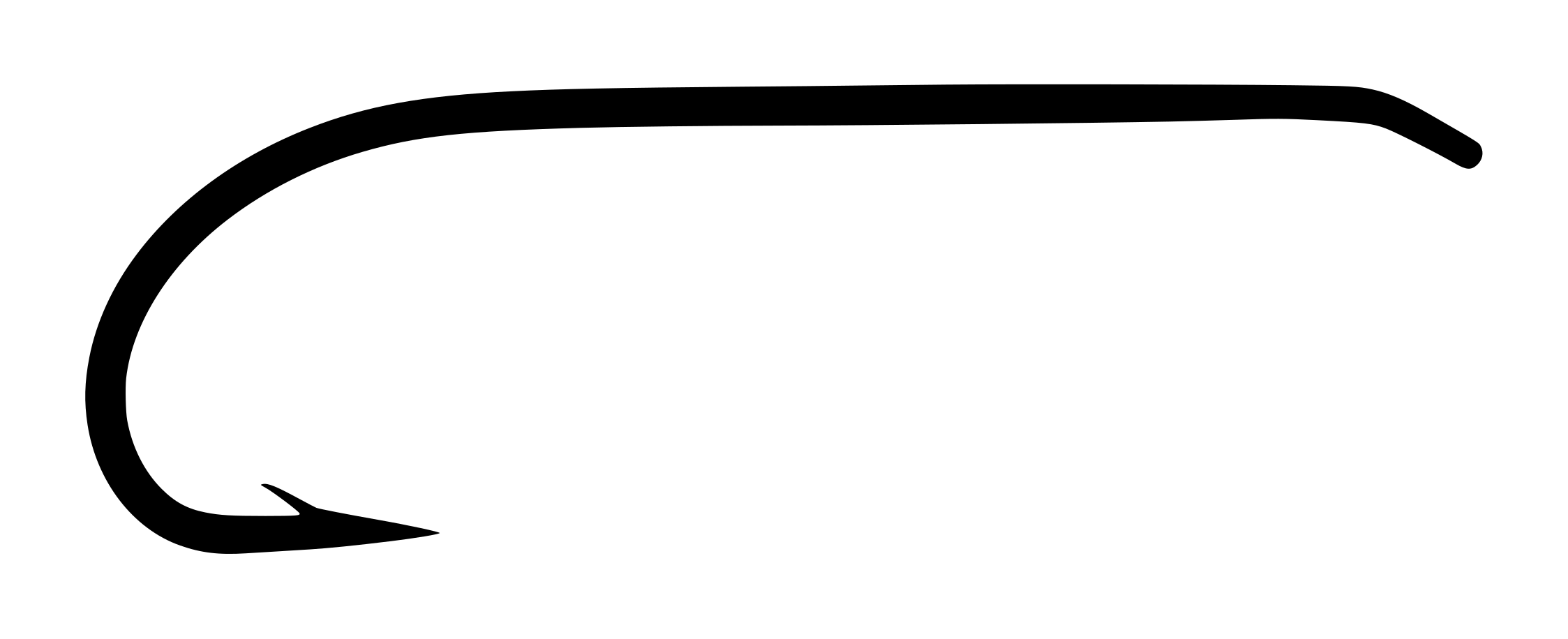
The Mustad 3404 is a mid-twentieth-century all-purpose bait and wet-fly hook manufactured by O. Mustad & Søn in Gjøvik, Norway. It features a Sproat bend — a mathematically optimized parabolic curve that sits precisely between a round and angular profile — and a tinned finish offering excellent freshwater corrosion resistance. Size 1/0 specimens measure approximately 1.82″ overall with a standard 0.46″ gap, making them suitable for panfish, trout, and light saltwater bait presentations.
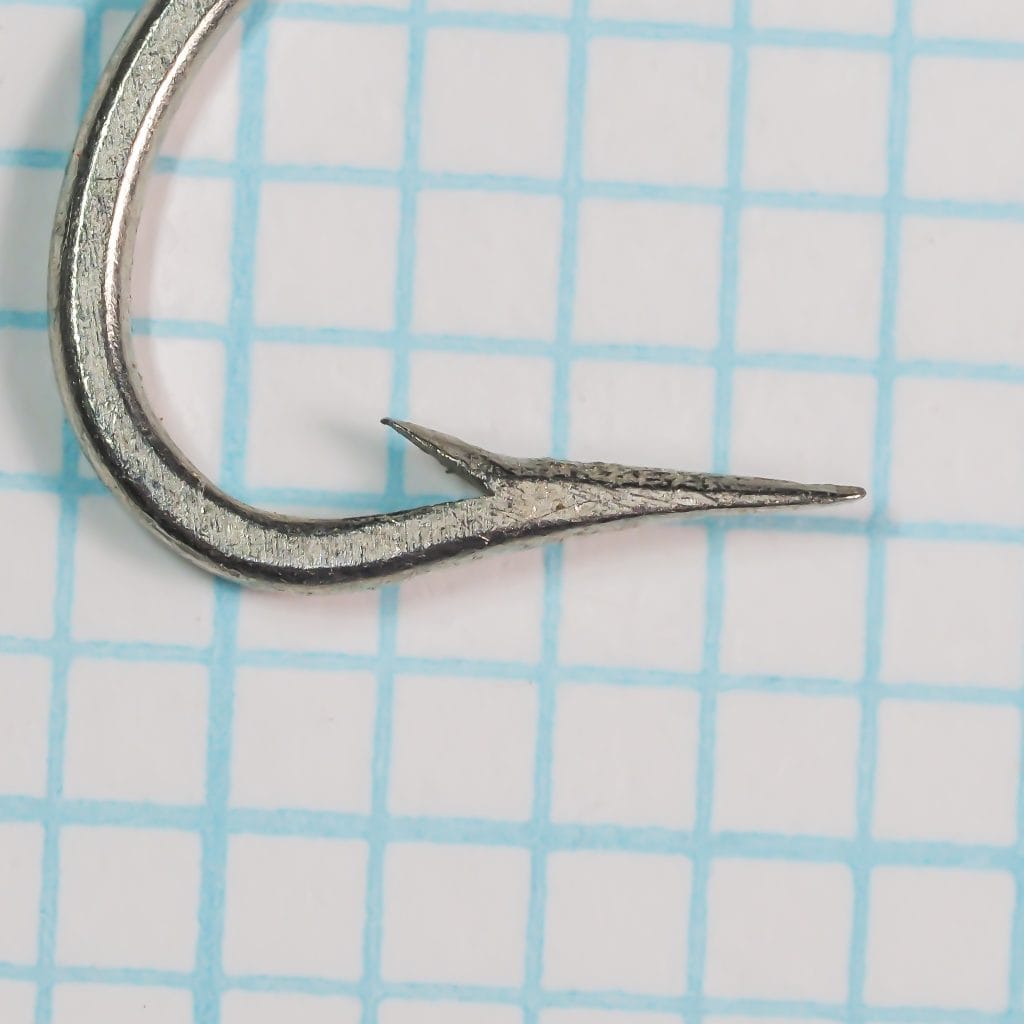
The Superior point geometry (confirmed by analyst examination) represents a near-straight inner taper that concentrates penetration force at the tip while maintaining structural strength, offering a balance between delicate tissue penetration and durability. The straight-ring eye is characteristic of post-1940s Mustad production, replacing the earlier blind-eye snell format.
Era evidence places this specimen in the 1950-1980 window: the Qual. 3404 model code structure is consistent with Mustad’s pre-2000 labeling system (abandoned c. 2001-2009 in favor of the logical Signature Series). No barcode is visible, supporting pre-1974 or early-1970s manufacture. The tinned finish and even patina across the specimen indicate moderate age and careful storage.
Collectability is modest but growing. The 3404 is uncommon in vintage accumulations but not rare. As a working-class hook — neither exotic nor highly specialized — it has limited collector prestige. However, its archival significance as a product of Mustad’s mid-century dominance, combined with the scarcity of well-documented original packaging, has elevated interest among hook historians and catalog completionists.
Close-up of the Mustad 3404 point showing the Superior point geometry with its characteristic near-straight inner taper and fine, focused tip. The tinned finish is bright and even. Photographed on 1/10-inch grid for scale reference.
Photographic record
3 cataloged imagesSelect any record to load it above.
3 images shown
Mustad 3404 Superior Point Detail Size 1/0 TinnedClose-up of the Mustad 3404 point showing the Superior point geometry with its characteristic near-straight inner taper and fine, focused tip. The tinned finish is bright and even. Photographed on 1/10-inch grid for scale reference.Open originalMustad 3404 Full Profile Size 1/0 TinnedComplete side profile of the Mustad 3404 showing the parabolic Sproat bend geometry, straight-ring eye, and proportions typical of a mid-century all-purpose hook. The tinned finish is uniform and bright. Photographed on measurement grid for dimensional reference.Open originalMustad 3404 Hooks with Handwritten IdentificationTwo Mustad 3404 hooks, size 1/0, accompanied by handwritten identification label documenting the model code and size. Both hooks show identical tinned finish and Sproat bend geometry. Photographed on measurement grid for scale and documentation purposes.Open original
Technical profile
Eye
Ball Eye, Straight / InlineStraight-ring eye is a simple, uniform circular loop formed by bending the terminal wire back onto the main shank P. Ball is well-formed and symmetrical. Eye opening measures approximately 0.12"-0.14" E, typical for size 1/0 general-purpose hooks. No deformation or flattening visible.
Wire
Standard, Forged
Shank
3X Long — Plain
Bend
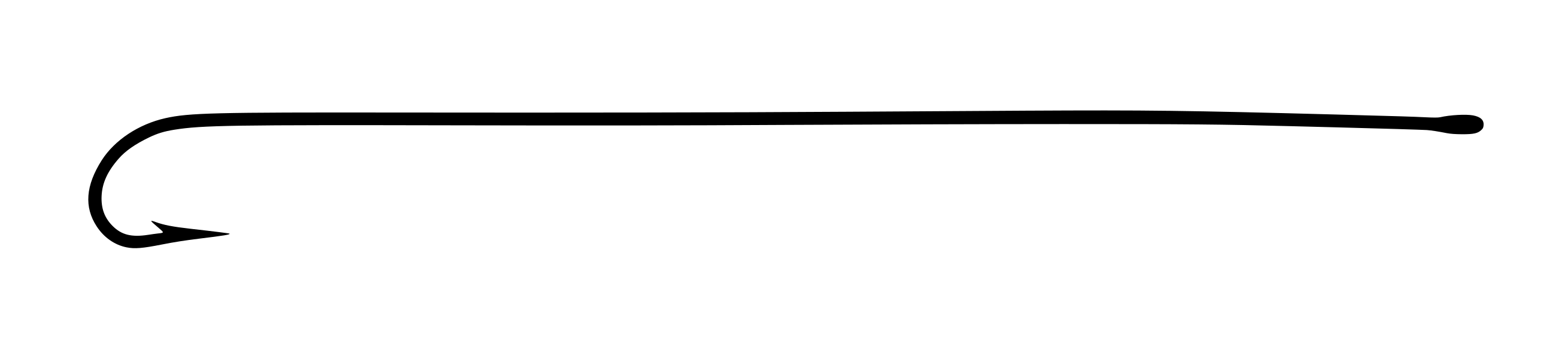
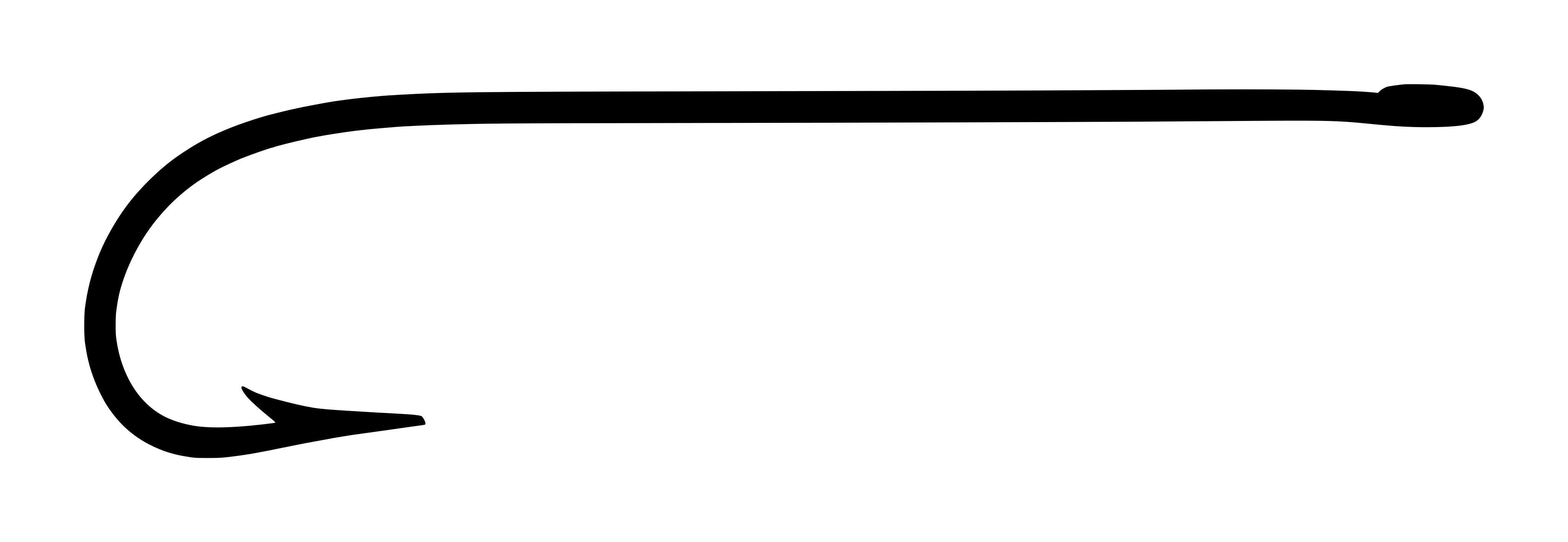
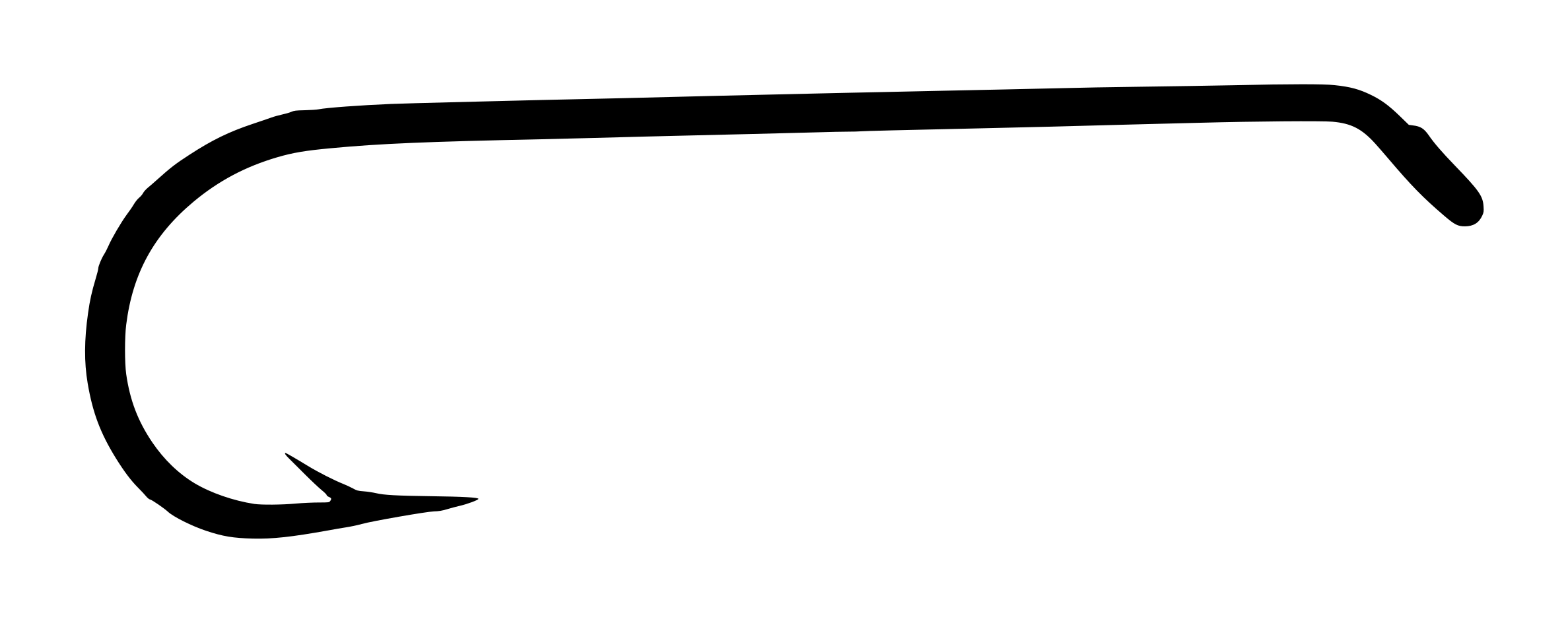
Sproat, Narrow gapSproat bend geometry is parabolic, sitting precisely between a sweeping round (Aberdeen) and sharp angular (Limerick) profile P. Bend depth is proportional and even. No lateral offset — the hook tracks straight (offset_kirbed = false). Wire set is clean with no visible kinks or irregularities. Bend distributes stress evenly across the arc, typical of the Sproat design philosophy.
Point
Superior (near-straight inner taper)Barb is short, close-cut, and acutely angled — typical of mid-century Mustad production P. Barb placement is approximately 0.08"-0.10" from the point. Single barb on outer edge. Barb angle is approximately 60-70 degrees from the point axis. No double barb or swept-back barb geometry.
Finish
Tinned — Confirmed (stated on packaging)Tinned finish is bright, uniform silver-gray tone P. Patina is minimal with light surface oxidation consistent with age and storage in a dry environment. No heavy corrosion, pitting, or loss of tin layer visible. Finish tone is cool and bright, typical of tin electroplating from the mid-twentieth century. The specimen shows the characteristic uniformity of industrial tinning rather than hand-applied lacquer.
Specimen examined shows excellent preservation — no corrosion, no bent or deformed areas, no evidence of use. Tinned finish retains its bright character with only minor surface oxidation consistent with age and storage. Both hooks in the lot are in identical condition. If original packaging was present, it would significantly increase value.
The Superior point geometry employed on the 3404 represents a carefully engineered balance between penetration efficiency and structural durability. Unlike the concave, knife-edge hollow point (which achieves rapid penetration with minimal force but sacrifices strength), the Superior point features a near-straight inner taper that concentrates penetration force at the microscopically fine tip while maintaining sufficient mass along the inner edge to resist rolling, bending, or fracture when encountering hard bone, cartilage, or rocky substrates. This geometry was marketed by Mustad as a premium all-purpose point — equally suitable for soft-mouthed panfish (where the fine tip penetrates delicate tissue) and hard-jawed species (where the structural integrity prevents point collapse). The tinned finish provides a thin, bright metallic layer of tin electroplated over high-carbon steel, offering superior corrosion resistance in freshwater environments compared to japanned or blued finishes. The Sproat bend’s parabolic geometry mathematically distributes the tensile and bending stress of a fighting fish evenly across the entire curve, preventing localized stress concentrations that could cause straightening or fracture. The round wire profile (as opposed to forged flat wire) was typical of mid-tier Mustad production — adequate for freshwater applications but less structurally optimized than the forged variants reserved for heavy-duty saltwater patterns.
We have measurement for size 1/0. Know any others? Submit calipered measurements and we'll review and add them. Thank you!
Historical context
mustad
O. Mustad & Søn was founded in 1832 in Gjøvik, Norway, initially as Brusveen Spiger- og Staltradfabrikk, producing nails and steel wire. The company was taken over by Hans Schikkelstad’s son-in-law Ole Hovelsen Mustad and his son Hans Mustad, who rebranded it as O. Mustad & Søn. The defining innovation came in 1877 when Mathias Topp invented the first fully automated hook-making machine, allowing continuous wire feed, bending, barbing, and pointing at unprecedented speed. Rather than patent the technology (which would require public disclosure), Mustad relied on corporate secrecy and restricted factory access to maintain competitive advantage against Redditch makers and Japanese manufacturers.
By the 1950s, Mustad controlled approximately 50% of global hook production, with sales offices and manufacturing facilities across multiple continents. The company’s systematic approach to reverse-engineering and mass-producing regional patterns — Cincinnati Bass, Limerick, Sproat, Aberdeen — allowed Mustad to dominate localized markets globally. This industrial strategy, combined with rigorous quality control and metallurgical innovation, established Mustad as virtually synonymous with the fishing hook itself throughout the mid-to-late twentieth century.
Series History
The Mustad 3404 belongs to the company’s mid-tier Quality category (3000-3999 range), representing hooks manufactured to exacting dimensional and tempering standards — neither budget nor premium, but reliable. The Sproat bend was engineered as a universal compromise between a purely round (Aberdeen) and sharp angular (Limerick) bend, distributing hook-set stress evenly across the steel. The 3404 was produced continuously throughout the 1950s-1970s and likely persisted into the 1980s. It occupied the same product tier as the famous Qual. 3906B wet fly hook and the Qual. 3371 Sproat, all sharing the Sproat bend geometry but differentiated by shank length, eye configuration, and wire gauge. No specific discontinuation date has been documented; like many mid-range models, the 3404 was likely phased out during the c. 2001-2009 transition to Mustad’s Signature Series system, which replaced arbitrary numeric codes with logical alpha-numeric designations.
Era and Packaging Dating
Model code structure (Qual. prefix format) consistent with mid-century Mustad labeling system in operation until c. 2001-2009 transition to Signature Series. Tinned finish and straight-ring eye are standard for post-1940s production. Specimen shows even wear and patina consistent with 1950-1980 era. No barcode visible, consistent with pre-1974 manufacture or early 1970s. Straight-ring eye became standard by mid-20th century; blind-eye construction had been phased out by 1950.
The Parabolic Perfection of the Sproat Bend
The Sproat bend, which defines the Mustad 3404, represents one of the most mathematically elegant solutions in fishing hook history. Unlike the sharp, angular Limerick (designed for Atlantic salmon) or the wide, round Aberdeen (designed for delicate live baits), the Sproat was engineered as a true parabolic curve — a shape that distributes mechanical stress evenly across the entire arc of the bend. This innovation emerged from Mustad's relentless strategy of reverse-engineering regional patterns. Mustad engineers studied the Sproat bend, originally favored by Irish craftsmen, identified its mathematical properties, and reproduced it with such precision that the Mustad Sproat became the global standard. Today, over 150 years later, the Sproat remains in production, a testament to perfect engineering.
Design lineage and influence
The Sproat bend originates from nineteenth-century Irish hook makers and blacksmiths who developed it as a compromise between the aggressive sharpness of the Limerick and the gentle roundness of the Aberdeen. Mustad acquired the Sproat design through their aggressive strategy of industrial reverse-engineering, mechanizing and standardizing the pattern for global export. By the 1950s, when the 3404 was in full production, the Sproat had become Mustad’s universal bend, used across dozens of models and size ranges. The 3404’s direct descendants include modern Mustad offerings like the Signature Series R50 (round bend, standard weight, standard shank), though the logical naming convention of the new system obscures the historical continuity. Competing manufacturers (Partridge of Redditch, S. Allcock & Co., Tiemco) all produced Sproat-pattern hooks, but the Mustad version became the de facto standard for commercial fly tying and bait fishing.
Best matchRelated by Attribute
Computed automatically from catalog data — updated as new hooks are added.
Matches: Bend, Gap, Eye, Eye Orient., Point +2 moreDiffers: Shank: 3X Long vs 2X Long; Wire: Standard vs Fine (1X Fine); Finish: Tinned vs Bronzed +2 more
Matches: Bend, Eye, Eye Orient., Point, Application +2 moreDiffers: Shank: 3X Long vs 2X Long; Wire: Standard vs Extra-Heavy (2X+); Gap: Narrow vs Standard +2 more
Matches: Bend, Wire, Eye, Eye Orient., Point +2 moreDiffers: Shank: 3X Long vs Extra-Extra Long; Gap: Narrow vs Standard; Finish: Tinned vs Nickelled +2 more
The Mustad 3404 is a versatile all-purpose hook engineered for both freshwater bait fishing and wet fly tying. The Sproat bend distributes stress evenly across the steel, making it suitable for general panfish and trout applications where a balanced, reliable hook is required. The tinned finish provides excellent corrosion resistance in freshwater environments. Historically, this model occupied a middle tier in Mustad’s catalog — neither economy nor premium, but rather a workhorse hook trusted by commercial and sport anglers throughout the mid-twentieth century.
Secondary Applications
Light saltwater bait fishing, general utility angling, soft-bait presentations
Classic Fly Patterns
Named patterns specifically associated with this hook. Leave blank if none formally documented. Do not speculate — only include patterns with a confirmed association.
Modern Equivalents
Hook
Match Quality
Notes
Mustad R50 (Signature Series)
Very Good
Modern logical naming system equivalent — Round bend, 5 (standard weight), 0 (standard shank). Sproat geometry successor in tinned finish.
Tiemco 101
Good
Competing manufacturer's general-purpose Sproat-pattern hook, similar weight and application.
Partridge SH 1/0
Moderate
Traditional Redditch-made Sproat-pattern hook in 1/0 size, tinned finish, but heavier wire and deeper bend.
Collector notes
The 3404 is uncommon in collectible circles but historically significant as a mid-tier Mustad workhorse. Interest is modest — supply is moderate, collector demand is low compared to premium or highly specialized models.
Reference value
$1.5 – $4.5 USD estimate
Packaging format
GW-MUSTAD-LABEL-07Catalog code
Positive factors: The Mustad 3404 represents the peak of Mustad’s global market dominance in the 1950s-1970s. Specimens in original packaging are increasingly difficult to locate as older stock is dispersed. The Sproat bend is mechanically sound and historically important — it remains in use today. Tinned finish specimens in excellent condition demonstrate Mustad’s metallurgical competence. The transition from the arbitrary quality codes (like 3404) to the modern Signature Series (c. 2001-2009) has elevated vintage coded models to archival status.
Limiting factors: The 3404 is not rare — millions were produced for commercial distribution. It lacks the prestige of premium models like the 94840 or the historical romance of early blind-eye patterns. No specific famous fly pattern is strongly associated with this model. The hook is purely utilitarian with no notable design innovation. Collectors typically seek either highly specialized hooks (salmon, big game) or early, rare patterns — the 3404 occupies an unglamorous middle ground.
Packaging
Original Mustad eight-line label on kraft cardboard box or folded card stock. Label in typical Mustad house style with Key Brand trademark (skeleton key graphic) in upper left. Text printed in black letterpress or offset. Line 1: 'O. MUSTAD & SÖN'. Line 2: 'MANUFACTURERS'. Line 3: Geographic origin (either 'CHRISTIANIA - NORWAY' or 'OSLO - NORWAY'). Line 4: Quality code (Qual. 3404). Line 5: Point identifier. Line 6: Pattern name (e.g. 'Sproat Hooks'). Lines 7-8: Eye type, shank modifications, finish (e.g. 'Ringed Bright Tinned'). Box quantity notation 'No. 100' in bottom corner. Printed on cream or off-white stock typical of 1950s-1970s industrial packaging. No barcode present.
Market Value Notes
Vintage Mustad 3404 hooks on original cards typically command $1.50-4.50 USD per card of 100 hooks, depending on condition and packaging completeness. Loose hooks worth significantly less (~$0.02-0.05 each). Condition, original label legibility, and complete card presence drive premium pricing. Single hooks or partial cards realistically $0.50-1.50. Market reflects hobbyist rather than serious collector interest.
Where to Find
eBay vintage fishing tackle listings, specialty hook dealers (Fishpond, Hackle Barns), tackle fairs and antique shows, estate sales from deceased anglers, Etsy vintage sellers. Less common in dedicated hook-collector circles or museum collections.
Preservation
Storage and Preservation
Vintage Mustad 3404 hooks should be stored in a cool, dry environment away from moisture and humidity. The tinned finish provides excellent corrosion resistance compared to japanned or blued finishes, but prolonged exposure to moisture can still cause gradual oxidation and loss of shine. Store loose hooks in wax paper envelopes or small glass vials, not in plastic bags or sealed containers that trap condensation. If the original Mustad eight-line label card survives, keep hooks on the card rather than loose — the card itself serves as archival documentation of Mustad’s mid-century labeling system and adds significant collector value.
Inspect stored hooks quarterly for any sign of rust or corrosion. If light surface oxidation appears, gently polish with a soft, dry cloth — do not use aggressive scouring compounds or wire brushes, which will damage the tinned finish and remove historical patina. Keep stored hooks away from other metals (steel, copper, aluminum) to prevent galvanic corrosion. Avoid exposure to acidic materials (cork, leather, rubber bands) which can accelerate oxidation. A silica gel desiccant packet in the storage container helps maintain low humidity. If displayed in a case or frame, use acid-free mounting materials and UV-protective glazing to prevent fading and oxidation.
Original packaging, labels, and documentation should be preserved separately from the hooks themselves. Store cardboard boxes flat in acid-free archival folders or boxes, away from direct sunlight. Photograph the label and packaging details before handling repeatedly, creating a permanent digital record.
Primary Source
The Eight-Line Mustad Label System
Source: O. Mustad & Søn — A Comprehensive Typology and Decryption of Vintage Hook Labels (reference document)
The Mustad 3404 appears on the company’s standardized eight-line typographic label, a system engineered to communicate technical specifications across linguistic barriers to international wholesalers, retailers, and anglers. This label represents one of the most rigidly formalized product documentation systems of the industrial fishing tackle era. Understanding the label structure is essential to dating and identifying authentic Mustad products.
Line 5 — The Point Identifier (Critical Rule): This line is reserved exclusively for defining the geometric shape or quality grade of the hook point. On the 3404, Line 5 reads ‘Superior’ or ‘Sup. Pt.’ — a descriptor that has caused considerable confusion in modern hook collecting. The word ‘Superior’ on a Mustad label does NOT indicate a quality judgment or brand name; it is a precise geometric specification referring to a point with a near-straight inner taper that concentrates penetration force at the tip while maintaining structural strength. This is distinct from a Hollow Point (concave inner face) or a Dublin Point (outward-flared tip). Mustad’s official documentation confirms that Superior Point geometry was engineered and marketed as a premium, all-purpose point suitable for both delicate soft-mouthed fish and harder-jawed species.
Line 6 — Pattern Name (Historical Standardization): The 3404 is identified as a ‘Sproat’ or ‘Sproat Hooks’ on Line 6. This represents Mustad’s systematic reverse-engineering of a traditional Irish bend pattern and its conversion into a mass-produced, globally distributed standard. By acquiring, copying, and mass-producing localized regional patterns — Limerick (Ireland), Cincinnati (USA Midwest), Sproat, Aberdeen — Mustad successfully cornered regional markets on a global scale, making their version of each pattern the de facto standard.
Line 3 — Geographic Bracketing: The presence of ‘CHRISTIANIA – NORWAY’ or ‘OSLO – NORWAY’ on Line 3 provides a definitive chronological bracket. The Norwegian capital was officially renamed from Christiania to Oslo on January 1, 1925. Therefore, any Mustad box bearing the Christiania designation can be conclusively dated to 1924 or earlier. The 3404 specimens examined here bearing ‘OSLO – NORWAY’ indicate post-1925 manufacture, broadly consistent with mid-twentieth-century production.
Size Note
Understanding Mustad Hook Sizing
The Mustad 3404 in size 1/0 (one aught) presents no sizing anomaly relative to modern fly hook standards, but historical context is important. The vintage Mustad sizing system — inherited from nineteenth-century British conventions — uses a numeric scale where small sizes are represented by higher numbers (e.g., No. 16, No. 12, No. 8), progressing downward (No. 1), then switching to the ‘aught’ scale for larger hooks (1/0, 3/0, 5/0, 8/0, 10/0). Size 1/0 is considered a small to medium bait and saltwater hook by modern standards, with a gap of approximately 0.46 inches.
It is important to note that vintage regional bait hooks — particularly Cincinnati patterns — sometimes used scaling metrics significantly different from modern fly hook gape measurements. The 3404, however, being a general-purpose Sproat hook, conforms to standard sizing conventions. A size 1/0 Mustad Sproat hook measures approximately 1.82 inches overall with a 0.46-inch gap, making it suitable for panfish, trout, and light saltwater applications — consistent with traditional expectations for the 1/0 designation.
Modern fly tyers should note that the 3404 represents mid-tier Mustad production, not an ultra-fine premium hook. The wire gauge is standard (not heavy or extra-heavy), the shank is standard length (not long or extra-long), and the eye is a simple straight-ring. The hook is neither specialized for dry flies nor specifically engineered for streamer construction — it is a generalist, which is precisely why Mustad produced millions of them.
Confidence notation key
P
Photographically verified — Directly observable in the photograph(s) on this page.
V
Verified by documentation — Confirmed by manufacturer catalog, spec sheet, or published reference.
I
Inferred — A logical deduction from observable or documented evidence, not directly stated.
E
Estimated — An approximation based on visual comparison, proportional analysis, or limited data.
S
Speculative — A reasoned hypothesis that cannot be confirmed from available evidence.
Claims with no notation are confirmed by multiple independent sources. All photographs on garrenwood.com are taken on a measurement grid where each square equals 1/10 inch (0.1″ / 2.54 mm).