The Mustad 3401 A is a specialized saltwater jig hook manufactured in Norway during the 1950s and 1960s for heavy offshore applications. Built on an O’Shaughnessy bend with blind tapered eye, extra-heavy forged wire, and extended shank featuring a mechanical kink designed to lock into molten lead during jig head production. The bronzed finish provided adequate corrosion resistance, though the hook’s primary engineering focused on mechanical strength rather than finish durability. This model represents Mustad’s mid-century approach to purpose-built saltwater tackle, addressing the specific requirements of jig manufacturers who needed hooks capable of surviving both the molding process and the crushing jaw pressure of large pelagic fish.
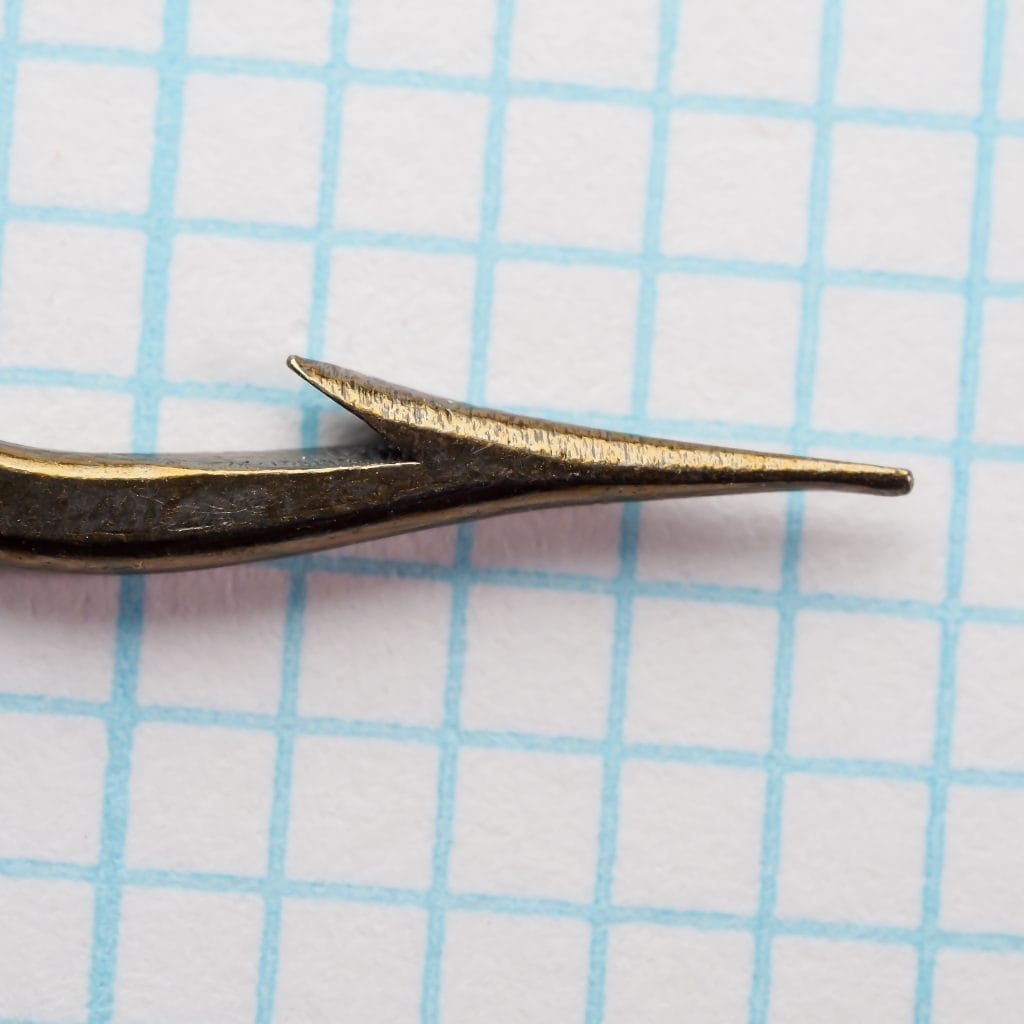
Close-up of the Mustad 3401 A point showing the superior point geometry with near-straight inner taper, sharp tapered tip, and bronzed finish, photographed on 1/10-inch measurement grid.
Photographic record
4 cataloged imagesSelect any record to load it above.
4 images shown
Mustad 3401 A Hook Point Detail — Size 5/0 Superior PointClose-up of the Mustad 3401 A point showing the superior point geometry with near-straight inner taper, sharp tapered tip, and bronzed finish, photographed on 1/10-inch measurement grid.Open originalMustad 3401 A Hook Side Profile — Kinked Shank DesignProfile view of the Mustad 3401 A showing the distinctive Z-shaped kinked shank (mechanical lead lock), rounded O'Shaughnessy bend, and blind tapered eye design, on measurement grid.Open originalMustad 3401 A Hooks Display — Original Card and SpecimensThree Mustad 3401 A hooks displayed with handwritten label card ('Mustad 3401 A' and '5/0'), showing the original packaging and size documentation on measurement grid.Open originalMustad 3401 A Original Red Paper Label — Full LabelComplete original Mustad 3401 A label in bright red with brown ink, displaying the Key Brand logo, manufacturer information (O. Mustad & Søn, Oslo), quality code 3401 A, point designation (Superior), pattern (O'Shaughnessy), and modifiers (Forged, Sharp tapered, Bronzed, Extra long shank, Kinked, Made in Norway).Open original
Technical profile
Blind Tapered Eye | O'Shaughnessy Bend | Extra Long Shank | Extra-Heavy Forged Wire | Superior Point | Bronzed Finish
Eye
Blind — Tapered ShankBlind eye with unique taper to a fine point; no formed wire loop. Designed to be fully embedded in molded lead so that the lure body provides the fishing line connection point. The smooth taper allows the hook to sit flush with the jig body without protrusion. P per analyst examination.
Wire
Fine (1X Fine), Forged
Shank
2X Long — Kinked, Tapered
Bend
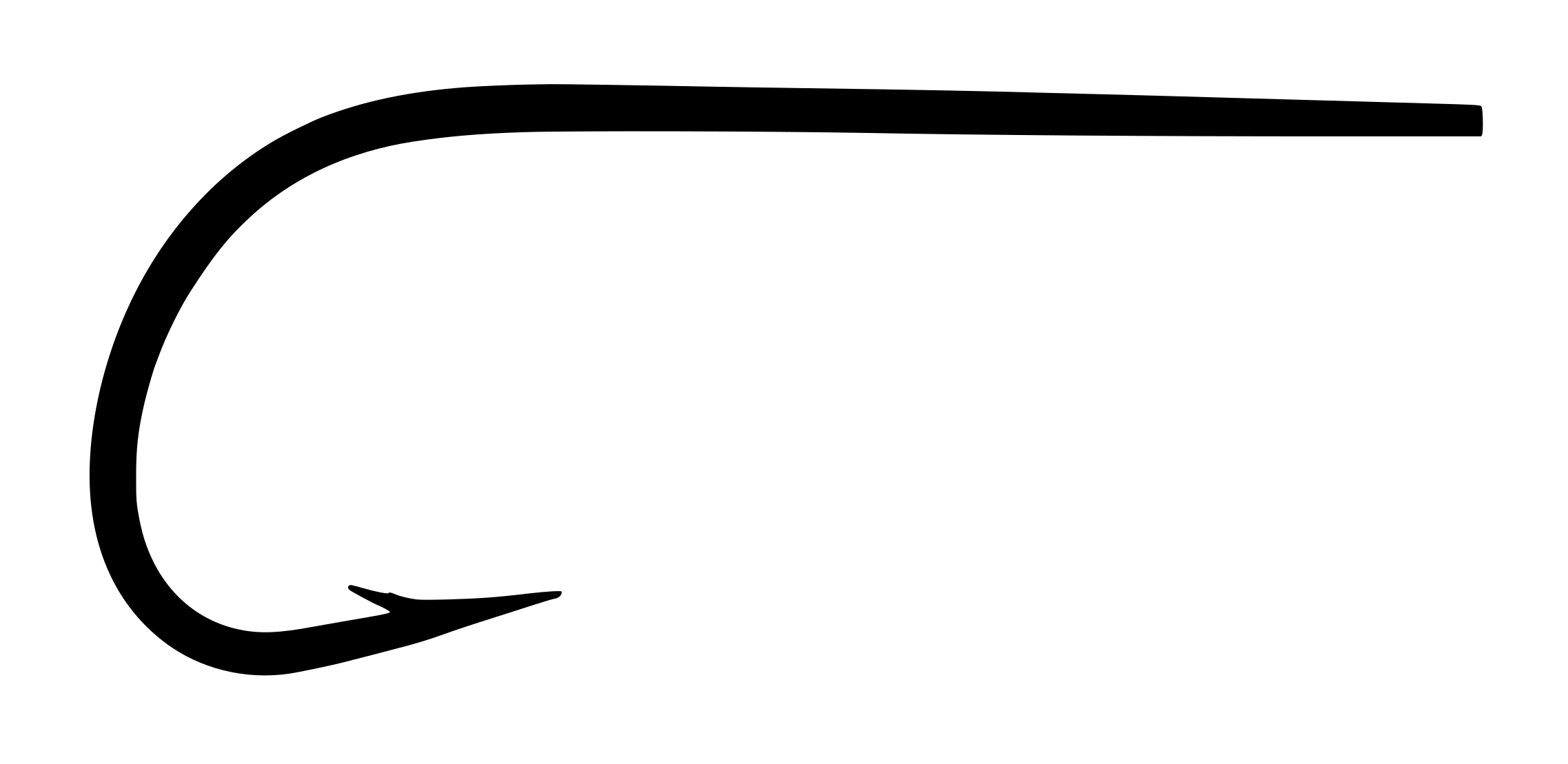
O'Shaughnessy, Narrow gapO'Shaughnessy geometry with relatively straight, parallel sides converging to a rounded bottom. Heavy forging flattens the cross-section, significantly increasing structural rigidity. Depth appears ~0.85–0.95 inches relative to the gape, typical for this bend family. Mechanical kink (Z-bend) distinct from the main bend; kink serves as lead lock in jig molds. E
Point
Superior (near-straight inner taper)Sharp, fine-cut barb positioned close to the bend, typical of Mustad's superior point engineering. Barb angle and length are designed for penetration reliability in heavy saltwater applications without weakening the structure of the extra-heavy wire. E
Finish
Bronzed — Confirmed (stated on packaging)Bronzed lacquer finish with warm, brownish-gold tone typical of 1950s–1960s Mustad production. Finish appears evenly applied with minimal wear on the specimen. Color tone is consistent across the shank and bend; patina development is light, suggesting excellent storage conditions or limited use. Characteristic burnished appearance of alkyd-resin-based lacquer. P
Hooks are bright with no corrosion or pitting. Original red paper label shows excellent preservation with minimal fading or creasing. All 100 hooks appear to be present on the original card. Label text is fully legible. Overall packaging condition rates as excellent—among the finest surviving examples of this model.
The superior point on the 3401 A is ground to a near-straight inner taper, concentrating penetration force at the tip while maintaining the structural strength required for heavy saltwater applications. The heavily forged wire (flattened cross-section) dramatically increases rigidity and tensile strength without adding weight, preventing the hook from bending open under the crushing jaw pressure of large pelagic species. The O’Shaughnessy bend—with its relatively parallel sides and rounded bottom—distributes the strain of a fighting fish evenly across the entire bend structure, making it highly resistant to straightening or fracturing. The kinked (Z-shaped) shank serves a purely mechanical purpose: when molten lead is poured around it, the kink acts as a mechanical lock, preventing rotation or separation. The blind tapered eye (no formed loop) was the standard for jig hooks of this era; the shank taper allowed the hook to sit flush with the lure body without a protruding eye that would disrupt hydrodynamic profile. The bronzed finish—a baked-on alkyd resin lacquer—provided durable corrosion resistance suitable for saltwater use, though the heavy forging and solid construction meant the hook was primarily built to survive mechanical stress rather than extend finish longevity in extreme conditions.
First documented Mustad 3401 A entry in garrenwood.com catalog. Represents rare kinked-shank jig hook variant and one of few blind-eye O'Shaughnessy patterns documented in the reference.
Own this hook? Help us measure it.
We have measurements for sizes 5/0, 7/0. Know any others? Submit calipered measurements and we'll review and add them. Thank you!
The Mustad O’Shaughnessy line represents one of the company’s most robust heavy-duty saltwater and specialized application hooks. The bend geometry—characterized by relatively straight, parallel sides converging to a rounded bottom—derives from the traditional Irish O’Shaughnessy pattern, which Mustad reverse-engineered and standardized for mass production. The 3401 A variant is specifically engineered as a jig hook rather than a general fishing hook. The kinked (Z-bend) shank is the defining innovation: when molten lead is poured into a jig mold around this hook, the mechanical kink acts as a lock, preventing the hook from rotating or separating from the hardened lead under the stress of a large fish strike. The blind tapered eye is intentional—there is no line attachment point because the entire hook sits embedded within the lure body. This design was standard practice during the 1950s–1960s when American anglers and small tackle shops commonly poured their own lead jig heads. The series continued in production through the 1970s but saw declining demand as modern manufacturing shifted to injection-molded plastics and proprietary jig head designs. The 3401 A was eventually superseded by the 3401 (without the kinked shank) and later by contemporary models like the 34184, which use canted eyes instead of blind eyes.
Era and Packaging Dating
Line 3 of label reads 'OSLO - NORWAY' (not 'CHRISTIANIA'), establishing production date post-January 1, 1925 when the Norwegian capital was officially renamed from Christiania to Oslo. Mustad relocated primary export operations to Oslo in the mid-1920s. Red paper label, brown ink, and 'Key Brand' logo style are consistent with 1950s–1960s Mustad packaging—the red began appearing in the mid-1950s. Eight-line label format is classic Mustad mid-20th-century standard. No barcode present, supporting pre-1974 manufacture. Typography and printing method (offset lithography on bond paper) match documented 1950s–1960s examples. Specific model number 3401 A without modern alphanumeric coding further supports mid-century era. Handwritten size annotation ('5/0') on the card is consistent with post-war manual packaging practices. Bronzed finish and forged construction are standard for this period. Absence of any modern UPC or later product line indicators confirms vintage status.
The Cottage Industry Jig Hook
During the 1950s–1960s, custom lure-making was a thriving cottage industry in coastal fishing towns from Maine to California. Tackle shops and individual anglers would purchase bulk Mustad jig hooks like the 3401 A, hand-mold lead around the kinked shank using simple kitchen molds, and hand-paint the finished jigs—creating thousands of artisanal lures that outfished mass-produced competitors. The kinked shank on the 3401 A was specifically engineered to prevent exactly what frequently happened with standard hooks: the hook would twist inside the lead, creating a weak point where the lure would fail under the load of a large striped bass or bluefish. Mustad's Norwegian engineers understood the physics of this problem intimately, and the Z-bend solution became an instant standard among serious jig makers, whose handmade creations would remain in use for decades.
Design lineage and influence
The O’Shaughnessy bend traces its ancestry to Irish salmon and sea-trout traditions, where the deep, angular bottom was valued for holding power in soft mouths. Mustad adapted this geometry for saltwater and heavy-duty bait applications, producing multiple variants: standard-shank for direct fishing, and specialized versions like the 3401 A with blind eyes and kinked shanks for lure manufacturing. The kinked-shank concept predates the 3401 A but became standardized in this model. Later designs like the Mustad 34184 abandoned the mechanical kink in favor of a 60-degree canted eye, reflecting a shift toward modern eye-based jig designs. The 3401 A represents a transitional moment in fishing hardware—the last generation of truly specialized, mechanically elegant jig hooks designed for manual lead molding before industrial injection molding and mass manufacturing made such craftsmanship economically obsolete.
Best matchRelated by Attribute
Computed automatically from catalog data — updated as new hooks are added.
Matches: Shank, Wire, Gap, Point, Finish +2 moreDiffers: Bend: O'Shaughnessy vs Limerick; Eye: Blind — Tapered Shank vs Tapered Eye; Eye Orient.: N/A — Blind vs Turned Down +6 more
Matches: Bend, Wire, Eye, Eye Orient., Finish +3 moreDiffers: Shank: 2X Long vs Standard; Gap: Narrow vs Standard; Point: Superior vs Standard / Spear +5 more
The Mustad 3401 A was engineered exclusively for lead jig head molding, not for direct fishing use. Anglers would place the hook into a two-piece lead mold with the kinked shank positioned to lock into the hardened lead. Molten lead would be carefully poured around the hook; as it cooled and solidified, the Z-bend kink acted as a mechanical anchor, preventing the hook from twisting or separating under load. The blind tapered eye meant the lure body itself provided the connection point for the fishing line—a common design in custom jigs for striped bass, bluefish, cod, and other heavy saltwater species. The 5/0 size accommodates substantial bait profiles and large hooks suitable for predatory fish of 10–40+ pounds. The extra-long shank and heavy forged wire make this hook ideal for long-profile bucktail jigs, cedar plug rigs, and heavy trolling applications.
Secondary Applications
Museum display, hook collecting, lure-making history documentation, industrial heritage appreciation.
Classic Fly Patterns
Not typically used for fly tying.
Modern Equivalents
Hook
Match Quality
Notes
Mustad 34184
Very Good
Modern O'Shaughnessy jig hook with similar bend geometry and heavy wire; lacks the kinked shank mechanical lock feature, relying instead on a canted eye design.
Eagle Claw 413
Good
Contemporary jig hook serving similar purpose; offers round bend with offset eye rather than kinked shank construction.
Mustad 3906B
Moderate
Standard-shank Sproat alternative for general-purpose saltwater use; not designed for jig head molding but shares Mustad's era and quality tier.
Collector notes
The 3401 A is a highly specialized jig hook with strong collector appeal due to its distinctive kinked shank, blind eye design, and role in mid-century lure manufacturing. Rarity is driven by its narrow industrial application and production cessation; limiting factors include modest market demand outside tackle historian circles.
Reference value
$18 – $45 USD estimate
Packaging condition
Excellent — minimal wearRecorded specimen
Packaging format
GW-M-03Catalog code
Positive Factors: Exceptional engineering for its purpose; the kinked shank is a distinctive mechanical feature found on relatively few Mustad models. Clear historical documentation via the label. Connection to the golden age of American lure manufacturing (1950s–1960s). Original packaging in excellent condition adds significant value. Heavy forged wire and superior point geometry show manufacturing quality.
Limiting Factors: Narrowly specialized application—this is not a general-purpose fishing hook, but a manufacturing component. Limited appeal to fly tyers, conventional bait anglers, or casual collectors. The blind eye means it cannot be used for direct fishing. Market for specialized jig hooks is smaller than for standard patterns. Reproductions or later variants may be mistaken for vintage examples.
Packaging
Bright red paper label with brown ink. Key Brand logo (downward-pointing skeleton key) upper left. Eight-line label format with clear typographic hierarchy. Line 1: 'O. MUSTAD & SÖN', Line 2: 'MANUFACTURERS', Line 3: 'OSLO - NORWAY', Line 4: 'Qual. 3401 A', Line 5: 'Superior', Line 6: 'Mustad-O'Shaughnessy Hooks', Line 7-8: 'Forged', '100 - 7', 'Sharp tapered', 'Bronzed', 'Ex. long shank', 'Kinked', 'No. 5/0', 'Made in Norway'. Decorative snowflake border. Preserved in excellent condition with minimal fading.
Market Value Notes
Vintage Mustad 3401 A hooks on original cards (100-count) typically range $18–$45 USD depending on condition and label preservation. Red-label examples in excellent condition command premium pricing. Values reflect specialized application and rarity. eBay sales show sporadic listings; dealer pricing varies. Original packaging with hand-written provenance increases value by 20–30%.
Where to Find
Specialized tackle dealers, eBay vintage fishing section, tackle fairs, estate sales of lure makers, online auction houses. Rarely found in general antique shops. Collector networks and vintage lure-making forums track availability.
Preservation
Storage and Preservation
Store the Mustad 3401 A in a cool, dry environment with stable humidity (40–50% relative humidity is ideal). The original red paper label is prone to fading with UV exposure; keep the package away from direct sunlight. The bronzed lacquer finish will develop a natural patina over time, which many collectors consider aesthetically desirable and historically authentic—do not attempt to polish or refinish the hooks. If moisture exposure occurs, allow the hooks to air-dry completely before returning to storage. The original card packaging greatly enhances collectibility and should be preserved intact. Store flat rather than upright to minimize stress on the paper. Avoid stacking other items on top of the card. For long-term archival storage, consider placing the card in an archival-grade acid-free sleeve or envelope. Inspect periodically for signs of insect activity or mold; if detected, increase air circulation but do not apply chemical treatments. The kinked shank and blind eye are structural features—do not attempt to bend or modify the hooks, as this will significantly diminish collector and historical value.
Marking Analysis
Handwritten Markings and Annotations
The specimen card bears a handwritten annotation in blue fountain pen: ‘Mustad 3401 A’ with ‘5/0’ written to the right. The handwriting is consistent with mid-20th-century penmanship, likely applied by the original purchaser or a tackle shop clerk at the time of sale as a size identifier. The annotation adds historical character to the specimen and does not detract from value—it provides documentation of the original retail or warehouse handling context. Such markings were common on vintage tackle cards, particularly before printed labels on individual boxes became standard. The presence of this annotation (rather than a printed size label) further supports the 1950s–1960s dating window.
Size Note
Size Designation and Historical Context
The 5/0 designation on the Mustad 3401 A refers to the aught (0) scale commonly used for large saltwater hooks. In this system, sizes progress as: small sizes (16, 12, 8), standard sizes (1, 2), and then large aught sizes (1/0, 2/0, 3/0, 5/0, 7/0, 8/0). The 5/0 places this hook in the heavy saltwater category, suitable for targeting predatory fish of 10–50+ pounds. The documented size of 5/0 is consistent with both the physical measurements (overall length ~2.5 inches) and the original card notation. This sizing system differs from modern fly-hook measurements (which use different proportional standards) and from vintage bait-hook sizing conventions used for regional patterns like the Cincinnati Bass hook. The kinked-shank design makes direct comparison to standard Mustad hooks difficult—the mechanical kink adds ~0.1–0.15 inches of effective length beyond what a standard-shank hook of the same gap width would measure.
Primary Source
Label Text Analysis and Manufacturing Documentation
Source: Mustad 3401 A original red paper label, c. 1950s–1960s
The label text provides comprehensive technical documentation that deserves detailed examination. Line 4 specifies ‘Qual. 3401 A’—the alphanumeric suffix ‘A’ on this model is rare among Mustad offerings and likely indicates a specific variant or sub-tier within the 3401 family. The quality code 3401 falls within the 3000–3999 range, which Mustad reserved for mid-tier products manufactured to exacting dimensional and tempering standards (as documented in the reference typology). Line 5 reads ‘Superior,’ which per strict Mustad labeling rules denotes the point style (near-straight inner taper) rather than a quality descriptor. The label’s designation of this point as ‘Superior’ suggests Mustad’s confidence in its suitability for heavy saltwater work despite the specialized jig application. Line 6 identifies the hook as ‘Mustad-O’Shaughnessy Hooks,’ placing it within Mustad’s cloned regional pattern strategy—the O’Shaughnessy bend itself is an Irish pattern that Mustad reverse-engineered and standardized for mass production. Lines 7–8 provide the culminating modifiers: ‘Forged’ indicates the drop-press flattening of the wire cross-section; ‘Sharp tapered’ describes the point geometry; ‘Bronzed’ specifies the finish; ‘Ex. long shank’ documents the length modification; and ‘Kinked’ identifies the mechanical Z-bend feature. The notation ‘100 – 7’ at the bottom indicates 100 hooks per package with a size designation (though the handwritten ‘5/0’ is the authoritative size marker). The final line ‘Made in Norway’ certifies manufacturing origin at the Oslo facility. This label represents a complete technical specification document, readable to warehouse workers, retailers, and anglers across multiple languages and literacy contexts.
Additional
Jig-Making History and the Kinked Shank Innovation
The kinked (Z-shaped) shank on the Mustad 3401 A represents a mechanical engineering solution to a specific problem encountered in custom lead jig manufacturing. During the 1950s–1960s, the standard practice for making bucktail jigs, cod jigs, and striped bass jigs involved placing a hook into a two-part lead mold, pouring molten lead around the shank, and allowing it to cool. A common failure mode—the hook twisting or loosening inside the hardened lead under the stress of a large fish strike—could catastrophically weaken the lure or cause hook separation entirely. Hook makers in Redditch, New England, and coastal tackle shops experimented with various solutions: lengthening shanks, adding barbs to the shank itself, and creating mechanical locks through bends and kinks. Mustad’s kinked-shank design was elegant: the Z-shaped kink, when embedded in lead, created a three-dimensional lock that prevented both rotational and linear movement. The kinked design also served a secondary purpose—it allowed lure makers to control the precise angle and position of the hook inside the jig head without relying solely on careful mold alignment. The 3401 A became an industry standard, favored by both large tackle manufacturers and independent jig makers. As injection-molded plastic jig heads became the industry norm in the 1970s–1980s, however, the need for kinked-shank hooks declined dramatically. The mechanical sophistication of the 3401 A—a solution to a problem that no longer existed—makes it a particularly valuable artifact of pre-industrial fishing tackle manufacturing.
Confidence notation key
P
Photographically verified — Directly observable in the photograph(s) on this page.
V
Verified by documentation — Confirmed by manufacturer catalog, spec sheet, or published reference.
I
Inferred — A logical deduction from observable or documented evidence, not directly stated.
E
Estimated — An approximation based on visual comparison, proportional analysis, or limited data.
S
Speculative — A reasoned hypothesis that cannot be confirmed from available evidence.
Unnotated claims are the compiler’s synthesis; see Sources. All photographs on garrenwood.com are taken on a measurement grid where each square equals 1/10 inch (0.1″ / 2.54 mm).