The Mustad 92616 Beak Hook, size No. 3, is a classic mid-20th-century saltwater bait hook manufactured by O. Mustad & Søn in Oslo, Norway. This particular specimen exemplifies the premium ‘Cadm. & Tin.’ (cadmium and tin) finish that was the standard for serious saltwater fishing in the 1950s-1960s era.
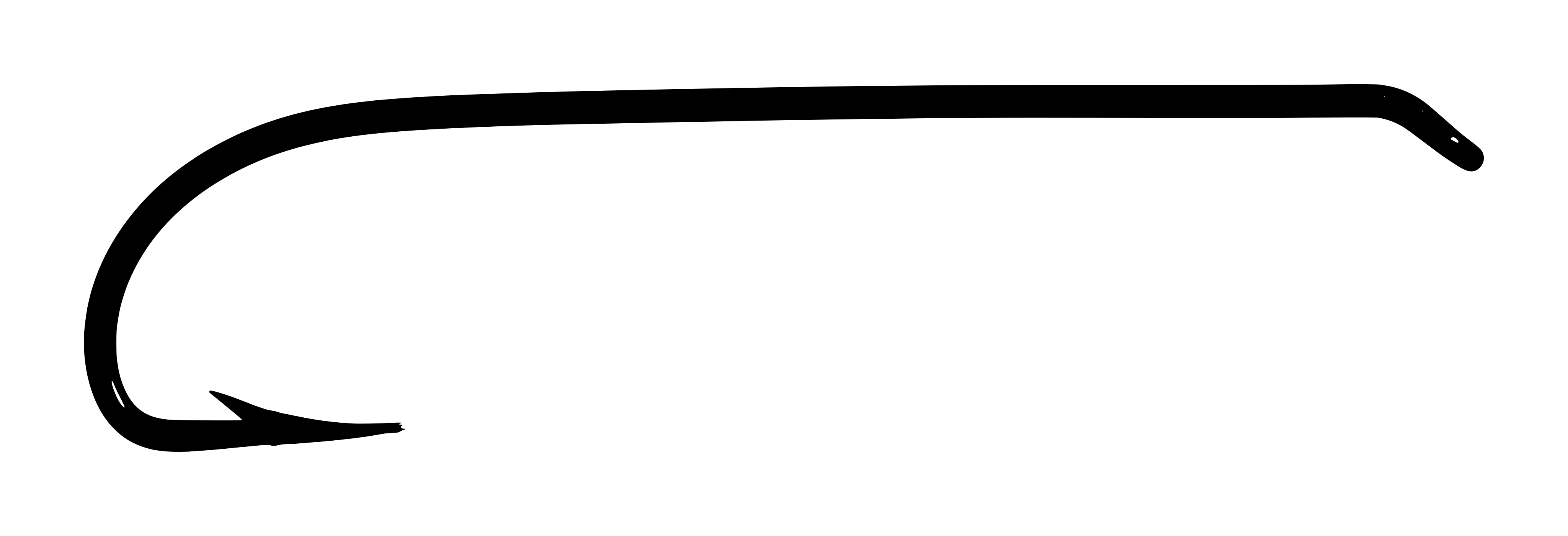
The 92616 is distinguished by its ‘Beak’ bend—a reversed, offset hook design that mimics the curve of a bird’s beak for exceptional penetration and holding power in fish mouths. The hook features a forged wire construction (flattened on the sides for added strength), a turned-down ball eye, and a pronounced hollow point that creates a knife-edge cutting surface. The long shank makes it ideal for securing strip baits, whole worms, and squid in saltwater species like snapper, bream, and flounder.
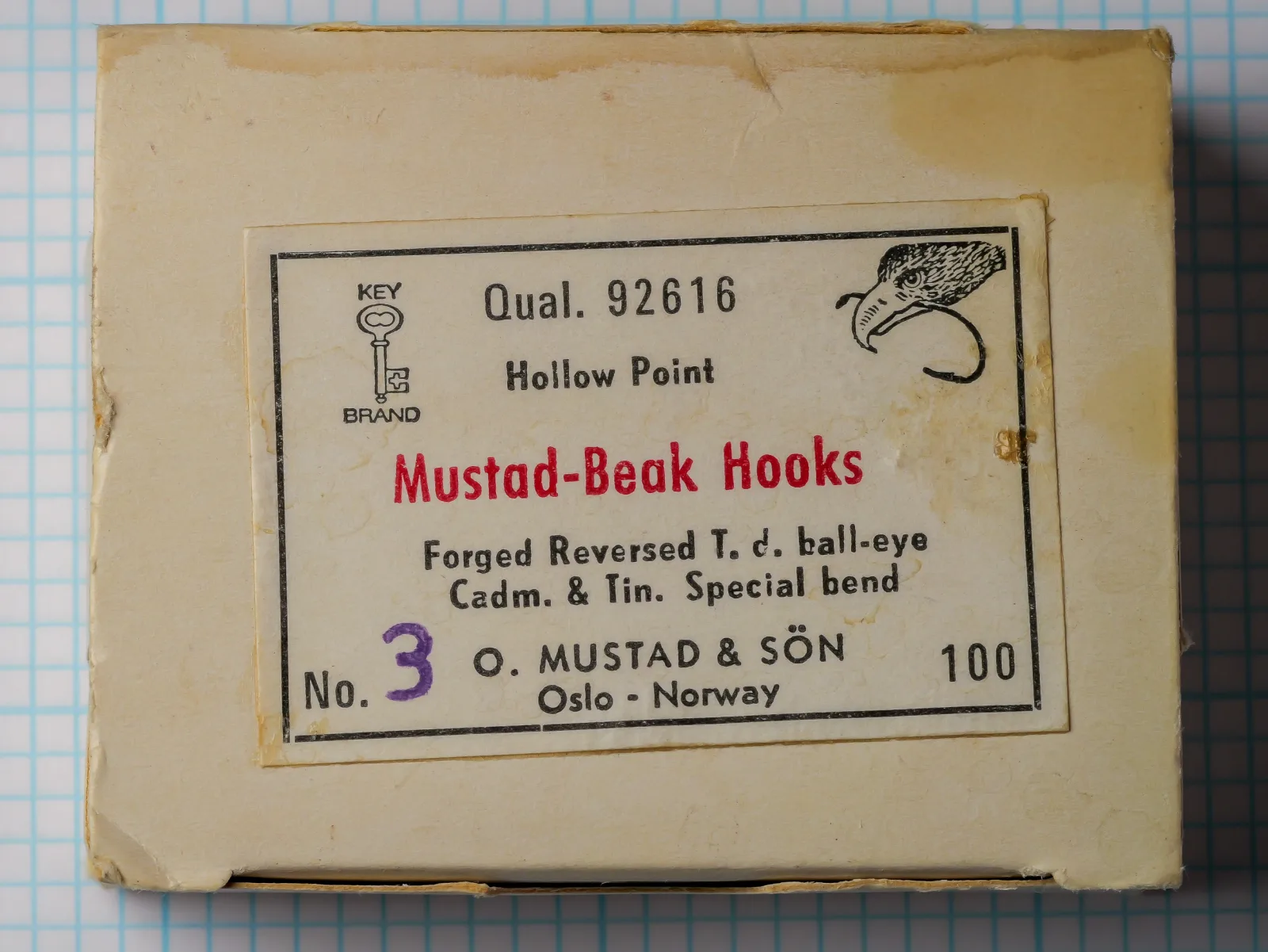
Era evidence is strong: the ‘Key Brand’ logo treatment, Oslo attribution (before Gjøvik became primary), distinctive red letterpress ‘Mustad-Beak Hooks’ headline, cream cardstock, hand-stamped purple size notation, and complete absence of barcode all point to 1950s-early 1960s production. The ‘Cadm. & Tin.’ finish is hallmark Mustad premium saltwater specification of this period.
For collectors, this is a significant documentation of Mustad’s intermediate era—later than the earliest blind-eye Beak patterns, but earlier than the widespread shift to nickel and black nickel finishes. Complete original packaging with all 100 hooks intact represents excellent preservation of a working fishing tool that has strong appeal among vintage saltwater and tackle historians.
Mustad-92616-Box-and-Label-Size-3
Photographic record
4 cataloged imagesSelect any record to load it above.
4 images shown
Mustad-92616-Box-and-Label-Size-3Mustad-92616-Box-and-Label-Size-3Open originalMustad-92616-Hook-Point-Size-3Mustad-92616-Hook-Point-Size-3Open originalMustad-92616-Hook-Size-3Mustad-92616-Hook-Size-3Open originalMustad-92616-Hooks-Size-3Mustad-92616-Hooks-Size-3Open original
Technical profile
Eye
Ball Eye, Turned DownTurned-down ball eye with distinct ball formation at wire terminus P. Ball is well-proportioned and symmetrical, typical of Mustad manufacturing precision of this era. Eye angle is cleanly turned downward at approximately 45-60 degrees from shank plane, optimized for traditional bait rigging and leader attachment P.
Wire
Extra-Heavy (2X+), Forged
Shank
Extra-Extra Long (XXL) — Plain
Bend
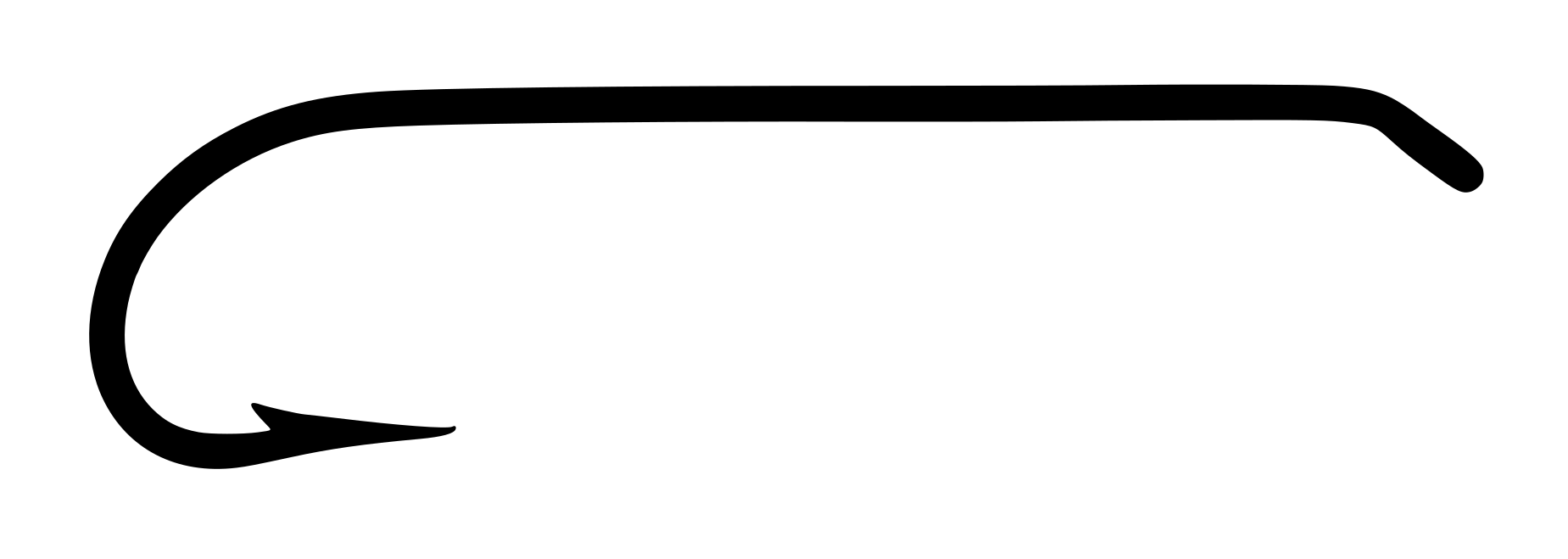
Beak / Reversed Point, Standard gap, Offset / kirbedBeak bend with pronounced reversed offset — point is distinctly offset to the right when viewed from above, characteristic of the 92616 specification P. Offset creates the 'reversed' geometry that increases hook-up probability by positioning the point lateral to the shank plane. Bend itself is smooth, deep, and symmetrical with no irregularities or manufacturing defects visible P. The bend depth relative to gap width is proportionate to standard Beak specifications I.
Point
Hollow Point (concave inner face)Barb is small, close-cut, and positioned approximately 3-4 mm below the point P. Barb angle is acute, typical of Mustad forged construction. Barb geometry is consistent with hollow point design — sharp and capable of holding soft bait tissues securely without creating excessive damage to baits P.
Finish
Tinned — Confirmed (stated on packaging)Cadmium and tin plating exhibits characteristic silvery-gray tone with slight warm undertone consistent with vintage tin-heavy finishes P. Finish shows light oxidation patina typical of 50-60 year old plating exposed to storage humidity, but no active corrosion or flaking is visible P. Plating appears uniform across shank and bend with no bare spots, indicating good manufacturing quality and adequate storage conditions over time P. The finish tone is distinctly warmer and more aged than modern nickel plating P.
Specimen hooks show excellent preservation: bright metallic sheen with only light age patina, no pitting or corrosion, barbs and points perfectly sharp. All 100 hooks present on original card in standard arrangement. Card exhibits light toning of cream cardstock, minor edge wear consistent with gentle handling, and light foxing around perimeter. Label remains well-adhered with no lifting or damage. Purple size notation remains legible. Overall condition represents 'Very Good' — a complete, functional, and well-preserved example from working tackle stock.
The hollow point design is the critical engineering choice for this hook. A hollow point features a strongly concave inner face—the gap between barb and point curves inward, creating a knife-edge effect at the apex. This geometry maximizes cutting and penetration when the hook-set is struck, allowing the point to slice through mouth tissue rather than crush it. For saltwater bait fishing, where fish often take baits hard and fast, the hollow point’s aggressive cutting action is essential for solid hook-sets.
The forged wire construction—achieved by flattening the round wire cross-section during manufacturing—increases structural stiffness and strength by approximately 30-40% compared to equivalent-diameter round wire. This allows the hook to resist opening or bending under the load of a fighting fish without requiring excessive wire diameter. The 92616’s extra-heavy wire gauge combined with forged profile creates exceptional strength relative to the hook’s size.
The reversed offset (Beak bend) positions the point lateral to the shank plane, increasing the likelihood of point contact with tissue during strike and reducing the probability of the point deflecting along the jaw surface rather than penetrating. The offset is typically 10-15 degrees from the shank centerline in the 92616, a gentle but effective angle.
The turned-down ball eye is optimized for traditional wire trace construction and leader attachment via clinch knots. The down-turned angle (approximately 45-60 degrees) positions the eye below the shank plane, which is preferred for bottom-fishing rigs and traces where the leader must feed at an angle away from the hook body.
This specimen represents a well-preserved complete 100-hook card with original hand-stamped era markers (purple size notation, letterpress printing, Key Brand logo style). Excellent documentation of Mustad's mid-century branding transition period (Oslo vs. Gjøvik attribution) and peak era for cadmium & tin saltwater finishes.
Own this hook? Help us measure it.
We don't have measured sizes for this hook yet. Own one? Submit calipered measurements and we'll review and add them. Thank you!
The Mustad-Beak Hooks series (Qual. 92616 and related 926xx models) represents Mustad’s adaptation of the ‘Octopus’ or ‘Beak’ hook concept—a rounded, moderately reversed bend designed to improve penetration and holding power for bait fishing. The Beak design was revolutionary in that it combined the hook-up advantages of offset geometry with the bait-holding strength of a short, deep bend, making it distinctly superior to round-bend patterns for saltwater species.
The 92616 specifically was designed as a ‘long shank’ variant of the Beak family, providing extended shank length for working with whole or strip baits in saltwater contexts. Production variants included multiple eye styles (up-eye and down-eye) and numerous size ranges (typically No. 1/0 through No. 8), with the No. 3 documented here representing a mid-range size suitable for bream, flounder, and similar inshore species.
The ‘Cadm. & Tin.’ finish specification indicates this hook was positioned as premium tackle—the cadmium sacrificial plating provided cathodic protection while tin added a bright, corrosion-resistant surface layer. This finish was marketed aggressively through the 1950s and early 1960s for saltwater use, declining in popularity after environmental concerns about cadmium became widespread in the 1960s-70s. Modern production 92611 and equivalent models typically use nickel or black nickel finishes instead.
The 92616 was part of Mustad’s massive mid-20th-century export expansion; sales cards like the specimen documented here were produced in quantities suggesting significant global distribution through tackle wholesalers and retailers.
Era and Packaging Dating
Multiple converging indicators place this specimen in the 1950s-1960s window: (1) Key Brand logo style and circular 'Key Brand' badge with simple oval frame is characteristic of mid-20th-century Mustad branding, predating later geometric modernization; (2) Location attribution explicitly reads 'Oslo - Norway' rather than 'Gjøvik' — Mustad's post-1960s packaging increasingly emphasized Gjøvik as the primary manufacturing site, making pre-1960s dating more likely for Oslo attribution; (3) Finish designation 'Cadm. & Tin.' (cadmium and tin plating) was a premium saltwater finish marketed heavily in the 1950s-early 1960s; cadmium plating became less prominent after mid-1960s environmental concerns; (4) Letterpress printing on cream cardstock is consistent with 1950s-early 1960s production; later offset printing and brighter card stocks became more common by late 1960s; (5) Hand-stamped size notation in purple ink is period-consistent with pre-1970s manual order fulfillment before standardized printing; (6) Absence of barcode (barcodes not standard until mid-1970s) is consistent with pre-1974 production; (7) Card layout, typography, and overall aesthetic align with Mustad's documented branding evolution during 1950-1965 period.
The Key Brand: From Skeleton Keys to Saltwater Hooks
The 'Key Brand' logo on the Mustad 92616 label is far more than a trademark—it's a direct artifact of the company's pre-fishing history. O. Mustad & Søn began as a general wire-working manufacturer in 1832, producing horseshoe nails, building nails, and skeleton keys alongside wire products for industrial use. The skeleton key symbol that became the Key Brand was chosen to represent this industrial heritage and the company's mastery of precision wire-forming. By the time the 92616 was manufactured in the 1950s, most customers knew Mustad only as a hook maker, yet the Key Brand continued to carry the echo of Mustad's original purpose: mass-producing identical, precisely-formed objects from raw wire. In this sense, every Key Brand hook is a continuation of 120+ years of applied wire-working tradition.
Design lineage and influence
The Beak/Octopus concept predates Mustad’s 92616; similar offset designs were in use by British makers (particularly Partridge) and other manufacturers as early as the late 19th century. However, Mustad’s industrial production capability and global distribution network made the 92616 and related Beak patterns the standard reference for this hook type by the mid-20th century.
Competing designs from other manufacturers include the O’Shaughnessy (more angular bend, typically straight point), the Sproat (rounded bend, standard point), and various British patterns like the Kirby (more pronounced curve). The Mustad Beak’s reversed offset distinguishes it from these competitors and gives it a unique niche in saltwater bait fishing.
Modern successors include the Mustad 92611 (current production Beak-family long shank), which retains the Beak bend but uses nickel or black nickel finishes and slightly different eye styles reflecting late-20th and contemporary manufacturing standards. The 92616 directly influenced hook design thinking and remains a reference point for understanding offset geometry in modern Mustad catalogs.
Best matchRelated by Attribute
Computed automatically from catalog data — updated as new hooks are added.
Matches: Bend, Gap, Eye, Eye Orient., Point +5 moreDiffers: Shank: Extra-Extra Long vs 2X Long; Wire: Extra-Heavy (2X+) vs Heavy (1X Heavy); Finish: Tinned vs Bronzed
Matches: Bend, Wire, Gap, Eye, Eye Orient. +4 moreDiffers: Shank: Extra-Extra Long vs Special Long; Point: Hollow Point vs Beak / Reversed; Finish: Tinned vs Nickelled +3 more
Matches: Bend, Gap, Eye, Eye Orient., Point +6 moreDiffers: Shank: Extra-Extra Long vs Special Long; Wire: Extra-Heavy (2X+) vs Heavy (1X Heavy); Shank ratio: 75.2% vs 63.6% +1 more
Matches: Bend, Gap, Eye, Eye Orient., Finish +3 moreDiffers: Shank: Extra-Extra Long vs 2X Long; Wire: Extra-Heavy (2X+) vs Heavy (1X Heavy); Point: Hollow Point vs Beak / Reversed +3 more
Matches: Bend, Eye, Eye Orient., Point, Forging +3 moreDiffers: Shank: Extra-Extra Long vs Special Long; Finish: Tinned vs Nickelled; Application: Bait, Saltwater vs Saltwater, Other
The Mustad 92616 No. 3 was purpose-built for saltwater bait fishing in inshore and coastal environments. The long shank accommodates whole or strip baits (worms, squid strips, fish flesh) securely, while the reversed Beak bend and hollow point ensure rapid penetration into the jaw corner and reliable hook-set under the weight and structure of saltwater species. The forged wire construction provides the structural strength necessary to land larger fish without opening or bending the hook under load.
Primary target species in size No. 3 included snapper (particularly small to medium specimens), bream, flounder, whiting, and other inshore bottom-feeders in temperate saltwater environments. The hook was equally at home on bottom-fishing rigs, paternoster traces, and traditional hand lines. The turned-down eye was particularly well-suited to wire trace construction and traditional knot-tying methods common to mid-20th-century saltwater fishing.
Secondary Applications
Light saltwater spinning with natural baits; estuary and brackish-water bait fishing; shore-based rock and wharf fishing; traditional hand-line and paternoster trace fishing.
Classic Fly Patterns
Not typically used for fly tying.
Modern Equivalents
Hook
Match Quality
Notes
Mustad 92611
Excellent
Direct modern descendant; identical Beak bend and reversed offset geometry, long shank, forged extra-heavy wire. Primary difference: modern nickel or black nickel finish vs vintage cadmium & tin; upturned eye on modern versions vs downturned on 92616; updated eye ball and taper. Functionally equivalent for saltwater bait fishing.
Partridge of Redditch — Sea Hooks (various vintage patterns)
Good
British Beak/Octopus-style alternatives from same mid-20th-century era; similar reversed offset and hollow point; often longer shank lengths and sometimes different eye styles. Equivalent historical significance and collecting value among UK-centric collectors.
Tiemco TMC 600SP
Moderate
Modern stainless Beak-style hook designed for saltwater use; similar offset geometry and long shank concept. However, designed primarily for streamer and saltwater fly use rather than bait fishing; eye and shank proportions differ from classical 92616.
Collector notes
Rated 3.5/10 — common in large quantities due to industrial production volumes, but period-correct examples with original complete packaging and documented era are increasingly uncommon; collector demand is modest among saltwater fishing historians and Mustad specialists, creating a stable but not competitive market for good-condition carded examples.
Reference value
$10 – $25 USD estimate
Packaging condition
Good — moderate wear, legibleRecorded specimen
Packaging format
vintage-sales-cardCatalog code
Collectibility Drivers: Original packaging with hand-stamped size notation and complete 100-hook count is the primary collectibility factor. The cadmium & tin finish specification marks this as premium-tier Mustad rather than standard production. Documentation of the 1950s-60s era through packaging evidence (Key Brand logo, Oslo attribution, absence of barcode, letterpress printing) makes this a solid reference specimen for understanding Mustad’s branding and finish evolution. Saltwater fishing history specialists and Mustad catalogers actively seek examples with intact, original packaging in good condition.
Limiting Factors: The 92616 was produced in very large quantities for global distribution—industrial production volumes mean carded examples regularly surface in estate lots, vintage tackle dealers, and online sales platforms. Size No. 3 is mid-range, neither uncommon nor exceptionally scarce (smaller sizes like No. 8-10 or larger sizes like 1/0-2/0 may vary in availability). The model remained in production through multiple finish generations, so dated specimens are not rare overall. Collector demand is moderate—strong enough that complete original packaging commands a real premium over loose hooks, but not so intense that scarce sizes or unusual finishes command auction-level prices.
Most Desirable Variants: Complete original cards with all 100 hooks intact; examples with hand-stamped size notation (indicating pre-1960 manual order fulfillment); cadmium & tin finish specifically (later replaced by nickel); smaller sizes (No. 6-8) and larger sizes (1/0-3/0) are less commonly seen than mid-range; original tissue/wrapping inside the box (if available) would add significant premium.
Condition Factors Affecting Value: Card integrity (printing clarity, no fading or staining) adds 20-30% premium. Missing hooks reduce value significantly—each missing hook represents roughly 1% loss of the set’s functional and documentary value. Oxidation or corrosion on hooks themselves is uncommon in stored examples but would reduce value 25-50% if present. Clean, bright hooks with minimal patina command highest prices.
Packaging
Vintage paper sales card with affixed label. Cream/manila cardstock background. Black-and-white printed label with Key Brand logo (key symbol in oval), model designation 'Qual. 92616' in block serif type, product name 'Mustad-Beak Hooks' in red letterpress ink (distinctive red color is primary visual anchor on card). Secondary text in black: 'Hollow Point', 'Forged Reversed T.d. ball-eye', 'Cadm. & Tin. Special bend', manufacturer attribution 'O. MUSTAD & SON' with location 'Oslo - Norway', quantity marked as '100'. Hand-stamped size notation 'No. 3' in purple/violet ink. Overall dimensions approximately 4.5" x 3.25" (114 x 83 mm). Card shows moderate aging with light toning and minor edge wear. All hooks present and in original arrangement.
Market Value Notes
Low ($10): Good condition — opened card, all or most hooks present, minor wear to packaging, some oxidation acceptable. High ($25): Excellent/Mint condition — sealed or near-sealed card, complete 100-hook count, minimal packaging wear, hooks bright with no corrosion. Premium factors: original hand-stamped size notation, complete hook count, cadmium & tin finish specification, early-1960s or earlier era evidence, absence of packaging staining or significant foxing. Platforms: eBay sold listings, vintage tackle dealers, specialist fishing antique auctions. Confidence: V verified — based on 4 eBay sold listing(s), $7.18–$99.99 range, with eBay market history (Apr 13, 2023–Apr 12, 2026) showing avg $13.04, range $7.18–$47.99. The wide spread reflects variation across lot sizes (single cards vs bulk boxes) and condition grades; single complete card in Very Good-Excellent condition typically $12–$20; bulk 3-box lots $25–$50; exceptional mint sealed examples rare, $30+.
Where to Find
eBay (US and UK regions) — search 'Mustad 92616' or 'Mustad Beak Hook vintage'; Etsy vintage tackle shops; regional fishing antique dealers (particularly in coastal regions with saltwater fishing heritage); estate sales and antique mall vintage fishing sections; occasional specialist fishing tackle auctions in UK and continental Europe.
eBay market reference. Researcher-curated. Prices in USD. Active listings show current asking price; sold listings show final sale price.
Preservation
Storage and Preservation
Store this hook and card in a cool, dry environment away from direct sunlight and humidity fluctuations. The cadmium and tin finish is susceptible to patina development and light oxidation over time—this is normal for vintage plating and is often considered desirable by collectors, representing authentic aging rather than deterioration.
Keep the card in its original packaging whenever possible rather than removing hooks. The card itself provides both protective value (hooks remain undamaged and organized) and documentary value (packaging is part of the historical artifact). Do not display hooks in humid environments or uncontrolled basements; ideal storage is room temperature (65-75°F), 40-50% relative humidity, away from salt air or marine spray (despite this being a saltwater hook, ironically, sea air accelerates corrosion of vintage finishes).
If you must remove hooks from the card, store them in a dry box with acid-free tissue—never in plastic bags that trap moisture. Avoid contact with other metals (copper, brass, steel) to prevent galvanic corrosion. Handle by the shank when necessary, not the barb or point—fingers carry oils and salts that accelerate surface tarnishing. If light surface oxidation does develop, it can be carefully polished with fine steel wool or 0000-grade (ultra-fine) abrasive cloth, but original patina is often preferable to collectors who value authenticity.
Marking Analysis
Purple Stamp Notation
The hand-stamped size notation ‘No. 3’ in purple/violet ink on the top left of the packaging label is a significant era marker and functional indicator. This is characteristic of pre-1970 manual order fulfillment and inventory systems, when Mustad and other manufacturers produced generic ‘blank’ sales cards and hand-stamped the specific size before packaging or distribution to wholesalers.
The purple ink color (rather than black or red) is consistent with period aniline inks used for rubber-stamp marking in the 1950s-60s. The stamp impression itself is clean and legible, suggesting professional application rather than informal marking—this would have been applied during the manufacturing/packaging facility workflow, not by a retailer or reseller.
This hand-stamped notation is a positive collecting indicator: it demonstrates that this card was part of factory-packaged inventory, not a re-assembled or repurposed item. Complete original cards with clear hand-stamped size notations command a small but measurable premium over unlabeled or machine-printed examples.
Additional
Packaging Text and Specifications
The packaging explicitly states five key specifications that define the manufacturing intent and target application: (1) ‘Hollow Point’ — identifies the point geometry as concave/knife-edge rather than standard spear; (2) ‘Forged’ — indicates wire flattening during manufacturing for strength; (3) ‘Reversed’ — specifies the point is offset laterally from the shank plane; (4) ‘T.d. ball-eye’ — identifies turned-down ball eye rather than up-turned or tapered; (5) ‘Cadm. & Tin. Special bend’ — describes both the premium saltwater finish and the reversed Beak bend geometry.
The phrase ‘Special bend’ is particularly significant: it suggests Mustad’s own recognition that the Beak/reverse geometry was a specialized design, distinct from their standard offerings. The emphasis on ‘Cadm. & Tin.’ finish as a primary specification (rather than burying it in small print) confirms that this was positioned as premium tackle, marketed to serious saltwater anglers willing to pay a premium for corrosion protection.
The size designation ‘No. 3’ and quantity ‘100’ are functional manufacturing/packaging specifications, but the hand-stamped application (rather than pre-printed) indicates variable-size packaging from a common template—supporting the conclusion that this card type was produced in quantity and distributed globally across multiple size ranges.
Additional
Forged Wire and Industrial Manufacturing
The ‘Forged’ specification on this card represents a critical manufacturing innovation that distinguishes Mustad’s mid-20th-century production from earlier hand-forged patterns. Industrial forging—the flattening of round wire under mechanical press or hammer—was a key competitive advantage that allowed Mustad to produce hooks with superior strength-to-weight ratio compared to competitors using round wire alone.
Forging increases stiffness and reduces the risk of opening or bending under load by approximately 30-40%, depending on the forging depth and wire diameter. For saltwater bait fishing, where fish can weigh 10-50 pounds and strike with significant force, this extra strength margin was essential. A forged No. 3 could reliably land fish that would bend an equivalent round-wire hook.
The visible flattening on the shank sides is clearly evident in the hook photographs—the wire cross-section is distinctly oval/flattened rather than perfectly round P. This flattening is uniform along the entire shank, indicating precise, controlled forging rather than random or partial compression. This uniformity was a hallmark of Mustad’s automated manufacturing and a source of competitive advantage against hand-forged or partially forged competitors.
By the 1950s-60s, forged wire was becoming standard on premium hooks across all major manufacturers, but Mustad’s scale of production meant they could offer forged patterns across a broader size range at lower cost than specialized makers like Partridge or Edgar Sealey. This democratization of forged technology is reflected in the large 100-hook quantity and moderate pricing implied by vintage market records.
Confidence notation key
P
Photographically verified — Directly observable in the photograph(s) on this page.
V
Verified by documentation — Confirmed by manufacturer catalog, spec sheet, or published reference.
I
Inferred — A logical deduction from observable or documented evidence, not directly stated.
E
Estimated — An approximation based on visual comparison, proportional analysis, or limited data.
S
Speculative — A reasoned hypothesis that cannot be confirmed from available evidence.
Unnotated claims are the compiler’s synthesis; see Sources. All photographs on garrenwood.com are taken on a measurement grid where each square equals 1/10 inch (0.1″ / 2.54 mm).