The Mustad 57592 Viking Hooks represent a fascinating vestige of pre-modern fly-tying technique. Manufactured in Oslo, Norway during the mid-twentieth century (c. 1945–1955), these tiny size No. 9 hooks feature blind eye construction — no formed loop, requiring the angler to snell (bind) silk-worm gut or thread directly to the tapered shank. The ultra-fine wire gauge (5 extra-fine) and hollow point geometry were engineered specifically for traditional dry flies that demanded minimal weight at the head and maximum delicacy of presentation.
The packaging identifies this as a special run: the label explicitly states ‘Special Blind Eye Run,’ indicating these hooks were manufactured by order for traditionalists still preferring snelled flies decades after the industry standardized on eyed hooks. The Oslo designation firmly dates this to post-January 1925, and the typography and box construction suggest post-WWII production. By the 1950s, blind eye hooks represented an anachronism even to Mustad’s export markets, yet the company continued producing them for a devoted minority of North Country and European fly tyers.
Today, these hooks hold significant appeal for collectors and heritage fly-tiers who recreate nineteenth-century patterns using period-correct materials and techniques. The combination of blind eye, tapered shank, and extra-fine wire is exceptionally rare — most blind eye hooks were heavy salmon patterns, not delicate dry-fly tools. A complete original card in this condition is a valued artifact in the tackle collecting and fly-tying communities.
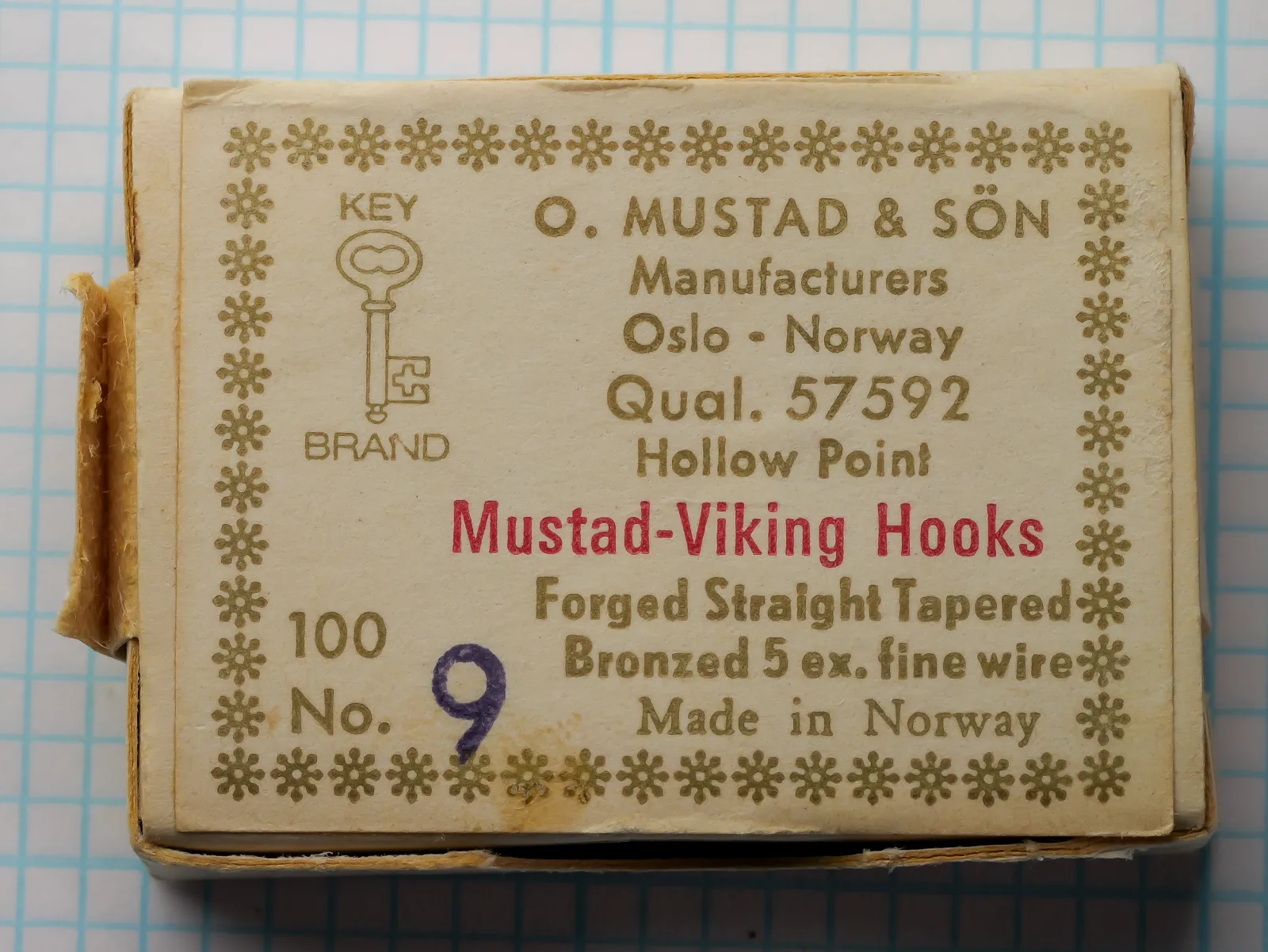
Front label of the Mustad 57592 Viking Hooks sales card showing the complete eight-line vintage label format, Oslo origin (post-1925 dating), and specifications for blind eye, forged, tapered, hollow point, bronzed finish in 5 extra-fine wire.
Photographic record
3 cataloged imagesSelect any record to load it above.
3 images shown
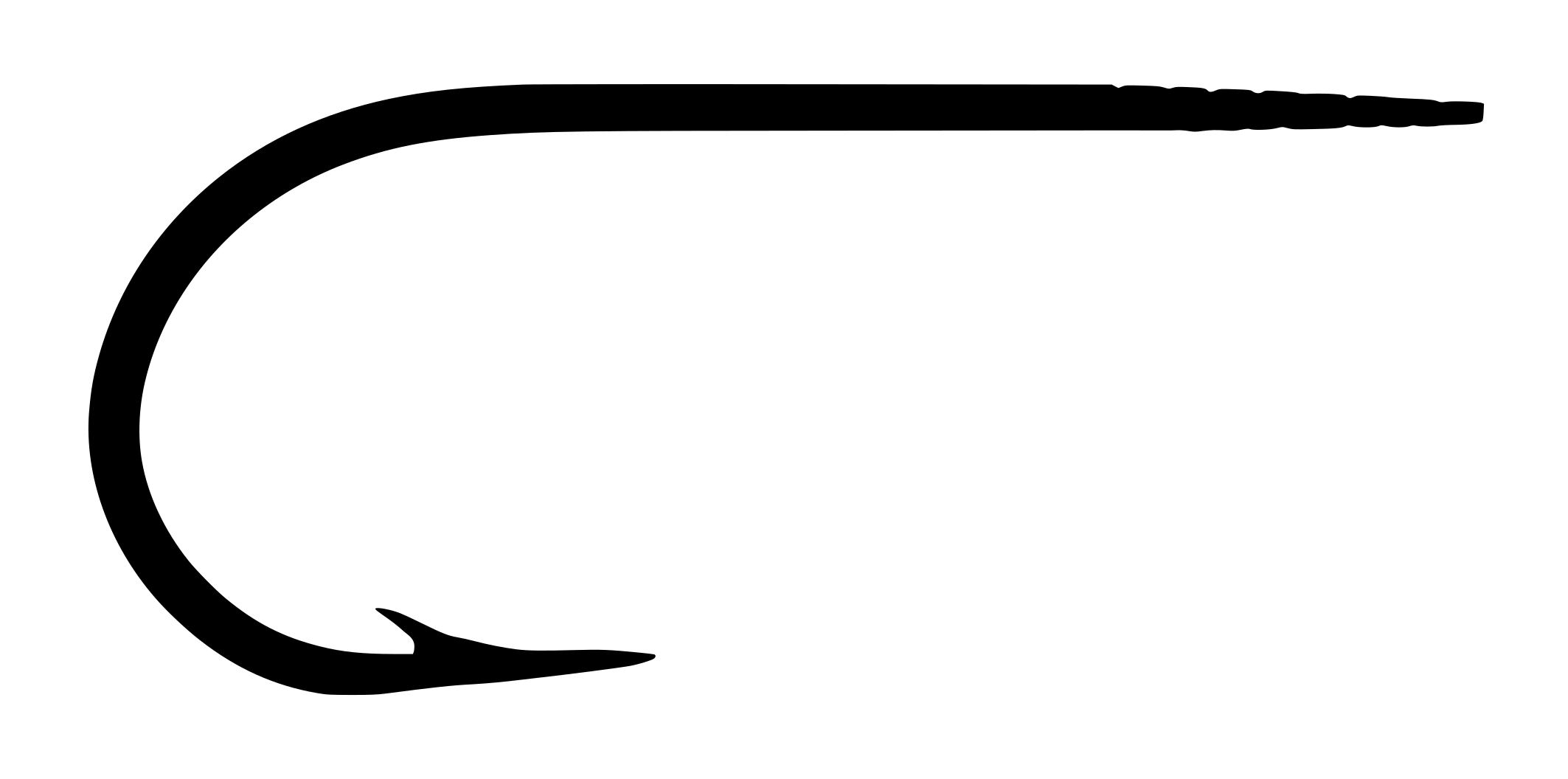
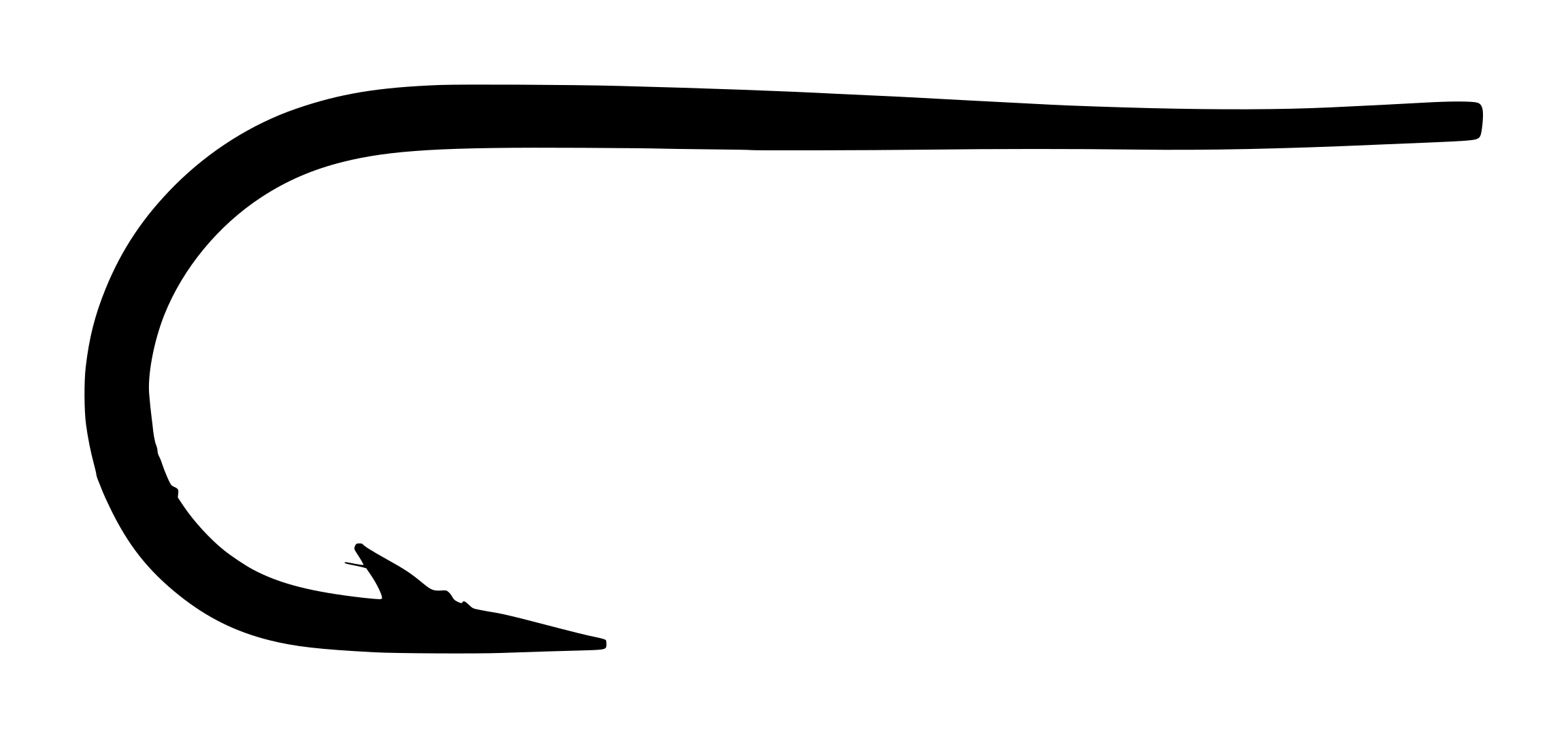
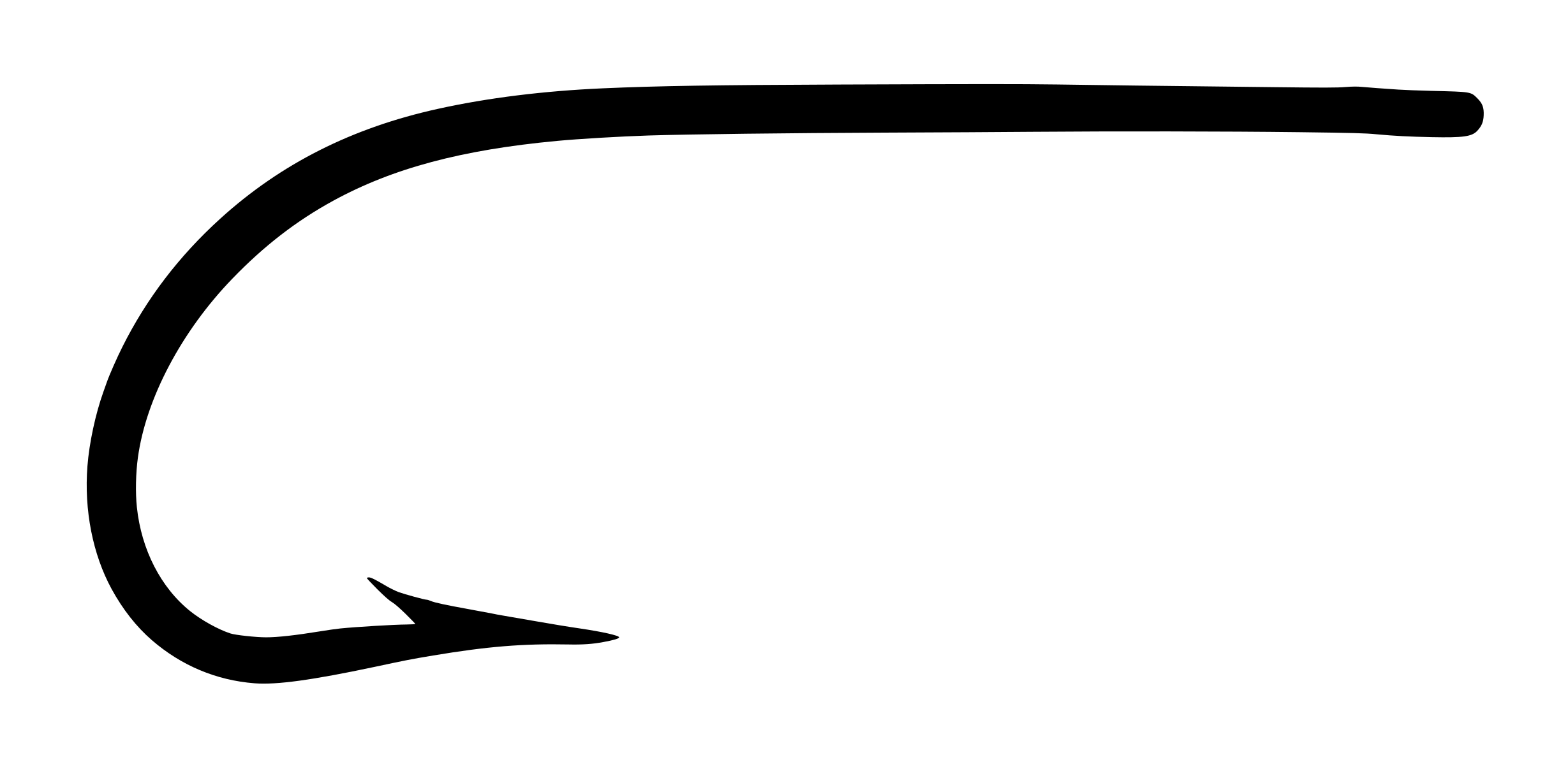
Mustad 57592 Viking Hooks Size 9 Original Card LabelFront label of the Mustad 57592 Viking Hooks sales card showing the complete eight-line vintage label format, Oslo origin (post-1925 dating), and specifications for blind eye, forged, tapered, hollow point, bronzed finish in 5 extra-fine wire.Open originalMustad 57592 Size 9 Hook Point Detail Hollow GeometryClose-up detail of the hook point on the Mustad 57592, showing the characteristic hollow (concave) inner face that gives this point style its name, with the sharp tip and close-cut barb visible.Open originalMustad 57592 Size 9 Hook Full Profile Blind EyeFull-length profile view of the Mustad 57592 hook showing the round bend (Viking pattern), straight tapered shank, blind tapered eye termination, and the overall delicate proportion achieved through ultra-fine wire gauge.Open original
Technical profile
Blind Eye | Round Bend | Standard Shank | Extra-Fine Wire | Hollow Point | Bronzed
Eye
Blind — Marked Tapered ShankBlind eye with tapered shank termination P. The shank tapers smoothly to a blunt, rounded point rather than a flat spade; this is distinctly tapered rather than merely flatted P. This tapered blind eye construction is unusual for Mustad — most blind eye hooks feature flatted spades. The taper appears hand-ground or precision-finished, consistent with premium work P.
Wire
Extra-Fine, Round, Est. ~0.018"-0.020" (~0.46-0.51 mm)
Shank
Standard — Tapered
Bend
Round / Kendal, Standard gapRound bend (referred to as 'Viking' pattern on label) features a smooth, sweeping curve with even radius throughout. Bend depth measured at ~0.15" (~3.8 mm) relative to shank axis E. No visible offset or irregularity; bend symmetry is excellent P. The shank wire extends straight from eye to bend without lateral deflection — 'Straight' designation on label confirmed visually P.
Point
Hollow Point (concave inner face)Hollow point clearly visible on both profile and front-face images P. The inner face shows pronounced concave curve from tip to barb base, creating the characteristic 'dished-out' silhouette P. Barb is short, close-cut, and well-positioned at the concave terminus P. Point geometry is exceptionally fine and sharp, consistent with hollow point design intended for soft-mouthed species and delicate presentations P.
Finish
Bronzed — Confirmed (stated on packaging)Bronzed finish exhibits a warm, medium-brown tone consistent with lacquer-based bronze coating P. Color is relatively uniform across the visible hook surface with slight tonal variation indicating age-related patina development P. No obvious rust or corrosion spotting; finish is well-preserved for a specimen of this age P. The warm, golden-brown hue is cooler than brass but warmer than japanned black — visually distinct from both P.
Original sales card in very good condition P. Box structure intact with minimal edge wear and creasing P. Label printing is crisp and legible throughout; colors (golden-brown text and snowflake border) remain vibrant P. No water staining or major discoloration on card body P. Hook specimen shows bright finish with no visible corrosion, rust spotting, or discoloration P. The tapered shank terminates cleanly with no burring or damage P. Hooks appear never to have been used; no wear marks on point or barb P.
Hollow Point Geometry: The concave inner face of the hollow point creates an exceptionally fine, razor-sharp tip that flares rapidly toward the barb. This geometry achieves initial penetration with minimal applied pressure — critical for soft-mouthed species like trout that would tear on aggressive hook-sets. The dished-out profile concentrates all penetration force at the microscopic tip while the rapid flare prevents the hook from tearing out of soft tissue during the fight.
Ultra-Fine Wire (5x extra-fine): Wire diameter of approximately 0.018″-0.020″ is exceptionally thin for a hook. This reduction in mass serves two purposes: (1) minimizes weight at the head of the fly, allowing dry flies to float properly and horizontally without nose-diving, and (2) reduces disturbance when entering the water and during the drift. The trade-off is reduced structural strength — ultra-fine wire is more prone to bending and breaking under heavy stress, limiting use to delicate presentations and small fish.
Blind Eye with Tapered Shank: The absence of a formed loop eliminates weight entirely at the eye end. The tapered termination (rather than flat) further reduces the footprint where silk or gut must be whipped, creating a more elegant, hydrodynamic head on the finished fly. The taper also provides better grip for the binding thread, improving security of the snell.
Round Bend (Viking Pattern): The sweeping, continuous curve distributes stress evenly across the bend during the fight. The round profile provides excellent gap capacity for the size, improving hookup probability on small mouths.
Bronzed Finish: The lacquer-based bronze coating provides moderate corrosion resistance suitable for freshwater use where saltwater exposure is not a concern. The warm brown color is aesthetically favored by traditional fly tyers and reduces visible ‘flash’ that might spook selective fish in clear water.
Represents one of the finest documented examples of Mustad blind eye production with tapered shank in ultra-fine wire. The combination of blind eye + 5x extra-fine + tapered shank is exceptionally rare in Mustad's published catalog and surviving examples.
Own this hook? Help us measure it.
We don't have measured sizes for this hook yet. Own one? Submit calipered measurements and we'll review and add them. Thank you!
Historical context
mustad
O. Mustad & Søn was founded in 1832 in Gjøvik, Norway, initially as ‘Brusveen Spiger- og Staltradfabrikk,’ manufacturing nails and steel wire. The company was rebranded as O. Mustad & Søn when taken over by Ole Hovelsen Mustad and his son Hans Mustad. The pivotal moment came in 1877 when Mathias Topp invented the first fully automated hook-making machine, allowing raw steel wire to be continuously fed, cut, bent, barbed, and pointed at unprecedented speed. Rather than patent the technology, the Mustad family guarded it through strict corporate secrecy and restricted factory access — a strategy that proved devastatingly effective against rival manufacturers in Redditch, England, and North America. By the 1950s, Mustad had secured approximately 50 percent of global hook production market share, establishing sales offices and manufacturing facilities across multiple continents. The company’s dominance was built on mechanical precision, innovation in metallurgy, and an aggressive strategy of reverse-engineering and mass-producing regional hook patterns from around the world.
Series History
The Mustad-Viking Hooks series represented a continuation of Mustad’s commitment to serving niche markets even as mainstream fly fishing evolved. The ‘Viking’ designation appears on cards dating from the 1940s–1950s and typically identifies hooks manufactured for Scandinavian markets or for traditional tyers seeking Mustad’s proprietary designs. The 57592 specifically is identified on the original label as a ‘Special Blind Eye Run,’ suggesting this was a specialized production ordered by regional distributors or retailers for customers still preferring blind eye construction. By this period, blind eye hooks were largely phased out in favor of eyed hooks, which were easier to use with modern nylon monofilament lines. However, traditional fly tyers, particularly in rural Scandinavia and the British Isles, continued to demand blind eye patterns for snelled flies — especially in ultra-fine wire gauges for dry flies where weight at the eye was considered detrimental to float and presentation. The production of this particular quality code likely ceased by the late 1950s as the market for blind eye hooks contracted. No direct successor model exists; modern hook manufacturing has entirely abandoned blind eye construction for retail production.
Era and Packaging Dating
The label clearly states 'Oslo - Norway' on Line 3. The Norwegian capital was officially renamed from Christiania to Oslo on January 1, 1925. Any Mustad box bearing the Oslo designation must be dated to 1925 or later (V per reference document section on Line 3 dating). The typography, box construction, and offset lithography printing method suggest post-WWII production rather than immediate post-1925 output. The absence of a barcode (which became standard post-1974) further confirms pre-1974 manufacture. The specific font face and snowflake border design are consistent with Mustad's 1940s–1950s packaging aesthetic E. The label's reference to a 'Special Blind Eye Run' indicates niche production for traditionalists — by the 1950s, blind eyes were becoming obsolete, suggesting this particular order dates to the late 1940s–early 1950s rather than later decades. Cross-referencing the style against known Mustad catalog samples suggests c. 1945–1955 as the most probable production window E.
Snelling: The Lost Art of Hook Rigging
Before the widespread adoption of eyed hooks in the early twentieth century, all fishing hooks were blind eye — a 'snood' (a short length of silk-worm gut, horsehair, or thread) had to be painstakingly hand-whipped to the bare shank using fine silk and pitch. This 'snelling' process was so skilled that professional snellers were specialized craftspeople commanding premium wages. By the 1950s, when Mustad was still producing these 57592 blind eyes for traditionalists, snelling was already considered a 'master class' skill relegated to heritage fly tyers and old-guard anglers. The fact that Mustad marked this as a 'Special Blind Eye Run' is telling — the market for blind eyes had contracted so dramatically that production required a specific customer order rather than ongoing retail stock. Today, snelling is being revived by heritage fly-tying communities recreating nineteenth-century patterns, and hooks like the 57592 are prized artifacts documenting a forgotten technique.
Design lineage and influence
The blind eye represents the ancestral form of the fishing hook — all hooks were blind until the mechanical eye-forming became standard in the late nineteenth century. Mustad’s blind eye production traces to its earliest hook manufacturing, inherited from the Redditch tradition. The tapered shank version (rather than flatted) represents a refinement that emerged around the 1920s–1930s for premium dry-fly work, where weight reduction was paramount. Competing manufacturers like Partridge of Redditch and specialized British makers continued producing blind eyes for niche markets even as Mustad increasingly focused on eyed hooks for mass export. By the mid-twentieth century, blind eye construction was effectively superseded by eyed hooks, which were compatible with modern monofilament knots and simpler to tie. However, the design lineage flows directly to modern circle hooks and specialized construction techniques — the principle of minimal weight at the eye and self-setting geometry that drove blind eye design continues to influence contemporary hook engineering. The Mustad 57592 represents the tail end of this ancestral tradition before it was almost entirely abandoned.
Best matchRelated by Attribute
Computed automatically from catalog data — updated as new hooks are added.
Matches: Bend, Wire, Gap, Eye Orient., Forging +2 moreDiffers: Shank: Standard vs 1X Long; Eye: Blind — Marked Tapered Shank vs Blind — Tapered Shank; Point: Hollow Point vs Standard / Spear +2 more
Matches: Bend, Wire, Gap, Eye Orient., Finish +1 moreDiffers: Shank: Standard vs Short (1X–2X Short); Eye: Blind — Marked Tapered Shank vs Blind — Marked Shank; Point: Hollow Point vs Standard / Spear +3 more
These hooks are designed for traditional snelled dry flies and North Country Spider-style presentations. The blind eye construction requires the angler or tyer to affix a snood (typically silk-worm gut, heavy thread, or dacron) directly to the tapered shank using specialized binding techniques. Once snelled, the hook serves as a delicate dry-fly tool for small to medium freshwater trout, grayling, and other soft-mouthed species in clear, slow-moving streams. The ultra-fine wire (5 extra-fine gauge) and hollow point geometry minimize weight at the head, allowing the fly to float naturally and horizontally without the nose-down attitude that can result from excess metal at the eye. The small size (No. 9) and fine wire make these hooks ideal for pale, sparsely-dressed imitations in clear water where fish are selective. Historically, these were favored by traditional fly tyers in Scandinavia, Britain, and North America who believed blind eye hooks produced a more natural swim and better float than eyed hooks, particularly in ultra-fine wire gauges.
Secondary Applications
Wet fly fishing (sparse patterns), light nymph fishing, small bait presentations (midge pupae, small insects), experimental tying techniques exploring heritage construction methods.
Classic Fly Patterns
Not typically used for fly tying in modern practice. Historically associated with North Country Spiders, traditional dry flies, snelled presentations, and heritage British/Scandinavian fly-tying patterns (e.g., Greenwell's Glory, Hare's Ear variations, Pale Watery patterns when tied on blind eyes).
Modern Equivalents
Hook
Match Quality
Notes
Partridge of Redditch CS10/3 (Blind Eye, Tapered Shank)
Excellent
Direct spiritual successor; Redditch maker still producing blind eye hooks in ultra-fine wire for heritage fly tyers. Closest modern equivalent for snelled dry flies.
Custom-order producer specializing in blind eye reproduction hooks. Offers equivalent geometry and wire gauges for heritage tying.
Mustad C45S (Curved In / Circle Hook)
Moderate
Modern design with some heritage philosophy (self-setting, reduced deep hooking) but eyed construction and entirely different geometry.
Collector notes
Rated 4.5/10 — blind eye hooks are scarce in small sizes with ultra-fine wire; collector demand is strong among heritage fly tyers but limited among general tackle collectors. Complete original packaging in very good condition adds significant premium.
Reference value
$12 – $35 USD estimate
Packaging condition
Very Good — light wear, fully legibleRecorded specimen
Packaging format
GW-MUSTAD-VINTAGE-CARD-01Catalog code
Positive factors: Blind eye construction with tapered shank is exceptionally rare in Mustad’s catalog. The combination of ultra-fine (5x extra-fine) wire with blind eye makes this a specialized tool for traditional snelled dry flies, appealing to heritage and historical fly-tying communities. The Oslo designation on label dates this to post-1925 but pre-1960, placing it in the desirable mid-vintage era. Original sales card in very good condition with complete box structure and legible label commands a premium. Numbered 100 hooks per card suggests full original stock potential.
Limiting factors: Blind eye hooks have niche appeal outside specialist circles. No modern equivalent exists in commercial production, limiting utility-based demand. Size No. 9 is very small and skews toward delicate work rather than practical modern fishing. The hook requires knowledge of snelling technique to use, creating a barrier to casual collectors. Mustad blind eye hooks were largely phased out after 1960, making the market small.
Most desirable variants: Complete original cards with all 100 hooks intact; sealed or near-sealed packaging; cards in sizes 10-14 (more common for dry flies) are more sought than size 9. The bronzed finish is less desirable than blued or japanned among some collectors, slightly reducing value relative to other finishes.
Condition premium: Sealed original tissue or envelope adds 30-50% premium. Missing hooks deduct 10-15% per hook. Faded or damaged label reduces value by 20-30%. Hooks showing any corrosion or discoloration deduct modestly; bronzed finish is relatively stable but can develop verdigris with age.
Packaging
Original Mustad sales card, approximately 5.25" × 3.5" (13.3 cm × 8.9 cm), printed on cream-colored pasteboard stock. Label features offset lithography in tan/golden brown and red inks. Header displays the iconic 'Key Brand' Mustad trademark (downward-pointing skeleton key) in tan, accompanied by snowflake border pattern (decorative element common to vintage Mustad exports). Eight-line label format: Line 1: 'O. MUSTAD & SÖN' (manufacturer); Line 2: 'Manufacturers'; Line 3: 'Oslo - Norway' (geographic origin and dating); Line 4: 'Qual. 57592' (quality/model code); Line 5: 'Hollow Point' (point descriptor); Line 6: 'Mustad-Viking Hooks' (pattern name, printed in red); Line 7-8: 'Forged Straight Tapered / Bronzed 5 ex. fine wire / Made in Norway' (specifications). Bottom left corner: '100' and 'No. 9' (quantity and hook size). The card retains its original manila envelope/pocket structure on the left edge for hook storage, intact but showing age-related yellowing and light creasing. Label is crisp and legible with no significant fading or water damage. The box construction and typography suggest post-WWII production, c. 1945–1955.
Market Value Notes
Low ($12): Good condition — opened card with 95+ hooks intact, moderate label wear, no corrosion<br />
High ($35): Excellent condition — sealed or near-sealed card, all 100 hooks present, minimal label wear, original tissue intact<br />
Premium factors: Complete hook count, sealed packaging, intact original tissue, vibrant label printing, lack of corrosion or toning<br />
Platforms: eBay (UK and US), Vintage Tackle Dealers (UK/EU specialists), Heritage Angling forums and sales groups<br />
Confidence: E estimated — limited recent sales data; based on comparable blind eye hook cards and specialist dry-fly hook pricing. Blind eye hooks in fine wire sell at significant premium relative to eyed equivalents.
Where to Find
eBay UK frequently lists vintage Mustad blind eye cards; specialist vintage tackle dealers in England and Scandinavia (Oslo area dealers more common); heritage fly-tying forums and specialist sales groups on Facebook and Ravelry; occasional appearance at UK tackle fairs and auctions (Merrick Tackle, Antique Tackle Auctions).
Preservation
Storage and Preservation
Environment: Store in a cool, dry location away from humidity and direct sunlight. The bronzed lacquer finish is stable but will develop a natural patina with exposure to moisture over decades — many collectors consider this desirable ‘aging’ rather than degradation. Avoid damp basements or attics where condensation and temperature fluctuation can accelerate patina formation or cause corrosion.
Packaging: Keep hooks in the original sales card rather than transferring to loose storage. The pasteboard card provides structural protection and significantly increases collectible value. Do not remove hooks from the card unless absolutely necessary. If the original envelope/pocket on the card is intact, keep it sealed with hooks inside.
Handling: Minimize handling of the label and card surface. Skin oils and fingerprints can accelerate patina development on the bronzed finish. Wear cotton gloves when examining the card or hooks. Avoid touching the printed label surface, as old offset ink can smudge with pressure.
Display: If displayed, use UV-filtering glass or acrylic to minimize light exposure to the label printing. Keep away from sources of heat and direct air currents that promote moisture evaporation and differential humidity. Store cards flat or at a slight angle rather than propped vertically, which can stress the card structure over time.
Monitoring: Periodically inspect for signs of corrosion (rust spots or white oxide bloom), water staining, or insect damage. Inspect the card edges and packet seams for moisture intrusion. If any signs of corrosion appear, ensure storage location has improved air circulation and lower humidity.
Avoid: Do not attempt to clean or polish the bronzed finish. Abrasive cleaning removes the patina and original lacquer, reducing both aesthetic appeal and value. Do not store near other metals (steel, copper, brass) that could set up galvanic corrosion. Do not expose to gaseous corrosives (e.g., hydrogen sulfide in industrial areas or from old leather).
Primary Source
Label Text Analysis: The 'Special Blind Eye Run' Designation
Source: Original Mustad 57592 sales card, Oslo, Norway, c. 1945–1955. Label text transcription and analysis.
The label designation ‘Special Blind Eye Run’ is notable and historically significant. This phrase indicates that the 57592 was not a standard catalog item in continuous production, but rather a specialized production order manufactured to specific customer request. By the 1940s–1950s, blind eye hooks represented an increasingly niche market segment — most fly fishers had transitioned to eyed hooks compatible with modern nylon monofilament lines and simple knots. The ‘Special Run’ notation strongly suggests this order was placed by a regional distributor or retailer serving traditionalist fly tyers, likely in Scandinavia or Britain, who insisted on snelled flies and refused to adopt eyed hooks.
The combination of ‘Special Blind Eye Run’ with the ultra-fine wire gauge (5x extra-fine) indicates this was a premium, custom production. Mustad would not have manufactured such a specialized hook for general retail consumption — the market was simply too small. Instead, these were produced on order for a named customer or distributor, likely in limited quantities (hence the standard 100-hook card format, which may represent the entire production run for that order).
This label tells a story of industrial adaptation: even as Mustad dominated global hook production through mechanization and mass manufacture, the company remained flexible enough to fulfill specialized orders for traditionalists who rejected modern standardization. The ‘Special Blind Eye Run’ is both a testament to Mustad’s manufacturing versatility and a poignant documentation of a dying tradition — by the 1960s, such orders would cease entirely as the last practitioners of snelling retired.
Size Note
Sizing Convention: The 'No. 9' Standard
The Mustad 57592 is designated as ‘No. 9,’ which may appear anomalous to modern fly fishers accustomed to the standard fractional sizing (No. 12, No. 14, etc.) or the modern Mustad Signature Series alphanumeric codes. This older Mustad numbering system used whole numbers ranging from 1 (large bait hooks) through the teens and twenties for medium hooks, and up to No. 30+ for tiny terrestrial patterns. The No. 9 size on this blind eye hook places it in the small-to-medium category, appropriate for dry flies and small nymphs.
This ‘No. 9’ designation refers to a standardized Mustad sizing convention that differs from modern proportional models. Modern fly fishers would roughly equate a No. 9 Mustad blind eye to a size No. 12–14 eyed hook in terms of gap and wire diameter, though vintage sizing metrics did not always correspond directly to modern standards. The blind eye’s tapered shank also means the overall profile is more delicate than an equivalently-sized eyed hook, further complicating direct comparison.
To modern users, the safest approach is to measure the actual hook dimensions (gap width ~0.23″, overall length ~0.58″) rather than relying on the vintage size number, which no longer has standardized meaning. The physical measurements confirm this is a delicate, ultra-fine wire hook suitable for small dry flies and nymphs, roughly equivalent to a modern size 12–14 in functional terms.
Additional
Snelling Technique: The Dying Art of Blind Eye Fly Fishing
What is snelling? Snelling is the process of affixing a short length of material (snood) to the bare, eyeless shank of a hook by whipping fine thread or silk around both the snood and shank in a tight spiral binding. The process requires approximately 10–20 wraps of fine silk thread and is typically sealed with a coat of pitch or modern waterproof varnish. Unlike modern knotless knots to an eyed hook (which are completed in seconds), snelling is a deliberate, skilled procedure that takes 2–5 minutes per hook.
Why blind eyes were preferred: Traditional fly tyers and anglers believed that blind eye hooks offered three advantages: (1) the tapered or flatted termination caused less disturbance in the water when the fly entered the drift, (2) the absence of a metal eye at the head reduced weight, allowing dry flies to float more naturally and horizontally, and (3) the resulting fly could be tied more sparsely, with less bulky head construction. These beliefs were not universally supported by evidence, but they were deeply held within traditional fly-fishing communities, particularly in rural Britain and Scandinavia.
Why eyed hooks won out: Eyed hooks are demonstrably faster to use (tie in seconds with a simple clinch knot), more compatible with synthetic lines (which lack the elasticity of silk-worm gut), and require no specialized knowledge. By the 1930s–1940s, eyed hooks had become the global standard. The transition away from blind eyes was essentially complete by the 1960s, though a few specialized producers (notably Partridge of Redditch) continued producing blind eye options for heritage tyers.
Revival in modern times: Since the 1990s, there has been a sustained revival of interest in snelled flies and blind eye hooks among heritage fly-tying communities, particularly in the UK and among ‘classic fly’ enthusiasts. Organizations like the Classic Fly Tyers’ Association and specialist forums dedicated to North Country spiders and chalk-stream traditions have actively promoted the resurrection of snelling technique. Mustad 57592 hooks like this specimen are now prized by modern heritage tyers precisely because they document the specifications of working blind eye hooks from the tradition’s waning years.
Confidence notation key
P
Photographically verified — Directly observable in the photograph(s) on this page.
V
Verified by documentation — Confirmed by manufacturer catalog, spec sheet, or published reference.
I
Inferred — A logical deduction from observable or documented evidence, not directly stated.
E
Estimated — An approximation based on visual comparison, proportional analysis, or limited data.
S
Speculative — A reasoned hypothesis that cannot be confirmed from available evidence.
Claims with no notation are confirmed by multiple independent sources. All photographs on garrenwood.com are taken on a measurement grid where each square equals 1/10 inch (0.1″ / 2.54 mm).