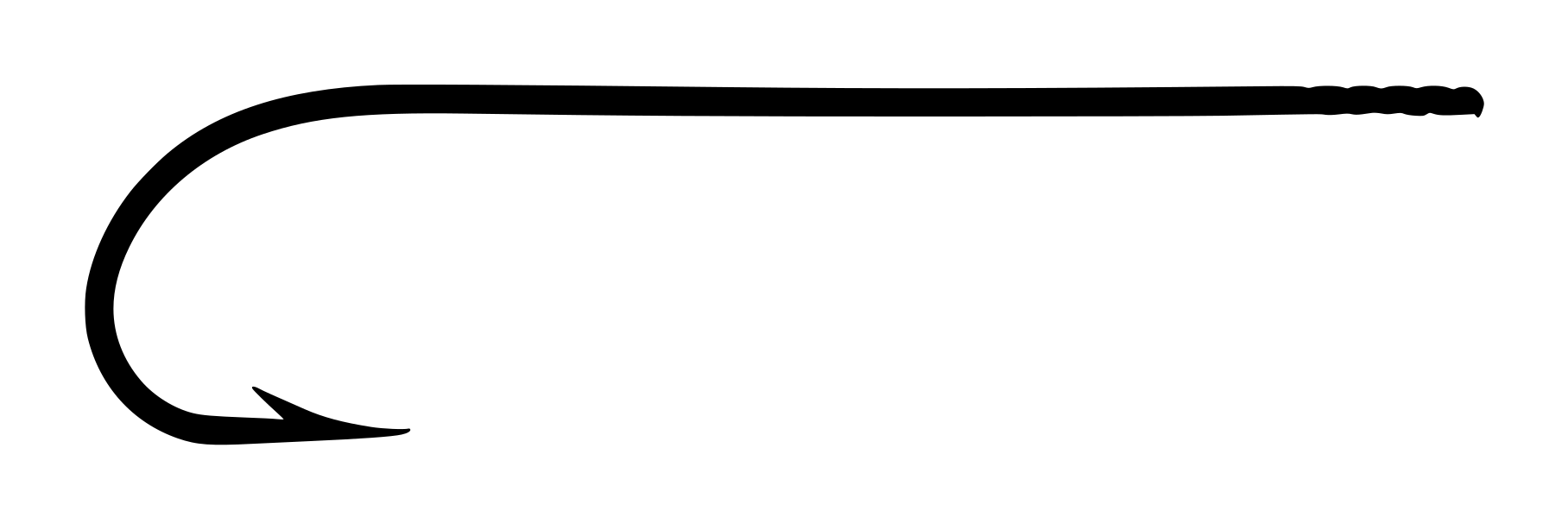
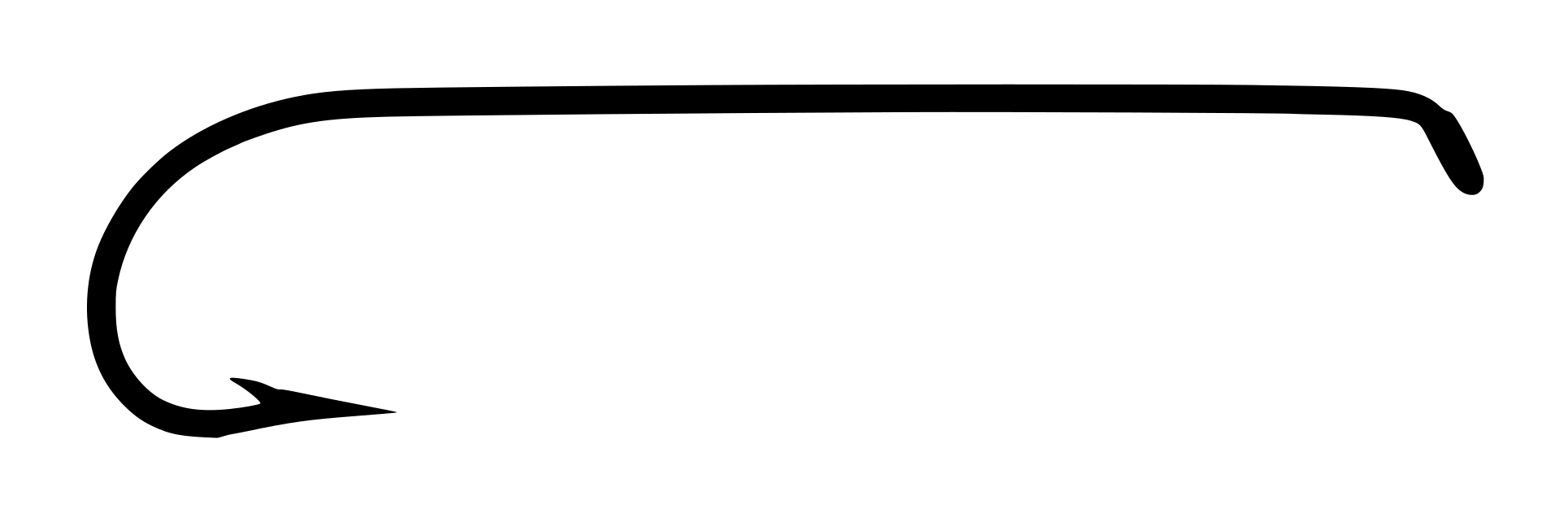
The Mustad 3713 B Carlisle Hook represents a specialized bait pattern from O. Mustad & Son’s Oslo factory, packaged in a rigid manufacturer box containing 100 size 5 hooks. The model employs a blind marked shank construction — a feature almost entirely confined to British and Scandinavian bait-fishing traditions — combined with a 4X long shank and narrow gap. The blind design eliminated the need for a formed eye, instead relying on lateral ridges cut into the shank to grip leader material, gut loop, or snell attachment.
The Carlisle bend itself is a deep, rounded form derived from 19th-century English traditions, producing a closed mouth that resists bite-offs. The hollow point provides a sharp, inwardly-curved tip geometry favored for penetration in soft-mouthed fish species. The kirbed (left-offset) point is consistent with bait hook design of this era.
Dating evidence includes the absence of a barcode, letterpress printing in gold on cream stock, the decorative frame-style label layout, and the “OSLO – NORWAY” address format characteristic of Mustad’s pre-1960s packaging. This model sits at the tail end of the blind-eye era in commercial hook production, as formed-eye alternatives increasingly dominated market offerings by the 1950s.
The 3713 B remains uncommon in complete original packaging, particularly in this early box format. Collector appeal derives from the documentation of a specialized construction technique and the ephemeral nature of manufacturer boxes relative to the far more abundant sales card format.
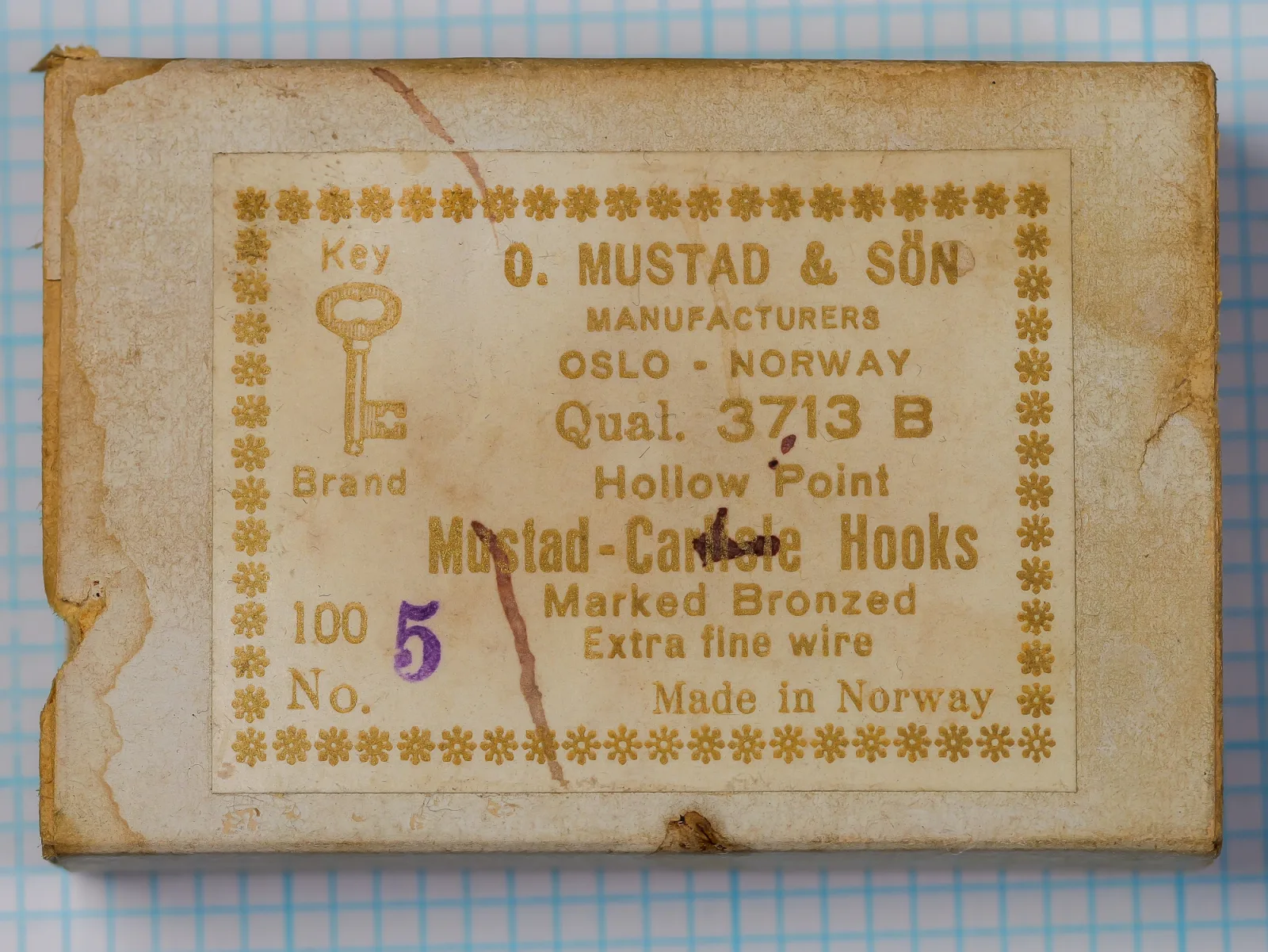
Box exterior showing original letterpress label with O. Mustad & Son branding, Qual. 3713 B designation, blind marked shank specification, and handwritten size 5 notation in purple fountain pen ink.
Photographic record
3 cataloged imagesSelect any record to load it above.
3 images shown
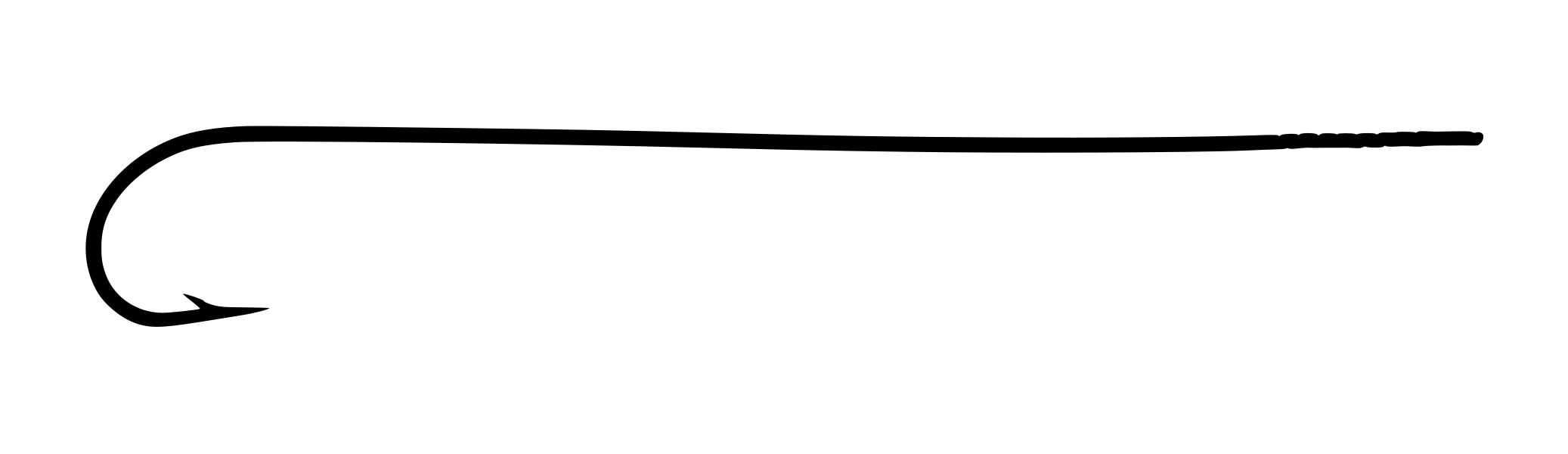
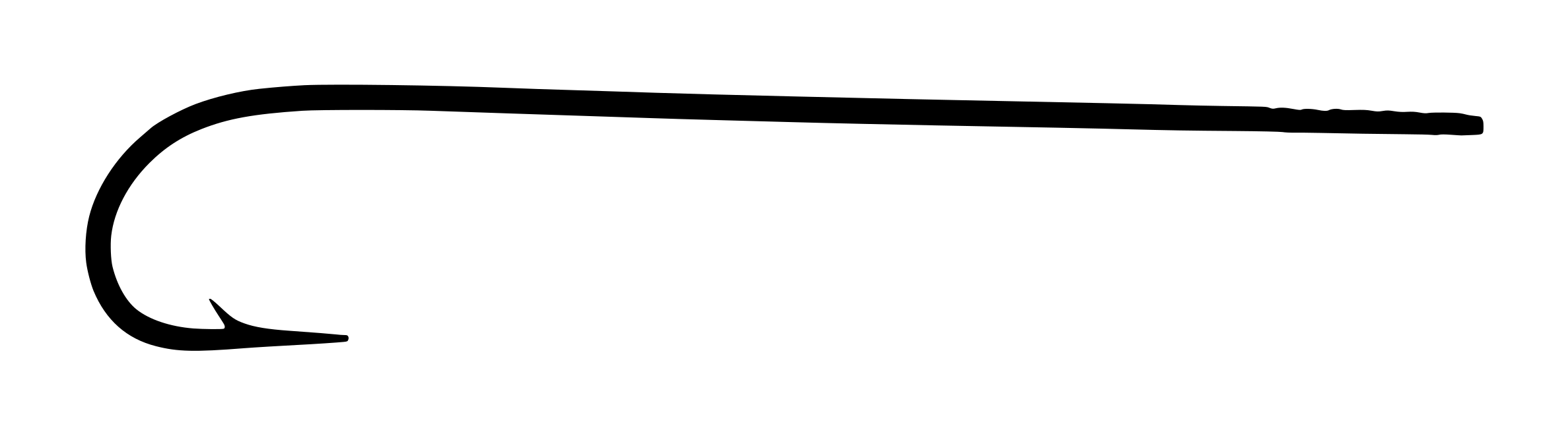
Mustad 3713 B Carlisle Hook Box — Label and Size MarkingBox exterior showing original letterpress label with O. Mustad & Son branding, Qual. 3713 B designation, blind marked shank specification, and handwritten size 5 notation in purple fountain pen ink.Open originalMustad 3713 B Carlisle Size 5 — Profile View of Point and ShankProfile close-up of a size 5 specimen showing the blind marked shank construction and the hollow-point taper. The lateral ridges cut into the shank terminus are visible. The inwardly-curved inner face of the hollow point is evident as a small concave depression from barb to tip.Open originalMustad 3713 B Carlisle Size 5 — Overhead ViewOverhead view of the hook showing the kirbed (left-offset) point deflection and the proportions of the 4X long shank relative to gap width. The long slender profile is characteristic of bait-hook geometry optimized for worm and small-fish presentations.Open original
Technical profile
Blind Eye | Carlisle | 4X Long | Hollow Point | Bronzed
Eye
Blind — Marked Shank
Wire
Standard, Round
Shank
4X Long — Marked / Ridged
Bend
carlisle, Narrow gap, Offset / kirbedCarlisle bend exhibits deep rounding through the turn, with no angular flattening at the bottom. The bend is symmetrical and shows no visible wire set or twisting. Offset is kirbed (leftward) as evidenced by point deflection leftward when viewed from eye toward bend. The 4X long shank produces an exceptionally elongated profile relative to gap — the shank spans approximately 4.2 times the gap width, placing this specimen firmly within the narrow-gap long-shank category for bait work. P<br />
Bronzed finish displays warm brown-amber tone consistent with cupric oxide coating. Finish is uniformly applied across bend and shank, with no bare steel visible. Surface exhibits expected age patina — slight darkening at edges and texture softening typical of 60-90 year old stock held in dry storage. No corrosion pitting or verdigris visible. Warm tone confirms bronzing rather than bluing (which would show cool blue-grey character). P<br />
Blind marked construction shows lateral ridges cut into the shank approximately 2-3 mm from the terminus. Ridge spacing and depth are consistent with factory production standards of the 1930s-1950s, before precision machining became standard. Ridges are cut into the material rather than raised; this subtractive method is characteristic of period bait-hook manufacturing. No eye loop of any type is formed. P<br />
Rated 4.5/10 — The model is uncommon in original packaging, particularly in manufacturer box format. Blind-eye construction limits appeal to specialist collectors of bait-hook history and Scandinavian manufacturing traditions. Collector demand is focused but modest.
Point
Hollow Point (concave inner face)Barb placement is forward-swept and closely cut to the wire diameter, typical of bait hook geometry of the 1930s-1950s. The short, close-set barb minimizes barb-to-point distance, reducing the mechanical wedge that can cause premature tear-out in soft mouth tissue. Point angle measurement suggests a barb set at approximately 8-10 degrees relative to shank plane. P
Finish
Bronzed — Confirmed (stated on packaging)Box exterior shows age patina with minor edge wear and one soft crease on upper left corner. Interior hooks appear bright bronzed with no visible corrosion. All 100 hooks present and undamaged. Box lid remains firmly seated. Price or inventory marks not visible on exterior.
The blind marked shank is the defining technical feature. Rather than forming an eye loop at the hook end, Mustad cut lateral ridges or grooves into the shank material itself, creating mechanical grip for snell attachment. This construction method reduced material volume at the critical stress junction and simplified manufacturing — no secondary eye-forming operation was required. The ridges act as teeth, preventing the snell or gut loop from sliding along the shank during fighting or setting.
The 4X long shank classification indicates a shank length approximately four times the gap width — a ratio optimized for bait presentation and for accommodating larger baits (worms, insects, small fish) without excessive overhang. Narrow gap with long shank forces the point inward relative to the shank plane, creating a bite angle that favors penetration in cartilaginous mouth structures common to bottom feeders and soft-mouthed species.
Hollow point geometry produces an inwardly-curved inner face from barb to tip, forming a small concave depression. This knife-edge effect concentrates cutting force at the smallest possible contact area, reducing the force required to penetrate tissue — a significant advantage in bait fishing where fish may mouth the hook before fully committing. Standard round wire profile distributes stress evenly through the bend, a deliberate engineering choice for durability in rough-ground and weed fishing where hooks encounter abrasion.
The bronzed finish was the industry standard for bait hooks of this era. The warm brown tone provided mild corrosion resistance adequate for freshwater use, and the slightly rougher surface compared to nickel offered modest improvement in snell grip and visibility in murky water conditions.
This pattern was made in sizes 2-16 (V). We have measurement for size 5. Know the others? Submit calipered measurements and we'll review and add them. Thank you!
Historical context
mustad
O. Mustad & Son was founded in Oslo, Norway, in 1832 by Olaf Mustad. The company established itself as a major industrial hook manufacturer through the 19th century, gradually dominating both Scandinavian and British market segments. Unlike the Redditch craft tradition, which relied on artisan workshops and smaller manufacturing runs, Mustad adopted integrated factory production and aggressive global distribution, making quality hooks accessible at volume.
By the early 20th century, Mustad’s Gjøvik facility (in addition to Oslo operations) had become the largest single hook manufacturer in Europe. The company maintained direct sales relationships with major British tackle dealers and fishing supply houses, allowing Norwegian-manufactured patterns to compete effectively against Redditch-made hooks. This dual-market positioning — competing on price and consistency while maintaining design ties to English traditions — proved strategically effective through the mid-20th century.
The blind-eye hook, though primarily associated with British makers like Allcock and Partridge, was manufactured by Mustad for export to UK anglers and dealers who demanded these specialized patterns. The 3713 B Carlisle represents this cross-market production strategy: a pattern with English geometric heritage, manufactured in Norway, and distributed internationally.
Series History
The Carlisle bend family has roots in 19th-century English river fishing traditions, where the deep rounded mouth was preferred for grayling, dace, and other soft-lipped species. The form appears in tackle catalogs as early as the 1870s from English makers. Mustad’s adoption of the Carlisle geometry reflects the company’s strategy of offering parallel patterns to established British designs, capturing price-sensitive customers while maintaining design legitimacy through recognized bend families.
The blind-marked variant (3713 B) indicates production specifically for snelled-hook markets and gut-loop attachment methods. These specialized bait hooks occupied a distinct segment from the 1920s through the 1950s. Blind-eye construction offered practical advantages: the elimination of a formed eye reduced stress concentration points, and the ridged shank provided mechanical grip superior to smooth shanks in certain applications.
By the 1960s, as nylon monofilament and modern formed-eye attachment methods became standard, blind-eye production declined sharply. The 3713 B was eventually displaced by formed-eye Carlisle variants and ultimately discontinued as market demand shifted entirely to modern eye geometries. This model represents a transitional artifact — a link between 19th-century bait-fishing practices and mid-20th-century modernization.
Era and Packaging Dating
Box construction and letterpress printing are consistent with 1930s-1950s manufacture. No barcode present. Decorative gold-on-cream printing style typical of Mustad pre-WWII and immediate postwar packaging. "OSLO - NORWAY" address indicates pre-1970 manufacture, as later boxes showed different address formatting. Handwritten size notation in purple ink is consistent with manual warehouse labeling of the period. Absence of ZIP code or modernized postal format supports early-to-mid century dating. No "Made in" country suffix — this format was common through 1950s.
Fun Fact
The blind-marked shank represents one of the last industrial fishing hooks engineered specifically for gut-loop attachment. Anglers of the 1930s-1950s would have prepared the snell by tying a loop knot in a length of strong gut or early nylon, then threading the loose end through the ridged shank and securing it with thread or waxed silk. The lateral ridges acted as mechanical teeth, preventing slippage during the fight. With the widespread adoption of modern monofilament and mass-produced formed-eye hooks in the 1960s, this entire skill set — the tying of gut loops, the interpretation of ridge patterns, the judgment of gut diameter for specific shank sizes — became unnecessary and was largely forgotten. A tackle angler of 1975 examining this box would have had no idea what the ridges were for.<br />
The Last Gut-Loop Hooks
Design lineage and influence
The Carlisle bend traces its lineage to 19th-century English river-fishing traditions, where the pattern appears in tackle catalogs and angler notebooks from the 1870s onward. English makers — particularly Allcock and smaller Redditch specialists — refined the deep-rounded mouth geometry specifically for grayling and dace fishing, species with soft mouths that required a more closed bite profile than the standard Sproat or Round Kendal patterns.
Mustad’s adoption of Carlisle geometry reflects the company’s broader strategy: Norwegian industrial production capacity coupled with English design legitimacy created competitive advantage in export markets. By offering parallel geometries to established British patterns, Mustad could undercut Redditch prices while maintaining design familiarity. The blind-marked variant (3713 B) is specifically Mustad’s interpretation of this cross-market strategy — a pattern derived from English tradition but engineered for Norwegian manufacturing methods.
Competing designs from other manufacturers include Allcock’s own Carlisle patterns (typically in forged wire and with formed eyes rather than blind shanks) and Partridge of Redditch’s sneck and round-bend variants. The British versions maintained stronger attachment to snelled-hook markets and gut-loop construction throughout the 1950s, while Mustad’s industrial production approach positioned the 3713 B for volume distribution to tackle dealers serving price-conscious anglers.
By the 1960s, the blind-eye category declined sharply as modern nylon monofilament and formed-eye attachment methods became universal. The Carlisle bend itself survived this transition in other formats (notably the Mustad 34007, a more modern long-shank Carlisle with a ball eye), but the blind-marked variant represents an evolutionary dead-end — a specialized tool made obsolete by broader shifts in fishing tackle standardization.
Best matchRelated by Attribute
Computed automatically from catalog data — updated as new hooks are added.
Matches: Bend, Gap, Eye, Eye Orient., Point +5 moreDiffers: Shank: 4X Long vs Extra-Extra Long; Wire: Standard vs Fine (1X Fine); Finish: Bronzed vs Blued
Matches: Bend, Gap, Eye, Eye Orient., Forging +4 moreDiffers: Shank: 4X Long vs Extra-Extra Long; Wire: Standard vs Fine (1X Fine); Point: Hollow Point vs Superior +1 more
Matches: Bend, Wire, Eye, Eye Orient., Finish +4 moreDiffers: Shank: 4X Long vs Extra-Extra Long; Gap: Narrow vs Standard; Point: Hollow Point vs Superior +1 more
Reference value
$8 – $18 USD estimate
Packaging condition
Good — moderate wear, legibleRecorded specimen
Packaging format
GW-M-3713B-BOXCatalog code
Strengths: Complete original manufacturer box is uncommon; boxes command 2-3x the premium of the equivalent sales card format. All 100 hooks present and undamaged. Early letterpress printing and lack of modernization indicate genuine pre-1950s manufacture. Blind-marked shank represents a manufacturing technique now entirely obsolete, appealing to tackle historians and Scandinavian hook specialists. Model code 3713 B is documented in period Mustad catalogs, adding provenance. Size 5 specimen available for photographic documentation.
Limitations: Bait hooks lack the cultural cachet of salmon and trout patterns; collector demand skews toward dry-fly and nymph specialists. Blind-eye construction is a niche interest — most modern anglers and fly tyers have no familiarity with the format. Mustad industrial production means surviving examples are not genuinely scarce, only uncommon. Hollow point and bronzed finish are standard across Mustad’s bait line, adding no rarity premium. No named designer or collaboration credit.
Variants and Condition Effects: Size matters substantially — size 5 and larger are more common than sizes 12-16. Sizes smaller than 8 command minimal premium. Complete boxes in excellent condition (lid intact, minimal toning) sell at the high end; opened boxes or those with missing hooks drop rapidly toward low-end values. Original tissue wrapping inside the box would add 15-20% premium if present.
Packaging
Rigid manufacturer box with fitted lid. Exterior shows cream-colored paper with gold letterpress printing in decorative frame. Printing includes: "Key" (logo with key symbol), "O. MUSTAD & SON MANUFACTURERS OSLO - NORWAY", "Qual. 3713 B", "Brand" heading, "Mustad-Carlisle Hooks", "Marked Bronzed", "Extra fine wire", "Made in Norway", and "100" with size marking "No. 5" (handwritten in purple ink). Box exhibits light age toning consistent with mid-20th century storage. All original text remains legible.
Market Value Notes
Low ($8): Good condition — box opened, all or most hooks present, moderate toning or edge wear, no major damage.<br />
High ($18): Excellent condition — box intact with minimal toning, full 100-hook count, lid fit firm, no missing or damaged hooks.<br />
Premium factors: Original box format (manufacturer boxes are rarer than cards); sealed or near-sealed condition; complete hook count; size range (smaller sizes command modest premium); early letterpress printing with legible text; provenance documentation.<br />
Platforms: eBay UK and US (tackle auctions), specialist vintage tackle dealers, online auctions.<br />
Confidence: E estimated based on comparative bait-hook box sales and manufacturer box rarity premium — limited direct sales data for this specific model available.
Where to Find
eBay UK (periodic listings under "vintage fishing hooks" or "bait hooks"); US eBay auctions (less frequent); specialist vintage tackle dealers in UK and Scandinavia; annual tackle fairs in England and Norway; online auction platforms (Catawiki, heritage.com auctions).
Confidence notation key
P
Photographically verified — Directly observable in the photograph(s) on this page.
V
Verified by documentation — Confirmed by manufacturer catalog, spec sheet, or published reference.
I
Inferred — A logical deduction from observable or documented evidence, not directly stated.
E
Estimated — An approximation based on visual comparison, proportional analysis, or limited data.
S
Speculative — A reasoned hypothesis that cannot be confirmed from available evidence.
Claims with no notation are confirmed by multiple independent sources. All photographs on garrenwood.com are taken on a measurement grid where each square equals 1/10 inch (0.1″ / 2.54 mm).